




Category: Erectile Dysfunction
Core Research Direction: Evidence quality and clinical decision-making in erectile dysfunction: what systematic reviews establish about treatment effectiveness, testosterone's role in men with and without biochemical hypogonadism, and cardiovascular risk framing
Search Intent: How strong is the evidence for current erectile dysfunction treatments, and does testosterone replacement help erectile function in men without confirmed hypogonadism?
Platform: SANYUN Science Center
Evidence reviewed through: 2026-11-20
Executive Summary
Erectile dysfunction is a common, multifactorial condition, and the menu of available treatments has expanded well beyond phosphodiesterase type 5 inhibitors. The more uncomfortable question is whether the evidence supporting that menu is as robust as the menu itself. An umbrella review covering studies published up to October 2025 screened 1191 studies and extracted 23 published meta-analyses, yielding 42 summary effects across the IIEF, IIEF-5, IIEF-EF and erectile hardness score endpoints and spanning 36 interventions.[1]
The quality picture was sobering. Of those 23 meta-analyses, 13 (56.5%) were rated critically low by AMSTAR-2, 7 (30.5%) low, 2 (8.7%) moderate and 1 (4.3%) high. At the level of individual summary effects, only two of 42 were rated high and moderate quality respectively, while 20 (47.6%) were low and 20 (47.6%) very low. The reviewers concluded that the evidence base for erectile dysfunction treatments is predominantly of low or very low quality.
Statistically significant improvements were observed for both pharmacological and nonpharmacological interventions, but the authors urged caution because of limited patient numbers and the subjective nature of outcome indicators. That distinction—statistical significance versus trustworthy, clinically meaningful effect—is the organizing theme of this review. It matters most when clinicians counsel men about testosterone, where a 2024 Cochrane systematic review cited in clinical commentary found no significant benefit on erectile function in men without biochemical androgen deficiency.[2]
Why Evidence Certainty Matters More Than the Treatment List
Guidelines that present many options as reasonable first-line choices depend on an implicit assumption: that the evidence behind each option is strong enough to support comparison. The umbrella review challenges that assumption directly. It called for further well-designed studies of single treatments and high-quality meta-analyses comparing treatments against each other, framing these as needs rather than achievements.
This is not an argument that treatments do not work. It is an argument about epistemic humility. When most summary effects are graded low or very low, a reported point improvement on a symptom score cannot be read as a settled clinical benefit, and comparisons between interventions rest on uneven foundations. For a treatable condition with a large commercial market, that gap between availability and certainty deserves explicit acknowledgment in patient conversations.
Mechanism and Diagnostic Framing
Erectile dysfunction is best understood as a vascular and neurological event with hormonal and psychological modulation, not a single-pathway disorder. Diabetes, obesity, dyslipidemia, smoking and sedentary lifestyle are described as major determinants of erectile dysfunction, which is why a sexual symptom can be the first visible signal of systemic metabolic and vascular disease rather than an isolated genital problem.
Testosterone's role is frequently overstated. Testosterone deficiency is classified as primary (testicular), secondary (hypothalamic-pituitary) or functional hypogonadism, the latter commonly associated with ageing, obesity and chronic systemic disease. Diagnosis requires both clinical symptoms and biochemical confirmation of low testosterone, typically assessed using morning serum measurements—biochemistry alone or symptoms alone are insufficient.[3]
Guidelines emphasize fasting morning total testosterone measurement, ideally between 7 and 11 a.m., corresponding to the circadian peak of androgen secretion. When values are borderline or low, a confirmatory second measurement is recommended, with free or bioavailable testosterone testing where appropriate; free testosterone and SHBG can add diagnostic clarity when symptoms are discordant with total testosterone. Where initial values are clearly normal—above 12 nmol/L in the commentary's framing of guideline practice—the value of pursuing further hormonal workup becomes debatable.
What the Evidence Shows on Testosterone
The most policy-relevant finding is a negative one. According to clinical commentary on a 2024 Cochrane systematic review, testosterone supplementation in men with erectile dysfunction but without biochemical androgen deficiency provided no significant benefit on erectile function, and the impact on overall sexual quality of life and patient satisfaction was minimal to absent. The same commentary notes the review did not show efficacy on improving cardiovascular health in this population.
The positive findings sit in a different population. A narrative review reports that testosterone replacement therapy can provide clinically meaningful benefits in appropriately selected men with confirmed testosterone deficiency, with reported improvements in sexual function, mood, anaemia, body composition, bone mineral density and metabolic parameters. Multiple formulations exist—transdermal, oral, intramuscular, subdermal and intranasal—each with distinct pharmacokinetic profiles.
One nuance is worth separating from established evidence. The commentary suggests that in men who do not respond to PDE5 inhibitors, testosterone may restore sensitivity to these drugs through direct effects on cavernous tissue. That is a proposed mechanism raised in expert commentary, not a demonstrated effect in the material summarized here, and it should not be presented to patients as settled.
Cardiovascular Framing: Signal, Not Verdict
Cardiovascular risk dominates the erectile dysfunction literature for good reason. A 2021 umbrella review reported that men with erectile dysfunction have increased risk of cardiovascular disease (RR 1.45, 95% CI 1.36–1.54), coronary heart disease (RR 1.50), cardiovascular mortality (RR 1.50), myocardial infarction (RR 1.55), stroke (RR 1.36) and all-cause mortality (RR 1.25), all with P<0.001. These are observational associations reported secondhand; they support risk stratification, not a claim that erectile dysfunction causes cardiac events.[4]
Testosterone's cardiovascular story is more nuanced than either enthusiasts or critics usually allow. TRAVERSE enrolled 5,246 men with hypogonadism and preexisting or high cardiovascular risk; transdermal testosterone was noninferior to placebo for major adverse cardiac events (HR 0.96, 95% CI 0.78–1.17) over a mean 21.7 months. The same trial reported more atrial fibrillation, acute kidney injury and pulmonary embolism in the testosterone group—a mixed safety picture that belongs in informed consent.
The commentary's point about population is important: the Cochrane review studied men with erectile dysfunction, whereas TRAVERSE specifically assessed cardiovascular safety in hypogonadal men at risk. A narrative review likewise reports that contemporary data do not support increased prostate cancer or major adverse cardiovascular event risk when therapy is appropriately monitored. Neither statement generalizes to men with normal testosterone using replacement for erectile function alone.
Interpreting Effect Sizes and Certainty Labels
| Evidence domain | Reported finding | Design and context | Interpretation |
|---|---|---|---|
| Umbrella review quality | 13 of 23 meta-analyses critically low by AMSTAR-2; 20 of 42 summary effects very low quality | Umbrella review, studies to October 2025 | Certainty, not absence of effect |
| Pharmacological and nonpharmacological benefit | Statistically significant improvements on IIEF-family and hardness endpoints | Pooled meta-analyses, heterogeneous interventions | Limited patient numbers and subjective endpoints warrant caution |
| Testosterone without androgen deficiency | No significant benefit on erectile function; minimal or absent quality-of-life gain | 2024 Cochrane systematic review, secondhand summary | Does not support replacement as standalone ED therapy |
| Testosterone with confirmed deficiency | Clinically meaningful benefits reported across sexual, metabolic and bone outcomes | Narrative review, appropriately selected men | Benefit is conditional on confirmed diagnosis |
| Cardiovascular safety | MACE HR 0.96 (95% CI 0.78–1.17); more AF, AKI and PE | TRAVERSE, n=5,246, mean 21.7 months | Neutral MACE signal with specific safety signals |
| Low-intensity shockwave therapy | IIEF-EF gain of roughly 3.9 points short-term, 5.3 long-term versus sham | 2025 Cochrane review, 21 trials, 1,357 men | Low certainty; several industry-funded trials |
| Erectile dysfunction as cardiovascular marker | CVD RR 1.45 (95% CI 1.36–1.54); CHD RR 1.50 | 2021 umbrella review, observational | Risk-enhancing association, not causation |
Treatment Context Beyond Testosterone
Phosphodiesterase type 5 inhibitors remain the practical first-line pharmacological option in most care pathways, and their safety profile has a hard boundary: they are absolutely contraindicated with nitrate medications and recreational nitrites because the combination can cause severe, potentially fatal hypotension. A 2025 analysis of 53,517 FDA Adverse Event Reporting System reports from 2004 to 2024 identified label-listed side effects plus nervous-system, cardiovascular and eye signals not on labels that require further study—a reminder that spontaneous reporting generates hypotheses rather than confirmed risks.
Low-intensity shockwave therapy illustrates the certainty problem well. A 2025 Cochrane review of 21 randomized trials (1,357 men) found it may improve short-term IIEF-EF scores by roughly 3.9 points and long-term scores by 5.3 points versus sham, but with low certainty of evidence; several included studies were industry-funded, mainly by device makers. A numerical gain and a trustworthy gain are not the same claim.
Comorbidity-directed evidence is similarly unsettled. In a 2018 study of 150 men newly diagnosed with moderate to severe obstructive sleep apnea, erectile dysfunction prevalence was 51 percent, and erectile function scores rose after three months of continuous positive airway pressure, though the authors could not conclusively determine whether it works as stand-alone erectile dysfunction treatment. A 2023 meta-analysis of 8 studies and 457 patients reported higher post-treatment IIEF-5 domain scores with sildenafil than with CPAP (37.7 versus 27.3), and a 2021 Cochrane review rated CPAP versus no CPAP evidence as very uncertain.
Metabolic interventions produce conflicting signals. A 2025 controlled pilot study compared tirzepatide, lifestyle intervention and transdermal testosterone in men with obesity-associated hypogonadism; tirzepatide produced greater weight loss and IIEF-5 improvement than lifestyle alone and significantly raised total testosterone, LH, FSH and SHBG. Separately, a 2024 database analysis of 3,094 non-diabetic, non-hypogonadal men aged 18–50 found higher rates of new erectile dysfunction diagnosis or PDE5 inhibitor prescription with semaglutide (1.47 versus 0.32 percent) and of testosterone deficiency (1.53 versus 0.80 percent), though absolute rates were low and database studies cannot establish causation. A 2026 narrative review called the overall GLP-1 evidence inconsistent.
Limitations and Conflicting Findings
Several boundaries should temper confidence. The umbrella review is summarized here from a dataset-catalog abstract, and pooled patient numbers are not stated. The Cochrane findings on testosterone reach this review through clinician commentary rather than the primary report, and no pooled effect estimates are provided. The TRAVERSE data and the shockwave, sleep apnea and GLP-1 findings are reported secondhand in a physician-authored consumer guide, which is useful for orientation but not a substitute for the primary trials.
There is also genuine tension in the literature rather than simple error. Testosterone appears ineffective for erectile function in biochemically normal men yet beneficial in confirmed deficiency; it appears cardiovascularly neutral for major events in TRAVERSE yet carries signals for atrial fibrillation, acute kidney injury and pulmonary embolism. A narrative review reporting no increased prostate cancer or major cardiovascular event risk with monitoring sits alongside an observational cohort reported in the consumer guide showing higher major cardiac event risk in testosterone users, where men diagnosed with deficiency showed the same increase and causality remains unclear. These are questions about populations, ascertainment and follow-up, and they require primary-source appraisal rather than confident summary.
Outcome measurement is a structural limitation. The IIEF family and erectile hardness score are patient-reported or semi-objective instruments, and the umbrella reviewers explicitly flagged the subjective nature of outcome indicators. A statistically significant score change of a few points may or may not cross a man's personal threshold for satisfactory sexual function, and low-certainty evidence cannot resolve that question for an individual.
Research Outlook
The clearest research priority is methodological. The umbrella review recommends well-designed trials of single treatments and high-quality meta-analyses of head-to-head comparisons, which would allow clinicians to rank options rather than merely list them. Studies that prespecify clinically meaningful thresholds, reduce reliance on industry funding and report harms consistently would address the certainty gap more effectively than additional underpowered trials of already-marketed interventions.
On testosterone, the field would benefit from trials that stratify by biochemical status and by PDE5 inhibitor response, testing the proposed restoration-of-sensitivity mechanism directly rather than inferring it from commentary. On cardiovascular framing, prospective work is needed to determine whether treating erectile dysfunction as a risk-enhancing factor changes outcomes, not merely whether the association exists.
Key Takeaways
- Most meta-analytic evidence on erectile dysfunction treatments is graded low or very low quality; statistical significance should not be equated with reliable clinical benefit.
- Testosterone supplementation showed no significant benefit on erectile function in men without biochemical androgen deficiency, with minimal to absent effect on sexual quality of life.
- Benefits of testosterone replacement are best supported in men with confirmed deficiency, where diagnosis requires symptoms plus biochemically confirmed low morning testosterone.
- Erectile dysfunction is associated with higher cardiovascular risk, making risk assessment a core part of evaluation rather than an optional extra.
- TRAVERSE found a neutral major adverse cardiac event signal but more atrial fibrillation, acute kidney injury and pulmonary embolism with testosterone—a mixed safety profile relevant to counseling.
Questions and Answers
What does the umbrella review say about the quality of erectile dysfunction treatment evidence?
It found that of 23 included meta-analyses, 13 (56.5%) were critically low quality by AMSTAR-2 and only one was high quality. At the summary-effect level, 20 of 42 were very low and 20 low quality. The reviewers concluded the evidence base is predominantly low or very low quality, despite statistically significant improvements across many interventions.
Does testosterone replacement improve erectile function in men without hypogonadism?
According to clinical commentary on a 2024 Cochrane review, testosterone supplementation in men with erectile dysfunction but without biochemical androgen deficiency produced no significant benefit on erectile function, and minimal to absent improvement in sexual quality of life or satisfaction. This negative finding applies specifically to men with normal androgen levels, not to men with confirmed deficiency.
How is testosterone deficiency diagnosed before considering replacement therapy?
Diagnosis requires both clinical symptoms and biochemical confirmation of low testosterone, typically with morning serum measurements taken fasting, ideally between 7 and 11 a.m. Borderline or low values should be confirmed on a second measurement. Free testosterone and SHBG can clarify cases where symptoms and total testosterone disagree.
Is testosterone therapy safe for the heart in men with hypogonadism?
TRAVERSE enrolled 5,246 hypogonadal men at high cardiovascular risk and found transdermal testosterone noninferior to placebo for major adverse cardiac events (HR 0.96, 95% CI 0.78–1.17) over a mean 21.7 months. However, atrial fibrillation, acute kidney injury and pulmonary embolism were more common with testosterone, so the safety profile is mixed rather than uniformly reassuring.
Why is erectile dysfunction treated as a cardiovascular warning sign?
A 2021 umbrella review of meta-analyses reported that men with erectile dysfunction have higher relative risks of cardiovascular disease (1.45), coronary heart disease (1.50), myocardial infarction (1.55), stroke (1.36) and all-cause mortality (1.25). These are observational associations reported secondhand; they justify cardiovascular risk assessment, not a claim that erectile dysfunction causes heart disease.
How strong is the evidence for low-intensity shockwave therapy for erectile dysfunction?
A 2025 Cochrane review of 21 randomized trials involving 1,357 men found shockwave therapy may improve IIEF-EF scores by roughly 3.9 points short-term and 5.3 points long-term versus sham, but rated the evidence low certainty. Several included trials were industry-funded, mainly by device makers, so the numerical gains should not be read as proven clinical benefit.
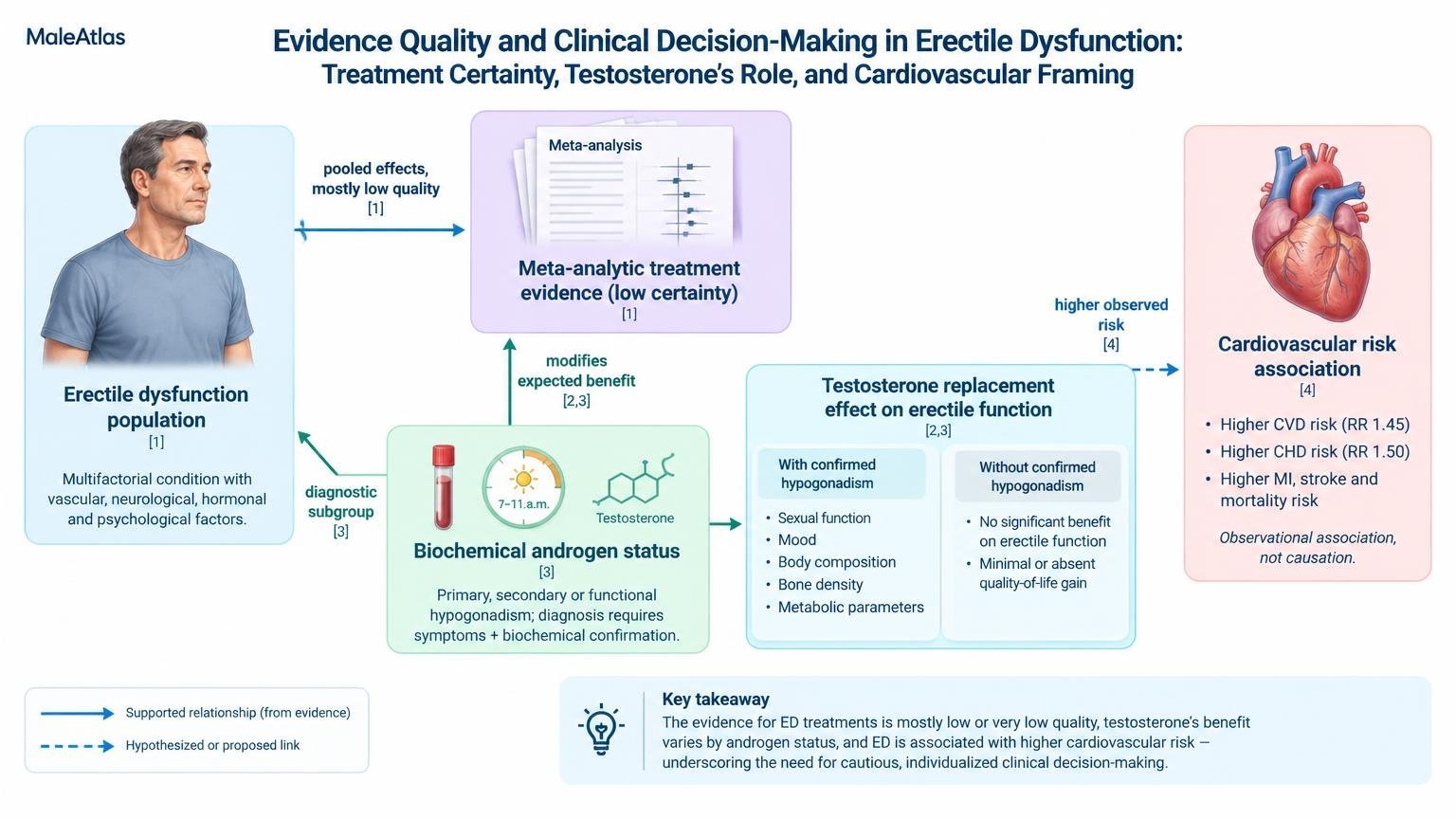
Conceptual framework: Conceptual framework, not a tested causal model. It maps the variables discussed in this evidence review: an erectile dysfunction population, meta-analytic treatment evidence graded mostly low certainty, biochemical androgen status as a diagnostic subgroup, testosterone replacement effects that differ by that status, and an observational cardiovascular risk association. Arrows indicate reported associations or proposed subgroup relationships; they are not proof of causation or mediation.
Academic References & Evidence
- Current treatment for erectile dysfunction: an umbrella review of systematic reviews and meta-analyses. Figshare. 2026 DOI: 10.6084/m9.figshare.31562993.v1.
- Charlotte Methorst; Pierre Derrouch. Dysfonction sexuelle masculine : évaluation hormonale et indications du traitement substitutif – Urofrance. Urofrance
- Thomas Thompson. Update on testosterone deficiency and therapeutic options for testosterone replacement therapy. Nature Reviews. Urology. 2026
- Parth Bhavsar. Erectile Dysfunction. teledirectmd.com. 2026
SANYUN Science Center explains published research on men's reproductive and sexual health, connecting scientific evidence with everyday questions while making sources and limitations clear.
Disclaimer: This article is for scientific education and research communication only. It does not provide medical advice, diagnosis, or individualized treatment recommendations, and does not endorse any medication, supplement, device, penile enlargement procedure, or other intervention. Decisions about sexual and reproductive health should be made in consultation with a qualified healthcare professional. Do not delay seeking professional care because of information in this article.
Original Content & Copyright Notice
- This article is prepared for SANYUN Science Center, drawing on published research and publicly available academic literature on men’s sexual and reproductive health. Its editorial explanations and presentation are developed for this platform.
- Copyright in the original editorial content, selection, and arrangement is reserved by SANYUN Science Center to the extent protected by applicable law. Referenced research, quotations, and third-party materials remain subject to the rights of their respective owners. This notice does not claim ownership of scientific facts or third-party research.
- Except where permitted by applicable law or an applicable license, prior written permission is required to reproduce, republish, translate, adapt, redistribute, or commercially reuse protected content. Attribution alone does not grant permission for such reuse.
- For permitted quotation or authorized reuse, clearly identify the source and retain a link to the original article.
- Source: SANYUN Science Center
- Original URL: Retain the original article URL on science.san-yun.com.
- Copyright Holder: SANYUN Science Center, for its own protected editorial content.
- Quotation, excerpts, or authorized reuse must not distort the scientific meaning, omit material limitations or disclaimers, or imply unverified medical claims, product efficacy, or endorsement by SANYUN Science Center.



