




Category: Erectile Dysfunction
Core Research Direction: Evidence quality and comparative effectiveness of current erectile dysfunction treatments, including penile rehabilitation after nerve-sparing radical prostatectomy, framed within a broader umbrella review of systematic reviews
Search Intent: How reliable is the current evidence base for erectile dysfunction treatments, and what do registered trials and systematic reviews actually establish versus leave uncertain?
Platform: SANYUN Science Center
Evidence reviewed through: 2026-11-14
Executive Summary
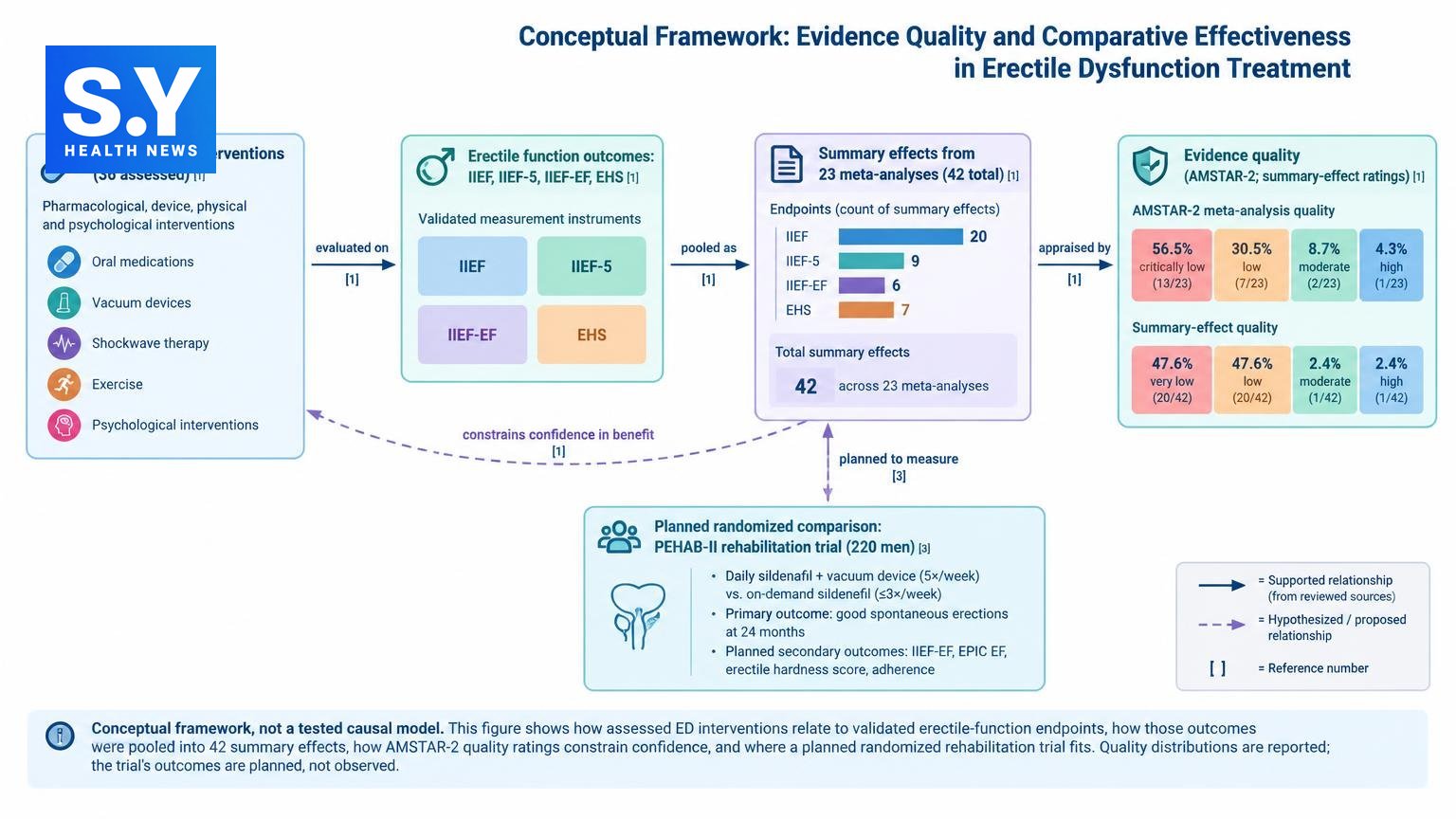
A 2026 umbrella review of systematic reviews and meta-analyses evaluated the effectiveness of current erectile dysfunction (ED) treatments and the quality of the evidence behind them. The review screened 1191 studies, extracted 23 published meta-analyses, and derived 42 summary effects across the IIEF, IIEF-5, IIEF-EF and erectile hardness score endpoints, covering 36 interventions.[1]
The central finding is not that ED treatments fail, but that the evidence supporting them is weaker than its volume suggests. Under AMSTAR-2, 13 of 23 meta-analyses (56.5%) were rated critically low quality, seven (30.5%) low, two (8.7%) moderate and one (4.3%) high. At the summary-effect level, only two of 42 effects were rated high and moderate quality respectively, while 20 were low and 20 very low.
Statistically significant improvements were observed with both pharmacological and non-pharmacological interventions, but the authors caution that limited patient numbers and subjective outcome indicators constrain interpretation. Their recommendation is for better-designed single-treatment studies and high-quality meta-analyses comparing treatments directly, rather than more of the same evidence.
Why This Matters
ED is common and increasingly treated with a diverse menu of options, including oral drugs, vacuum devices, shockwave therapy, exercise and psychological interventions. Yet the review's authors describe a mismatch: the treatment landscape is increasingly diverse, while the reliability of the evidence is poor. That matters clinically because patients and clinicians make daily decisions on the assumption that a statistically significant pooled effect means a dependable benefit.
Statistical significance and clinical reliability are not the same thing. A pooled effect can reach significance while resting on meta-analyses judged critically low quality under a validated appraisal instrument. The review's quality distribution, with only one meta-analysis rated high quality, suggests the literature is dominated by small, heterogeneous and sometimes methodologically limited studies rather than large, well-controlled comparisons.
This framing also affects how clinicians interpret safety and cardiovascular context. A widely cited secondary clinical guide reports that a 2021 umbrella review found ED to be associated with higher risks of cardiovascular disease, coronary heart disease, myocardial infarction, stroke and all-cause mortality, and that the 2024 Princeton IV consensus advises treating men with ED as at cardiovascular risk until proven otherwise. These associations are reported secondhand within that guide and are not part of the 2026 review's treatment-effectiveness analysis.[2]
Biological and Clinical Mechanism
The review did not conduct mechanistic experiments; its purpose was effectiveness and evidence appraisal. Mechanistic context therefore comes from clinical guides rather than the umbrella review itself. According to the physician-authored guide, sexual arousal triggers nitric oxide release in penile arteries, which activates guanylate cyclase to produce cyclic GMP, relaxing vascular smooth muscle and allowing blood to fill the corpora cavernosa. PDE5 inhibitors block the enzyme that breaks down cGMP, and they require sexual stimulation rather than producing erections independently.
That same guide states that PDE5 inhibitors are absolutely contraindicated with nitrate medications and recreational nitrites because the combination can cause severe, potentially fatal hypotension. This is a safety boundary rather than an efficacy question, and it should frame any discussion of treatment selection.
In the post-prostatectomy setting, the clinical rationale for penile rehabilitation is that cavernous nerve injury during radical prostatectomy can impair erectile signaling, and early, regular pro-erectile activity is proposed to preserve tissue oxygenation and function. The registered trial described below tests this rationale directly, but its results have not been reported in the material available here.[3]
What the Evidence Shows
The 2026 umbrella review searched PubMed, Web of Science, the Cochrane Library and Embase, covering studies published up to October 2025. From the source pool of 1191 studies, 23 published meta-analyses were extracted, yielding 42 summary effects distributed across IIEF (n = 20), IIEF-5 (n = 9), IIEF-EF (n = 6) and erectile hardness score (n = 7) endpoints, spanning 36 interventions. These are counts of summary effects, not individual-patient outcomes.
The quality picture is the review's most striking contribution. AMSTAR-2 appraisals placed more than half of the included meta-analyses in the critically low category, and only four of 42 summary effects reached the moderate or high quality tier. The authors characterize the current evidence base as predominantly of low or very low quality.
It is important not to overcorrect toward nihilism. The review did observe statistically significant improvements in ED with both pharmacological and non-pharmacological interventions. The caution is about confidence, not direction: the findings should be interpreted cautiously because of limited patient numbers and the subjective nature of outcome indicators such as symptom questionnaires.
For readers seeking concrete effect sizes across specific drug classes, the umbrella review summary does not provide them in the available text. The broader clinical guide reports selected estimates secondhand, including an aerobic exercise meta-analysis associating training with roughly a 2.8-point IIEF-EF improvement and a 2025 Cochrane review reporting that low-intensity shockwave therapy may improve short-term IIEF-EF scores by about 3.9 points and long-term scores by 5.3 points versus sham, with low certainty. These figures come from the guide's reporting, not from the umbrella review's own synthesis, and should be read with that provenance in mind.
A registered multicentre randomized trial, PEHAB-II, illustrates what higher-quality comparative research looks like in the post-surgical setting. It plans to enroll 220 men after nerve-sparing robot-assisted radical prostatectomy and compare 12 months of daily sildenafil 75/100 mg plus vacuum erection device therapy five times per week against sildenafil 75/100 mg on demand (up to three times per week). Its primary objective is the difference in the percentage of patients achieving good spontaneous erections at 24 months. Secondary planned outcomes include return to preoperative erectile function by IIEF-EF or EPIC erectile function and erectile hardness score, and adherence during the first 12 months. These are planned objectives, not reported results.
The trial's eligibility criteria also shape how far its eventual findings will generalize. Participants must have had a preoperative diagnostic IIEF-EF of at least 22, at least unilateral nerve-sparing surgery or an FP score of 5 or greater, and no adjuvant radiotherapy or hormonal therapy. Those criteria select men with good baseline function and favorable surgical anatomy, which is appropriate for a rehabilitation question but limits extension to men with poorer baseline erections or those requiring adjuvant treatment.
| Dimension | What the review reported | How to interpret it |
|---|---|---|
| Source pool and included reviews | 1191 studies screened; 23 meta-analyses extracted, yielding 42 summary effects across four erectile-function endpoints and 36 interventions | A broad but pooled evidence base; effect counts are summary effects, not patient-level results |
| Review methodology quality | 13 of 23 meta-analyses critically low (56.5%), 7 low (30.5%), 2 moderate (8.7%), 1 high (4.3%) by AMSTAR-2 | Most included reviews have methodological limitations that weaken confidence in their pooled estimates |
| Summary-effect quality | 20 of 42 effects low, 20 very low, 1 moderate, 1 high | Statistical significance in the source reviews does not equal high-certainty evidence |
| Direction of findings | Statistically significant ED improvements with pharmacological and non-pharmacological interventions | Benefit signal exists, but limited patient numbers and subjective outcomes warrant caution |
| Authors' conclusion and recommendation | Evidence base predominantly low or very low quality; call for well-designed single-treatment studies and high-quality intertreatment meta-analyses | Future research should prioritize rigor and direct comparisons over additional low-quality pooling |
| Post-prostatectomy comparative trial (planned) | PEHAB-II plans 220 men; primary objective is good spontaneous erections at 24 months after 12 months of daily sildenafil plus vacuum device versus on-demand sildenafil | A registered, randomized design addresses a real comparative question; no results are reported here |
Interpretation and Limitations
Several limitations constrain what can be concluded. First, an umbrella review inherits the weaknesses of its included meta-analyses; when more than half are critically low quality, the overview cannot manufacture certainty the underlying literature lacks. Second, the outcome instruments, while validated, are largely subjective symptom scales, and the authors explicitly flag this subjectivity alongside limited patient numbers. Third, the available summary does not provide pooled effect sizes per intervention, so no fair head-to-head efficacy ranking can be constructed from it.
The broader clinical guide introduces additional uncertainty when cited as context. It is a physician-authored narrative guide rather than peer-reviewed primary research, and several of its quantitative claims are reported secondhand. For example, the cardiovascular relative risks it attributes to a 2021 umbrella review, and the TRAVERSE cardiovascular safety findings for testosterone in hypogonadal men, cannot be verified from the primary publications within this packet. They are plausible and widely discussed, but they should be presented as guide-reported context rather than confirmed by the 2026 review.
The PEHAB-II registration is likewise a plan, not evidence of benefit. Registry records document design, eligibility and intended outcomes; they do not show whether daily dosing plus vacuum therapy outperforms on-demand dosing. Treating the trial's existence as proof of rehabilitation efficacy would be a category error. The appropriate reading is that a well-designed randomized comparison is underway or completed but unreported in this material.
Finally, the packet mixes evidence types: a peer-reviewed umbrella review, a trial registry record and a secondary clinical guide. Each carries different evidentiary weight. The umbrella review is the strongest source for the central question about evidence quality; the registry describes planned research; the guide supplies mechanistic and contextual material that should be attributed to it, not treated as part of the review's findings.
Research Outlook
The umbrella review's recommendation is specific: further well-designed studies on single treatments and high-quality meta-analyses of intertreatment comparisons are urgently needed. This implies a shift away from pooling heterogeneous small trials toward rigorous, adequately powered comparisons that can support clinical choices among the growing list of options.
Trials such as PEHAB-II fit that agenda for the post-prostatectomy population, with a randomized design, a 24-month primary endpoint, a planned sample of 220 and predefined adherence and quality-of-life secondary outcomes. If reported rigorously, such work could clarify whether intensive early penile rehabilitation changes long-term spontaneous erectile function. Until then, claims of comparative superiority between rehabilitation strategies remain unproven.
A parallel methodological need is better outcome reporting. Because the field relies heavily on subjective symptom scores, future work would benefit from consistent use of validated instruments, transparent handling of industry funding and clearer separation of statistical significance from clinically meaningful change. Those are the conditions under which the next generation of meta-analyses could move more summary effects into the moderate or high quality tiers.
Key Takeaways
- A 2026 umbrella review of 23 meta-analyses and 42 summary effects found that current ED treatments show statistically significant benefits, but the evidence base is predominantly low or very low quality.
- By AMSTAR-2, 13 of 23 included meta-analyses were critically low quality and only one was high quality; at the summary-effect level, 20 were low and 20 very low.
- The review warns that limited patient numbers and subjective outcome instruments temper interpretation, and calls for better single-treatment trials and high-quality comparative meta-analyses.
- PEHAB-II is a registered 220-participant randomized trial comparing daily sildenafil plus vacuum device therapy with on-demand sildenafil after nerve-sparing prostatectomy; its 24-month primary endpoint is planned, not reported.
- Mechanistic and cardiovascular-risk context in this article derives largely from a secondary physician-authored guide, including the absolute nitrate contraindication for PDE5 inhibitors.
Questions and Answers
What did the 2026 umbrella review find about the quality of erectile dysfunction treatment evidence?
The review extracted 23 meta-analyses and 42 summary effects covering 36 interventions, then appraised them. Under AMSTAR-2, 13 of 23 meta-analyses were critically low quality, seven low, two moderate and one high. At the summary-effect level, only two of 42 reached moderate or high quality, while 20 were low and 20 very low. The authors concluded the evidence base is predominantly low or very low quality.
Do erectile dysfunction treatments actually work despite low-quality evidence?
The review observed statistically significant improvements in erectile function with both pharmacological and non-pharmacological interventions. So the direction of benefit is supported, but confidence is limited by small patient numbers and subjective outcome scales. Low-quality evidence does not mean treatments fail; it means pooled estimates carry substantial uncertainty and should not be treated as precise or definitive.
How does the PEHAB-II trial test penile rehabilitation after prostate surgery?
PEHAB-II plans to enroll 220 men after nerve-sparing robot-assisted radical prostatectomy and compare 12 months of daily sildenafil 75/100 mg plus vacuum erection device therapy five times weekly against on-demand sildenafil up to three times weekly. The primary objective is the percentage achieving good spontaneous erections at 24 months. These are registered planned outcomes; no results are reported in the available material.
Which men are eligible for the PEHAB-II penile rehabilitation trial?
Eligibility requires a preoperative IIEF-EF of at least 22, at least unilateral nerve-sparing surgery or an FP score of 5 or greater, and no adjuvant radiotherapy or hormonal therapy. These criteria select men with good baseline erectile function and favorable surgical features, which suits a rehabilitation question but limits how far findings will apply to men with poorer baseline function or those needing adjuvant treatment.
Why is an umbrella review of erectile dysfunction treatment limited in what it can conclude?
An umbrella review inherits the weaknesses of the meta-analyses it summarizes. With more than half of included reviews rated critically low quality and the available summary lacking pooled effect sizes per intervention, no fair head-to-head efficacy ranking can be built. Outcome measures are largely subjective symptom scales, and limited patient numbers further constrain interpretation.
What should patients understand about PDE5 inhibitor safety before starting treatment?
According to the physician-authored clinical guide, PDE5 inhibitors are absolutely contraindicated with nitrate medications and recreational nitrites because the combination can cause severe, potentially fatal hypotension. They also require sexual stimulation to work. Patients should disclose all medications and recreational substances to a prescriber. This is general safety information, not personalized medical advice, and individual decisions belong with a qualified clinician.
Conceptual framework: Conceptual framework, not a tested causal model. It maps how assessed ED interventions relate to validated erectile-function endpoints, how those outcomes were pooled into 42 summary effects, how AMSTAR-2 quality ratings constrain confidence, and where a planned randomized rehabilitation trial fits. Quality distributions are reported; the trial's outcomes are planned, not observed.
Academic References & Evidence
- Current treatment for erectile dysfunction: an umbrella review of systematic reviews and meta-analyses. 2026 DOI: 10.6084/m9.figshare.31562993.v1.
- Parth Bhavsar. Erectile Dysfunction. 2026
- PEHAB-II.
SANYUN Science Center explains published research on men's reproductive and sexual health, connecting scientific evidence with everyday questions while making sources and limitations clear.
Disclaimer: This article is for scientific education and research communication only. It does not provide medical advice, diagnosis, or individualized treatment recommendations, and does not endorse any medication, supplement, device, penile enlargement procedure, or other intervention. Decisions about sexual and reproductive health should be made in consultation with a qualified healthcare professional. Do not delay seeking professional care because of information in this article.
Original Content & Copyright Notice
- This article is prepared for SANYUN Science Center, drawing on published research and publicly available academic literature on men’s sexual and reproductive health. Its editorial explanations and presentation are developed for this platform.
- Copyright in the original editorial content, selection, and arrangement is reserved by SANYUN Science Center to the extent protected by applicable law. Referenced research, quotations, and third-party materials remain subject to the rights of their respective owners. This notice does not claim ownership of scientific facts or third-party research.
- Except where permitted by applicable law or an applicable license, prior written permission is required to reproduce, republish, translate, adapt, redistribute, or commercially reuse protected content. Attribution alone does not grant permission for such reuse.
- For permitted quotation or authorized reuse, clearly identify the source and retain a link to the original article.
- Source: SANYUN Science Center
- Original URL: Retain the original article URL on science.san-yun.com.
- Copyright Holder: SANYUN Science Center, for its own protected editorial content.
- Quotation, excerpts, or authorized reuse must not distort the scientific meaning, omit material limitations or disclaimers, or imply unverified medical claims, product efficacy, or endorsement by SANYUN Science Center.



