




Category: Erectile Dysfunction
Core Research Direction: Evidence quality and clinical context of current erectile dysfunction treatments: what umbrella-level evidence shows about efficacy, what observational data suggest about ED's cardiovascular links, and where evidence remains weak or uncertain
Search Intent: How strong — and how limited — is the evidence behind current erectile dysfunction treatments and the claimed cardiovascular links of ED?
Platform: SANYUN Science Center
Evidence reviewed through: 2026-11-12
Executive Summary
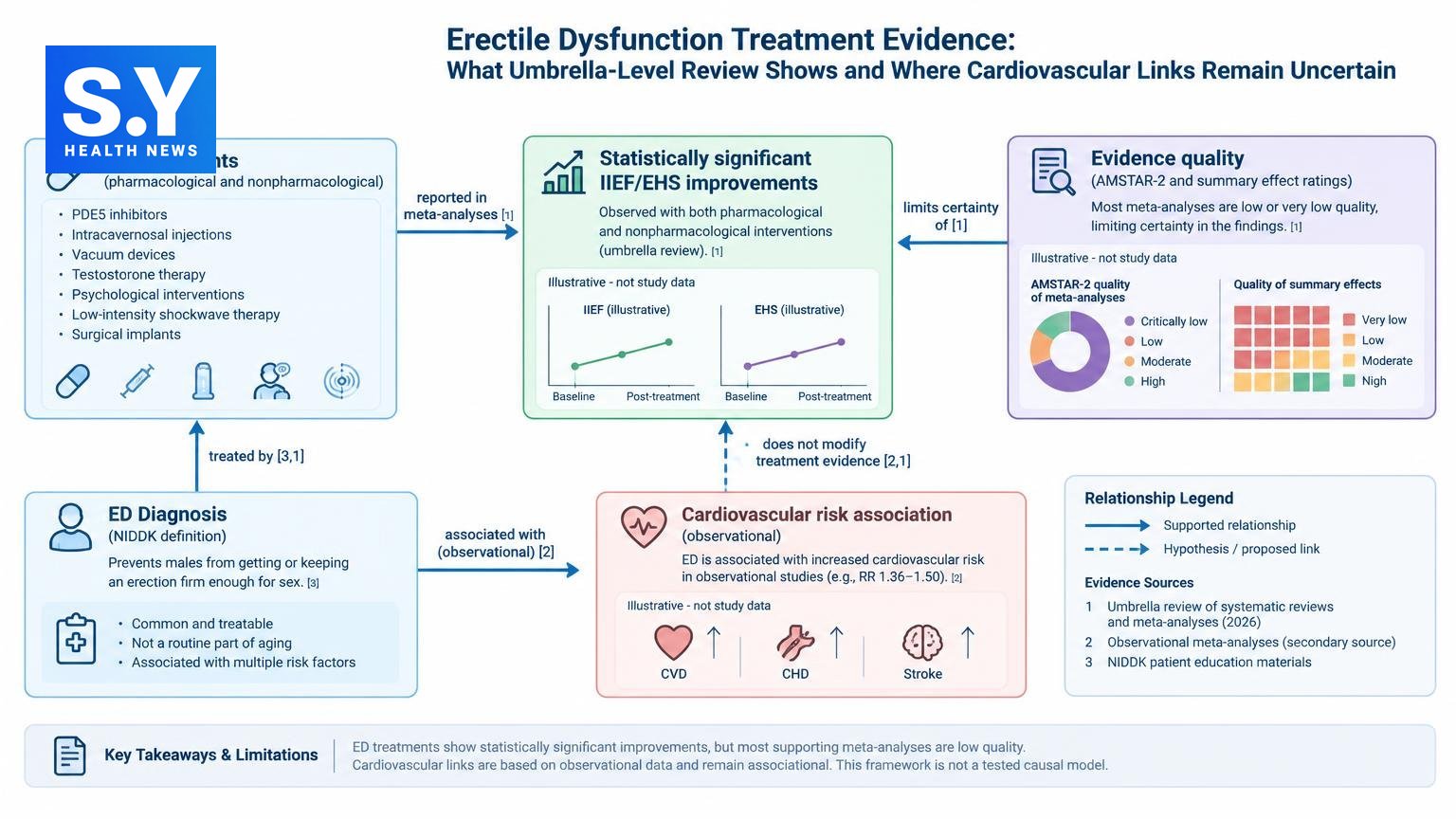
A 2026 umbrella review of systematic reviews and meta-analyses examined the effectiveness of current treatments for erectile dysfunction (ED) and assessed the quality of the underlying evidence. The review screened 1,191 studies, extracted 23 published meta-analyses, and derived 42 summary effects across 36 interventions, using the International Index of Erectile Function (IIEF) or its simplified versions and the erectile hardness score (EHS) as endpoints.[1]
The central finding is a paradox: statistically significant improvements in ED were observed with both pharmacological and nonpharmacological interventions, but the authors caution that these findings should be interpreted with caution due to limited patient numbers and the subjective nature of outcome indicators. The evidence base is predominantly of low or very low quality.
Quality appraisal using AMSTAR-2 rated 13 of 23 included meta-analyses (56.5%) as critically low quality, 7 (30.5%) as low quality, 2 (8.7%) as moderate quality, and only 1 (4.3%) as high quality. Among the 42 summary effects, only two were rated high and moderate quality respectively, while 20 (47.6%) were low and 20 (47.6%) were very low quality.
Separately, observational evidence summarized in secondary clinical sources suggests ED is associated with increased cardiovascular risk, but these data come from meta-analyses of observational studies and cannot establish causation. The umbrella review does not address cardiovascular outcomes, and the commercial guide relaying those cardiovascular figures is a secondary source whose underlying reviews were not supplied for independent appraisal.[2]
Why This Matters
Erectile dysfunction is defined by the National Institute of Diabetes and Digestive and Kidney Diseases (NIDDK) as preventing males from getting or keeping an erection firm enough for sex. It is common, treatable, and not a routine part of aging, yet the quality of evidence supporting its many treatments has not been comprehensively appraised at the umbrella level until recently.[3]
The treatment landscape for ED is increasingly diverse, encompassing oral phosphodiesterase type 5 (PDE5) inhibitors, intracavernosal injections, vacuum devices, testosterone therapy, psychological interventions, low-intensity shockwave therapy, and surgical implants. This diversity creates a practical problem: clinicians and patients must choose among options whose comparative effectiveness is often supported by low-certainty evidence.
At the same time, ED is increasingly discussed as a potential marker of underlying cardiovascular disease. The artery-size hypothesis proposes that because penile arteries are smaller than coronary arteries, atherosclerotic changes may manifest first as erectile difficulty. This hypothesis is biologically plausible and supported by observational associations, but it remains a hypothesis rather than an established causal mechanism.
Men with diabetes are two to three times more likely to develop ED than men without diabetes, according to NIDDK, and many factors affecting the vascular, nervous, and endocrine systems can contribute to or cause ED. These established risk relationships underscore why ED warrants clinical attention beyond the bedroom.[4]
Biological and Clinical Mechanism
An erection requires coordinated activity across vascular, neurological, and endocrine systems. NIDDK states that many factors affecting these systems can contribute to or cause ED. Vasculogenic ED involves impaired blood flow to the corpora cavernosa; neurogenic ED involves nerve damage from conditions such as diabetes or pelvic surgery; and endocrine factors such as low testosterone can modulate libido and nitric oxide signaling.[5]
PDE5 inhibitors, the most commonly discussed pharmacological treatment, work by blocking the enzyme that breaks down cyclic guanosine monophosphate (cGMP), the molecule responsible for smooth-muscle relaxation and blood flow into the penis. These drugs do not cause erections without sexual stimulation. This mechanism explains both their efficacy and their dependence on intact nitric oxide signaling.
Psychological factors can also worsen ED; NIDDK notes that emotional or psychological factors can exacerbate the condition. Importantly, the direction of effect can run both ways: anxiety can contribute to ED, and the distress of ED or related conditions such as Peyronie's disease can produce anxiety. This bidirectionality complicates attribution in both clinical practice and research.[6]
Peyronie's disease, a condition involving penile plaque and curvature, illustrates how ED can coexist with other penile pathology. According to a secondary commentary quoting NIDDK, the acute phase can last up to 18 months with plaque formation, curvature, and pain even without erection. The commentary reports that the sources do not explain the gap between diagnosed prevalence (about 1 in 100 US men over 18) and symptom-based estimates (more than 1 in 10).
What the Evidence Shows: The Umbrella Review
The 2026 umbrella review, which searched PubMed, Web of Science, the Cochrane Library, and Embase for studies published up to October 2025, represents one of the most comprehensive attempts to synthesize ED treatment evidence. Of 1,191 studies screened, 23 published meta-analyses were extracted, yielding 42 summary effects on IIEF (n=20), IIEF-5 (n=9), IIEF-EF (n=6), and EHS (n=7) across 36 interventions.
The review's quality appraisal is its most consequential finding. Using AMSTAR-2, 13 of 23 meta-analyses (56.5%) were rated critically low quality, 7 (30.5%) low quality, 2 (8.7%) moderate quality, and 1 (4.3%) high quality. At the level of individual summary effects, 20 (47.6%) were rated low quality and 20 (47.6%) very low quality, with only two rated high and moderate respectively.
Despite this quality concern, the review did observe statistically significant improvements in ED with both pharmacological and nonpharmacological interventions. The authors explicitly caution that these findings should be interpreted with caution due to limited patient numbers and the subjective nature of outcome indicators. The IIEF and EHS are self-reported or clinician-administered instruments, not objective physiological measures.
| Evidence Domain | Reported Finding | Interpretation |
|---|---|---|
| Meta-analyses included | 23 meta-analyses yielding 42 summary effects across 36 interventions | Broad but fragmented evidence base; unit of analysis is published meta-analyses, not individual trials |
| AMSTAR-2 quality of meta-analyses | 13 critically low (56.5%), 7 low (30.5%), 2 moderate (8.7%), 1 high (4.3%) | Most included meta-analyses have serious methodological limitations |
| Quality of 42 summary effects | 2 high/moderate; 20 low (47.6%); 20 very low (47.6%) | Effect-level certainty is predominantly low to very low |
| Direction of treatment effects | Statistically significant improvements with pharmacological and nonpharmacological interventions | Statistical significance does not equal clinical certainty; authors urge caution due to limited patient numbers and subjective outcomes |
| Outcome instruments | IIEF, IIEF-5, IIEF-EF, and EHS | Self-reported or clinician-administered; subject to response bias and limited objective validation |
Cardiovascular Links: Observational Signals and Their Limits
A separate body of evidence, relayed by a commercial clinical guide, reports that a 2023 umbrella review in JACC Advances found ED independently predicts cardiovascular disease (relative risk 1.45), coronary heart disease (RR 1.50), and stroke (RR 1.36). The guide states that the 2024 Princeton IV Consensus treats ED as a cardiovascular risk-enhancing factor based on these findings.
These figures derive from meta-analyses of observational studies, not randomized trials. Observational associations can be confounded by shared risk factors such as age, smoking, diabetes, hypertension, and dyslipidemia, all of which increase both ED and cardiovascular disease risk. The relative risks are modest (1.36 to 1.50), meaning the absolute risk increase for any individual may be small even if the association is real.
The artery-size hypothesis provides a plausible mechanism: penile arteries are smaller than coronary arteries, so atherosclerotic plaque might produce symptoms earlier in the penis than in the heart. However, this remains a hypothesis. The umbrella review of ED treatments did not assess cardiovascular outcomes, and the commercial guide relaying the cardiovascular data is a secondary source that did not supply the original meta-analyses for independent appraisal.
NIDDK's patient education materials list heart and blood vessel disease, atherosclerosis, and high blood pressure among conditions that can cause ED, consistent with a vascular contribution. But listing a condition as a potential cause is not the same as establishing that ED independently predicts future cardiovascular events after adjusting for all confounders.
Other Treatment Evidence: Testosterone, Shockwave Therapy, and Sleep Apnea
The commercial guide reports that the 2023 TRAVERSE trial (n=5,246 hypogonadal men with elevated cardiovascular risk) found transdermal testosterone non-inferior to placebo for major adverse cardiac events (HR 0.96, 95% CI 0.78-1.17) over a mean 21.7 months. However, the guide also notes higher rates of pulmonary embolism (0.9% vs 0.5%), atrial fibrillation (3.5% vs 2.4%), and acute kidney injury (2.3% vs 1.5%) in the testosterone arm. These are small absolute differences whose statistical significance was not stated in the passage, and the trial details are relayed secondhand.
For low-intensity shockwave therapy, the guide reports a 2025 Cochrane review of 21 randomized trials (1,357 men) finding possible improvements in IIEF-EF scores of roughly 3.9 points short-term and 5.3 points long-term versus sham, with low certainty of evidence. The guide notes that the American Urological Association continues to classify shockwave therapy as investigational. These findings are consistent with the umbrella review's conclusion that many interventions show statistically significant but low-certainty benefits.
The guide also reports a 2018 study of 150 men newly diagnosed with moderate-to-severe obstructive sleep apnea finding an ED prevalence of 51%. This is a single-cohort association and cannot establish that sleep apnea causes ED or that treating sleep apnea improves erectile function. The finding is reported secondhand and has not been independently verified from the primary source in this review.
The guide states that all four PDE5 inhibitors are effective in roughly 60% to 80% of men with ED, citing the AUA guideline. This figure is a secondary summary; the response definition and trial denominators are not provided. It should be interpreted as a broad estimate rather than a precise efficacy rate.
Interpretation and Limitations
The umbrella review's most important contribution is not a new efficacy claim but a quality audit. It confirms that statistically significant improvements have been reported for many ED treatments while simultaneously demonstrating that most of the supporting meta-analyses are methodologically weak. The authors urgently recommend further well-designed studies on single treatments and high-quality meta-analyses of intertreatment comparisons.
Several limitations apply to this evidence base. The unit of analysis was published meta-analyses, not individual trials, so overlapping primary studies may inflate the apparent breadth of evidence. The outcome instruments (IIEF, IIEF-5, IIEF-EF, EHS) are subjective or clinician-administered rather than objective physiological measures. The review did not report effect sizes in the abstract, limiting interpretation of clinical magnitude.
The cardiovascular evidence has distinct limitations. The relative risks relayed by the commercial guide come from observational meta-analyses that cannot establish causation. The original reviews were not supplied, and the guide is a secondary source with a commercial interest in telehealth prescribing. The absolute risk increase for an individual man is not reported, and the clinical utility of treating ED as a cardiovascular risk marker depends on whether early intervention improves outcomes, which remains unproven in the sources reviewed here.
The evidence base is also evolving. NIDDK's ED pages were last reviewed in October 2024, while its Peyronie's page dates to August 2019, and the MedlinePlus sildenafil page was last revised in August 2023. Some patient education sources are therefore several years old, and the commercial guide's 2026 update is not a peer-reviewed systematic review.
Age-related prevalence data are also inconsistent across sources. One patient quiz attributed to NIDDK states about 5% of 40-year-old men and up to 25% of 65-year-old men have ED, but the underlying study and population definition are not given. These figures should be treated as rough estimates rather than precise epidemiological parameters.
Research Outlook
The umbrella review's call for better-designed single-treatment studies and high-quality comparative meta-analyses is the clearest research priority. Future work should use objective outcome measures where possible, report absolute as well as relative effects, and standardize outcome definitions to permit meaningful comparison across interventions.
For cardiovascular links, prospective cohort studies with rigorous adjustment for shared risk factors and randomized trials testing whether early cardiovascular intervention in men with ED improves outcomes would be needed to move from association toward causation. The current evidence supports clinical vigilance, not a proven causal pathway or a proven benefit of treating ED as a stand-alone cardiovascular screening tool.
In practice, the evidence supports a cautious approach: treat ED as a legitimate medical condition with effective but variably evidenced options, consider cardiovascular risk factors as part of a comprehensive assessment, and avoid overstating the certainty of any single intervention or the strength of the ED-cardiovascular association.
Key Takeaways
- An umbrella review of 23 meta-analyses found statistically significant improvements in ED with pharmacological and nonpharmacological treatments, but the evidence base is predominantly low or very low quality.
- Using AMSTAR-2, 56.5% of included meta-analyses were rated critically low quality, and 47.6% of summary effects were very low quality.
- Observational data relayed by a secondary source suggest ED is associated with increased cardiovascular risk (RR 1.45 for cardiovascular disease, 1.50 for coronary heart disease, 1.36 for stroke), but causation is not established.
- Men with diabetes are two to three times more likely to develop ED than men without diabetes, per NIDDK.
- ED is not a routine part of aging and can be treated at any age, but age-related prevalence estimates vary across sources and lack transparent methodology.
- The review authors urgently recommend better-designed single-treatment studies and high-quality meta-analyses comparing treatments.
Questions and Answers
What did the 2026 umbrella review of erectile dysfunction treatments find about evidence quality?
The review included 23 meta-analyses and rated 13 (56.5%) as critically low quality, 7 (30.5%) low, 2 (8.7%) moderate, and 1 (4.3%) high using AMSTAR-2. Among 42 summary effects, 20 were low quality and 20 very low quality, with only two rated high or moderate. The authors concluded the evidence base is predominantly low or very low quality.
Is erectile dysfunction a reliable early warning sign of heart disease?
Observational meta-analyses relayed by a secondary clinical guide report that ED is associated with increased cardiovascular risk (RR 1.45 for cardiovascular disease, 1.50 for coronary heart disease, 1.36 for stroke). However, these are associations from observational studies and cannot establish causation. Shared risk factors such as age, smoking, and diabetes may confound the relationship, and the absolute risk increase for an individual is not reported in the sources reviewed.
How effective are PDE5 inhibitors for erectile dysfunction according to current evidence?
A commercial clinical guide states that all four PDE5 inhibitors are effective in roughly 60% to 80% of men with ED, citing the AUA guideline. However, this is a secondary summary without response definitions or trial denominators. The umbrella review found statistically significant improvements with pharmacological treatments but rated the underlying evidence as predominantly low quality, urging caution in interpretation.
What does the evidence say about low-intensity shockwave therapy for erectile dysfunction?
A 2025 Cochrane review of 21 randomized trials (1,357 men), relayed by a secondary source, found low-intensity shockwave therapy may improve IIEF-EF scores by roughly 3.9 points short-term and 5.3 points long-term versus sham, with low certainty of evidence. The American Urological Association classifies it as investigational. These findings are consistent with the umbrella review's conclusion that many ED interventions show statistically significant but low-certainty benefits.
Can erectile dysfunction be caused by psychological factors, and how strong is that evidence?
NIDDK states that emotional or psychological factors can worsen ED, and a secondary commentary notes that anxiety can both contribute to ED and arise as a consequence of conditions like Peyronie's disease. However, the direction of effect can run both ways, and sources do not quantify how often psychological factors are the primary cause. This is a general mechanistic statement rather than a precise causal estimate.
What are the limitations of the evidence linking erectile dysfunction to cardiovascular disease?
The cardiovascular relative risks (RR 1.36 to 1.50) come from observational meta-analyses, which cannot prove causation because shared risk factors like age, smoking, and diabetes may confound the association. The figures were relayed by a commercial secondary source whose original reviews were not supplied for independent appraisal. The absolute risk increase for an individual is not reported, and whether treating ED as a cardiovascular marker improves outcomes remains unproven in the sources reviewed.
Conceptual framework: Conceptual framework: published meta-analyses report statistically significant improvements in erectile dysfunction with pharmacological and nonpharmacological treatments, but AMSTAR-2 ratings indicate predominantly low or very low evidence quality. ED diagnosis is also associated with cardiovascular risk in observational data, a relationship that remains associational and hypothesis-generating. This framework is not a tested causal model.
Academic References & Evidence
- Current treatment for erectile dysfunction: an umbrella review of systematic reviews and meta-analyses. 2026 DOI: 10.6084/m9.figshare.31562993.v1.
- Parth Bhavsar. Erectile Dysfunction. 2026
- Erectile Dysfunction (ED) – NIDDK. 2024
- Síntomas y causas de la disfunción eréctil – NIDDK. 2017
- Krames Online – Erectile Dysfunction Quiz.
- MedicalFoundationOfNC.org Research Team. Erectile pain and performance concerns: Why the symptom changes the care question.
SANYUN Science Center explains published research on men's reproductive and sexual health, connecting scientific evidence with everyday questions while making sources and limitations clear.
Disclaimer: This article is for scientific education and research communication only. It does not provide medical advice, diagnosis, or individualized treatment recommendations, and does not endorse any medication, supplement, device, penile enlargement procedure, or other intervention. Decisions about sexual and reproductive health should be made in consultation with a qualified healthcare professional. Do not delay seeking professional care because of information in this article.
Original Content & Copyright Notice
- This article is prepared for SANYUN Science Center, drawing on published research and publicly available academic literature on men’s sexual and reproductive health. Its editorial explanations and presentation are developed for this platform.
- Copyright in the original editorial content, selection, and arrangement is reserved by SANYUN Science Center to the extent protected by applicable law. Referenced research, quotations, and third-party materials remain subject to the rights of their respective owners. This notice does not claim ownership of scientific facts or third-party research.
- Except where permitted by applicable law or an applicable license, prior written permission is required to reproduce, republish, translate, adapt, redistribute, or commercially reuse protected content. Attribution alone does not grant permission for such reuse.
- For permitted quotation or authorized reuse, clearly identify the source and retain a link to the original article.
- Source: SANYUN Science Center
- Original URL: Retain the original article URL on science.san-yun.com.
- Copyright Holder: SANYUN Science Center, for its own protected editorial content.
- Quotation, excerpts, or authorized reuse must not distort the scientific meaning, omit material limitations or disclaimers, or imply unverified medical claims, product efficacy, or endorsement by SANYUN Science Center.



