




Category: Erectile Dysfunction
Core Research Direction: Evidence quality and long-term outcomes of erectile dysfunction treatments: an umbrella review of 23 meta-analyses showing predominantly low-certainty evidence, plus ten-year penile prosthesis outcomes and predictors of early prosthetic infection, framed against cardiovascular risk context.
Search Intent: How strong is the evidence behind current erectile dysfunction treatments, and what do long-term penile prosthesis outcomes and infection predictors show?
Platform: SANYUN Science Center
Evidence reviewed through: 2026-11-23
Executive Summary
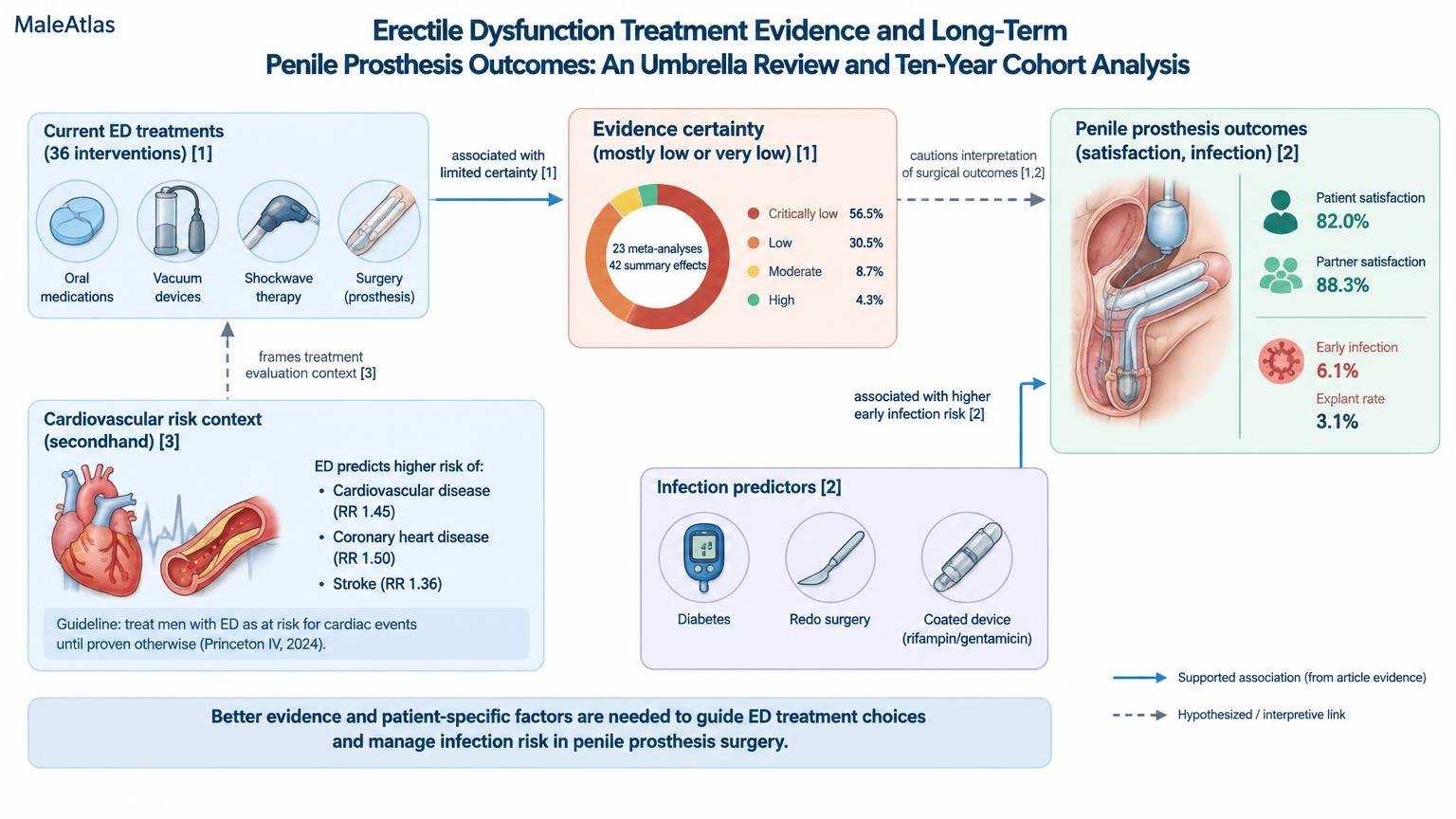
Two recent publications approach erectile dysfunction (ED) treatment from opposite ends of the evidence hierarchy. An umbrella review of systematic reviews and meta-analyses set out to summarize the effectiveness of current ED treatments and to assess the quality of the evidence behind them, covering publications up to October 2025. Its central finding is sobering: the evidence base is predominantly of low or very low quality. From 1,191 studies screened, the authors extracted 23 meta-analyses yielding 42 summary effects across four erectile function endpoints and 36 interventions. By AMSTAR-2 appraisal, 13 of the 23 meta-analyses (56.5%) were rated critically low quality, 7 (30.5%) low, 2 (8.7%) moderate and only 1 (4.3%) high. At the level of individual summary effects, 20 of 42 (47.6%) were graded low quality and another 20 (47.6%) very low, leaving just two effects rated high or moderate.[1]
A separate retrospective cohort followed 549 men who underwent 576 penile prosthesis placements between 2008 and 2018 in a tertiary care setting, reporting ten-year outcomes and predictors of early prosthetic infection. Early infection occurred in 35 cases (6.1%) with an explant rate of 3.1%; 82.0% of patients described themselves as satisfied and partner satisfaction was 88.3%. Diabetes, longer operative time and reinterventions were associated with infection risk, postoperative ciprofloxacin was inversely associated with it, and rifampin/gentamicin-coated three-piece inflatable prostheses showed a higher infection signal. In multivariate analysis, diabetes, redo surgery and use of that coated device each carried roughly two-fold higher early infection risk.[2]
Together these sources frame a practical tension. Patients and clinicians have more ED treatment options than ever, yet the comparative certainty supporting those options is thin. Meanwhile, the most invasive option, penile prosthesis implantation, shows durable satisfaction in a specialized cohort but carries identifiable infection risks that are concentrated in specific patient and surgical factors. Neither source is a randomized comparison, and neither can establish that any treatment prolongs life or prevents cardiovascular events.
Why This Matters
ED is common and shares risk factors with cardiovascular disease, so treatment decisions are rarely purely sexual-health decisions. A separate narrative clinical guide in the packet summarizes a 2021 BJU International umbrella review reporting that ED predicts cardiovascular disease (RR 1.45), coronary heart disease (RR 1.50) and stroke (RR 1.36), and notes that the 2024 Princeton IV Consensus advises treating men with ED as at risk for cardiac events until proven otherwise. That source is a commercially hosted physician-authored guide, not a primary study, so these figures should be read as secondhand context rather than independently verified relative risks. Nonetheless, the direction is consistent with the broader literature: erectile dysfunction often signals vascular risk that deserves assessment regardless of which ED treatment is chosen.[3]
If the evidence behind most ED treatments is low certainty, then communicating uncertainty becomes part of good care. Patients choosing between a daily tablet, a vacuum device, shockwave therapy or surgery need to know not only expected benefits but also how confident anyone can be about those benefits. The umbrella review's quality distribution is therefore not an academic footnote; it directly influences how strongly clinicians should present each option and how much weight shared decision-making must carry.
Biological and Clinical Mechanism
Erection depends on nitric oxide signaling in penile arteries, cyclic GMP-mediated smooth-muscle relaxation and adequate arterial inflow into the corpora cavernosa. Phosphodiesterase type 5 (PDE5) inhibitors block the enzyme that degrades cyclic GMP, amplifying this pathway when sexual stimulation is present; they do not initiate erection on their own. Because the same nitric oxide pathway mediates nitrate-induced vasodilation, PDE5 inhibitors are absolutely contraindicated with nitrate medications and recreational nitrites, a combination that can cause severe, potentially fatal hypotension. This mechanism is well established and is not what the umbrella review questioned; the review questioned the strength of clinical outcome evidence across the much wider treatment landscape.
Penile prosthesis surgery bypasses the vascular and neural pathway entirely by implanting a mechanical device that produces rigidity. Its outcomes therefore depend less on erectile physiology and more on surgical technique, device selection, infection control and patient factors such as diabetes and prior surgery. The ten-year cohort reflects exactly these clinical variables: infection is the main early complication, and the identified predictors are plausible surgical and host factors rather than markers of erectile function itself.
What the Evidence Shows
The umbrella review screened 1,191 studies and extracted 23 published meta-analyses, producing 42 summary effects distributed across the International Index of Erectile Function (IIEF, 20 effects), its five-item version (IIEF-5, 9 effects), the erectile function domain (IIEF-EF, 6 effects) and the Erectile Hardness Score (EHS, 7 effects). These effects covered 36 interventions. The authors report that statistically significant improvements were observed with both pharmacological and nonpharmacological interventions, but they caution that patient numbers were limited and the outcome indicators are subjective. Their overall conclusion is that the current evidence base for ED treatments is predominantly of low or very low quality.
The quality appraisal deserves emphasis because it operates at two levels. At the review level, AMSTAR-2 rated 13 of 23 meta-analyses critically low, 7 low, 2 moderate and 1 high. At the effect level, 20 summary effects were low quality and 20 very low, with only one high-quality and one moderate-quality effect among the 42. A high AMSTAR-2 rating for a review and a high certainty grade for its effect are different things, and here both distributions skew heavily toward low confidence. The authors explicitly call for further well-designed studies of single treatments and high-quality meta-analyses comparing treatments against each other.
The prosthesis cohort offers a different kind of evidence: a large single-center surgical series with long follow-up rather than a pooled estimate. Among 549 men and 576 placements performed between 2008 and 2018, early prosthetic infection occurred in 35 cases (6.1%) and the explant rate was 3.1%. Patient satisfaction was 82.0% and partner satisfaction 88.3%. Univariate associations linked diabetes (P = 0.012), longer operative time (P = 0.032) and reinterventions (P = 0.048) to infection risk, while postoperative ciprofloxacin was inversely associated (P = 0.014) and rifampin/gentamicin-coated three-piece inflatable prostheses showed higher risk (P = 0.019). Multivariate analysis showed approximately two-fold higher infection risk for diabetic patients, redo surgeries and use of the coated device, all with P < 0.03.
| Domain | Reported finding | Evidence type | Interpretation |
|---|---|---|---|
| Umbrella review scope | 23 meta-analyses, 42 summary effects, 36 interventions across IIEF, IIEF-5, IIEF-EF and EHS | Umbrella review of systematic reviews and meta-analyses covering publications to October 2025 | Broad but fragmented evidence map; counts reflect extracted analyses, not pooled patient totals |
| Review-level quality (AMSTAR-2) | 13 critically low (56.5%), 7 low (30.5%), 2 moderate (8.7%), 1 high (4.3%) | Methodological appraisal of 23 meta-analyses | Most included reviews had serious methodological limitations |
| Effect-level certainty | 20 low (47.6%), 20 very low (47.6%), 1 high, 1 moderate | Grading of 42 summary effects | Only two effects rated high or moderate certainty |
| Prosthesis early infection | 35 cases (6.1%); explant rate 3.1% | Retrospective ten-year cohort, 549 men and 576 placements, 2008-2018 | Infection uncommon but clinically consequential; denominator for explant rate not specified in source |
| Satisfaction | Patients 82.0%; partners 88.3% | Same retrospective cohort | High reported satisfaction in a specialized center; denominators not detailed |
| Infection predictors (multivariate) | Diabetes, redo surgery and coated three-piece inflatable device each approximately two-fold higher risk (all P < 0.03) | Observational adjusted analysis | Associations, not proof of causation; adjusted ratios and confidence intervals not stated in source |
Interpretation and Limitations
The umbrella review's headline conclusion is not that ED treatments fail. It is that statistically significant improvements have been observed but the reliability of that evidence is poor. This distinction matters because statistical significance and clinical certainty are different currencies. A treatment can produce a statistically significant change on the IIEF while the underlying trials are small, unblinded or inconsistent. The review authors highlight limited patient numbers and the subjective nature of erectile function questionnaires as specific reasons for caution. Erectile function scores are patient-reported and susceptible to expectation effects, particularly in unblinded device trials.
Several structural limitations weaken the umbrella review's conclusions as well as the evidence it examines. Overlapping primary trials across meta-analyses can inflate apparent certainty. The review assessed 23 meta-analyses but did not perform new patient-level pooling, so its quality grades reflect published reviews rather than reanalysis of raw data. It also could not resolve comparative effectiveness: the authors explicitly recommend high-quality meta-analyses of intertreatment comparisons because the existing literature is better at asking whether a treatment beats placebo or sham than at asking which treatment works best for which patient. The search cutoff of October 2025 means later publications are not represented.
The prosthesis cohort has complementary limitations. It is a single tertiary-care center series without a comparator group, so satisfaction and infection rates reflect one institution's case mix, surgical technique and follow-up. The infection associations are observational; diabetic patients may differ in glycemic control, wound healing and prior surgery in ways that confound the device comparison in particular. The finding that coated three-piece inflatable prostheses had higher infection risk is counterintuitive and should not be interpreted as evidence that coating is harmful. Device selection is not random, and coated implants may have been used preferentially in patients perceived as higher risk. The reported two-fold risk estimates are described without confidence intervals in the available summary. The predictive nomogram proposed for preoperative counseling has not been externally validated and is presented as a hypothesis requiring further validation.
The cardiovascular context adds an interpretive caution. The relative risks attributed to ED for cardiovascular disease, coronary heart disease and stroke come from a physician-authored commercial guide summarizing a 2021 umbrella review, and the original study is not in the packet. These figures are useful for orientation but should not be treated as independently confirmed in this analysis. Observational associations between ED and cardiovascular events are also susceptible to shared risk factors such as age, smoking, diabetes and hypertension. They support cardiovascular assessment; they do not prove that treating ED modifies cardiac outcomes.
Research Outlook
The umbrella review's most actionable recommendation is methodological. Well-designed trials of single treatments, and high-quality meta-analyses comparing treatments with each other rather than only with placebo, are needed before certainty grades can rise. Priorities implied by the quality distribution include adequate sample sizes, blinded outcome assessment where feasible, consistent use of validated instruments such as IIEF-EF and EHS, and transparent reporting of industry funding. The review's finding that only two of 42 summary effects reached high or moderate certainty sets a clear benchmark for what future research must improve.
For prosthesis research, the cohort's infection predictors suggest testable hypotheses. Prospective registries with standardized device documentation, glycemic control measures and surgical time recording could clarify whether the coated-device signal reflects device properties, patient selection or both. External validation of the proposed nomogram, including calibration and discrimination in independent populations, is a prerequisite before it is used in counseling. Satisfaction measured with validated partner-reported instruments and longer follow-up would strengthen the ten-year outcome picture. None of these studies has been done in the packet sources, and the current findings remain hypothesis-generating for those questions.
Key Takeaways
- An umbrella review of 23 meta-analyses covering 42 summary effects on 36 ED interventions found the evidence base predominantly low or very low quality, with 40 of 42 effects graded low or very low.
- By AMSTAR-2, 13 of 23 included meta-analyses (56.5%) were critically low quality, and only one was rated high quality.
- Statistically significant improvements were reported for pharmacological and nonpharmacological interventions, but limited patient numbers and subjective outcomes require cautious interpretation.
- In a ten-year cohort of 549 men and 576 penile prosthesis placements, early infection occurred in 6.1% with a 3.1% explant rate, while patient satisfaction was 82.0% and partner satisfaction 88.3%.
- Diabetes, redo surgery and use of rifampin/gentamicin-coated three-piece inflatable prostheses were each associated with roughly two-fold higher early infection risk in multivariate analysis; these are observational associations, not causal effects.
Questions and Answers
What did the umbrella review of erectile dysfunction treatments find about evidence quality?
It found the evidence base predominantly low or very low quality. Of 23 meta-analyses, 13 were rated critically low by AMSTAR-2 and only one high. Of 42 summary effects, 20 were graded low and 20 very low, leaving just two high or moderate. Statistically significant improvements were reported for many interventions, but small samples and subjective outcomes limit confidence.
Which interventions were covered by the erectile dysfunction umbrella review and how were outcomes measured?
The review covered 36 interventions and measured outcomes with the International Index of Erectile Function and its shortened versions plus the Erectile Hardness Score. It extracted 42 summary effects: 20 on IIEF, 9 on IIEF-5, 6 on IIEF-EF and 7 on EHS. Both pharmacological and nonpharmacological treatments were included, but the review did not perform new patient-level pooling.
What are the ten-year outcomes and satisfaction rates after penile prosthesis implantation for erectile dysfunction?
In a single-center cohort of 549 men and 576 placements from 2008 to 2018, early prosthetic infection occurred in 35 cases (6.1%) and the explant rate was 3.1%. Patient satisfaction was 82.0% and partner satisfaction 88.3%. These are observational rates from one tertiary center without a comparator group, so they may not generalize to all surgical settings.
What predicts early infection after penile prosthesis surgery?
Diabetes, longer operative time and reinterventions were associated with higher early infection risk, while postoperative ciprofloxacin was inversely associated. In multivariate analysis, diabetes, redo surgery and rifampin/gentamicin-coated three-piece inflatable prostheses each carried roughly two-fold higher risk. These are observational associations; device selection may be confounded by patient risk, and adjusted confidence intervals were not stated in the available summary.
How does cardiovascular risk context affect interpretation of erectile dysfunction treatment evidence?
ED shares risk factors with cardiovascular disease, and a physician-authored guide summarizing a 2021 umbrella review reports relative risks of 1.45 for cardiovascular disease, 1.50 for coronary heart disease and 1.36 for stroke. That source is secondhand and the original study is not in the packet, so the figures orient rather than confirm. They support cardiovascular assessment but do not show that ED treatment changes cardiac outcomes.
What are the main limitations of the evidence on erectile dysfunction treatments and penile prostheses?
The umbrella review graded most evidence low or very low, citing limited patient numbers and subjective outcome measures, and called for better single-treatment trials and comparative meta-analyses. The prosthesis cohort is a single-center observational series without a comparator; its infection predictors may be confounded, and its proposed predictive nomogram has not been externally validated. Neither source establishes causal treatment effects on cardiovascular outcomes.
Conceptual framework: Conceptual framework, not a tested causal model. The framework shows the article's key constructs: a 36-intervention ED treatment landscape linked to predominantly low-certainty evidence; penile prosthesis outcomes of satisfaction and early infection; infection predictors including diabetes, redo surgery and coated devices; and secondhand cardiovascular risk context. Supported edges reflect reported associations; hypothesis edges indicate proposed interpretive relationships.
Academic References & Evidence
- Current treatment for erectile dysfunction: an umbrella review of systematic reviews and meta-analyses. 2026 DOI: 10.6084/m9.figshare.31562993.v1.
- Search Results.
- Parth Bhavsar. Erectile Dysfunction. 2026
SANYUN Science Center explains published research on men's reproductive and sexual health, connecting scientific evidence with everyday questions while making sources and limitations clear.
Disclaimer: This article is for scientific education and research communication only. It does not provide medical advice, diagnosis, or individualized treatment recommendations, and does not endorse any medication, supplement, device, penile enlargement procedure, or other intervention. Decisions about sexual and reproductive health should be made in consultation with a qualified healthcare professional. Do not delay seeking professional care because of information in this article.
Original Content & Copyright Notice
- This article is prepared for SANYUN Science Center, drawing on published research and publicly available academic literature on men’s sexual and reproductive health. Its editorial explanations and presentation are developed for this platform.
- Copyright in the original editorial content, selection, and arrangement is reserved by SANYUN Science Center to the extent protected by applicable law. Referenced research, quotations, and third-party materials remain subject to the rights of their respective owners. This notice does not claim ownership of scientific facts or third-party research.
- Except where permitted by applicable law or an applicable license, prior written permission is required to reproduce, republish, translate, adapt, redistribute, or commercially reuse protected content. Attribution alone does not grant permission for such reuse.
- For permitted quotation or authorized reuse, clearly identify the source and retain a link to the original article.
- Source: SANYUN Science Center
- Original URL: Retain the original article URL on science.san-yun.com.
- Copyright Holder: SANYUN Science Center, for its own protected editorial content.
- Quotation, excerpts, or authorized reuse must not distort the scientific meaning, omit material limitations or disclaimers, or imply unverified medical claims, product efficacy, or endorsement by SANYUN Science Center.



