




Category: Erectile Dysfunction
Core Research Direction: An umbrella review of systematic reviews and meta-analyses assessing the effectiveness and methodological quality of current pharmacological and non-pharmacological treatments for erectile dysfunction
Search Intent: How strong and reliable is the overall evidence base supporting current treatments for erectile dysfunction?
Platform: SANYUN Science Center
Evidence reviewed through: 2026-11-21
Executive Summary
An umbrella review of systematic reviews and meta-analyses set out to summarize the effectiveness of current erectile dysfunction (ED) treatments and to grade the quality of the evidence supporting them. Searching PubMed, Web of Science, the Cochrane Library and Embase for studies published up to October 2025, the authors screened 1191 records and extracted 23 published meta-analyses. These yielded 42 summary effects spanning 36 interventions, measured with the International Index of Erectile Function (IIEF), its short forms IIEF-5 and IIEF-EF, and the Erectile Hardness Score (EHS).[1]
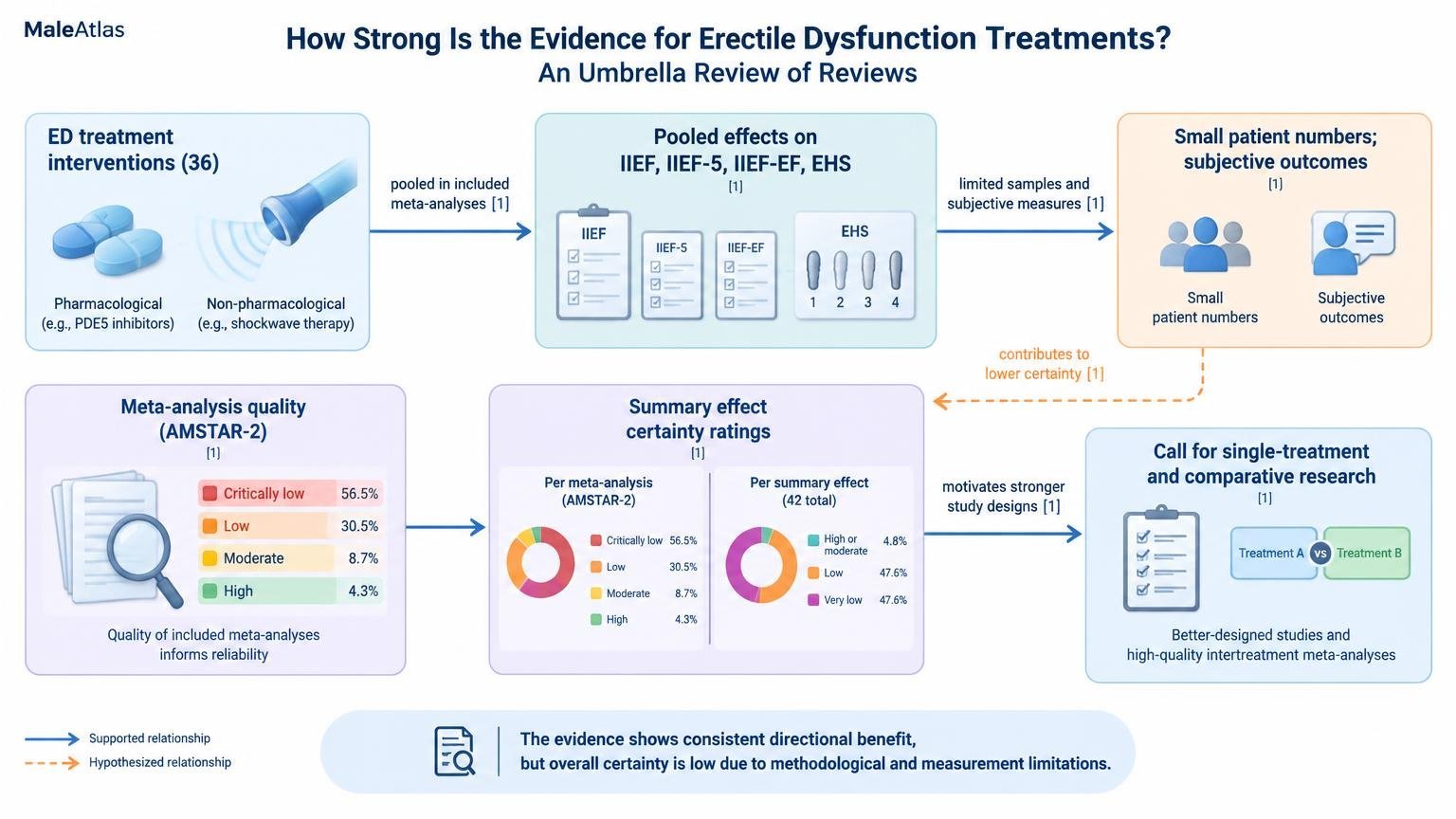
The central finding is a mismatch between statistical signal and evidentiary strength. The review reports that statistically significant improvements were observed with both pharmacological and non-pharmacological interventions, yet it cautions that these results should be interpreted carefully because of limited patient numbers and the subjective nature of the outcome measures. Appraised with AMSTAR-2, 13 of the 23 meta-analyses (56.5%) were rated critically low quality, 7 (30.5%) low, 2 (8.7%) moderate and 1 (4.3%) high. At the level of individual summary effects, only two of 42 were rated high or moderate quality, while 20 (47.6%) were low and 20 (47.6%) very low.
The authors' bottom line is that the evidence base for ED treatments is predominantly of low or very low quality, and they call for better-designed single-treatment trials and high-quality head-to-head meta-analyses. This is not a claim that treatments do not work; it is a statement about how confidently the literature can quantify how well they work, in whom, and relative to each other.
Why This Matters
ED is common, treatable and frequently discussed as a barometer of vascular health, so patients and clinicians make daily decisions in this area. A large volume of meta-analytic literature creates an impression of settled science. An umbrella review deliberately steps back from individual trials and asks a different question: when you stack the reviews on top of each other, does the foundation hold? In this case, the answer is mixed, with consistent directional benefit but weak certainty.[2]
The practical stakes are asymmetric. A drug with a modest true effect but a favorable safety profile may still be a reasonable choice, whereas an invasive or costly intervention needs stronger evidence to justify its burden. Grading the strength of evidence is therefore not an academic exercise; it determines how much weight a clinician should place on a pooled effect size when counselling a patient about what to expect.
How the Review Was Built
The design is a review of reviews. Rather than re-pooling primary trial data, the authors identified published meta-analyses and treated each pooled estimate as a unit of analysis. This approach can efficiently map a broad field, but it inherits every limitation of the included reviews, including their search strategies, inclusion criteria, risk-of-bias judgments and statistical choices.
Two appraisal layers were applied. AMSTAR-2 assessed the methodological quality of each included meta-analysis, and a separate quality rating was applied to each of the 42 summary effects. The distribution across both layers points in the same direction. Most included reviews had serious methodological shortcomings, and most individual pooled effects rested on evidence that could not be graded above low certainty.
The outcome measures deserve attention because they shape interpretation. The IIEF and its abbreviated forms are patient-reported questionnaires, and the EHS is a clinician-assessed hardness rating. Both capture experiences that matter to patients, but both are indirect and susceptible to expectation effects, particularly in unblinded trials. The review authors explicitly flag the subjective nature of these indicators as a reason for caution.
What the Evidence Shows
| Measure | Reported result | What it means |
|---|---|---|
| Meta-analyses included | 23 meta-analyses; 42 summary effects; 36 interventions from 1191 records screened | Broad coverage of the treatment landscape, but breadth is not depth |
| AMSTAR-2 quality of meta-analyses | 13 (56.5%) critically low; 7 (30.5%) low; 2 (8.7%) moderate; 1 (4.3%) high | Most pooled reviews had serious methodological limitations |
| Quality of the 42 summary effects | 2 high or moderate; 20 (47.6%) low; 20 (47.6%) very low | Only a small minority of pooled estimates reached meaningful certainty |
| Direction of treatment effects | Statistically significant improvements with both pharmacological and non-pharmacological interventions | Signals are consistent in direction but limited by small patient numbers and subjective outcomes |
| Authors' overall conclusion | Evidence base predominantly low or very low quality | Certainty, not absence of effect, is the core problem |
| Recommended next steps | Well-designed single-treatment studies and high-quality intertreatment meta-analyses | The field needs comparative and confirmatory research, not more of the same |
Read together, these rows describe a field in which many interventions have been tested and many pooled analyses published, yet the resulting certainty is thin. The high proportion of critically low AMSTAR-2 ratings is particularly consequential, because a meta-analysis with flawed search or risk-of-bias methods can produce a precise-looking pooled estimate that overstates confidence.
The pattern also highlights a distinction that is often blurred in clinical communication: statistical significance answers whether an effect is unlikely to be due to chance under the model, not whether it is large, durable, clinically meaningful or reliably estimated. A pooled mean difference on a questionnaire can be statistically significant while remaining compatible with little perceived change for an individual patient.
Interpreting Certainty: Statistical Versus Clinical Meaning
The review's most transferable lesson concerns how evidence quality is communicated. A statement that a treatment "significantly improved erectile function" in a meta-analysis describes the statistical behaviour of a pooled estimate. A statement that the evidence is "low certainty" describes how much confidence should be placed in that estimate once bias, inconsistency, imprecision and indirectness are considered. Both can be true of the same intervention at the same time.
Imprecision is central here. The authors specifically note the limited number of patients underlying the pooled effects. Small pooled samples widen confidence intervals and make it harder to detect real differences between treatments or to exclude meaningful harms. Subjectivity of the IIEF-family and EHS outcomes adds a second source of uncertainty, because self-reported and clinician-rated measures can shift with expectancy, especially when blinding is imperfect.
None of this means the interventions are ineffective. A consistent direction of benefit across many reviews is itself informative, and for widely used drug classes it aligns with longstanding clinical experience. The correct reading is that the literature supports plausible, probably modest benefits while leaving the size, durability and comparative ranking of those benefits inadequately established.
Where Guidelines and Evidence Reviews Diverge in Emphasis
Clinical guidelines and umbrella reviews address different questions and can appear to disagree without actually contradicting each other. Guideline panels weigh benefits, harms, evidence quality and patient values to produce actionable recommendations. For ED, the European Association of Urology panel conducted an updated systematic review of literature published from 2021 to 2024 and built a decision algorithm supporting individualized treatment that considers invasiveness, tolerability and efficacy alongside patient expectations.
The strength of each recommendation was graded using three factors: the balance of benefits and disadvantages, the quality and reliability of the available evidence, and patient preferences and values. That structure explicitly accommodates low-certainty evidence, because a recommendation can be reasonable even when the underlying certainty is modest, provided harms are limited and patient values are respected.
The 2026 EAU update illustrates how guidance evolves without dramatic therapeutic breakthroughs. It incorporated 116 updated studies across the sexual and reproductive health guidelines and reorganized the ED treatment recommendations so they flow more logically. Notably, the summary of changes describes structural and evidentiary refinement rather than a new first-line paradigm, which is consistent with an umbrella review finding a crowded but weakly evidenced field.[3]
For readers, the implication is to read guideline recommendations and certainty appraisals as complementary. A conditional recommendation is not a weak endorsement of a treatment; it is an acknowledgement that individualization and shared decision-making carry much of the decision weight when pooled evidence is uncertain.
Limitations and What Remains Unknown
The umbrella design has inherent constraints. It can only summarize what has been published as meta-analyses, so interventions studied mainly in single trials or not yet pooled are underrepresented relative to their clinical importance. Overlap among included meta-analyses, with the same trials contributing to multiple pooled estimates, can also inflate the apparent volume of evidence without adding independent information.
Quality appraisal of reviews is not a direct measure of primary trial quality. A high-quality meta-analysis of weak trials remains limited, and a critically low-rated review may still contain accurate pooled estimates. The review's quality distribution should therefore be read as a warning about the reliability of the review layer, not as a verdict on any specific drug or device.
The review did not, on the available description, resolve comparative effectiveness. With 36 interventions and 42 summary effects distributed across several outcome instruments, head-to-head certainty is sparse, which is precisely why the authors call for high-quality intertreatment comparisons. Questions about which option works best for which patient profile, and how benefits hold up beyond short-term follow-up, remain open.
Safety is another gap. The summary focuses on effectiveness and evidence quality; it does not provide a pooled harm profile. Adverse events, contraindications and drug interactions still require dedicated sources rather than inference from efficacy reviews.
Research Outlook
The review's recommendations are unusually specific for a field-level appraisal. It calls for well-designed studies of single treatments, which would reduce the confounding introduced when trials combine multiple co-interventions, and for high-quality meta-analyses that compare treatments directly rather than against placebo alone. Together these would begin to answer the question patients actually ask: which option, for this person, and with what expected magnitude of benefit.
Several methodological improvements follow naturally. Pre-registration of meta-analyses, adherence to established risk-of-bias tools, transparent handling of industry funding and consistent use of validated patient-reported outcomes would all raise the review layer's credibility. Larger pooled samples and longer follow-up would address the imprecision the authors highlight.
Until such work appears, the appropriate stance is calibrated optimism. The treatments are plausibly beneficial, the guideline infrastructure for individualized decision-making exists, and the principal unmet need is certainty rather than novelty.
Key Takeaways
- An umbrella review screened 1191 records and extracted 23 meta-analyses yielding 42 summary effects on 36 ED interventions, using IIEF-family and EHS endpoints.
- With AMSTAR-2, 13 of 23 meta-analyses (56.5%) were critically low quality, 7 (30.5%) low, 2 (8.7%) moderate and 1 (4.3%) high.
- Of the 42 summary effects, only two were rated high or moderate quality, while 20 (47.6%) were low and 20 (47.6%) very low.
- Statistically significant improvements were reported for both pharmacological and non-pharmacological interventions, but the authors urge caution because of limited patient numbers and subjective outcome measures.
- Guidelines such as the EAU update grade recommendations using benefit-harm balance, evidence quality and patient values, allowing individualized care even when certainty is limited.
- The authors recommend well-designed single-treatment studies and high-quality head-to-head meta-analyses to strengthen the evidence base.
Questions and Answers
What did the 2026 umbrella review of erectile dysfunction treatments actually measure?
It summarized published meta-analyses rather than re-analyzing primary trial data. From 1191 records it extracted 23 meta-analyses producing 42 summary effects across 36 interventions, using the IIEF, IIEF-5, IIEF-EF and Erectile Hardness Score as endpoints. It then graded the methodological quality of each review and the certainty of each pooled effect.
Did the umbrella review find that erectile dysfunction treatments work?
It reports statistically significant improvements with both pharmacological and non-pharmacological interventions. However, the authors caution that these findings must be interpreted carefully because of limited patient numbers and the subjective nature of the outcome measures. So the direction of benefit is consistent, but the magnitude and reliability of that benefit are less firmly established than the significance statements alone suggest.
How reliable is the meta-analytic evidence base for erectile dysfunction treatment?
Not very, by the review's own grading. Thirteen of 23 meta-analyses (56.5%) were rated critically low on AMSTAR-2, seven (30.5%) low, two (8.7%) moderate and one (4.3%) high. At the effect level, only two of 42 summary effects reached high or moderate quality, while 20 (47.6%) were low and 20 (47.6%) very low. The authors conclude the evidence base is predominantly low or very low quality.
Why can a treatment be statistically significant but still low-certainty evidence?
Statistical significance describes how unlikely a pooled result is under a model, not how much confidence to place in it. Certainty ratings also account for bias risk, inconsistency, imprecision and indirectness. In this review, small pooled patient numbers and subjective questionnaire or hardness outcomes widened uncertainty, so many statistically significant pooled effects were still graded low or very low.
How do clinical guidelines handle erectile dysfunction evidence that is low certainty?
Guideline panels can still make recommendations when certainty is limited. The European Association of Urology graded recommendation strength using the balance of benefits and harms, the quality and reliability of evidence, and patient preferences and values. Its decision algorithm supports individualized treatment based on invasiveness, tolerability, efficacy and patient expectations rather than a fixed sequence.
What research would improve confidence in erectile dysfunction treatments?
The review authors recommend well-designed studies of single treatments and high-quality meta-analyses that compare treatments directly rather than only against placebo. Better handling of imprecision, longer follow-up and consistent use of validated patient-reported outcomes would also help. These are proposals for future research, not findings of the current review.
Conceptual framework: Conceptual framework. Evidence type: an umbrella review of 23 meta-analyses covering adults with erectile dysfunction. Arrows show how interventions feed pooled effects, which are graded for certainty alongside review methodology; small samples and subjective outcomes are shown as a proposed contributor to lower certainty. This is not a tested causal model.
Academic References & Evidence
- Current treatment for erectile dysfunction: an umbrella review of systematic reviews and meta-analyses. Figshare. 2026 (Mar) DOI: 10.6084/m9.figshare.31562993.v1.
- Salonia A; Capogrosso P; Boeri L; Cocci A; Corona G; Dinkelman-Smit M; Falcone M; Jensen CF; Gül M; Kalkanli A; Kadioğlu A; Martinez-Salamanca JI; Afonso Morgado L; Russo GI; Serefoğlu EC; Verze P; Minhas S. Disturbi sessuali e riproduttivi maschili: le linee guida dell'Associazione Europea di Urologia – Disturbi sessuali maschili – Alessandra Graziottin. Eur Urol. 2025 88(1):76-102 DOI: 10.1016/j.eururo.2025.04.010. PMID: 40340108.
- EAU Guidelines on Sexual and Reproductive Health – Uroweb.
SANYUN Science Center explains published research on men's reproductive and sexual health, connecting scientific evidence with everyday questions while making sources and limitations clear.
Disclaimer: This article is for scientific education and research communication only. It does not provide medical advice, diagnosis, or individualized treatment recommendations, and does not endorse any medication, supplement, device, penile enlargement procedure, or other intervention. Decisions about sexual and reproductive health should be made in consultation with a qualified healthcare professional. Do not delay seeking professional care because of information in this article.
Original Content & Copyright Notice
- This article is prepared for SANYUN Science Center, drawing on published research and publicly available academic literature on men’s sexual and reproductive health. Its editorial explanations and presentation are developed for this platform.
- Copyright in the original editorial content, selection, and arrangement is reserved by SANYUN Science Center to the extent protected by applicable law. Referenced research, quotations, and third-party materials remain subject to the rights of their respective owners. This notice does not claim ownership of scientific facts or third-party research.
- Except where permitted by applicable law or an applicable license, prior written permission is required to reproduce, republish, translate, adapt, redistribute, or commercially reuse protected content. Attribution alone does not grant permission for such reuse.
- For permitted quotation or authorized reuse, clearly identify the source and retain a link to the original article.
- Source: SANYUN Science Center
- Original URL: Retain the original article URL on science.san-yun.com.
- Copyright Holder: SANYUN Science Center, for its own protected editorial content.
- Quotation, excerpts, or authorized reuse must not distort the scientific meaning, omit material limitations or disclaimers, or imply unverified medical claims, product efficacy, or endorsement by SANYUN Science Center.



