




Category: Erectile Dysfunction
Core Research Direction: Quality and reliability of the current evidence base for erectile dysfunction treatments: an umbrella review of meta-analyses of pharmacological and non-pharmacological interventions
Search Intent: How strong is the evidence behind commonly studied erectile dysfunction treatments, and what does an umbrella review of meta-analyses say about effect sizes, certainty, and gaps?
Platform: SANYUN Science Center
Evidence reviewed through: 2026-11-08
Executive Summary
An umbrella review of systematic reviews and meta-analyses set out to summarise the effectiveness of current erectile dysfunction (ED) treatments and to grade the quality of that evidence. Searching PubMed, Web of Science, the Cochrane Library and Embase for studies published up to October 2025, it screened 1191 studies and extracted 23 published meta-analyses, yielding 42 summary effects across 36 interventions.[1][2]
The headline quality finding was stark. On AMSTAR-2, 13 of 23 meta-analyses (56.5%) were rated critically low quality, 7 (30.5%) low, 2 (8.7%) moderate and 1 (4.3%) high. At the level of individual summary effects, only one was graded high quality and one moderate, while low and very low quality each accounted for 47.6% (20 of 42).
Statistically significant improvements on patient-reported erectile function scales were observed for both pharmacological and non-pharmacological interventions, but the review cautions that limited patient numbers and subjective outcome indicators weaken confidence in these estimates. The evidence base is therefore broad in scope but predominantly low or very low quality.
Why This Matters
ED is common and its burden rises with age. Estimates cited in secondary reporting place prevalence at about 40% among men aged 40–49 years and as high as 90% among men aged 70 years and older; these figures originate outside the umbrella review itself and should be treated as approximate context rather than precise measurement.
The treatment landscape has diversified well beyond conventional oral drugs to include shockwave therapy, stem cell and platelet-rich plasma preparations, supplements, acupuncture, electrical stimulation, hyperbaric oxygen and exercise, often in combination. For clinicians and patients, the practical question is not whether a therapy produced a statistically significant change in a pooled analysis, but how much confidence that change deserves. The umbrella review addresses that question directly by mapping methodological quality across the field.
How the Review Was Built
An umbrella review does not pool primary trial data itself; it pools the products of earlier syntheses. This one included meta-analyses of any therapeutic intervention for ED, spanning pharmacological agents such as phosphodiesterase type 5 inhibitors, alprostadil, hormones, antioxidants and testosterone; non-pharmacological approaches such as low-intensity shockwave therapy, cognitive behavioural therapy, vacuum erection devices, penile prosthesis and acupuncture; and combined regimens.
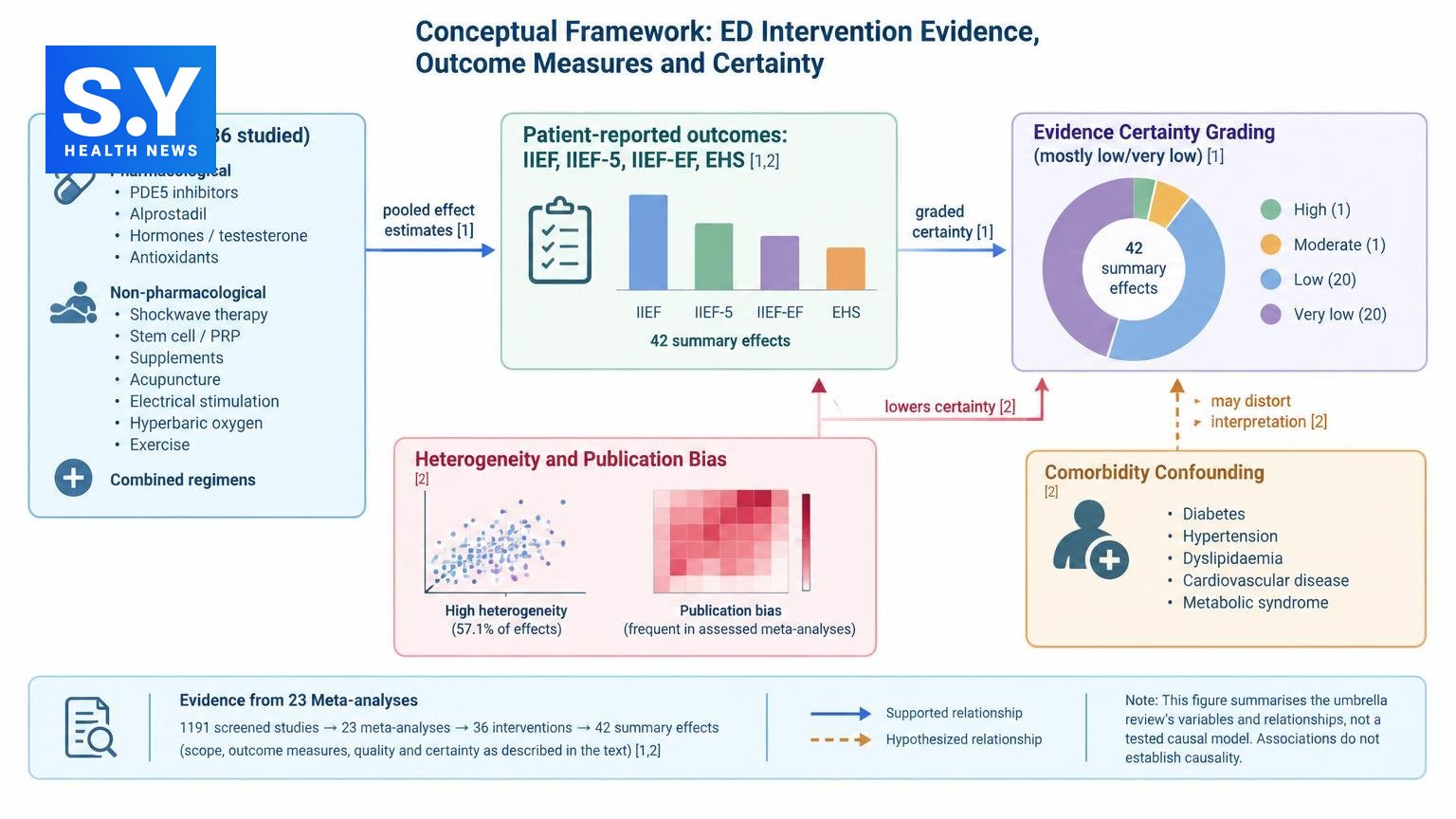
Effectiveness was judged through the International Index of Erectile Function (IIEF) or its abbreviated forms (IIEF-5 and IIEF-EF) and the Erectile Hardness Score (EHS). The 42 summary effects were distributed as 20 for IIEF, 9 for IIEF-5, 6 for IIEF-EF and 7 for EHS. Methodological quality of the included meta-analyses was assessed with AMSTAR-2, and certainty of each summary effect was graded, with heterogeneity and publication bias also examined.
| Review feature | What was done | How to interpret it |
|---|---|---|
| Scope | 23 published meta-analyses extracted from 1191 screened studies, covering 36 interventions and 42 summary effects | Broad mapping of the field rather than a single pooled estimate |
| Outcome measures | IIEF (20 effects), IIEF-5 (9), IIEF-EF (6) and EHS (7) | All four are patient-reported or clinician-scored erectile function instruments; no objective physiological endpoints |
| Methodological quality | AMSTAR-2: 13 critically low, 7 low, 2 moderate and 1 high of 23 meta-analyses | Most underlying syntheses have serious methodological weaknesses |
| Evidence certainty | 1 high, 1 moderate, 20 low and 20 very low quality among 42 summary effects | Statistical significance frequently coexists with low certainty |
| Consistency | 57.1% of summary effects showed high heterogeneity; few meta-analyses assessed publication bias, and a high proportion of those showed significant bias | Pooled averages may conceal differences between studies and populations |
What the Evidence Shows
Across the pooled analyses, most evaluated interventions produced statistically significant improvements on at least one erectile function scale compared with placebo or control. The review's overall conclusion is not that treatments fail, but that the direction of effect is generally favourable while the certainty attached to those effects is weak. This distinction between statistical signal and evidential strength is central to interpreting the paper.
One of the largest reported effects concerned platelet-rich plasma therapy, which showed an improvement in IIEF scores up to 6 months with a standardised mean difference of 0.82 (95% CI 0.42–1.21); this effect was nevertheless graded low quality evidence. A standardised mean difference of this size is conventionally viewed as moderate to large, but the low certainty grading means the estimate could shift substantially with better-designed studies.
Equally informative are the null findings within specific endpoints and time windows. Stem cell therapy showed no clear positive effect on IIEF at 3 months, low-intensity shockwave therapy showed no clear positive effect on IIEF-EF at 3 months or less, and shockwave therapy showed no clear positive effect on IIEF-5 at 3 months or more. These inconsistencies across instruments and time points suggest that some apparently positive pooled results are sensitive to how and when outcomes are measured.
Only stem cell therapy showed significant improvement across all four endpoints in the review's summary, yet even this signal was graded very low quality and was not consistent at the 3-month IIEF time point. Such a pattern illustrates why a single favourable pooled estimate should not be read as established efficacy.
Biological Rationale Behind the Interventions
The review's discussion outlines plausible mechanisms for several of the categories it assessed. Antioxidants are described as improving nitric oxide bioavailability and endothelial function by scavenging free radicals, inhibiting oxidative stress pathways and modulating endothelial nitric oxide synthase uncoupling. These are proposed mechanisms drawn from narrative synthesis, not relationships established by the umbrella review's pooled data.
Other proposed mechanisms include nitric oxide release through dopaminergic pathways for apomorphine-like agents, paracrine growth factor release with stem cell therapy to support endothelial repair and nerve regeneration, local growth factor release with platelet-rich plasma to stimulate angiogenesis and collagen remodelling, and improved local blood flow, nerve stimulation and inflammation suppression with micro-energy therapies such as shockwave treatment. Acupuncture's mechanism is described as incompletely understood.
Mechanistic plausibility is not the same as demonstrated clinical benefit. A treatment can have a credible biological rationale and still fail to show reliable, reproducible improvement in well-controlled trials. The umbrella review's quality grading is the more decision-relevant signal.
Contextual evidence from related populations adds nuance without resolving the certainty problem. In a randomised trial of couples after localised prostate cancer treatment, couples were adaptively randomised to a 3-month waitlist, a 3-session face-to-face sexual counselling format or an internet-based format, with a second internet-based group added to examine the relation between website use and outcomes.[3]
In that trial, 34% of couples dropped out, and neither dropout nor improvements in outcomes differed significantly between the three groups. Across all participants, mean IIEF scores improved significantly from baseline (29.7 ± 17.9) to 12 months (36.2 ± 22.4; P < .001), and Female Sexual Function Index scores improved from 15.4 ± 8.5 to 18.2 ± 10.7 (P = .034). Because the improvement occurred across time in all participants, it cannot be attributed to a specific active intervention.
Better IIEF scores in that trial were associated with finding an effective medical treatment for ED and with normal female sexual function at baseline—associations, not causal effects. Within the second internet-based group, men who completed more than 75% of the intervention showed significantly greater IIEF improvement, a dose–response association within one group rather than a randomised comparison.
A separate randomised trial examined tele-sexual counselling for postpartum couples, recruiting 140 exclusively breastfeeding primiparous women and their spouses in Qazvin, Iran, between January and July 2023, assigned to five structured online couple-based counselling sessions or routine postpartum care. Men in the intervention group showed significant gains in sexual function and marked decreases in sexual distress (p < 0.001), assessed with FSFI-6, IIEF-5 and SDS-R at baseline, post-intervention and one- and two-month follow-up.[4]
These counselling trials address a narrow, contextual population—post-prostate-cancer couples and postpartum couples—rather than general ED. Their short follow-up in the postpartum study, absent effect sizes in the available report and high dropout in the prostate cancer trial all limit how far the results extend to routine ED care. They illustrate that psychosocial and couple-level interventions can move erectile function scores, but they do not strengthen the certainty of the pharmacological and device evidence graded in the umbrella review.
Interpretation and Limitations
The umbrella review's own authors identify several constraints. First, the number of included studies was limited and most evidence was low quality, with high between-study heterogeneity and potential publication bias weakening reliability. Second, the review focused exclusively on four patient-reported instruments—IIEF, IIEF-EF, IIEF-5 and EHS—excluding objective physiological measures, and reliance on subjective self-report may amplify differences between studies.
Third, most included studies enrolled participants on the basis of an ED diagnosis without controlling for common comorbidities such as diabetes, hypertension, dyslipidaemia, cardiovascular disease or metabolic syndrome. This comorbidity confounding may affect interpretation of treatment results, prevents the review from clarifying which pathways produce benefit, and limits movement toward individualised precision care.
There are also structural limits inherent to the umbrella design. It inherits the weaknesses of every meta-analysis it summarises, and overlapping primary trials across meta-analyses can inflate apparent consistency. The review explicitly calls for further well-designed studies on single treatments and high-quality meta-analyses comparing treatments directly, which indicates that head-to-head comparative evidence remains scarce.
A further caution concerns the prevalence figures sometimes used to frame ED as uniformly escalating with age. Those estimates were reported in secondary coverage rather than derived from the umbrella review, and their original sources are not specified in the available text. They are useful for orientation but should not be presented as precise epidemiological measurement.
Research Outlook
The review's priorities are clear: better-designed primary studies of individual treatments, high-quality meta-analyses that compare treatments against one another, and standardised objective measurement to bridge the gap between subjective clinical experience and biological endpoints. Addressing comorbidity stratification would also allow results to speak to the heterogeneous patients seen in practice rather than a generic ED diagnosis.
For now, the appropriate reading of the field is one of breadth without depth. Many interventions show statistically significant effects on validated symptom scales, but the certainty behind those effects is generally low, heterogeneity is substantial and publication bias is a concern. Patients and clinicians should treat promising pooled estimates—including relatively large ones such as the platelet-rich plasma result—as hypotheses awaiting confirmation rather than settled efficacy.
Key Takeaways
- An umbrella review of 23 meta-analyses covering 36 ED interventions found statistically significant improvements on patient-reported erectile function scales, but graded almost all summary effects as low or very low quality.
- On AMSTAR-2, 56.5% of included meta-analyses were critically low quality and only one of 23 was high quality, indicating serious methodological weakness across the evidence base.
- More than half (57.1%) of summary effects showed high heterogeneity, and among the few meta-analyses that assessed publication bias, a high proportion showed significant bias.
- Outcome assessment relied entirely on IIEF, IIEF-EF, IIEF-5 and EHS, all patient-reported or clinician-scored, with no objective physiological endpoints included.
- Most studies did not control for common comorbidities, limiting inference about mechanism and individualised application.
Questions and Answers
What did the umbrella review of erectile dysfunction treatments actually measure?
It assessed pooled effects from 23 published meta-analyses using the International Index of Erectile Function (IIEF, IIEF-5 and IIEF-EF) and the Erectile Hardness Score, all patient-reported or clinician-scored instruments. There were 42 summary effects across 36 interventions. The review graded methodological quality with AMSTAR-2 and evidence certainty per effect, but included no objective physiological endpoints.
How strong is the evidence for common erectile dysfunction treatments according to the umbrella review?
Weak overall. Of 42 summary effects, only one was high quality and one moderate, while low and very low quality each accounted for 47.6% (20 effects). On AMSTAR-2, 56.5% of the 23 included meta-analyses were critically low quality. Statistical significance was common, but certainty was generally poor.
Which erectile dysfunction intervention showed the largest effect on IIEF scores?
Platelet-rich plasma therapy up to 6 months showed the largest IIEF improvement, with a standardised mean difference of 0.82 (95% CI 0.42–1.21). However, this was graded low quality evidence, and the review cautioned that limited patient numbers and subjective outcome indicators mean the estimate could change with better studies.
Does sexual counselling improve erectile function after prostate cancer treatment?
In one randomised trial of couples after localised prostate cancer treatment, mean IIEF scores improved from 29.7 to 36.2 at 12 months across all participants, but improvements did not differ significantly between waitlist, face-to-face and internet-based formats, and 34% dropped out. The trial cannot attribute improvement to any specific active intervention.
What are the main limitations of the erectile dysfunction treatment evidence base?
The umbrella review cites limited patient numbers, subjective patient-reported outcomes, high heterogeneity in 57.1% of summary effects, potential publication bias, and failure to control for common comorbidities such as diabetes and cardiovascular disease. These factors weaken reliability and restrict individualised application of the findings.
Should a statistically significant result on the IIEF scale be treated as proven treatment benefit?
Not automatically. Statistical significance indicates that an effect is unlikely to be due to chance within the analysed data, but certainty grading reflects study quality, consistency and risk of bias. In this review most significant results were graded low or very low quality, so they should be read as encouraging signals rather than established efficacy.
Conceptual framework: Conceptual framework of the umbrella review's variables: 36 ED interventions assessed through patient-reported erectile function scales (IIEF, IIEF-5, IIEF-EF, EHS), with evidence certainty graded mostly low or very low. Heterogeneity and publication bias are shown as factors lowering certainty (supported), while comorbidity confounding is a proposed influence on interpretation (hypothesis). The framework summarises published meta-analyses and is not a tested causal model.
Academic References & Evidence
- Current treatment for erectile dysfunction: an umbrella review of systematic reviews and meta-analyses. 2026 DOI: 10.6084/m9.figshare.31562993.v1.
- 勃起功能障碍(ED)治疗方案疗效证据的总体评估:一项伞状综述的系统回顾与元分析. The Aging Male
- Leslie R. Schover; Andrea L. Canada; Ying Yuan; Dawen Sui; Leah Neese; Rosell Jenkins; Michelle M. Rhodes. A randomized trial of internet-based versus traditional sexual counseling for couples after localized prostate cancer treatment. Cancer. 2012 118(2):500-509 DOI: 10.1002/cncr.26308.
- 学者服务中心.
SANYUN Science Center explains published research on men's reproductive and sexual health, connecting scientific evidence with everyday questions while making sources and limitations clear.
Disclaimer: This article is for scientific education and research communication only. It does not provide medical advice, diagnosis, or individualized treatment recommendations, and does not endorse any medication, supplement, device, penile enlargement procedure, or other intervention. Decisions about sexual and reproductive health should be made in consultation with a qualified healthcare professional. Do not delay seeking professional care because of information in this article.
Original Content & Copyright Notice
- This article is prepared for SANYUN Science Center, drawing on published research and publicly available academic literature on men’s sexual and reproductive health. Its editorial explanations and presentation are developed for this platform.
- Copyright in the original editorial content, selection, and arrangement is reserved by SANYUN Science Center to the extent protected by applicable law. Referenced research, quotations, and third-party materials remain subject to the rights of their respective owners. This notice does not claim ownership of scientific facts or third-party research.
- Except where permitted by applicable law or an applicable license, prior written permission is required to reproduce, republish, translate, adapt, redistribute, or commercially reuse protected content. Attribution alone does not grant permission for such reuse.
- For permitted quotation or authorized reuse, clearly identify the source and retain a link to the original article.
- Source: SANYUN Science Center
- Original URL: Retain the original article URL on science.san-yun.com.
- Copyright Holder: SANYUN Science Center, for its own protected editorial content.
- Quotation, excerpts, or authorized reuse must not distort the scientific meaning, omit material limitations or disclaimers, or imply unverified medical claims, product efficacy, or endorsement by SANYUN Science Center.



