




Category: Clinical Insights
Core Research Direction: Patient treatment preferences for erectile dysfunction pharmacotherapy: what randomized trial evidence shows about preference for sildenafil vs intracavernosal injection, tadalafil vs sildenafil, and as-needed vs scheduled tadalafil dosing, and how strong that evidence is
Search Intent: When men with erectile dysfunction are offered different treatments, which options do they actually prefer, and how reliable is the randomized evidence behind those preferences?
Platform: SANYUN Science Center
Evidence reviewed through: 2026-11-12
Executive Summary
When men with erectile dysfunction are offered a choice between treatments, the randomized literature points in a consistent direction. A systematic review published in 2024 searched the literature from 1998 onward and included 14 randomized controlled trials enrolling a total of 6,841 patients, along with 4 post-hoc analyses of randomized trials.[1]
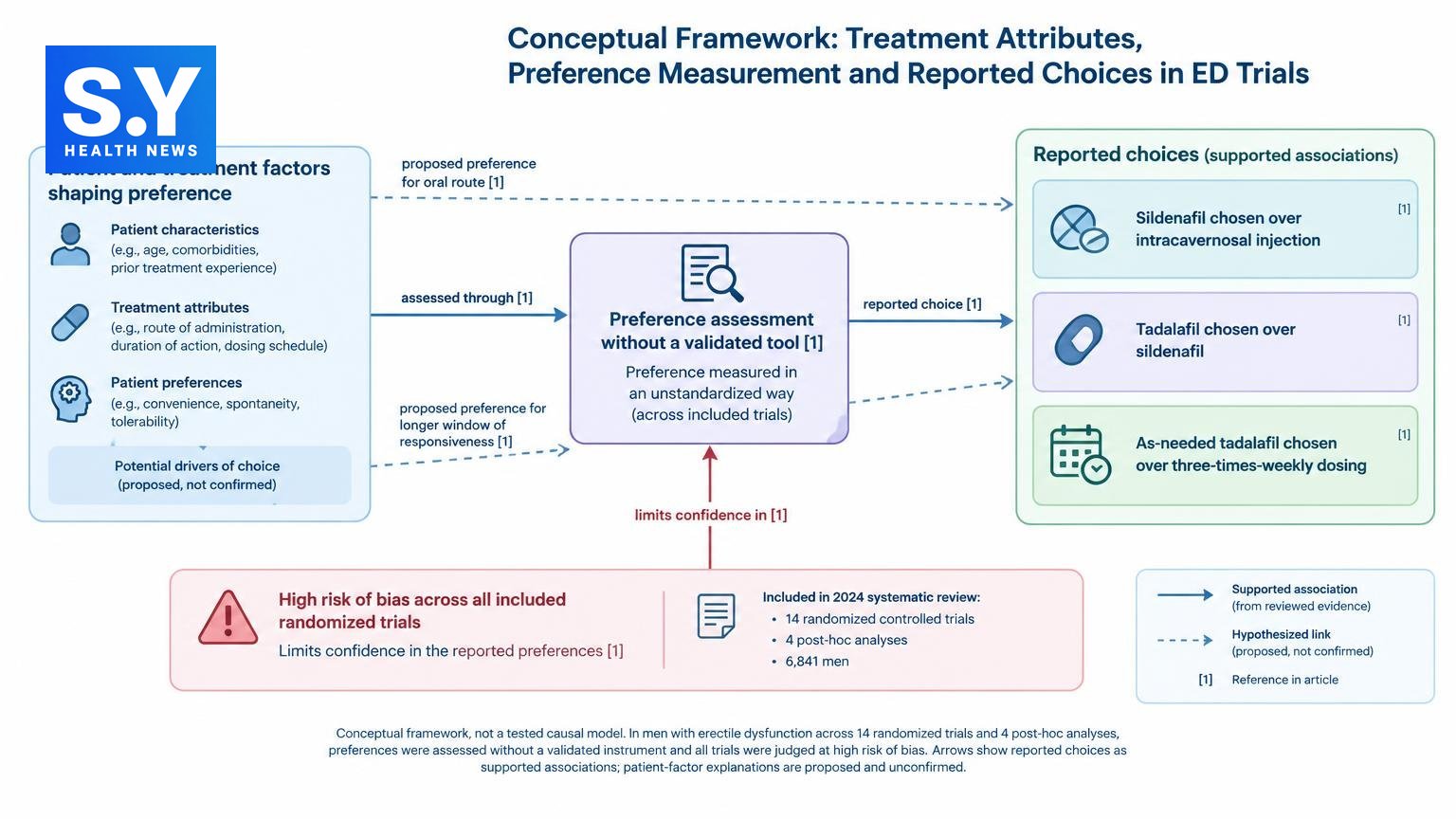
Three preferences recur across that evidence base. Sildenafil was chosen over intracavernosal injection by 70% of patients, with easier route of administration given as the reason. Tadalafil was preferred over sildenafil by 66-73% of patients, and as-needed tadalafil was preferred over three-times-weekly dosing by 57-59%. The review authors describe these findings as supported by the available randomized trials.
The strength of that support is the central caveat. All included randomized trials were judged to be at high risk of bias, and none used a validated tool to measure patient treatment preferences. Preference was therefore not measured in a standardized, psychometrically tested way, and the results are best read as consistent signals from imperfect trials rather than settled estimates of what most men would choose in routine care.
Why Treatment Preference Matters
Erectile dysfunction pharmacotherapy is rarely a case in which one option is simply better for everyone. Oral phosphodiesterase-5 inhibitors, intracavernosal injections and different dosing schedules differ in how they are taken, how quickly they act, how long their effect lasts and what they demand of the patient. The review's rationale is that preferences arise from a complex interaction of patient-related and treatment-related factors, and that assessing them could guide therapy and support adherence.
That rationale is plausible rather than proven. The review frames the compliance benefit as a proposed justification; it did not directly test whether matching treatment to stated preference improves long-term adherence or outcomes. Reading the preference percentages as evidence of that downstream benefit would overstate what was measured.
There is also a practical reason to scrutinize this literature. Preference data are often generated as secondary or exploratory endpoints within trials designed to test efficacy, not choice behavior. When a trial's main purpose is elsewhere, the preference comparison may receive less methodological attention, and the instruments used may not have been designed or validated for that purpose.
How the Evidence Was Assembled
The review's stated objective was to systematically describe the literature on treatment preferences of patients with erectile dysfunction published over the previous 25 years. The search was limited to publications from 1998 onward, and eligibility required randomized controlled trials or post-hoc analyses of randomized trials that reported patient treatment preferences. Findings were synthesized narratively rather than pooled statistically.
Eligible studies had to describe male patients with erectile dysfunction undergoing treatment for the condition, compared with other treatments, placebo or sham therapy, and to report preference outcomes. Risk of bias was evaluated with the RoB 2 tool and the Mulhall-Montorsi model. The included randomized trials were all ultimately classified as high risk of bias, a judgment that applies to the entire preference evidence base rather than to a subset of weaker studies.
Sildenafil was the most frequently evaluated treatment, appearing in 9 randomized trials. This concentration matters for interpretation: the evidence base is not evenly distributed across drug classes or administration routes, so comparisons involving less-studied options rest on fewer trials.
What the Randomized Trials Showed
Against placebo, oral sildenafil was the clear choice: 78-100% of participants chose it over placebo. That range is wide because it spans multiple trials with different designs, but the direction is unambiguous and unsurprising given that placebo offers no active erectile effect.
The more informative comparison is sildenafil versus intracavernosal injection, an active treatment requiring needle administration directly into the penis. Sildenafil was chosen by 70% of patients, and the review reports that easier route of administration was the stated reason. This is the preference signal most closely tied to a concrete, modifiable treatment attribute: route of delivery.
Formulation mattered much less. When sildenafil tablets were compared with orodispersible sildenafil, preference was 53% versus 47%, a difference that was not statistically significant (P>0.05). A non-significant result of this size should be read as an absence of demonstrated preference between the two formulations, not as proof that men are indifferent.
Tadalafil was preferred over sildenafil by 66-73% of patients, a statistically significant difference (P<0.05). The reason reported by 55-67% of patients was that tadalafil allowed an erection long after taking the drug, a property usually described as a longer window of responsiveness.
Within tadalafil, dosing strategy split preferences. As-needed tadalafil was chosen over tadalafil three times per week by 57-59% of patients (P<0.05). This is a narrower majority than the tadalafil-versus-sildenafil comparison, and it concerns scheduling rather than drug identity.
| Comparison | Reported preference | Statistical note |
|---|---|---|
| Sildenafil versus placebo | 78-100% chose sildenafil | Active drug versus no active erectile effect |
| Sildenafil versus intracavernosal injection | 70% chose sildenafil | Easier route of administration cited as the reason |
| Sildenafil tablets versus orodispersible sildenafil | 53% versus 47% | Not statistically significant (P>0.05) |
| Tadalafil versus sildenafil | 66-73% preferred tadalafil | Significant (P<0.05); longer window of responsiveness cited by 55-67% |
| As-needed versus three-times-weekly tadalafil | 57-59% preferred as-needed dosing | Significant (P<0.05) |
Interpretation: Why These Numbers Need Careful Reading
The most important limitation is the uniform high risk of bias. When every contributing trial is judged high risk, the review cannot bootstrap certainty by aggregating them. Bias can operate on preference estimates in several ways: unblinded participants may be influenced by expectations, prior exposure, physician framing or the order in which options are presented, and per-protocol or completer populations may over-represent patients who tolerated an assigned treatment.
The second limitation is measurement. No validated tool was used to investigate patient treatment preferences across the included trials. Without a validated instrument, it is difficult to know whether a stated choice reflects a stable preference, a momentary reaction, a tolerance-driven decision or simple convenience within the trial's structure. Preference definitions may also have differed between trials, making the reported percentages less directly comparable than they appear.
Third, the synthesis was narrative. The review described the literature rather than pooling effect estimates, so the ranges reported here reflect the span of trial-level findings, not a meta-analytic confidence interval. A range such as 66-73% should not be treated as a precise population estimate with known uncertainty bounds.
Fourth, trial participants are a selected group. Men who enroll in randomized erectile dysfunction trials may differ from the broader clinical population in age distribution, comorbidity, prior treatment experience and willingness to accept randomized assignment. Preference percentages from such samples may not transfer directly to first-time presenters or to men with complex medical histories.
Finally, the reason data deserve caution. The review reports why patients preferred certain options, such as easier administration for sildenafil over injection and a longer window of responsiveness for tadalafil over sildenafil. These attributions are informative, but because they were elicited without a validated preference instrument, they are best treated as plausible explanations rather than confirmed drivers.
What This Means for Clinical Conversations
The review's authors conclude that the available randomized trials support preferences for sildenafil over intracavernosal injection, tadalafil over sildenafil, and as-needed over three-times-weekly tadalafil, while explicitly cautioning that these findings should be considered at high risk of bias. Both halves of that sentence matter: the direction is consistent, and the certainty is limited.
For clinicians, the useful message is not that one agent should be defaulted to. It is that route of administration and duration of action are attributes patients appear to weigh heavily, and that these are reasonable topics to raise explicitly when discussing options. A 70% preference for oral over injectable therapy in trial settings suggests that fear of needles or dislike of invasive administration is a common and legitimate consideration, not an obstacle to be argued away.
The narrower 57-59% split on tadalafil dosing is a reminder that scheduling preferences are genuinely mixed. Some men value the spontaneity associated with as-needed use; others may value the structure of scheduled dosing. A near-even divide in trial data argues for asking rather than assuming, and for revisiting the choice if circumstances change.
The absence of a significant difference between tablet and orodispersible sildenafil suggests that formulation alone is unlikely to be a decisive factor for most patients, though individual needs, such as difficulty swallowing tablets, may still make one form preferable for a given person.
Gaps and Research Outlook
The clearest gap is measurement. A validated, reproducible instrument for erectile dysfunction treatment preference would allow future trials to report choices in a comparable way and would make pooled analysis meaningful. Until then, narrative synthesis of heterogeneous, unvalidated preference assessments will remain the norm.
A second gap is the link between preference and outcome. The review proposes that assessing preferences can guide therapy and promote compliance, but this pathway was not directly tested in the included evidence. Future work could examine whether patients whose treatment matches their stated preference adhere longer or report better satisfaction, which would convert a plausible rationale into an evaluated strategy.
A third gap concerns trial quality. Because all included randomized trials were at high risk of bias, the field would benefit from preference studies designed with allocation concealment, blinded outcome assessment where feasible, pre-specified preference endpoints and complete follow-up. Such designs are difficult in an area where patients often know which treatment they are receiving, but the difficulty explains the current state of the evidence rather than excusing it.
Finally, the distribution of research attention is uneven. Sildenafil was evaluated in 9 randomized trials, while other agents and comparisons rest on fewer studies. Broader coverage, including head-to-head comparisons among currently used oral agents and between oral and non-oral options, would give a more balanced picture.
Key Takeaways
- The 2024 review included 14 randomized trials with 6,841 patients plus 4 post-hoc analyses, making it a substantial but methodologically limited evidence base.
- Sildenafil was chosen over intracavernosal injection by 70% of patients, with easier administration cited; it was chosen over placebo by 78-100%.
- Tadalafil was preferred over sildenafil by 66-73% of patients, and as-needed tadalafil over three-times-weekly dosing by 57-59%.
- Tablet and orodispersible sildenafil did not differ significantly in preference (53% versus 47%, P>0.05).
- All included randomized trials were judged at high risk of bias, and no validated preference instrument was used, so the preference estimates should be treated as directional rather than definitive.
Questions and Answers
What were the main treatment preferences found in randomized trials of men with erectile dysfunction?
A 2024 systematic review reported that 70% of patients chose sildenafil over intracavernosal injection, 66-73% preferred tadalafil over sildenafil, and 57-59% preferred as-needed over three-times-weekly tadalafil. Sildenafil was also chosen over placebo by 78-100%. The authors concluded that randomized evidence supports these directions, while cautioning that all included trials were at high risk of bias.
How strong is the evidence that men prefer tadalafil over sildenafil?
The direction is consistent and statistically significant in the included trials, with 66-73% of patients preferring tadalafil (P<0.05), most often citing the longer window in which an erection was possible. However, all included randomized trials were judged at high risk of bias and no validated preference instrument was used, so the magnitude of the preference is less certain than its direction.
Do men prefer as-needed or scheduled tadalafil dosing?
In the reviewed trials, 57-59% of patients chose as-needed tadalafil over tadalafil three times per week, a statistically significant difference (P<0.05). This is a modest majority rather than an overwhelming one, suggesting that dosing preference is genuinely mixed and may depend on individual priorities such as spontaneity versus routine. The result comes from trials at high risk of bias.
Why was sildenafil preferred over intracavernosal injections for erectile dysfunction?
Sildenafil was chosen over intracavernosal injection by 70% of patients in the reviewed trials, and easier route of administration was the reason reported. Injection requires direct administration into the penis, whereas sildenafil is taken orally. This preference signal is one of the more intuitive findings in the review, though it still derives from trials at high risk of bias.
What are the main limitations of research on erectile dysfunction treatment preferences?
The central limitation is that every included randomized trial was judged at high risk of bias, and none used a validated tool to measure treatment preferences. The review synthesized findings narratively rather than pooling them. Trial participants may also differ from routine clinic populations. These issues mean the reported percentages are directional signals rather than precise estimates of real-world preference.
Does choosing a preferred erectile dysfunction treatment improve adherence?
That is plausible but not established by this review. The authors propose that assessing treatment preferences can guide therapy and promote compliance, framing this as a rationale rather than a tested finding. The review examined what patients preferred, not whether matching treatment to preference changed adherence, satisfaction or clinical outcomes. Future research would need to test that link directly.
Conceptual framework: Conceptual framework, not a tested causal model. In men with erectile dysfunction across 14 randomized trials and 4 post-hoc analyses, preferences were assessed without a validated instrument and all trials were judged at high risk of bias. Arrows show reported choices as supported associations; patient-factor explanations are proposed and unconfirmed.
Academic References & Evidence
- Manfredi C; Franco A; Ditonno F. RE-BVS – Piemonte Repository. Minerva urology and nephrology. 2024 76(1):42-51 DOI: 10.23736/S2724-6051.23.05552-0. PMID: 38426421.
SANYUN Science Center explains published research on men's reproductive and sexual health, connecting scientific evidence with everyday questions while making sources and limitations clear.
Disclaimer: This article is for scientific education and research communication only. It does not provide medical advice, diagnosis, or individualized treatment recommendations, and does not endorse any medication, supplement, device, penile enlargement procedure, or other intervention. Decisions about sexual and reproductive health should be made in consultation with a qualified healthcare professional. Do not delay seeking professional care because of information in this article.
Original Content & Copyright Notice
- This article is prepared for SANYUN Science Center, drawing on published research and publicly available academic literature on men’s sexual and reproductive health. Its editorial explanations and presentation are developed for this platform.
- Copyright in the original editorial content, selection, and arrangement is reserved by SANYUN Science Center to the extent protected by applicable law. Referenced research, quotations, and third-party materials remain subject to the rights of their respective owners. This notice does not claim ownership of scientific facts or third-party research.
- Except where permitted by applicable law or an applicable license, prior written permission is required to reproduce, republish, translate, adapt, redistribute, or commercially reuse protected content. Attribution alone does not grant permission for such reuse.
- For permitted quotation or authorized reuse, clearly identify the source and retain a link to the original article.
- Source: SANYUN Science Center
- Original URL: Retain the original article URL on science.san-yun.com.
- Copyright Holder: SANYUN Science Center, for its own protected editorial content.
- Quotation, excerpts, or authorized reuse must not distort the scientific meaning, omit material limitations or disclaimers, or imply unverified medical claims, product efficacy, or endorsement by SANYUN Science Center.



