




Category: Erectile Dysfunction
Core Research Direction: Patient treatment preferences for erectile dysfunction pharmacotherapy: how RCTs of sildenafil, tadalafil, and other ED treatments have measured and reported patients' choices, and how strong that preference evidence is given risk-of-bias and measurement limitations
Search Intent: When men with erectile dysfunction are offered different ED treatments in randomized trials, which options do they actually prefer — and how reliable is that preference evidence?
Platform: SANYUN Science Center
Evidence reviewed through: 2026-11-06
Executive Summary
When men with erectile dysfunction are enrolled in randomized trials that offer more than one treatment, trials have often asked which option they would rather keep using. A 2024 systematic review collected this literature, including 14 randomized controlled trials enrolling 6,841 patients plus 4 post-hoc analyses of trials, and summarized the direction of patient preference across drug comparisons and dosing schedules.[1]
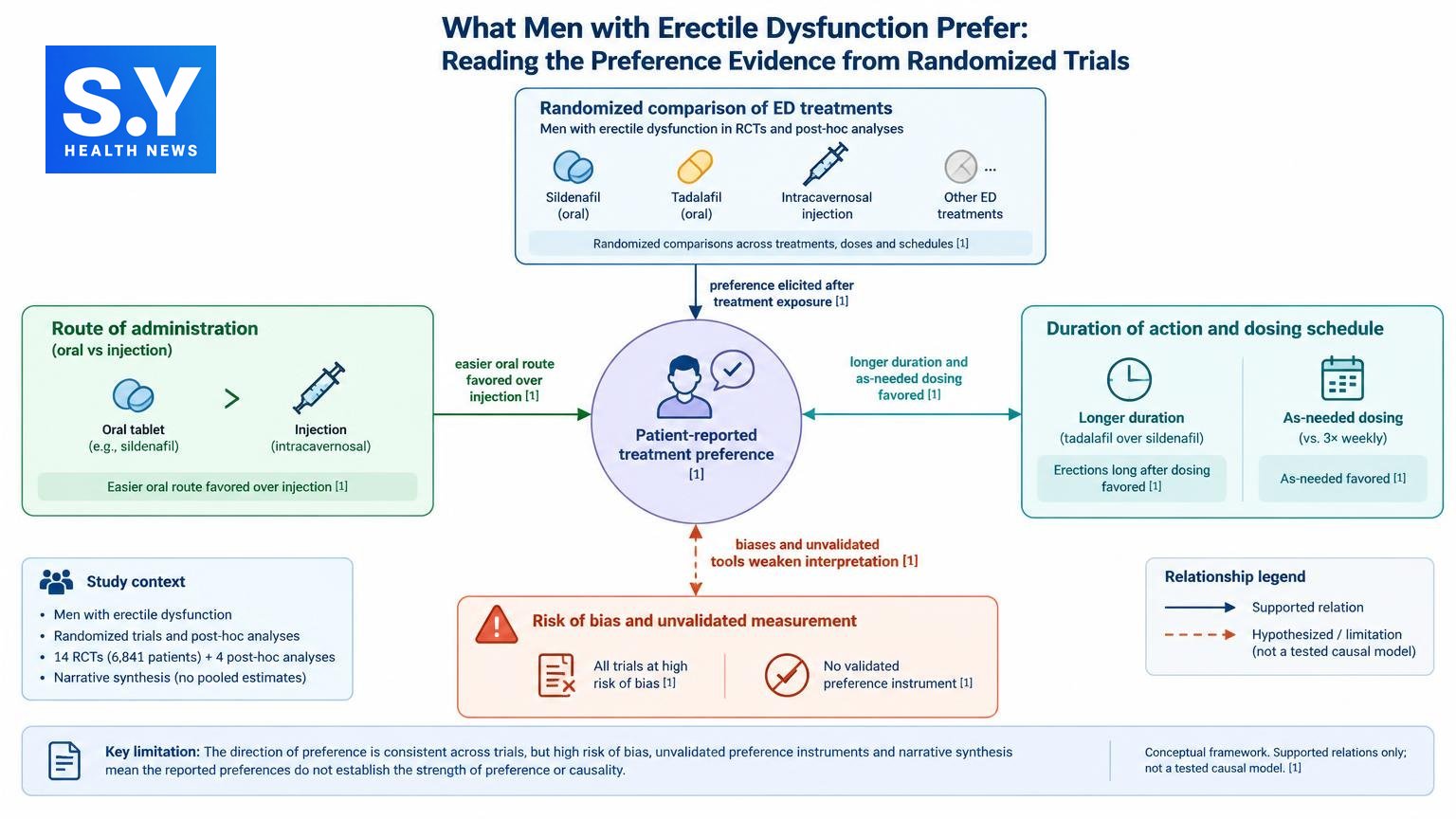
The pooled narrative picture is consistent in direction: sildenafil was preferred over placebo by 78-100% of subjects and over intracavernosal injection by 70% of patients, largely because a tablet is easier to use than an injection. Tadalafil was preferred over sildenafil by 66-73% of patients, and as-needed tadalafil over three-times-weekly tadalafil by 57-59%.
The critical qualifier is methodological. All included randomized trials were judged to be at high risk of bias, and no trial used a validated instrument to measure treatment preference. The review's conclusions therefore describe a recurring direction of preference across trials rather than a precise, well-measured estimate of how strongly men prefer one option over another.
Why This Matters
Treatment preference is not a soft add-on to efficacy data. In erectile dysfunction, where several oral agents share broadly similar efficacy profiles, the practical choice between them often turns on onset, duration, food effects, dosing spontaneity, cost and route of administration. If trials show that men systematically favor one profile over another, that information can structure a shared decision rather than leaving it to guesswork.[2]
Preference data also matter for adherence. A man who is given a drug whose timing constraints do not fit his life may use it inconsistently and conclude it does not work. Conversely, a preference-informed choice may improve persistence. However, this review did not measure adherence outcomes; it described how trials recorded preference, not whether matching treatment to preference improved clinical results. That gap should be stated plainly.
There is also a cardiovascular context worth keeping in view. Erectile dysfunction is frequently vascular in origin and can be an early marker of systemic cardiovascular risk, so treatment selection is not purely a matter of convenience. Preference evidence informs the conversation about which approved therapy a man will actually use; it does not replace evaluation of underlying causes or contraindications such as nitrate use.
How Trials Have Measured Preference
The review restricted eligibility to randomized controlled trials and post-hoc analyses of trials published since 1998, with a literature search run in June 2023. Eligible studies described men with erectile dysfunction receiving treatment compared with other treatments, placebo or sham therapy, and reported patient treatment preferences as an outcome. Data were synthesized narratively rather than pooled statistically.
That design choice matters. A narrative synthesis can describe whether preferences pointed in the same direction across trials, but it cannot produce a single weighted preference proportion with a confidence interval. Readers should not treat the ranges reported in the review as meta-analytic estimates.
Two measurement problems dominate the evidence base. First, no validated tool was used to investigate patient treatment preferences in the included trials, meaning the construct of preference was captured with ad hoc questions whose wording, timing and framing likely varied. Second, every included randomized trial was assessed as high risk of bias. Preference questions in open-label trials are especially vulnerable to expectancy, prior exposure and framing effects, because participants usually know which drug they are taking.
Sildenafil was the most frequently evaluated treatment, appearing in 9 randomized trials, which means the evidence base is unevenly distributed across the drug classes. Comparisons involving tadalafil, vardenafil, avanafil, injections or devices were less frequently studied, so the overall preference literature skews toward one agent.
| Comparison in reviewed trials | Reported preference result | Stated main reason |
|---|---|---|
| Sildenafil vs placebo | Preferred by 78-100% of subjects | Not specified in the reviewed summary |
| Sildenafil vs intracavernosal injection | Preferred by 70% of patients | Easier route of administration |
| Sildenafil tablet vs orodispersible sildenafil | 53% vs 47%, P>0.05 (no significant difference) | Not specified |
| Tadalafil vs sildenafil | Preferred by 66-73% of patients (P<0.05) | Erection possible long after dosing, cited by 55-67% |
| Tadalafil as-needed vs three times weekly | As-needed chosen by 57-59% (P<0.05) | Not specified |
What the Evidence Shows
Route of administration emerges as the clearest driver in the reviewed literature. Sildenafil was chosen over placebo by 78-100% of subjects and over intracavernosal injection by 70% of patients, with easier administration cited for the injection comparison. The direction is unsurprising: an oral tablet versus a needle injected into the penis is a comparison in which convenience and acceptability are likely to dominate, and it is the comparison least likely to be reversed by efficacy differences.
Among oral agents, the trials point toward tadalafil over sildenafil: 66-73% of patients preferred tadalafil, with the largest stated reason being that it allowed an erection long after taking the drug, cited by 55-67% of patients. This is consistent with the pharmacological difference in duration of action between the two agents, and it suggests that for many men, spontaneity and freedom from timing constraints weigh more heavily than other attributes.
Dosing schedule within the same drug also appears to matter. As-needed tadalafil was chosen over tadalafil three times per week by 57-59% of patients, a smaller margin than the between-drug comparisons but still statistically significant in the reviewed trials. A preference of roughly six in ten for as-needed use implies a substantial minority preferring a scheduled regimen, which fits men who value not having to plan dosing at all.
By contrast, formulation changes within the same drug produced no clear signal. Sildenafil tablets and orodispersible sildenafil were preferred at 53% versus 47%, a difference that was not statistically significant. This is a useful negative finding: it suggests that convenience innovations in formulation may not shift preference as much as differences in duration or route do, at least in the populations studied.
The reviewers' own conclusion follows these directions: available randomized trials support preference for sildenafil over intracavernosal injection, tadalafil over sildenafil, and as-needed over three-times-weekly tadalafil, while explicitly flagging the high risk of bias behind each.
Interpretation and Limitations
The most important interpretive step is to separate direction from magnitude. The consistency of direction across several comparisons is reassuring, and it aligns with plausible pharmacological and practical reasoning. But the percentage ranges should not be read as precise population estimates. They derive from trials without validated preference instruments, judged at high risk of bias, and synthesized narratively rather than pooled.
Several specific biases are worth naming. Open-label or unblinded comparison designs allow participants to know which drug they received, so prior beliefs about brands or duration may shape answers. Preference questions asked after a fixed treatment sequence can be influenced by order effects and by unequal exposure time. Post-hoc analyses of trials designed for other endpoints introduce additional risk, because preference was not the primary question and the analysis may be exploratory. The review's inclusion of 4 post-hoc analyses alongside 14 trials reflects this reality.
There is also a missing dimension: preference data tell us what men say they would choose, not what they actually continue using, nor how well they do on the chosen treatment. The review did not report adherence or satisfaction-linked clinical outcomes as its focus, so any claim that preference-matched care improves outcomes remains a reasonable hypothesis rather than an established finding from this evidence base.
Generalisability is another limit. The trials enrolled men with erectile dysfunction who agreed to participate in randomized studies of specific agents, typically excluding men with contraindications such as nitrate use and often excluding those with severe comorbidity. The preference patterns may not transfer to men with diabetes, post-prostatectomy erectile dysfunction, or those who have already failed one agent. Whether cost-sensitive preferences in real-world settings mirror trial preferences is likewise unstudied here.
Research Outlook
The most direct methodological advance would be a validated, standardized preference instrument applied consistently across trials. Without it, cross-trial comparison of preference proportions will remain fragile, because different question wording can generate different answers to what looks like the same choice. Development and validation of such a tool is a prerequisite for stronger evidence, and its absence in the reviewed trials is the single most actionable gap.
A second priority is linking stated preference to realized behavior. Trials that record both the preferred treatment and subsequent adherence, persistence and patient-reported outcomes would clarify whether preference is a useful proxy for the treatment a man will actually use successfully. Discrete-choice experiments, which ask men to trade off attributes such as onset, duration, food interaction, cost and route, could complement simple preference questions and are better suited to quantifying how much each attribute matters.
Third, the evidence base needs broadening beyond sildenafil, which dominated the reviewed trials, toward tadalafil, vardenafil, avanafil and non-oral options, and toward under-represented populations such as men with diabetes or after pelvic surgery. Until those comparisons accumulate, statements about class-wide preference patterns will remain anchored to a narrow set of trials.
Finally, future work should be designed with preference as a prespecified endpoint rather than a post-hoc question. Trials built around preference as the primary outcome can control exposure duration, randomize treatment order where feasible, and blind assessment where blinding is possible, reducing the biases that currently cap the certainty of this literature.
Key Takeaways
- A 2024 systematic review included 14 randomized trials of 6,841 patients plus 4 post-hoc analyses of trials on erectile dysfunction treatment preferences, with all trials judged at high risk of bias.
- No included trial used a validated tool to measure patient treatment preference, and the synthesis was narrative rather than statistical.
- Sildenafil was preferred over placebo by 78-100% of subjects and over intracavernosal injection by 70% of patients, with easier administration cited.
- Tadalafil was preferred over sildenafil by 66-73% of patients, with 55-67% citing erections long after dosing as the main reason.
- As-needed tadalafil was preferred over three-times-weekly dosing by 57-59% of patients, while sildenafil tablets and orodispersible sildenafil did not differ significantly (53% vs 47%).
- The direction of preference is consistent across comparisons, but the magnitudes should be treated as hypothesis-generating rather than precise, and preference has not been shown in this evidence base to improve adherence or outcomes.
Questions and Answers
What does patient treatment preference mean in erectile dysfunction trials?
In these trials, preference means the treatment a participant says they would choose to continue after experiencing more than one option, or the formulation or dosing schedule they favor. The 2024 review found no validated instrument was used, so preference was captured with study-specific questions rather than a standardized scale, which limits comparability across trials.
Which erectile dysfunction treatments did men prefer in randomized trials?
The reviewed trials most often pointed to tadalafil over sildenafil (66-73% preferring tadalafil), as-needed over three-times-weekly tadalafil (57-59%), and sildenafil over intracavernosal injection (70%) and placebo (78-100%). Sildenafil tablets and orodispersible sildenafil showed no significant difference (53% vs 47%). All findings come from trials at high risk of bias.
How strong is the evidence on erectile dysfunction treatment preferences?
The evidence is weak in methodological terms. Every included randomized trial was judged at high risk of bias, none used a validated preference instrument, and results were synthesized narratively without pooled estimates. The consistent direction across comparisons is informative, but the reported percentage ranges should be read as approximate signals rather than precise measurements of how strongly men prefer one option.
Why did men prefer tadalafil over sildenafil in these trials?
In the reviewed trials, 55-67% of patients who preferred tadalafil cited the ability to have an erection long after taking the drug as the main reason. This aligns with the longer duration of action of tadalafil compared with sildenafil, which may suit men who value spontaneity over predictable timing. The preference was reported by 66-73% of patients across the relevant comparisons.
Do these preference findings apply to all men with erectile dysfunction?
Not necessarily. The trials enrolled men who agreed to participate in randomized studies and typically excluded those with major contraindications such as nitrate use. Men with diabetes, post-prostatectomy erectile dysfunction, prior treatment failure, or strong cost constraints are under-represented. Preference patterns may differ in these groups, and no trial in this review tested whether matching treatment to preference improves adherence or outcomes.
How should clinicians use preference data when discussing ED medication?
Preference data can structure a shared conversation rather than dictate a choice. It is reasonable to note that trials show many men favor longer-acting or as-needed options and that route of administration strongly influences acceptability. Because the evidence is at high risk of bias, the most defensible approach is to present the trade-offs in onset, duration, food effects, cost and contraindications and let the individual's priorities guide the decision.
Conceptual framework: Conceptual framework. Randomized comparisons of erectile dysfunction treatments generate patient-reported preference data influenced by route of administration and by duration and dosing schedule; high risk of bias and the absence of validated preference instruments limit how strongly these reported preferences can be interpreted. Supported relations only; not a tested causal model.
Academic References & Evidence
- Manfredi C; Franco A; Ditonno F. RE-BVS – Piemonte Repository. Minerva Urology and Nephrology. 2024 76(1):42-51 DOI: 10.23736/S2724-6051.23.05552-0. PMID: 38426421.
- Erectile Dysfunction.
SANYUN Science Center explains published research on men's reproductive and sexual health, connecting scientific evidence with everyday questions while making sources and limitations clear.
Disclaimer: This article is for scientific education and research communication only. It does not provide medical advice, diagnosis, or individualized treatment recommendations, and does not endorse any medication, supplement, device, penile enlargement procedure, or other intervention. Decisions about sexual and reproductive health should be made in consultation with a qualified healthcare professional. Do not delay seeking professional care because of information in this article.
Original Content & Copyright Notice
- This article is prepared for SANYUN Science Center, drawing on published research and publicly available academic literature on men’s sexual and reproductive health. Its editorial explanations and presentation are developed for this platform.
- Copyright in the original editorial content, selection, and arrangement is reserved by SANYUN Science Center to the extent protected by applicable law. Referenced research, quotations, and third-party materials remain subject to the rights of their respective owners. This notice does not claim ownership of scientific facts or third-party research.
- Except where permitted by applicable law or an applicable license, prior written permission is required to reproduce, republish, translate, adapt, redistribute, or commercially reuse protected content. Attribution alone does not grant permission for such reuse.
- For permitted quotation or authorized reuse, clearly identify the source and retain a link to the original article.
- Source: SANYUN Science Center
- Original URL: Retain the original article URL on science.san-yun.com.
- Copyright Holder: SANYUN Science Center, for its own protected editorial content.
- Quotation, excerpts, or authorized reuse must not distort the scientific meaning, omit material limitations or disclaimers, or imply unverified medical claims, product efficacy, or endorsement by SANYUN Science Center.



