




Category: Erectile Dysfunction
Core Research Direction: Evidence quality and diagnostic/clinical reasoning in erectile dysfunction: what vascular diagnostic strategies can and cannot establish, and how reliable the current treatment evidence base is
Search Intent: How well can noninvasive tests identify the type of vascular lesion behind erectile dysfunction, and how strong is the evidence underpinning current ED treatments?
Platform: SANYUN Science Center
Evidence reviewed through: 2026-11-21
Executive Summary
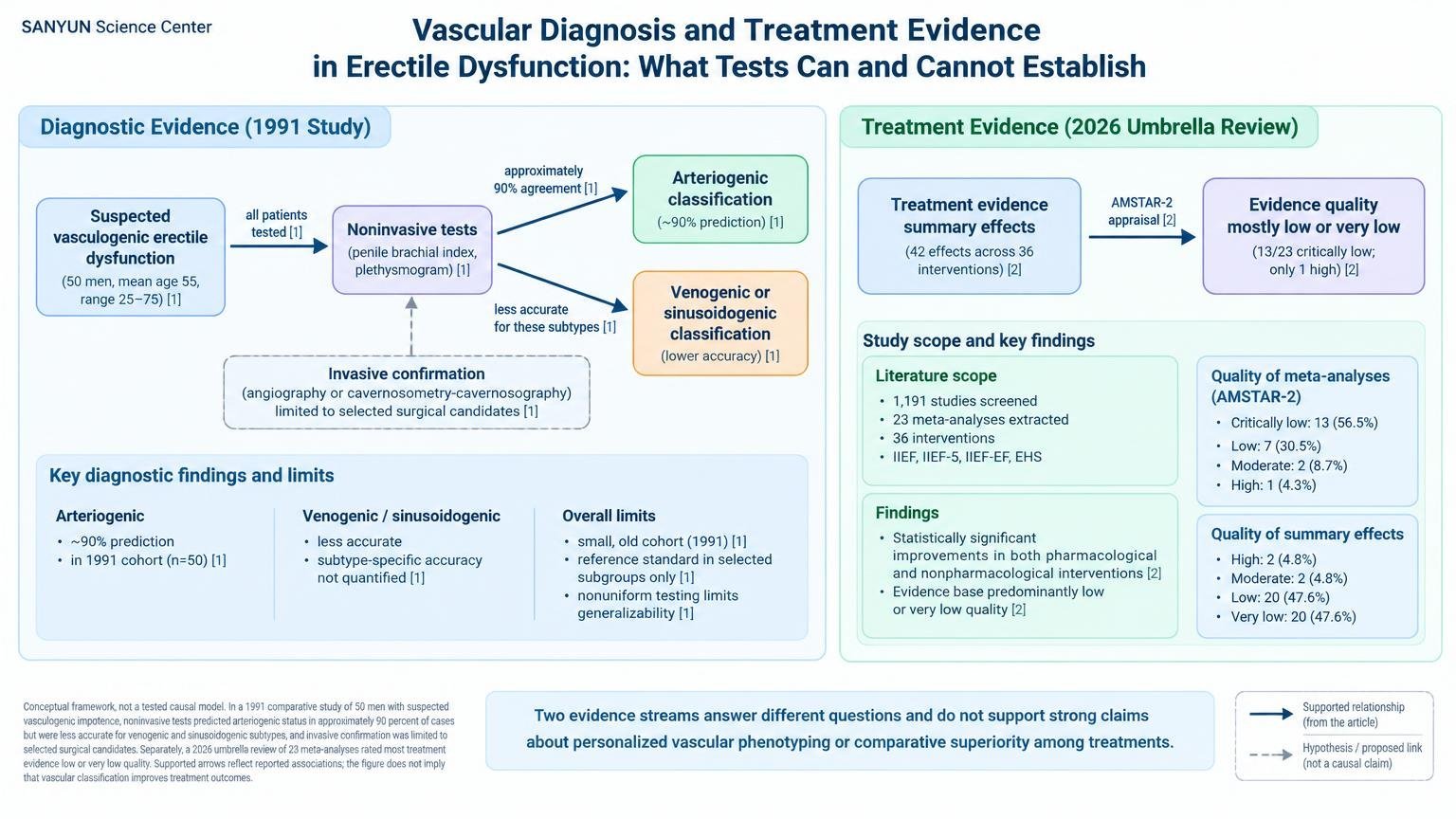
Erectile dysfunction is often described as a vascular problem, but the phrase compresses several distinct questions: whether a vascular lesion is present, which vascular mechanism dominates, and whether any test result changes what a clinician would do. A comparative diagnostic study published in 1991 remains one of the clearer attempts to separate these questions. In 50 men with clinically suspected vasculogenic impotence, noninvasive tests predicted whether the problem was arteriogenic in approximately 90 percent of cases, but were less accurate for venogenic and sinusoidogenic subtypes, for which penile duplex ultrasonography was presented as the preferred modality.[1]
Treatment evidence is a separate matter. A 2026 umbrella review of systematic reviews and meta-analyses screened 1191 studies, extracted 23 published meta-analyses, and obtained 42 summary effects covering 36 interventions measured on IIEF, IIEF-5, IIEF-EF, and EHS. On AMSTAR-2 appraisal, 13 of the 23 meta-analyses were critically low quality and only one was high quality. Among the 42 summary effects, only two were rated high and moderate quality respectively, while 20 were low and 20 very low. The umbrella review concluded that statistically significant improvements were observed for both pharmacological and nonpharmacological interventions, but that the overall evidence base is predominantly low or very low quality and should be interpreted cautiously.[2]
The two evidence streams answer different questions. Diagnostic studies ask whether a test classifies a mechanism correctly against a reference standard. Treatment synthesis asks whether an intervention changes a measured outcome across trials. The first stream in this packet is small, old, and uses a reference standard applied only to selected subgroups. The second is current and broad but reports that most of its underlying evidence is weak. Neither supports strong claims about personalized vascular phenotyping or about comparative superiority among treatments.
Why This Matters
Men and clinicians often want a test that explains why an erection fails. A label such as arteriogenic, venogenic, or sinusoidal dysfunction sounds mechanistic and specific. If such a label were reliable, it could guide referral, shape expectations, and avoid unnecessary procedures. The 1991 study is instructive precisely because it tested that promise rather than assuming it. Its design separated patients by suspected mechanism and compared noninvasive findings with invasive confirmatory testing only in selected surgical candidates. The reported approximately 90 percent prediction figure applies to the arteriogenic question in that cohort; it is not a general accuracy figure for all vascular subtypes.
Treatment evidence matters for a different reason. A large menu of options does not by itself mean that each option is well supported. The 2026 umbrella review found a diverse treatment landscape but poor reliability of the evidence behind it. That distinction is important for shared decision-making: a statistically significant IIEF improvement in a meta-analysis may reflect small trials, subjective endpoints, and heterogeneous interventions rather than a robust comparative effect.
Biological and Clinical Context
Erection depends on coordinated arterial inflow, cavernosal smooth-muscle relaxation, and venous occlusion. A failure can arise from inadequate arterial supply, from a venous leak that prevents pressure maintenance, or from sinusoidal dysfunction at the level of the cavernosal tissue. These categories overlap in practice, and a single patient may have more than one contributor. The 1991 study's three-way framework reflects that physiology and is useful for organizing diagnostic reasoning, but the framework itself does not establish that a test can cleanly assign every patient to one category.
The diagnostic sequence in the study reflects an era-specific logic. All patients first underwent penile brachial index, penile brachial subtraction index, and penile plethysmogram, followed by penile duplex ultrasonography with papaverine and phentolamine injection. Patients with suspected proximal arteriogenic lesions or suspected venous leakage who were considered surgical candidates then underwent angiography or cavernosometry-cavernosography respectively. This design means the invasive reference standard was not applied uniformly: patients with suspected sinusoidal dysfunction, and those with arteriogenic or venogenic insufficiency not considered surgical candidates, were not subjected to further studies. The accuracy estimates are therefore conditional on the subgroup that reached confirmatory testing.
What the Diagnostic Evidence Shows
| Diagnostic question | Test strategy studied | Reported finding | Interpretive limit |
|---|---|---|---|
| Is the dysfunction arteriogenic? | Noninvasive tests (penile brachial index, penile brachial subtraction index, penile plethysmogram) compared with duplex ultrasonography and angiography in selected surgical candidates | Predicted arteriogenic status in approximately 90 percent of cases | Small 1991 cohort of 50 men; reference standard applied only to selected subgroups |
| Is the dysfunction venogenic or sinusoidogenic? | Noninvasive tests compared with duplex ultrasonography; cavernosometry-cavernosography in suspected venous leakage considered for surgery | Noninvasive tests were less accurate for these subtypes; duplex ultrasonography was presented as the preferred modality | Subtype-specific accuracy was not quantified in the available abstract; small cohort |
| Which patients received invasive confirmation? | Angiography for suspected proximal arteriogenic lesions; cavernosometry-cavernosography for suspected venous leakage in surgical candidates | Confirmatory testing was limited to selected subgroups | Nonuniform reference standard limits generalizable accuracy estimates |
The most defensible reading is narrow. In a single cohort of 50 men with a mean age of 55 years and a range of 25 to 75 years, a combination of simple noninvasive tests separated arteriogenic from non-arteriogenic cases with roughly 90 percent agreement against subsequent invasive assessment in the subset that received it. That is a hypothesis-generating signal about triage, not a validated diagnostic algorithm. The study does not report confidence intervals or subtype-specific accuracy in the available text, and the technology and definitions are those of 1991. Duplex ultrasonography was positioned as the stronger modality for the harder distinctions, which implicitly concedes that the simplest tests were not sufficient for all mechanisms.
A second limitation is conceptual. Diagnostic accuracy is not the same as clinical utility. Even a test that classifies a mechanism correctly may not change management if the resulting treatment options are limited or if the same empirical therapy would be tried regardless. The 1991 study was motivated partly by surgical selection, which is a context in which mechanism matters more. Contemporary practice rarely relies on vascular subtyping to choose first-line therapy, so the practical value of the classification is narrower than the physiological labels suggest.
What the Treatment Evidence Shows
The 2026 umbrella review provides a different kind of signal. It screened 1191 studies and extracted 23 published meta-analyses, yielding 42 summary effects on IIEF, IIEF-5, IIEF-EF, and EHS across 36 interventions. That breadth is real: the literature covers many pharmacological and nonpharmacological options. The quality picture is the central finding. Using AMSTAR-2, 13 of 23 meta-analyses (56.5 percent) were critically low quality, 7 (30.5 percent) low, 2 (8.7 percent) moderate, and 1 (4.3 percent) high. At the level of summary effects, only two were rated high and moderate quality respectively, while 20 (47.6 percent) were low and 20 (47.6 percent) very low.
The authors explicitly caution that statistically significant improvements were observed with both pharmacological and nonpharmacological interventions, but that these findings should be interpreted with caution because of limited patient numbers and the subjective nature of outcome indicators. They conclude that the treatment landscape is increasingly diverse yet the reliability of the evidence is poor, and they call for better-designed single-treatment studies and high-quality meta-analyses of intertreatment comparisons. That recommendation is a proposed research priority, not an empirical result.
Two interpretive cautions follow. First, a low-quality rating for a meta-analysis is a statement about the review's methods and the trials it pooled, not proof that the intervention is ineffective. Second, the presence of many summary effects does not establish equivalence or rank order among treatments. The umbrella review did not provide the head-to-head comparisons needed to say one option is better than another, and its own conclusion is that such comparisons are lacking.
Interpretation and Limitations
The diagnostic and treatment literatures in this packet share a structural weakness: they can describe associations and measured improvements but cannot establish the causal or comparative claims that patients often hear. The 1991 study reports agreement between test strategies, not that a test-derived label improves outcomes. The 2026 umbrella review reports that significant improvements appear across intervention types, not that one type is superior or that the improvements are durable or clinically meaningful to every patient.
Additional limits are specific to each source. The diagnostic study enrolled 50 men at a single point in the early 1990s, used a reference standard only in selected surgical candidates, and did not provide quantified subtype accuracy in the available text. The umbrella review synthesized meta-analyses rather than individual trials, so its quality ratings describe reviews and summary effects, not the underlying patient-level data. It also relied on IIEF-family and EHS endpoints, which are validated but subjective, and it identified limited patient numbers as a concern. Neither source supports claims about individual prognosis or about the superiority of a particular diagnostic pathway in contemporary practice.
Conflicting findings are best understood as differences in question and method. A diagnostic study optimized for mechanistic classification will report accuracy, while a treatment umbrella review optimized for breadth will report quality. Neither contradicts the other. What would resolve the uncertainty is prospective diagnostic accuracy against a uniform reference standard, plus randomized trials with objective or hard clinical endpoints and prespecified head-to-head comparisons. Those studies are recommended by the umbrella review authors but are not reported in this packet.
Research Outlook
The most useful near-term research would address three gaps. First, diagnostic studies should apply a consistent reference standard to all participants rather than only to surgical candidates, and should report subtype-specific accuracy with confidence intervals. Second, treatment trials should use prespecified, patient-relevant endpoints and adequate sample sizes so that meta-analyses are not forced to pool small, heterogeneous studies. Third, comparative trials should test intertreatment differences directly, because the current literature is dominated by within-treatment summaries. The umbrella review authors' call for well-designed single-treatment studies and high-quality intertreatment meta-analyses aligns with these priorities.
For now, the honest position is layered. Vascular mechanisms are biologically plausible and clinically relevant, but classifying them reliably with noninvasive tests is supported mainly by a small, old study with a selective reference standard. Statistically significant treatment effects are widely reported, but the evidence base behind them is predominantly low or very low quality. Both statements can be true at once, and neither justifies confident individualized claims.
Key Takeaways
- In 50 men with suspected vasculogenic impotence, noninvasive tests predicted arteriogenic status in approximately 90 percent of cases, but were less accurate for venogenic and sinusoidogenic subtypes.
- The invasive reference standard was applied only to selected surgical candidates, so the accuracy estimates are conditional and not generalizable to all patients.
- A 2026 umbrella review of 23 meta-analyses found that 13 were critically low quality and only one was high quality on AMSTAR-2.
- Among 42 summary effects, only two were rated high and moderate quality respectively, while 20 were low and 20 very low.
- Statistically significant improvements were reported for pharmacological and nonpharmacological interventions, but the authors caution that limited patient numbers and subjective endpoints weaken interpretation.
- The umbrella review calls for better single-treatment trials and high-quality head-to-head meta-analyses; that is a proposed research priority, not an established finding.
Questions and Answers
What does it mean to classify erectile dysfunction as arteriogenic, venogenic or sinusoidogenic?
These labels refer to the dominant vascular mechanism thought to impair erection: inadequate arterial inflow (arteriogenic), failure of venous occlusion causing a leak (venogenic), or dysfunction at the level of cavernosal sinusoidal tissue (sinusoidogenic). They are physiological categories, not diagnoses that a single test establishes in every patient. The 1991 comparative study used this three-way framework in 50 men with suspected vasculogenic impotence, but the categories can overlap in practice and the study did not prove that noninvasive tests assign every patient correctly.
How accurate are noninvasive penile tests for identifying arteriogenic erectile dysfunction?
In the 1991 comparative study, noninvasive tests including penile brachial index, penile brachial subtraction index, and penile plethysmogram predicted whether impotence was arteriogenic in approximately 90 percent of cases. That figure comes from a single cohort of 50 men with a mean age of 55 years, and invasive confirmation was performed only in selected surgical candidates. It is therefore a signal about possible triage value, not a validated general accuracy estimate.
How reliable is the evidence behind current erectile dysfunction treatments?
A 2026 umbrella review of 23 meta-analyses found that 13 were critically low quality on AMSTAR-2 and only one was high quality. At the summary-effect level, only two of 42 effects were rated high and moderate quality respectively, while 20 were low and 20 very low. Statistically significant improvements were reported for both pharmacological and nonpharmacological interventions, but the authors caution that limited patient numbers and subjective endpoints weaken interpretation.
Does low-quality treatment evidence mean erectile dysfunction treatments do not work?
No. A low-quality rating describes the strength and rigor of the evidence, not proof that an intervention is ineffective. The umbrella review did observe statistically significant IIEF and EHS improvements across intervention types. What it could not establish is a reliable rank order or confident comparative superiority, because the underlying meta-analyses were mostly low or very low quality. The practical implication is caution in making strong personalized claims, not a blanket conclusion that treatment is useless.
Can penile duplex ultrasonography reliably distinguish venogenic from sinusoidogenic erectile dysfunction?
The 1991 study presented penile duplex ultrasonography as the preferred modality when noninvasive tests were less accurate, specifically for venogenic and sinusoidogenic impotence. However, the available text does not quantify subtype-specific accuracy, and cavernosometry-cavernosography was used only in suspected venous leakage considered for surgery. The claim that duplex is the better choice is therefore a study-level recommendation rather than a precisely measured comparative accuracy result.
What should patients and clinicians take from this evidence review?
Two things can be true simultaneously: vascular mechanisms are biologically meaningful, and the evidence for precisely classifying them or for confidently ranking treatments is weak. Noninvasive tests may help with broad triage, and several treatments show statistically significant improvements, but the diagnostic study is small and old with a selective reference standard, and the umbrella review rates most treatment evidence low or very low quality. Shared decisions should reflect that uncertainty rather than overstate certainty.
Conceptual framework: Conceptual framework, not a tested causal model. In a 1991 comparative study of 50 men with suspected vasculogenic impotence, noninvasive tests predicted arteriogenic status in approximately 90 percent of cases but were less accurate for venogenic and sinusoidogenic subtypes, and invasive confirmation was limited to selected surgical candidates. Separately, a 2026 umbrella review of 23 meta-analyses rated most treatment evidence low or very low quality. Supported arrows reflect reported associations; the figure does not imply that vascular classification improves treatment outcomes.
Academic References & Evidence
- J A Dow. Multiphasic diagnostic evaluation of arteriogenic, venogenic, and sinusoidogenic impotency. Value of noninvasive tests compared with penile duplex ultrasonography. Urology. 1991 38(5):402-7 DOI: 10.1016/0090-4295(91)80226-w. PMID: 1949448.
- Current treatment for erectile dysfunction: an umbrella review of systematic reviews and meta-analyses. 2026 DOI: 10.6084/m9.figshare.31562993.v1.
SANYUN Science Center explains published research on men's reproductive and sexual health, connecting scientific evidence with everyday questions while making sources and limitations clear.
Disclaimer: This article is for scientific education and research communication only. It does not provide medical advice, diagnosis, or individualized treatment recommendations, and does not endorse any medication, supplement, device, penile enlargement procedure, or other intervention. Decisions about sexual and reproductive health should be made in consultation with a qualified healthcare professional. Do not delay seeking professional care because of information in this article.
Original Content & Copyright Notice
- This article is prepared for SANYUN Science Center, drawing on published research and publicly available academic literature on men’s sexual and reproductive health. Its editorial explanations and presentation are developed for this platform.
- Copyright in the original editorial content, selection, and arrangement is reserved by SANYUN Science Center to the extent protected by applicable law. Referenced research, quotations, and third-party materials remain subject to the rights of their respective owners. This notice does not claim ownership of scientific facts or third-party research.
- Except where permitted by applicable law or an applicable license, prior written permission is required to reproduce, republish, translate, adapt, redistribute, or commercially reuse protected content. Attribution alone does not grant permission for such reuse.
- For permitted quotation or authorized reuse, clearly identify the source and retain a link to the original article.
- Source: SANYUN Science Center
- Original URL: Retain the original article URL on science.san-yun.com.
- Copyright Holder: SANYUN Science Center, for its own protected editorial content.
- Quotation, excerpts, or authorized reuse must not distort the scientific meaning, omit material limitations or disclaimers, or imply unverified medical claims, product efficacy, or endorsement by SANYUN Science Center.



