




Category: Erectile Dysfunction
Core Research Direction: Erectile dysfunction as a marker of cardiometabolic and vascular disease, and how guideline-based evaluation and staged, shared-decision treatment (PDE5 inhibitors first-line, with the nitrate contraindication) apply to the individual man — including why unproven supplements such as L-arginine are not endorsed
Search Intent: When a man has erectile dysfunction, how should it be evaluated and treated, and what does it tell him about his heart and vascular health?
Platform: SANYUN Science Center
Evidence reviewed through: 2026-10-30
Executive Summary
Erectile dysfunction (ED) is often framed as a sexual complaint, but contemporary clinical guidance treats it as a marker of underlying vascular and cardiometabolic disease. The Canadian Urological Association summary states plainly that ED can be an early cardiovascular-risk marker and should prompt risk-factor assessment (F11), and the AUA-based guidance advises clinicians to counsel that ED is a risk marker for cardiovascular and other underlying disease, potentially justifying evaluation beyond the sexual symptom (F2). The clinical corollary is that an ED consultation is simultaneously a sexual-medicine encounter and an opportunity for prevention (F19).[1][2][3]
Guideline-aligned evaluation begins with a medical, sexual and psychosocial history, a focused examination and selective laboratory tests, using a validated questionnaire to establish baseline severity and track treatment response (F1). Morning total testosterone should be measured, and a confirmed low result evaluated through an applicable hypogonadism pathway rather than prescribing testosterone from symptoms alone (F3). Phosphodiesterase type-5 (PDE5) inhibitors remain first-line pharmacotherapy in UK, US and Canadian guidance unless contraindicated, with agent choice guided by cost, patient preference and comorbidities (F8, F13). The absolute contraindication is concurrent nitrate therapy or recreational nitrites (F4, F12, F24). Unproven supplements such as L-arginine are not endorsed, because good-quality evidence for efficacy and safety is lacking (F7, F10).[4][5][6]
Why This Matters: The Cardiovascular Connection
The clinical importance of ED extends well beyond sexual function. A secondary summary of a 2023 umbrella review reported that ED independently predicts cardiovascular disease (relative risk 1.45), coronary heart disease (relative risk 1.50) and stroke (relative risk 1.36), findings cited as the basis for the 2024 Princeton IV consensus classifying ED as a cardiovascular risk-enhancing factor (F20). These are meta-analytic associations, not proof of causation, and the supplied text does not provide confidence intervals or primary data. The word "independently" in the source refers to statistical adjustment in the underlying meta-analyses; it does not establish that ED causes cardiac events.
The biological rationale is plausible and widely repeated: penile arteries are smaller than coronary arteries, so endothelial dysfunction and atherosclerosis may produce symptoms in the penis before they produce cardiac symptoms. The comparative review by Azrag situates ED within a multidimensional syndrome involving vascular, neurologic, endocrine, psychological and relational factors, and argues that an ED consultation can function as a gateway to prevention (F19). That framing is interpretive rather than a tested causal model. What the guidelines support is narrower and more actionable: ED should trigger cardiovascular risk-factor assessment (F11, F2).
Biological and Clinical Mechanism
An erection depends on coordinated vascular, neurologic, endocrine and psychological function. PDE5 inhibitors act by enhancing nitric oxide-mediated vasodilation, which is why UK guidance describes them as improving erectile function through that pathway (F8). L-arginine is a nitric oxide precursor, and nitric oxide mediates penile erection through vascular smooth-muscle relaxation (F9). That mechanism is genuinely plausible, but mechanistic plausibility is not clinical evidence; the same source notes that L-arginine is not recommended in UK guidelines because robust efficacy and safety evidence is lacking (F7).
ED frequently has mixed drivers. The comparative review notes that some men respond incompletely to PDE5 inhibitors, that others have mixed vascular, endocrine, neurologic or psychogenic causes, and that many present with comorbidities requiring broader assessment (F18). In men with diabetes, recent evidence highlighted in guideline-aligned material suggests more complex pathophysiology, including endothelial dysfunction and neuropathy, which may require multimodal approaches and specialist input (F16). This is presented as an evolving interpretation rather than an established causal pathway. Low testosterone may also reduce PDE5 inhibitor efficacy, supporting assessment for hypogonadism when response is poor (F15).
What the Evidence Shows: Evaluation and Treatment
Guideline-based evaluation is structured rather than exhaustive. It combines history, focused examination and selective laboratory tests, with a validated questionnaire used to grade baseline severity and to measure response (F1). The US source for this framework remains the 2018 AUA guideline, supplemented in practice by current FDA labeling and cardiovascular consensus (F6). The Canadian summary adds that assessment should clarify onset, libido, erections, relationship context, medicines, substance use, endocrine and neurologic factors, and cardiovascular risk, and should address reversible contributors before or alongside pharmacotherapy (F11).
Treatment is preference-sensitive and staged rather than a fixed ladder. PDE5 inhibitors are recommended first-line unless contraindicated, with the specific agent guided by cost, patient preference and comorbidities (F13). UK guidance describes sildenafil, tadalafil, vardenafil and avanafil as the standard first-line options, acting through nitric oxide-mediated vasodilation (F8). Correct-use counselling matters: patients should be advised to try each PDE5 inhibitor at the maximum tolerated dose four to eight times before switching to an alternative agent (F14). A large percentage of apparent treatment failures stem from incorrect use, so fundamentals should be checked before concluding that a drug does not work (F25).
The nitrate contraindication is absolute and repeated across jurisdictions. PDE5 inhibitors must never be combined with nitrate therapy, and alpha blockers, blood pressure, cardiac stability and product-specific washout intervals should be reviewed (F4). The Canadian summary extends the prohibition to recreational nitrites (F12). The mechanism is severe, potentially fatal hypotension (F24). A related safety boundary is priapism: an erection lasting four hours or longer is a urologic emergency requiring immediate treatment to prevent permanent damage (F5).
| Measure / finding | Result | Population / follow-up | Limitations |
|---|---|---|---|
| Guideline-based evaluation of ED begins with medical, sexual and psychosocial history, focused examination and selective labs, with a validated questionnaire to establish baseline severity and track treatment response. | adults with consistent or recurrent erectile difficulty | Educational summary of the AUA guideline, not the primary guideline text. | |
| Morning total testosterone should be measured, and a confirmed low result evaluated via a hypogonadism pathway rather than treating symptoms alone with testosterone. | men with erectile dysfunction | Guideline recommendation. | |
| UK guidelines endorse PDE5 inhibitors (sildenafil, tadalafil, vardenafil, avanafil) as first-line pharmacotherapy, acting by enhancing nitric oxide-mediated vasodilation. | men with ED | Summary statement without effect sizes. | |
| For men with diabetes and ED, PDE5 inhibitors are first-line unless contraindicated, with agent choice guided by cost, preference and comorbidities. | patients with diabetes and erectile dysfunction | Guideline-aligned educational answer; no trial data provided. | |
| Patients should be counseled to try a PDE5 inhibitor at the maximum tolerated dose 4–8 times before switching agents. | 4–8 trials | men with ED (diabetes-focused context) | Guideline-derived practical recommendation. |
| PDE5 inhibitors must never be combined with nitrate therapy; alpha blockers, blood pressure, cardiac stability and product-specific washout intervals should be reviewed. | men using PDE5 inhibitors | Safety boundary from an educational guideline summary. | |
| PDE5 inhibitors are absolutely contraindicated with nitrate medications and recreational nitrites, because the combination can cause severe, potentially fatal hypotension. | men using PDE5 inhibitors | Mechanistic/safety statement from secondary guide. | |
| UK clinical guidelines do not recommend L-arginine for ED because of a lack of robust efficacy and safety evidence. | men with ED considering L-arginine; posted/updated 20 January 2026 | Clinical answer summarizing NICE CKS; not a primary trial. | |
| NICE CKS guidelines note an absence of good-quality evidence for herbal or complementary medicines, including L-arginine supplements, and do not recommend their use. | men considering supplements for ED | Guideline-level claim; no effect estimates. |
Conflicting and Emerging Evidence
Several areas show genuinely mixed or preliminary evidence. A 2024 TriNetX database analysis found higher rates of new ED diagnoses and testosterone deficiency among non-diabetic, non-hypogonadal men taking semaglutide for weight loss (F27). This is an observational signal substantially attenuated by adjustment, and it cannot establish that the drug caused ED. Separately, a 2025 Cochrane review of 21 randomized trials involving 1,357 men found that low-intensity shockwave therapy may improve IIEF-EF scores by roughly 3.9 points in the short term and 5.3 points long term versus sham, with low certainty of evidence (F23). Statistically detectable score changes of that size may or may not be clinically meaningful to an individual man, and the AUA continues to classify the technology as investigational.
Testosterone therapy in hypogonadal men has been a long-running controversy. In the TRAVERSE trial, 5,246 hypogonadal men with elevated cardiovascular risk were randomized, and transdermal testosterone was non-inferior to placebo for major adverse cardiac events (HR 0.96, 95% CI 0.78–1.17) over a mean 21.7 months (F21). The same trial detected higher rates of pulmonary embolism (0.9 vs 0.5 percent), atrial fibrillation (3.5 vs 2.4 percent) and acute kidney injury (2.3 vs 1.5 percent) in the testosterone arm (F22). These are secondary safety findings reported through a secondary summary; the trial does not establish that testosterone treats ED in men without confirmed hypogonadism, and guidance continues to require morning testosterone measurement and evaluation of confirmed low results rather than symptom-driven prescribing (F3).
Supplements and the Limits of Mechanistic Reasoning
L-arginine illustrates a common reasoning error in men's health: a plausible mechanism is mistaken for proven benefit. L-arginine is a nitric oxide precursor, and nitric oxide mediates erection through vascular smooth-muscle relaxation (F9). Yet UK clinical guidelines do not recommend L-arginine for ED because of a lack of robust efficacy and safety evidence (F7), and NICE CKS explicitly notes the absence of good-quality evidence for herbal or complementary medicines, including L-arginine supplements, and does not recommend their use (F10). The appropriate clinical response is counselling about limited and inconclusive data, not endorsement. Guideline-based care prioritises PDE5 inhibitors and lifestyle modification.
Interpretation and Limitations
This review has substantive limitations that should temper confidence. Most of the quantitative estimates are drawn from secondary summaries — guideline digests, clinical answers and a physician-authored consumer guide — rather than from the primary trials or meta-analyses themselves. The relative risks for cardiovascular outcomes (F20) are reported without confidence intervals in the supplied material, and the umbrella review behind them is not itself reproduced here. The TRAVERSE effect estimates (F21) and adverse-event rates (F22) are similarly second-hand. The shockwave estimates (F23) carry low certainty by the reviewers' own assessment. The L-arginine conclusion (F7, F10) rests on guideline statements rather than a pooled analysis.
The comparative review of Western and Traditional Chinese Medicine is a narrative chapter, not a clinical trial, and its integrative claims are explicitly framed as interpretive (F17). Guideline jurisdictions differ in detail: the US framework rests on the 2018 AUA guideline supplemented by current labeling and cardiovascular consensus (F6), while Canadian implementation is shaped by provincial formularies and referral routes. None of the sources supplies original clinical research conducted for this article, and no systematic review was performed here. The evidence is therefore best read as a synthesis of published guidance and secondary summaries, not as new proof.
Research Outlook
Several questions remain open. Whether treating ED as a formal cardiovascular risk-enhancing factor improves hard outcomes, rather than simply prompting more testing, has not been established in the supplied evidence. The diabetes literature suggests that endothelial dysfunction and neuropathy create a more complex phenotype (F16), but the optimal multimodal sequence for these men is unresolved. Observational signals around GLP-1 receptor agonists (F27) require prospective designs with adequate confounding control. Whether low-certainty adjuncts such as shockwave therapy (F23) translate into patient-relevant benefit, and in which subgroups, remains uncertain. Finally, supplement research continues to lag behind supplement marketing, and the absence of good-quality evidence (F10) is itself a finding worth communicating.
Key Takeaways
- ED should be treated as a potential early marker of cardiovascular and cardiometabolic disease, prompting risk-factor assessment rather than a prescription alone.
- Evaluation combines medical, sexual and psychosocial history, focused examination, selective laboratory tests including morning total testosterone, and a validated questionnaire to track severity and response.
- PDE5 inhibitors are first-line unless contraindicated, with agent choice guided by cost, preference and comorbidities, and an adequate trial at the maximum tolerated dose of four to eight attempts before switching.
- PDE5 inhibitors must never be combined with nitrates or recreational nitrites because of severe, potentially fatal hypotension; priapism lasting four hours or longer is an emergency.
- L-arginine and similar supplements lack robust efficacy and safety evidence and are not endorsed by UK guidance, despite a plausible nitric oxide mechanism.
Questions and Answers
What is erectile dysfunction, and why is it more than a sexual problem?
ED is the consistent or recurrent inability to attain or maintain an erection sufficient for satisfactory sexual activity. It is more than a sexual problem because ED can be an early cardiovascular-risk marker and should prompt risk-factor assessment; clinicians are advised to counsel that it signals possible underlying cardiovascular or other disease and may justify evaluation beyond the sexual symptom.
What is the physiological mechanism behind erections and PDE5 inhibitor action?
Erection depends on nitric oxide-mediated vascular smooth-muscle relaxation, allowing blood to fill the penis. PDE5 inhibitors act by enhancing this nitric oxide-mediated vasodilation, which is why they improve erectile function in many men. They do not create an erection without sexual stimulation, and they act on a pathway that nitrate drugs also affect — the basis for the absolute contraindication.
What does the evidence show about ED and cardiovascular risk?
A secondary summary of a 2023 umbrella review reported that ED independently predicts cardiovascular disease (RR 1.45), coronary heart disease (RR 1.50) and stroke (RR 1.36), and the 2024 Princeton IV consensus treats ED as a cardiovascular risk-enhancing factor. These are adjusted associations from meta-analytic data, without confidence intervals in the supplied summary; they support risk assessment but do not prove that ED causes cardiac events.
How strong is the evidence behind these recommendations?
The recommendations come from guideline sources (AUA 2018, CUA, NICE-aligned material) rather than from a single definitive trial, and much of the quantitative detail is drawn from secondary summaries. The cardiovascular relative risks, TRAVERSE effect estimates and shockwave score changes are reported second-hand, and the shockwave review itself rated its evidence as low certainty. Guideline agreement across jurisdictions strengthens the core recommendations but does not remove these limitations.
Who does this guidance apply to, and where might it differ?
It applies to adults with a consistent or recurrent inability to attain or maintain an erection sufficient for satisfactory sexual activity. The US framework rests on the 2018 AUA guideline supplemented by current FDA labeling and cardiovascular consensus, while Canadian implementation varies by provincial formularies, access and referral routes. Men with diabetes may have more complex pathophysiology requiring multimodal and specialist input, and libido, ejaculatory or penile deformity problems need separate evaluation.
What are the key safety risks and the main practical misunderstandings?
The absolute risk is combining a PDE5 inhibitor with nitrates or recreational nitrites, which can cause severe, potentially fatal hypotension; an erection lasting four hours or longer is an emergency. A common practical misunderstanding is concluding a PDE5 inhibitor does not work too early — patients should try the maximum tolerated dose four to eight times before switching, and incorrect use explains many apparent failures. L-arginine is not recommended because robust efficacy and safety evidence is lacking.
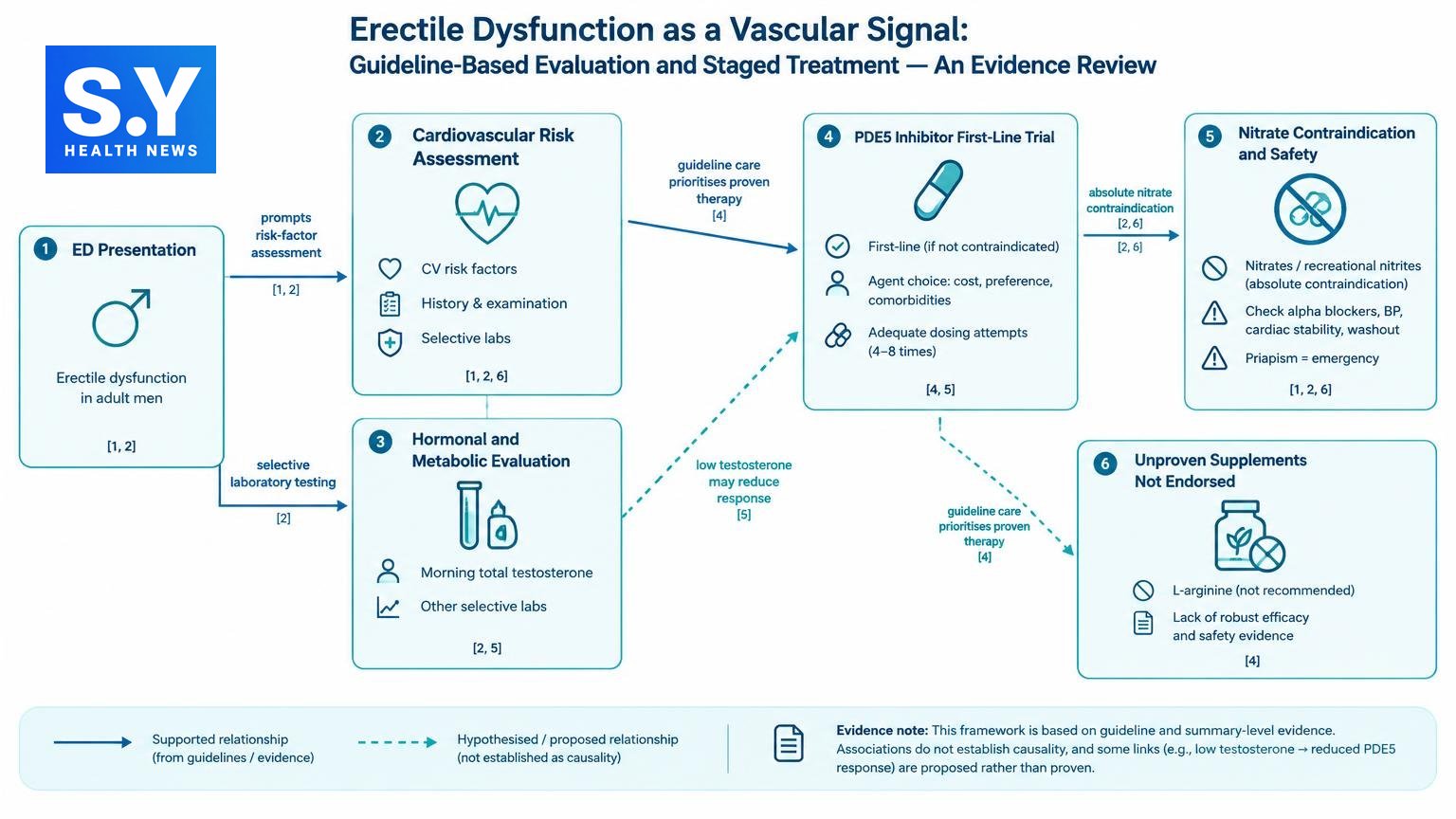
Conceptual framework: Conceptual framework. The figure maps the variables discussed in this evidence review: ED presentation as a prompt for cardiovascular risk assessment and selective hormonal/metabolic testing; PDE5 inhibitors as first-line therapy with an absolute nitrate contraindication; and the non-endorsement of unproven supplements. It represents guideline-supported relationships and proposed links (for example, low testosterone possibly reducing PDE5 inhibitor response) in adult men with ED; it is not a tested causal model or a biological pathway, and the underlying evidence is largely guideline- and summary-level.
Academic References & Evidence
- Erectile dysfunction | iatroX.
- Erectile dysfunction | iatroX. Journal of Urology. 2018 200:633-641
- Idrees Ibrahim Azrag. Bridging Perspectives: A Comparative Study of Erectile Dysfunction Treatments in Western Medicine and Traditional Chinese Medicine. 2026 DOI: 10.5772/intechopen.1016101.
- Can L Argynine Help: Clinical Answer | iatroX. 2026
- Erectile Dysfunction: Treatment & Management: Guideline-aligned Answer. 2025
- Erectile Dysfunction. 2026
SANYUN Science Center explains published research on men's reproductive and sexual health, connecting scientific evidence with everyday questions while making sources and limitations clear.
Disclaimer: This article is for scientific education and research communication only. It does not provide medical advice, diagnosis, or individualized treatment recommendations, and does not endorse any medication, supplement, device, penile enlargement procedure, or other intervention. Decisions about sexual and reproductive health should be made in consultation with a qualified healthcare professional. Do not delay seeking professional care because of information in this article.
Original Content & Copyright Notice
- This article is prepared for SANYUN Science Center, drawing on published research and publicly available academic literature on men’s sexual and reproductive health. Its editorial explanations and presentation are developed for this platform.
- Copyright in the original editorial content, selection, and arrangement is reserved by SANYUN Science Center to the extent protected by applicable law. Referenced research, quotations, and third-party materials remain subject to the rights of their respective owners. This notice does not claim ownership of scientific facts or third-party research.
- Except where permitted by applicable law or an applicable license, prior written permission is required to reproduce, republish, translate, adapt, redistribute, or commercially reuse protected content. Attribution alone does not grant permission for such reuse.
- For permitted quotation or authorized reuse, clearly identify the source and retain a link to the original article.
- Source: SANYUN Science Center
- Original URL: Retain the original article URL on science.san-yun.com.
- Copyright Holder: SANYUN Science Center, for its own protected editorial content.
- Quotation, excerpts, or authorized reuse must not distort the scientific meaning, omit material limitations or disclaimers, or imply unverified medical claims, product efficacy, or endorsement by SANYUN Science Center.



