




Category: Erectile Dysfunction
Core Research Direction: Erectile dysfunction as a marker of vascular and metabolic disease, and what the quality of the current treatment-evidence base can and cannot support
Search Intent: Is erectile dysfunction an early warning sign of cardiovascular and metabolic disease, and how strong is the evidence behind the treatments men are offered for it?
Platform: SANYUN Science Center
Evidence reviewed through: 2026-11-27
Executive Summary
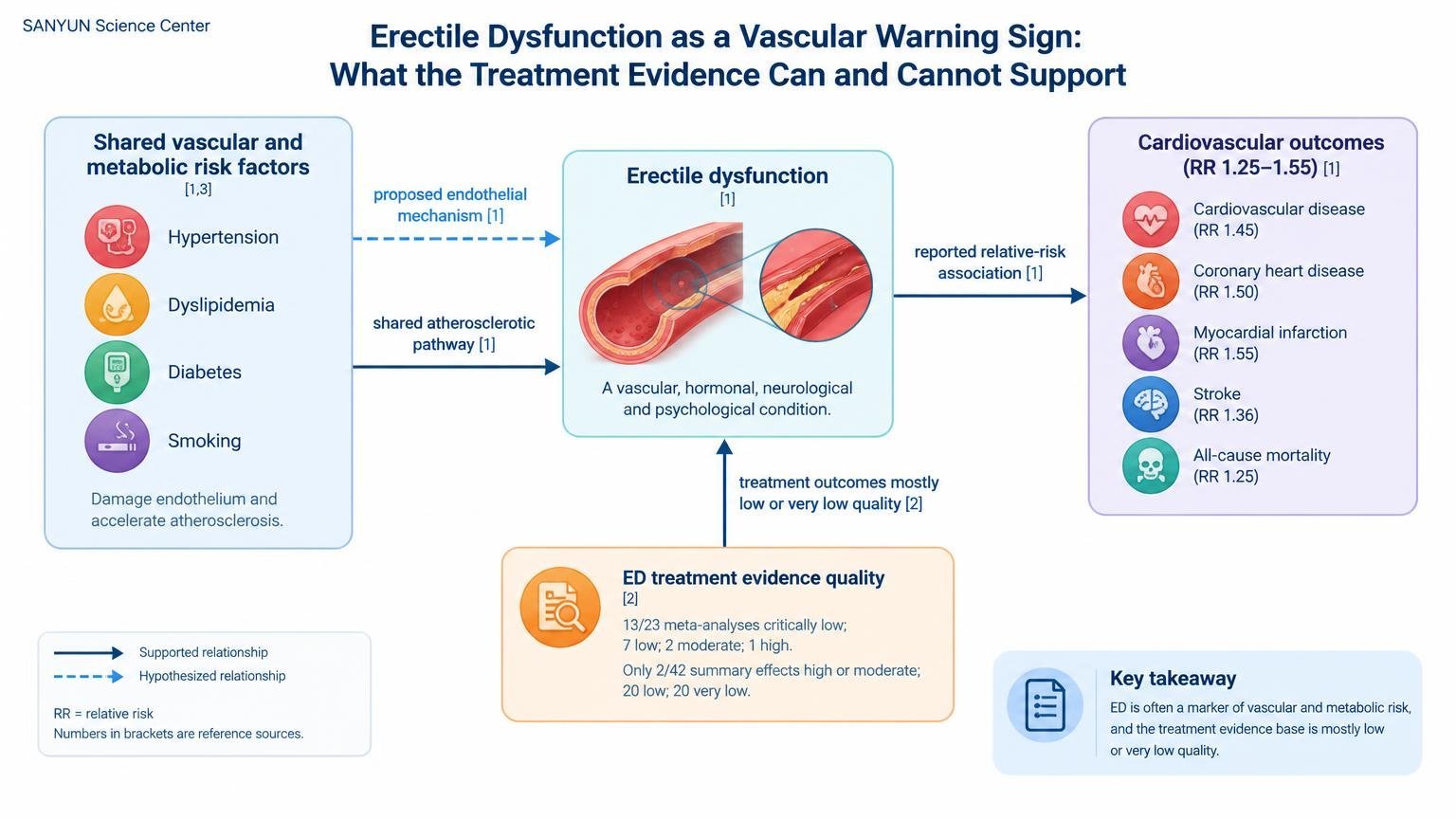
Erectile dysfunction (ED) is commonly framed as a sexual problem, but much of the clinical literature treats it as a vascular one. The most influential version of that argument comes from observational syntheses: a 2021 umbrella review reported in a physician-authored guide found that men with ED had higher relative risks of cardiovascular disease (RR 1.45, 95% CI 1.36-1.54), coronary heart disease (RR 1.50), myocardial infarction (RR 1.55), stroke (RR 1.36) and all-cause mortality (RR 1.25). A 2024 consensus statement went further, advising clinicians to treat men with ED as at cardiac risk until proven otherwise.[1]
The treatment side of the story is less secure. A 2026 umbrella review of systematic reviews and meta-analyses screened 1,191 studies and extracted 23 published meta-analyses, yielding 42 summary effects across 36 interventions measured with the International Index of Erectile Function (IIEF), its short and erectile-function versions, and the erectile hardness score. Using AMSTAR-2, 13 of the 23 reviews (56.5%) were rated critically low quality, 7 (30.5%) low, 2 (8.7%) moderate and 1 (4.3%) high. Only two of the 42 summary effects reached high or moderate quality; 20 were low and 20 very low.[2]
Those two findings can coexist. The cardiovascular association is a consistent observational signal with a plausible mechanism, while the treatment evidence base is broad, statistically active and methodologically uneven. The practical implication is not that ED treatments do not work, but that effect sizes should be read with appropriate humility, and that the cardiovascular conversation deserves at least as much attention as the prescription.
Why This Matters
ED is common and becomes more common with age. A patient-education quiz based on National Institute of Diabetes and Digestive and Kidney Diseases (NIDDK) material states that about 5% of 40-year-old men and up to 25% of 65-year-old men have ED, while stressing that it does not happen to every man as he ages. A separate physician-authored guide gives considerably higher figures, reporting that about 40% of men are affected at age 40 and 70% by age 70. The two estimates cannot both describe the same population in the same way, and the discrepancy is a useful reminder that prevalence depends heavily on definitions, survey methods and the population sampled.[3]
The guide estimates that between 30 million and 50 million men in the United States have ED. It also defines ED as the consistent inability to achieve or maintain an erection sufficient for satisfactory sexual performance. That definition matters because it sets a functional threshold rather than a purely biological one: the outcome is satisfaction, which is subjective and shaped by context.
If ED is an early marker of systemic vascular disease, then the consultation is an opportunity. A man who presents for a prescription may be presenting with the first clinical sign of a process that also narrows coronary arteries. Missing that opportunity is a clinical failure that no amount of treatment efficacy can offset.
The Mechanism: Shared Vascular Terrain
An erection depends on coordinated nerve signaling, blood flow, smooth-muscle relaxation and hormonal and psychological inputs. The most common identified contributors are vascular: hypertension, dyslipidemia, diabetes and smoking all damage the endothelium, the inner lining of blood vessels, and accelerate atherosclerotic narrowing. A patient-education quiz attributed to the American Urological Association states that vascular problems are the most common cause of ED, driven by high blood pressure, type 2 diabetes, high cholesterol and heart disease. The NIDDK-based material makes the same point in broader terms: any disorder that harms the nerves or blocks blood flow in the penis may cause ED, and diseases such as diabetes, hypertension, kidney disease, chronic alcoholism, multiple sclerosis, atherosclerosis, vascular disease and nerve disease account for most cases.[4]
Diabetes deserves particular attention. The NIDDK-based quiz states that up to half of men with diabetes have ED. That is an upper bound without an identified study or denominator, so it should be read as a broad statement of elevated risk rather than a precise prevalence estimate. It is nonetheless consistent with the vascular framing: diabetes damages both small vessels and nerves.
The artery-size hypothesis offers an intuitive anatomical explanation. It proposes that penile arteries are 1 to 2 mm in diameter, roughly one-third the size of coronary arteries, so the same plaque burden produces symptoms in the penis earlier than in the heart. This is an explanatory hypothesis rather than a directly tested mechanism in the supplied material, and the timing claim (that plaque causes noticeable penile problems years before cardiac symptoms) is not established by the data described. It remains a reasonable organizing idea, but it should not be presented as demonstrated fact.
Hormonal and psychological contributors are not mutually exclusive with vascular ones. The patient-education material notes that testosterone supports the erection process and that levels begin dropping after age 30. It also states that most providers and researchers now consider 80% of cases physical, a reversal of older assumptions. That 80% figure is an unattributed expert estimate, and a separate quiz source uses the same 80% figure for psychological contribution. The contradiction illustrates how loosely such percentages circulate.
What the Cardiovascular Evidence Shows
The observational signal is the strongest part of the ED-as-marker argument. According to the physician-authored guide, a 2021 umbrella review in BJU International found that men with ED had higher risks of cardiovascular disease (RR 1.45, 95% CI 1.36-1.54), coronary heart disease (RR 1.50), cardiovascular mortality (RR 1.50), myocardial infarction (RR 1.55), stroke (RR 1.36) and all-cause mortality (RR 1.25), all with P less than 0.001. These are relative risks from pooled observational data. They compare men with ED to men without it, and they cannot by themselves separate ED as a marker from ED as a consequence of the same underlying risk factors.
The relative risks are modest in magnitude but consistent across outcomes. A relative risk of 1.45 for cardiovascular disease means a 45% higher risk in relative terms; it does not mean a 45% absolute probability. Without absolute event rates and follow-up duration, the clinical meaning for an individual man remains uncertain. The pattern is more informative than any single estimate: the direction is consistent across coronary disease, stroke, cardiovascular mortality and all-cause mortality, which is what a shared-vascular-pathway hypothesis would predict.
The 2024 Princeton IV Consensus, published in Mayo Clinic Proceedings, advises clinicians to treat men with ED as being at risk for cardiac events until proven otherwise. This is a consensus recommendation, not primary evidence, and it is described secondhand in the guide. Its practical value is that it reframes the default: rather than assuming a man with ED is cardiac-safe until symptoms appear, the burden shifts toward assessment.
What the Treatment Evidence Shows
The 2026 umbrella review is the most direct available summary of treatment quality. Its search covered PubMed, Web of Science, the Cochrane Library and Embase, with studies published up to October 2025. From 1,191 identified studies it extracted 23 published meta-analyses and 42 summary effects across 36 interventions. The outcomes were measured with the IIEF, IIEF-5, IIEF-EF and the erectile hardness score. All meta-analyses were appraised with AMSTAR-2, a tool for assessing the methodological quality of systematic reviews.
The quality distribution is the central finding. Of 23 meta-analyses, 13 (56.5%) were rated critically low, 7 (30.5%) low, 2 (8.7%) moderate and 1 (4.3%) high. Of the 42 summary effects, only two reached high or moderate quality; 20 (47.6%) were low and 20 (47.6%) very low. The review concluded that the current evidence base for ED treatments is predominantly of low or very low quality.
The review did observe statistically significant improvements with both pharmacological and non-pharmacological interventions. Its authors caution that these findings should be interpreted carefully because of the limited number of patients and the subjective nature of outcome indicators. That distinction is essential: statistical significance in a small or imprecise body of evidence is not the same as a reliable clinical effect.
The review authors describe a treatment landscape that is increasingly diverse while the reliability of the evidence is poor. They call for well-designed studies of single treatments and high-quality meta-analyses comparing treatments directly. That is a recommendation for future research, not a study finding, and it points to a structural gap: many treatments are evaluated in isolation against placebo or usual care, while the comparisons men and clinicians actually face are between alternatives.
| Concept | Source-grounded definition | Interpretation |
|---|---|---|
| IIEF, IIEF-5 and IIEF-EF | Patient-reported scales used as endpoints in the umbrella review, alongside the erectile hardness score | Capture self-reported erectile function; subjective by design, which the review authors flag as a limitation |
| AMSTAR-2 review quality | Appraisal tool applied to all 23 included meta-analyses | Rates the methodology of the reviews, not the efficacy of the treatments themselves |
| Summary effect quality | Quality rating assigned to each of the 42 pooled effects | Only two of 42 reached high or moderate quality; most were low or very low |
| Observational relative risk | Pooled risk of cardiovascular outcomes in men with versus without ED | Suggests an association, but cannot establish causation or separate shared risk factors |
| Erectile hardness score | A hardness-based outcome measure used alongside the IIEF family | Adds a physical dimension but remains an indirect measure of the vascular process |
Interpretation and Limitations
The umbrella review's most important limitation is built into its design. An umbrella review summarizes existing meta-analyses; if those meta-analyses are themselves of low quality, the summary inherits that weakness. The review did not report total participant numbers in the available text, so the precision of the underlying evidence cannot be judged from the summary alone. Its quality ratings apply to reviews and summary effects, not to the individual trials inside them, and some treatments may have better evidence than the aggregate suggests.
The cardiovascular evidence has its own limits. The relative risks are derived from observational syntheses described secondhand in a physician-authored guide. Confidence intervals are given only for the overall cardiovascular disease estimate, and the other relative risks are reported without them in the supplied text. Observational designs cannot establish that ED causes cardiac events, and shared risk factors such as smoking, hypertension and diabetes may drive both. The artery-size hypothesis is plausible but not directly tested in the supplied material.
Prevalence estimates are inconsistent enough to warrant caution. The NIDDK-based figures of about 5% at age 40 and up to 25% at age 65 differ substantially from the guide's 40% at age 40 and 70% by age 70. The guide's citation details are not reproducible from the supplied text, and the NIDDK-based rendering does not identify its underlying study. Neither should be treated as definitive. What both support is the direction of the age gradient, not a precise number.
Screening instruments are not diagnoses. The German online test states that it is based on the Sexual Health Inventory for Men attributed to Rosen and colleagues in a 1999 issue of the International Journal of Impotence Research, and that it can only provide an initial indication of erectile dysfunction rather than a diagnosis. That caveat applies broadly: a questionnaire score can prompt a clinical conversation, but it cannot replace one.[5]
Treatment safety information is more secure than treatment efficacy information. PDE5 inhibitors are absolutely contraindicated with nitrate medications and recreational nitrites because the combination can cause severe, potentially fatal hypotension. The patient-education material also stresses that oral medicines are not aphrodisiacs, have no effect on sexual desire and work by relaxing penile vessels. These are well-established pharmacological boundaries, and they remain valid regardless of the quality of the efficacy literature.
Adjacent Evidence Worth Separating
Some newer lines of evidence add context but should not be merged into a single narrative. A 2018 study of 150 men newly diagnosed with moderate to severe obstructive sleep apnea found an ED prevalence of 51%, meaning roughly one in two of those men also had ED. Proposed mechanisms include intermittent nocturnal hypoxia damaging the vascular lining and fragmented sleep lowering testosterone, both of which are hypotheses. In the same trial, erectile function scores rose after three months of continuous positive airway pressure (CPAP), but the authors could not determine conclusively whether CPAP works as stand-alone ED treatment. A 2021 Cochrane review rated the evidence for CPAP versus no CPAP as very uncertain.
A 2023 meta-analysis in Medicina (8 studies, 457 patients) reported higher post-treatment IIEF-5 scores with sildenafil than with CPAP (37.7 versus 27.3) and suggested combining them may add benefit. That comparison involves separate treatment arms rather than a direct head-to-head randomized design, and the combination suggestion was not tested. A 2025 Cochrane review of 21 randomized trials (1,357 men) found low-intensity shockwave therapy may improve IIEF-EF scores by roughly 3.9 points short-term and 5.3 points long-term versus sham, with low certainty of evidence; several included studies were industry-funded, mainly by device makers.
Testosterone therapy adds another strand. In TRAVERSE, 5,246 men with hypogonadism and existing or high cardiovascular risk received transdermal testosterone or placebo; testosterone was noninferior for major adverse cardiac events (HR 0.96, 95% CI 0.78-1.17) over a mean 21.7 months, though atrial fibrillation, acute kidney injury and pulmonary embolism were more common in the testosterone group. The trial addressed cardiovascular safety, not erectile function as an endpoint, so it should not be cited as proof that testosterone improves ED.
Pharmacovigilance data offer another signal worth keeping separate from efficacy claims. A 2025 analysis of 53,517 FDA Adverse Event Reporting System reports from 2004 to 2024 confirmed the labeled side effects of all four PDE5 inhibitors and identified unlabeled nervous-system, cardiovascular and eye signals requiring further study. Spontaneous reporting cannot establish incidence or causality, so these are hypothesis-generating observations rather than confirmed risks.
Research Outlook
The clearest research priority follows directly from the umbrella review: well-designed single-treatment studies and high-quality meta-analyses that compare treatments directly. Much of the current literature evaluates interventions against placebo or no treatment, which answers whether a treatment can work but not how it compares with the alternatives a patient might choose. The review's finding that only two of 42 summary effects reached high or moderate quality is a measure of how far the field has to travel.
On the cardiovascular side, the observational signal is strong enough to justify risk assessment but not strong enough to specify exactly how that assessment should be structured. The 2021 umbrella review provides relative risks; what would sharpen the clinical picture is absolute risk by age and risk-factor profile, and evidence on whether treating modifiable risk factors changes erectile outcomes. The artery-size hypothesis remains an attractive explanation awaiting direct testing.
Key Takeaways
- Erectile dysfunction is associated with higher relative risks of cardiovascular disease, coronary heart disease, myocardial infarction, stroke and all-cause mortality in pooled observational data, but the absolute risk for an individual man is not established by the relative risks alone.
- A 2024 consensus statement advises treating men with ED as at cardiac risk until proven otherwise, shifting the default toward assessment rather than reassurance.
- An umbrella review of 23 meta-analyses found that 13 (56.5%) were critically low quality and only two of 42 summary effects reached high or moderate quality, so treatment effect sizes should be interpreted cautiously.
- Prevalence estimates vary widely between sources, from about 5% at age 40 in NIDDK-based material to 40% at age 40 in a physician-authored guide; definitions and methods differ, and neither figure is definitive.
- PDE5 inhibitors are absolutely contraindicated with nitrate medications and recreational nitrites because the combination can cause severe, potentially fatal hypotension.
- Screening questionnaires such as the SHIM provide an initial indication only; they do not diagnose ED and should prompt a clinical conversation.
Questions and Answers
Is erectile dysfunction an early warning sign of cardiovascular disease?
Pooled observational data suggest an association: a 2021 umbrella review reported higher relative risks of cardiovascular disease (RR 1.45, 95% CI 1.36-1.54), coronary heart disease (RR 1.50), myocardial infarction (RR 1.55) and stroke (RR 1.36) in men with ED. A 2024 consensus statement advises treating men with ED as at cardiac risk until proven otherwise. These are associations, not proof of causation, and absolute risk for an individual man is not established by relative risks alone.
How strong is the evidence behind erectile dysfunction treatments?
A 2026 umbrella review of 23 meta-analyses found the evidence base is predominantly low or very low quality. Of the 23 reviews, 13 (56.5%) were critically low quality and 7 (30.5%) low; only two of 42 summary effects reached high or moderate quality. Statistically significant improvements were observed with pharmacological and non-pharmacological interventions, but the authors caution that patient numbers were limited and outcome measures subjective.
Why might erectile dysfunction appear before heart symptoms?
The artery-size hypothesis proposes that penile arteries are 1 to 2 mm in diameter, roughly one-third the size of coronary arteries, so the same atherosclerotic process produces symptoms in smaller vessels earlier. This is an explanatory hypothesis rather than a directly tested mechanism in the available material, and the timing claim that penile symptoms precede cardiac symptoms by years is plausible but not established.
What causes erectile dysfunction in older men?
NIDDK-based patient education states that in older men ED usually has a physical cause, such as disease, injury or medication side effects, and that any disorder harming penile nerves or blocking penile blood flow may contribute. Vascular problems are described as the most common cause, driven by high blood pressure, type 2 diabetes, high cholesterol and heart disease. Psychological factors can coexist and often add to the problem after it first occurs.
How common is erectile dysfunction at age 40 and age 70?
Estimates differ substantially. NIDDK-based patient education states that about 5% of 40-year-old men and up to 25% of 65-year-old men have ED. A physician-authored guide reports about 40% of men affected at age 40 and 70% by age 70. The two figures cannot both describe the same population in the same way, so both should be treated as approximate indications that risk rises with age rather than precise prevalence values.
Are PDE5 inhibitors safe for men with heart disease?
PDE5 inhibitors are absolutely contraindicated with nitrate medications and recreational nitrites because the combination can cause severe, potentially fatal hypotension. For men without nitrate use, a 2024 consensus statement advises treating men with ED as at cardiac risk and assessing them accordingly before treatment. This is a clinical assessment question; no article can determine individual safety, and men with cardiac symptoms should seek medical evaluation.
Conceptual framework: Conceptual framework. Shared vascular and metabolic risk factors are proposed to drive both erectile dysfunction and cardiovascular outcomes, while ED is associated with higher cardiovascular relative risks in pooled observational data. The treatment evidence base for ED is separately rated mostly low or very low quality by a 2026 umbrella review. Supported edges reflect reported associations; the endothelial mechanism edge is proposed. This is not a tested causal model.
Academic References & Evidence
- Parth Bhavsar. Erectile Dysfunction.
- Current treatment for erectile dysfunction: an umbrella review of systematic reviews and meta-analyses. 2026
- Krames Online – Erectile Dysfunction Quiz.
- Krames Online – Impotence Quiz.
- Rosen et al.. Erektile Dysfunktion » Online-Tests » Mediathek. International Journal of Impotence Research. 1999 11:319
SANYUN Science Center explains published research on men's reproductive and sexual health, connecting scientific evidence with everyday questions while making sources and limitations clear.
Disclaimer: This article is for scientific education and research communication only. It does not provide medical advice, diagnosis, or individualized treatment recommendations, and does not endorse any medication, supplement, device, penile enlargement procedure, or other intervention. Decisions about sexual and reproductive health should be made in consultation with a qualified healthcare professional. Do not delay seeking professional care because of information in this article.
Original Content & Copyright Notice
- This article is prepared for SANYUN Science Center, drawing on published research and publicly available academic literature on men’s sexual and reproductive health. Its editorial explanations and presentation are developed for this platform.
- Copyright in the original editorial content, selection, and arrangement is reserved by SANYUN Science Center to the extent protected by applicable law. Referenced research, quotations, and third-party materials remain subject to the rights of their respective owners. This notice does not claim ownership of scientific facts or third-party research.
- Except where permitted by applicable law or an applicable license, prior written permission is required to reproduce, republish, translate, adapt, redistribute, or commercially reuse protected content. Attribution alone does not grant permission for such reuse.
- For permitted quotation or authorized reuse, clearly identify the source and retain a link to the original article.
- Source: SANYUN Science Center
- Original URL: Retain the original article URL on science.san-yun.com.
- Copyright Holder: SANYUN Science Center, for its own protected editorial content.
- Quotation, excerpts, or authorized reuse must not distort the scientific meaning, omit material limitations or disclaimers, or imply unverified medical claims, product efficacy, or endorsement by SANYUN Science Center.



