




Category: Clinical Insights
Core Research Direction: Long-term outcomes of combined extracorporeal shock wave therapy (ESWT) with or without bovhyaluronidase azoximer across chronic prostatitis (NIH II) and CP/CPPS (IIIA–IIIB) phenotypes, and how the CP/CPPS case definition shapes evaluation
Search Intent: In men with chronic prostatitis or chronic pelvic pain syndrome, does adding bovhyaluronidase azoximer to extracorporeal shock wave therapy improve long-term symptom, prostate tissue and erectile outcomes compared with shock wave therapy alone or standard therapy?
Platform: SANYUN Science Center
Evidence reviewed through: 2026-11-11
Executive Summary
Chronic prostatitis and chronic pelvic pain syndrome (CP/CPPS) remain difficult to manage, with no standardized treatment protocol and substantial effects on quality of life. A 2026 conference abstract from a single university center reported an open-label, randomized, placebo-uncontrolled study of 116 men with chronic prostatitis or CPPS and evaluated whether adding bovhyaluronidase azoximer (BA) to perineal extracorporeal shock wave therapy (ESWT) improved long-term outcomes relative to ESWT alone or to ESWT plus standard therapy in category II disease.[1][2]
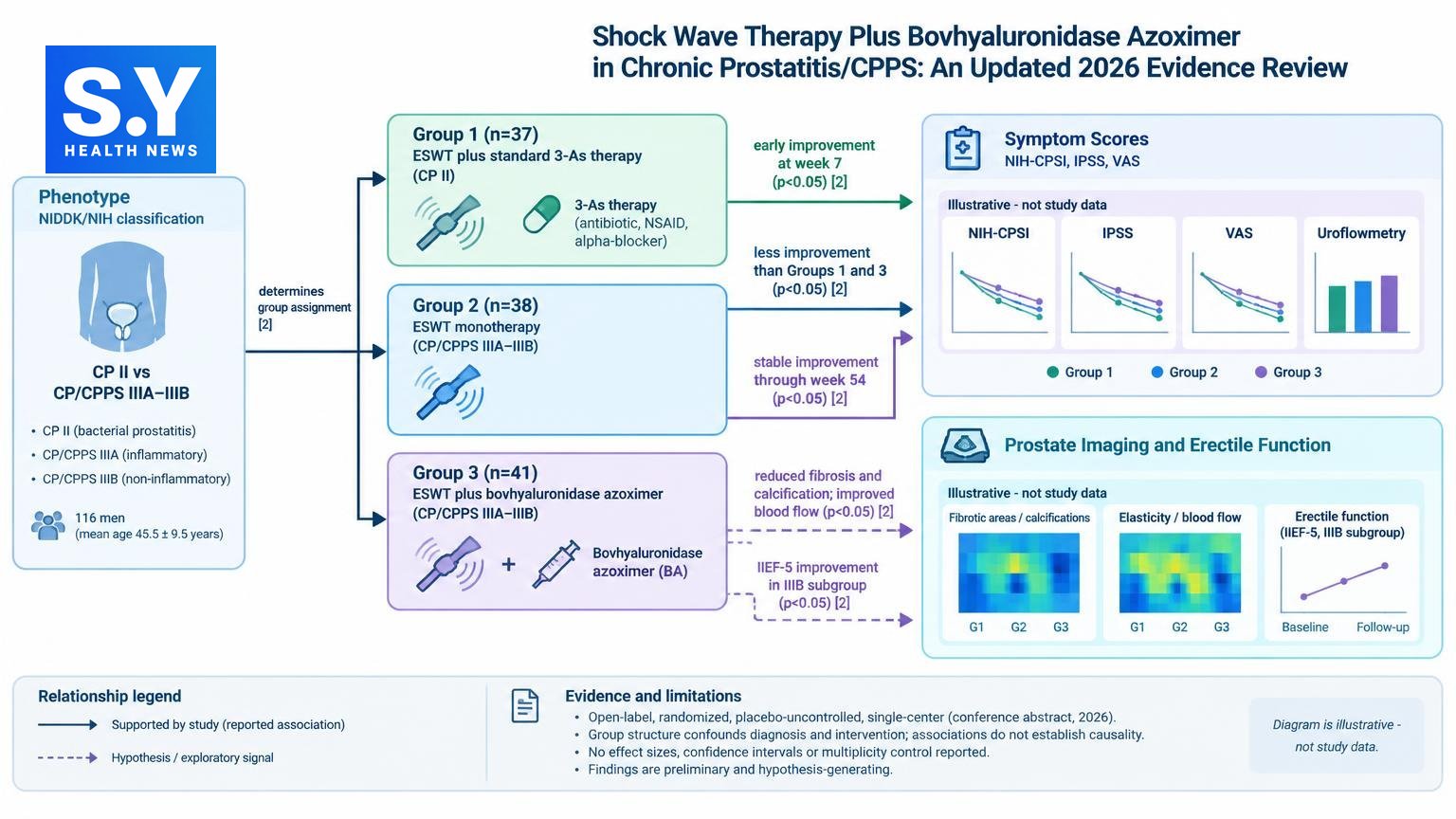
The study enrolled 116 men (mean age 45.5±9.5 years, mean disease duration 20.8±7.7 months). According to the NIDDK/NIH classification, 37 men (32%) had CP II, 39 (33.6%) had CP/CPPS IIIA and 40 (34.4%) had CP/CPPS IIIB. Three groups were formed: Group 1 (n=37, CP II) received ESWT plus standard “3-As” therapy (antibiotic, NSAID, alpha-blocker); Group 2 (n=38, CP/CPPS IIIA–IIIB) received ESWT monotherapy; and Group 3 (n=41, CP/CPPS IIIA–IIIB) received ESWT plus BA.
By week 7, Group 1 showed more pronounced improvement in NIH-CPSI, IPSS, VAS and uroflowmetry parameters (p<0.05). From weeks 10 to 54, all groups improved, but Group 3 showed the most stable and significant improvement, including reduced fibrotic areas and calcifications, more zones of normal elasticity and improved blood-flow parameters (p<0.05). Intergroup analysis showed Groups 1 and 3 outperformed Group 2 (p<0.05), with no significant differences between Groups 1 and 3 on NIH-CPSI, IPSS or VAS scores (p>0.05). In men with non-inflammatory CP/CPPS (IIIB), erectile function also improved significantly on the IIEF-5 (p<0.05).
These findings are preliminary. The study was open-label, placebo-uncontrolled, single-center and reported only as a conference abstract without effect sizes, confidence intervals or multiplicity control. The group structure confounds diagnosis category with intervention, limiting causal attribution. The results are hypothesis-generating and should not be read as established comparative efficacy.
Why This Matters
CP/CPPS is a clinical syndrome of pelvic-region pain or discomfort in men, often accompanied by urinary symptoms or sexual dysfunction. Research guidelines define it as chronic pelvic pain lasting at least 3 months within the preceding 6 months without another identifiable cause. Despite the term “prostatitis,” it remains unclear how closely these symptoms relate to the prostate itself, which is central to judging any therapy aimed at prostate tissue.
Management is complicated by the absence of standardized protocols. CP/CPPS is sometimes classed as inflammatory or non-inflammatory, but the distinction is usually made only in research because there is no evidence that symptoms or treatment response differ between these subgroups. A therapy that claims to alter prostate fibrosis would therefore need to show benefit that is not simply a restatement of a phenotype label.
Biological and Clinical Mechanism Underlying the Hypothesis
The proposed rationale combines two components. ESWT delivers acoustic impulses to perineal tissue; in this study, sessions used 2000–4000 impulses applied to the perineum twice weekly for a total of 12 sessions. Bovhyaluronidase azoximer is described by the investigators as a hyaluronidase-based agent intended to act on fibrotic tissue. The authors interpret that both ESWT and BA were highly effective in lysing fibrotic zones and prostatic calcifications and in sustained relief of CP/CPPS symptoms.
This mechanistic account should be treated as an author interpretation rather than a directly demonstrated pathway. The abstract does not report how tissue lysis was verified, whether imaging readers were blinded, or whether changes in elastography and Doppler parameters correspond to histological or clinical changes. The imaging findings are therefore supportive signals, not proof of a disease-modifying effect on prostate tissue.
What the Evidence Shows
Outcome assessment used the NIH-CPSI, IPSS, IIEF-5 and VAS scales, plus uroflowmetry, transrectal ultrasonography with elastography and Doppler, and laboratory tests at baseline and at weeks 7, 10, 18, 30 and 54. The breadth of assessment is a strength in principle, but the abstract reports only p-value thresholds, not effect sizes or confidence intervals, so the magnitude of benefit cannot be judged.
The early phase (through week 7) favored Group 1, which combined ESWT with antibiotics, an NSAID and an alpha-blocker in men with category II bacterial prostatitis. That group differs from the others in both diagnosis and co-intervention, so the early advantage cannot be attributed to ESWT, to BA or to any single drug. The later phase (weeks 10–54) favored Group 3 on imaging markers and stability of symptom improvement, while Groups 1 and 3 were statistically indistinguishable on NIH-CPSI, IPSS and VAS.
The erectile-function finding was confined to men with non-inflammatory CP/CPPS (IIIB) and measured with the IIEF-5 (p<0.05). The abstract does not report the subgroup sample size, effect size or control for sexual-function confounders, so this should be treated as a signal for future study rather than a reliable estimate of benefit.
| Group and phenotype | Intervention | Early phase (week 7) | Longer phase (weeks 10–54) | Intergroup comparison |
|---|---|---|---|---|
| Group 1 (n=37), CP II | ESWT plus standard 3-As therapy (antibiotic, NSAID, alpha-blocker) | More pronounced improvement in NIH-CPSI, IPSS, VAS and uroflowmetry (p<0.05) | Positive dynamics recorded | Superior to Group 2 (p<0.05); not significantly different from Group 3 on NIH-CPSI, IPSS or VAS (p>0.05) |
| Group 2 (n=38), CP/CPPS IIIA–IIIB | ESWT monotherapy | Not reported as the early leader | Positive dynamics recorded | Inferior to Groups 1 and 3 (p<0.05) |
| Group 3 (n=41), CP/CPPS IIIA–IIIB | ESWT plus bovhyaluronidase azoximer | Not reported as the early leader | Most stable and significant improvement; reduced fibrotic areas and calcifications, more normal-elasticity zones, improved blood flow (p<0.05) | Superior to Group 2 (p<0.05); not significantly different from Group 1 on NIH-CPSI, IPSS or VAS (p>0.05) |
| CP/CPPS IIIB subgroup | Within-group comparison | Erectile function improved on IIEF-5 (p<0.05) | Subgroup size and effect size not reported |
Interpretation and Limitations
The most important structural limitation is that the study's groups do not map cleanly onto a single comparison. Group 1 combines a different diagnosis (CP II) with additional drug therapy, Group 2 is ESWT alone, and Group 3 adds BA. A comparison of Groups 1 and 3 therefore mixes a diagnostic category difference with a treatment difference. The reported superiority of Groups 1 and 3 over Group 2 cannot be attributed to a single component, and the equivalence of Groups 1 and 3 on symptom scales is compatible with several explanations, including confounding by phenotype.
The study is described as open-label, randomized and placebo-uncontrolled, but the abstract's disclosure field states “RCT No,” and the registration-number text is incomplete. Readers should therefore treat the randomization description cautiously until a full publication clarifies methods and registration. Safety was reported as no adverse effects in any of the 116 men who completed treatment, but the abstract does not describe how adverse events were ascertained, and the absence of a placebo arm limits interpretation of tolerability.
The case definition also shapes evaluation. Guidelines define CP/CPPS by pain duration and the absence of another identifiable cause, not by prostate pathology, and inflammatory versus non-inflammatory subclassification is generally a research distinction. Because symptoms may not closely track prostate findings, imaging improvements such as reduced calcification or changed elasticity are not automatically patient-important outcomes. A therapy that improves imaging but not symptom scores, or vice versa, would require careful interpretation.
Finally, the abstract reports multiple endpoints at five time points without stated multiplicity control, and only p-value thresholds rather than effect sizes. Statistical significance at p<0.05 in this setting should not be equated with clinical importance, and the absence of a significant difference between Groups 1 and 3 should not be interpreted as proof of equivalence given the small group sizes. These findings remain preliminary and hypothesis-generating.
Research Outlook
A full peer-reviewed report is needed to clarify randomization and allocation procedures, blinding of imaging and symptom assessment, exact effect sizes with confidence intervals, multiplicity handling, and the definition and ascertainment of adverse events. A placebo-controlled or sham-controlled design would be important for distinguishing specific effects of ESWT and BA from regression to the mean and from the natural fluctuation of a chronic pain syndrome.
Future work should also separate phenotype from intervention: for example, comparing ESWT plus BA with ESWT alone within the same CP/CPPS category, and reporting patient-important outcomes alongside imaging markers. Until such data are available, the combination should be viewed as an investigational approach rather than an established therapy, and clinical decisions should remain individualized in consultation with a qualified clinician.
Key Takeaways
- A 2026 open-label study of 116 men reported that adding bovhyaluronidase azoximer to perineal ESWT produced more stable long-term imaging and symptom improvements than ESWT alone in CP/CPPS IIIA–IIIB.
- Groups 1 and 3 both outperformed ESWT monotherapy, but they did not differ significantly from each other on NIH-CPSI, IPSS or VAS, and Group 1 combined a different diagnosis with additional drug therapy.
- Erectile function improved significantly only in the non-inflammatory IIIB subgroup, with subgroup size and effect size unreported.
- The study was open-label, placebo-uncontrolled, single-center and reported as a conference abstract without effect sizes; findings are preliminary.
- Because CP/CPPS is defined clinically rather than by prostate pathology, imaging improvements do not automatically translate into patient-important benefit.
Questions and Answers
What is the difference between chronic prostatitis category II and CP/CPPS IIIA–IIIB?
CP II refers to chronic bacterial prostatitis and was present in 37 men (32%) in this study, treated with ESWT plus antibiotics, an NSAID and an alpha-blocker. CP/CPPS IIIA–IIIB is the non-bacterial pelvic pain syndrome, divided into inflammatory (IIIA) and non-inflammatory (IIIB) forms; guidelines note that this distinction is usually made only in research because evidence does not show different symptoms or treatment responses.
Does adding bovhyaluronidase azoximer to extracorporeal shock wave therapy improve chronic prostatitis symptoms?
In the 2026 abstract, Group 3 (ESWT plus bovhyaluronidase azoximer) showed the most stable improvement from weeks 10 to 54, including reduced fibrotic areas and calcifications and improved blood flow (p<0.05). However, it did not differ significantly from Group 1 on NIH-CPSI, IPSS or VAS (p>0.05), and the study was open-label and placebo-uncontrolled, so a specific added benefit is not established.
How strong is the evidence that ESWT plus bovhyaluronidase azoximer works for CP/CPPS?
The evidence is preliminary. It comes from a single-center, open-label, placebo-uncontrolled study of 116 men reported only as a conference abstract, with p-value thresholds but no effect sizes or confidence intervals, multiple endpoints and no stated multiplicity control. It is hypothesis-generating and does not establish comparative efficacy or a disease-modifying effect.
Did erectile function improve with shock wave therapy in non-inflammatory CP/CPPS?
Yes, the abstract reports that in men with non-inflammatory CP/CPPS (category IIIB), erectile function improved significantly on the IIEF-5 (p<0.05). The subgroup sample size, effect size and control for sexual-function confounders are not reported, so this should be regarded as an exploratory signal rather than a reliable estimate of benefit.
What are the main limitations of the 2026 ESWT and bovhyaluronidase azoximer study?
Key limitations include the open-label, placebo-uncontrolled design, single-center setting, abstract-only reporting without effect sizes, and groups that confound diagnosis with intervention. Group 1 received ESWT plus standard drug therapy in CP II, Group 2 received ESWT alone, and Group 3 added bovhyaluronidase azoximer, so superiority over ESWT alone cannot be attributed to one component.
Why does the CP/CPPS case definition affect how treatment results are judged?
Guidelines define CP/CPPS as pelvic pain lasting at least 3 months within the prior 6 months without another identifiable cause, and it remains unclear how closely symptoms relate to the prostate. Imaging changes such as reduced calcification may therefore not reflect patient-important benefit, and inflammatory versus non-inflammatory labels are mainly research distinctions without proven differences in treatment response.
Conceptual framework: Conceptual framework summarizing reported relationships in a 2026 open-label study of 116 men. Arrows indicate group assignment and reported associations; the dashed-style relationship marks an exploratory subgroup signal. Diagram is illustrative – not study data.
Academic References & Evidence
- Michel Pontari; Joann G Elmore; Han Li. 慢性前列腺炎和慢性盆腔疼痛综合征. UpToDate. 2025
- Epifanova M; Slavkina E; Artemenko S; Kostin A. Combined Extracorporeal Shock Wave Therapy and Bovinized Hyaluronidase Azoximer in the Long-Term Treatment of Chronic Prostatitis/Chronic Pelvic Pain Syndrome. ICS 2026 (International Continence Society) abstract book, Abstract 404. 2026
SANYUN Science Center explains published research on men's reproductive and sexual health, connecting scientific evidence with everyday questions while making sources and limitations clear.
Disclaimer: This article is for scientific education and research communication only. It does not provide medical advice, diagnosis, or individualized treatment recommendations, and does not endorse any medication, supplement, device, penile enlargement procedure, or other intervention. Decisions about sexual and reproductive health should be made in consultation with a qualified healthcare professional. Do not delay seeking professional care because of information in this article.
Original Content & Copyright Notice
- This article is prepared for SANYUN Science Center, drawing on published research and publicly available academic literature on men’s sexual and reproductive health. Its editorial explanations and presentation are developed for this platform.
- Copyright in the original editorial content, selection, and arrangement is reserved by SANYUN Science Center to the extent protected by applicable law. Referenced research, quotations, and third-party materials remain subject to the rights of their respective owners. This notice does not claim ownership of scientific facts or third-party research.
- Except where permitted by applicable law or an applicable license, prior written permission is required to reproduce, republish, translate, adapt, redistribute, or commercially reuse protected content. Attribution alone does not grant permission for such reuse.
- For permitted quotation or authorized reuse, clearly identify the source and retain a link to the original article.
- Source: SANYUN Science Center
- Original URL: Retain the original article URL on science.san-yun.com.
- Copyright Holder: SANYUN Science Center, for its own protected editorial content.
- Quotation, excerpts, or authorized reuse must not distort the scientific meaning, omit material limitations or disclaimers, or imply unverified medical claims, product efficacy, or endorsement by SANYUN Science Center.



 and CP/CPPS IIIA–IIIB, including limitations and the role of case definitions.)