




Category: Erectile Dysfunction
Core Research Direction: Supervised clinic-based resistance and aerobic exercise, with or without brief psychosexual education, for improving erectile and sexual function in men treated for prostate cancer, and the strength of the broader evidence base for pharmacological and non-pharmacological ED treatments.
Search Intent: In men treated for prostate cancer, does supervised exercise improve erectile and sexual function compared with usual care, and how reliable is the overall evidence base behind ED treatments?
Platform: SANYUN Science Center
Evidence reviewed through: 2026-11-07
Executive Summary
Sexual dysfunction is described by trial authors as a common adverse effect of prostate cancer treatment, and they note that current management strategies do not adequately address its physical and psychological causes. Against that background, a three-arm randomized clinical trial tested whether supervised, clinic-based resistance and aerobic exercise, delivered with or without a brief psychosexual education and self-management intervention, could improve sexual function compared with usual care in men treated for prostate cancer.[1]
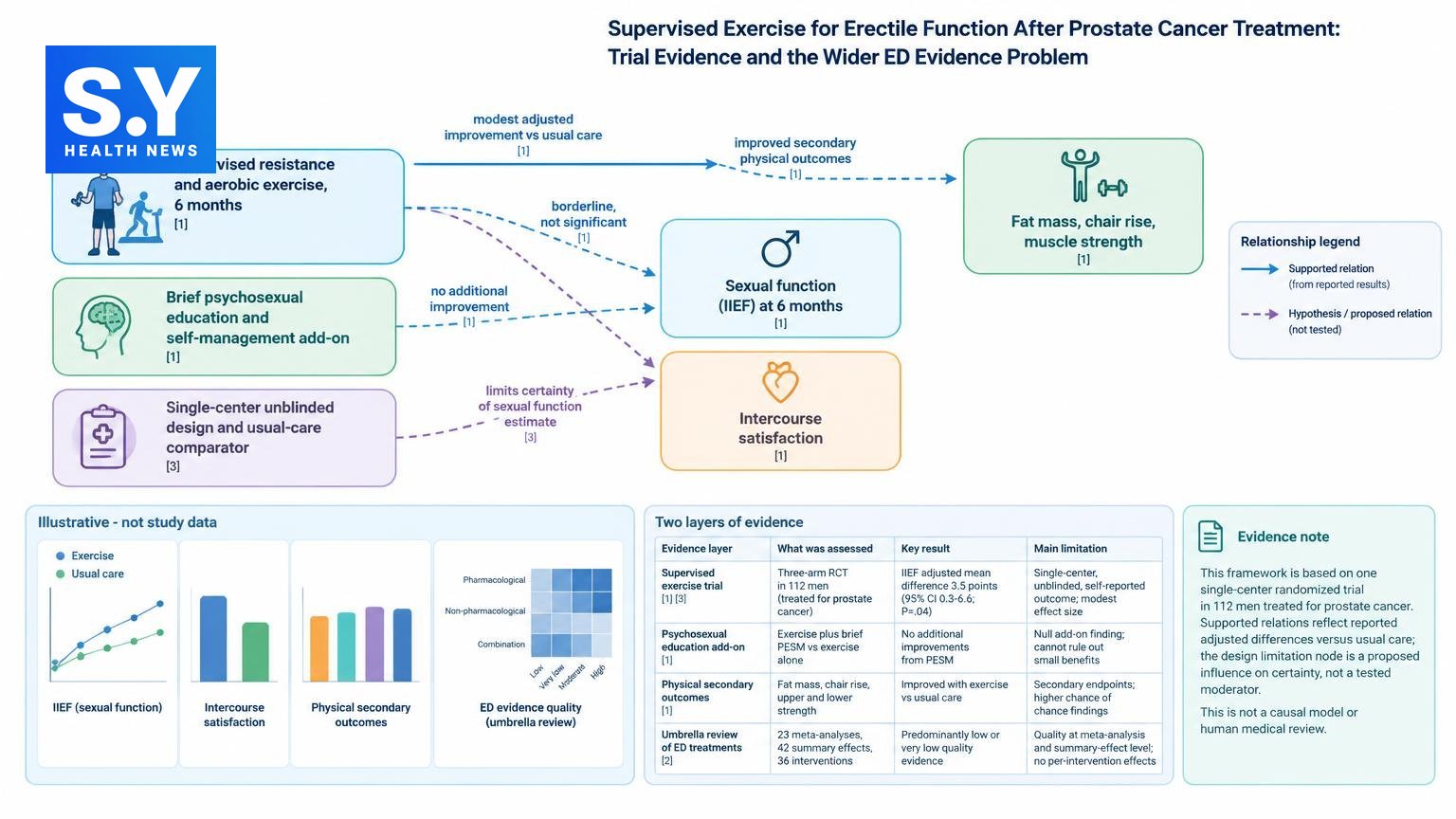
The trial randomized 112 men with a mean age of 66.3 years. At six months, the mean adjusted difference in International Index of Erectile Function score was 3.5 points in favor of exercise over usual care (95% CI 0.3 to 6.6; P=.04). The intercourse satisfaction difference was reported as not significant, and adding the education component produced no additional improvement. Exercise also improved several physical secondary outcomes.
These results sit within a much weaker broader evidence base. An umbrella review of 23 published meta-analyses covering 36 erectile dysfunction interventions found that most included meta-analyses were rated critically low or low quality on AMSTAR-2, and only two of 42 summary effects were rated high or moderate quality. Statistically significant improvements were reported for both pharmacological and non-pharmacological treatments, but the reviewers urge caution because of limited patient numbers and subjective outcome measures.[2]
Why This Matters
Erectile dysfunction after prostate cancer treatment is common, and the trial authors argue that existing management does not fully address the combined physical and psychological contributors. Exercise is attractive as a rehabilitation strategy because it is non-pharmacological, may be delivered in groups, and could address fitness, body composition and confidence at the same time as sexual function.
At the same time, the umbrella review's central message is that the treatment landscape for erectile dysfunction is increasingly diverse while the reliability of its evidence remains poor. That applies to how clinicians and patients interpret claims about drugs, devices, lifestyle programs and combination approaches. A statistically significant result in a meta-analysis is not automatically a reliable or clinically meaningful one, especially when the underlying trials are small and the outcomes are self-reported.
The Exercise Trial: Design and Population
The exercise study was a three-arm, parallel-group, single-center randomized clinical trial conducted at university-affiliated exercise clinics between July 24, 2014 and August 22, 2019, with data analysis undertaken from October 8 to December 23, 2024. Eligible participants were men with prostate cancer who had previously undergone or were currently undergoing treatment and who were concerned about sexual dysfunction.
Participants were allocated to six months of supervised, group-based resistance and aerobic exercise (39 men), the same exercise program plus a brief psychosexual education and self-management intervention (36 men), or usual care (37 men). Exercise was planned at three days per week. The primary outcome was sexual function on the International Index of Erectile Function; secondary outcomes included body composition, physical function and muscle strength, and analyses followed an intention-to-treat approach.
What the Trial Found
At six months, the adjusted mean difference in IIEF score was 3.5 points favoring exercise over usual care (95% CI 0.3 to 6.6; P=.04). The confidence interval excludes zero, so the result is statistically significant, but the lower bound is close to no effect and the point estimate is small on the IIEF scale. The authors concluded that erectile function was improved and that exercise should be offered after treatment as a potential rehabilitation measure.
The intercourse satisfaction domain did not reach significance: the adjusted mean difference was 1.7 points (95% CI 0.1 to 3.2; P=.05), which the report describes as not significant. This is a borderline result and should be read as inconclusive rather than as evidence of no effect or of benefit. The psychosexual education and self-management add-on produced no additional improvements over exercise alone.
Physical secondary outcomes moved more clearly. Compared with usual care, exercise reduced fat mass by an adjusted mean difference of 0.9 kg (95% CI −1.8 to −0.1; P=.02), improved chair rise performance by −1.8 seconds (95% CI −3.2 to −0.5; P=.002), and increased upper-body strength by 9.4 kg (95% CI 6.9 to 11.9; P<.001) and lower-body strength by 17.9 kg (95% CI 7.6 to 28.2; P<.001). These are secondary endpoints and therefore more vulnerable to chance findings, but they show the program was physiologically potent.
Interpreting the Size and Meaning of the Effect
A 3.5-point IIEF difference is statistically detectable in a trial of this size but modest in absolute terms. The IIEF is a multi-domain questionnaire, and a change of this magnitude may or may not correspond to a difference men notice in daily sexual life. The trial did not report a minimal clinically important difference, so readers should avoid assuming the result translates into a meaningful improvement for every participant.
The pattern across outcomes is informative: sexual function improved modestly, intercourse satisfaction was borderline, and physical fitness and strength improved substantially. One plausible reading is that exercise acts partly through general physical rehabilitation and body composition rather than through a direct erectile mechanism. The trial design cannot distinguish these pathways, and the article should not present them as established.
Evidence Strength and Trial Limitations
An external PEDro appraisal scored the trial 6/10. Random allocation, concealed allocation, baseline comparability, intention-to-treat analysis, between-group comparisons and point estimates with variability were all met, but subjects, therapists and assessors were not blinded, and follow-up was judged inadequate. Lack of blinding matters for self-reported sexual outcomes, where expectations can influence responses.[3]
The trial was single-center, enrolled 112 men, and was restricted to men concerned about sexual dysfunction, which may limit generalizability to all men treated for prostate cancer. The six-month horizon leaves open whether benefits persist, and the analysis was published years after recruitment ended. The trial registration and journal record identify it as a 2025 publication in JAMA Network Open by Galvao, Newton, Taaffe and colleagues.
The Broader ED Treatment Evidence Base
The umbrella review aimed to summarize the effectiveness of current erectile dysfunction treatments and assess the quality of that evidence. It searched PubMed, Web of Science, the Cochrane Library and Embase, covering studies published up to October 2025. From 1191 studies, 23 published meta-analyses were extracted, yielding 42 summary effects across the IIEF, IIEF-5, IIEF-EF and erectile hardness score for 36 interventions.
Quality was poor. On AMSTAR-2, 13 of 23 meta-analyses (56.5%) were rated critically low, 7 (30.5%) low, 2 (8.7%) moderate and 1 (4.3%) high. At the level of summary effects, only two of 42 were rated high or moderate quality, while 20 (47.6%) were low and 20 (47.6%) very low. The reviewers concluded that the evidence base is predominantly low or very low quality.
This does not mean ED treatments do not work. The reviewers observed statistically significant improvements with both pharmacological and non-pharmacological interventions, but cautioned that these findings should be interpreted cautiously because of limited patient numbers and the subjective nature of outcome indicators. They called for well-designed single-treatment studies and high-quality head-to-head meta-analyses.
Comparing the Two Evidence Layers
| Evidence layer | What was assessed | Key result | Main limitation |
|---|---|---|---|
| Supervised exercise trial | Three-arm randomized trial in 112 men treated for prostate cancer | IIEF adjusted mean difference 3.5 points favoring exercise at 6 months (95% CI 0.3-6.6; P=.04) | Single-center, unblinded, self-reported outcome; modest effect size |
| Psychosexual education add-on | Exercise plus brief PESM versus exercise alone | No additional improvements from PESM | Null add-on finding; cannot rule out small benefits |
| Physical secondary outcomes | Fat mass, chair rise, upper and lower strength | Improved with exercise versus usual care | Secondary endpoints; higher chance of chance findings |
| Umbrella review of ED treatments | 23 meta-analyses, 42 summary effects, 36 interventions | Predominantly low or very low quality evidence | Quality assessed at meta-analysis and summary-effect level; no per-intervention effects given |
Research Outlook
For exercise after prostate cancer treatment, the key open questions are durability beyond six months, reproducibility in multicenter trials with blinded outcome assessment, and whether benefits extend to men not specifically concerned about sexual dysfunction at baseline. The negative PESM result also raises questions about which psychological components, if any, add value on top of supervised exercise.
For erectile dysfunction treatment generally, the umbrella review's recommendation is clear: better-designed single-treatment trials and high-quality comparisons between treatments are needed. Until then, patients and clinicians should treat large claims about efficacy with appropriate skepticism and weigh statistical significance against effect size, blinding, population and outcome measurement.
Key Takeaways
- In a single-center randomized trial, six months of supervised resistance and aerobic exercise produced a modest but statistically significant improvement in IIEF sexual function scores versus usual care (3.5 points; 95% CI 0.3-6.6).
- Intercourse satisfaction did not reach significance, and adding brief psychosexual education and self-management produced no extra benefit.
- Exercise also improved fat mass, chair rise performance and upper- and lower-body strength, but these were secondary outcomes.
- The broader ED treatment literature is mostly low or very low quality, with only two of 42 summary effects rated high or moderate in an umbrella review.
- The exercise trial was unblinded, single-center and relatively small, so its results should be read as promising rather than definitive.
Questions and Answers
Does supervised exercise improve erectile function after prostate cancer treatment?
In one single-center randomized trial of 112 men, six months of supervised resistance and aerobic exercise modestly improved IIEF sexual function scores compared with usual care, with an adjusted mean difference of 3.5 points (95% CI 0.3-6.6; P=.04). Intercourse satisfaction was borderline and not significant. The result is promising but comes from an unblinded, single-center trial with a small effect size.
How large was the erectile function benefit from exercise in the prostate cancer trial?
The adjusted mean difference in IIEF score was 3.5 points favoring exercise over usual care, with a 95% confidence interval of 0.3 to 6.6. That is statistically significant but modest on the IIEF scale. Because the trial did not report a minimal clinically important difference and the outcome was self-reported without blinding, the practical meaning for individual men remains uncertain.
Did psychosexual education add benefit to exercise for sexual function?
No. In the three-arm trial, the same supervised exercise program plus a brief psychosexual education and self-management intervention produced no additional improvements compared with exercise alone. The report does not establish that education is useless in all formats; it only shows that this brief add-on did not add measurable benefit on top of supervised exercise in this population.
How reliable is the evidence for erectile dysfunction treatments overall?
An umbrella review of 23 meta-analyses found the evidence base is predominantly low or very low quality. Only one meta-analysis was rated high quality on AMSTAR-2, and only two of 42 summary effects were rated high or moderate. Both pharmacological and non-pharmacological treatments showed statistically significant improvements, but reviewers urged caution because of limited patient numbers and subjective outcomes.
What were the main limitations of the exercise trial in prostate cancer?
The trial was single-center, enrolled 112 men, and did not blind subjects, therapists or assessors, which matters for self-reported sexual outcomes. An external PEDro appraisal scored it 6/10 and judged follow-up inadequate. It was also restricted to men concerned about sexual dysfunction and followed participants for six months, so long-term and broader population effects remain unknown.
Should exercise be recommended for men with sexual dysfunction after prostate cancer treatment?
The trial authors concluded that patients with prostate cancer should be offered exercise after treatment as a potential rehabilitation measure, based on modest sexual function gains and clearer improvements in fitness and strength. This is a reasonable rehabilitation message, but it should not be framed as a proven replacement for other ED management, given the single-center unblinded design and small effect size.
Conceptual framework: Conceptual framework. Based on one single-center randomized trial in 112 men treated for prostate cancer. Supported relations reflect reported adjusted differences versus usual care; the design limitation node is a proposed influence on certainty, not a tested moderator. This framework is not a causal model or human medical review.
Academic References & Evidence
- Exercise and Psychosexual Education to Improve Sexual Function in Men With Prostate Cancer: A Randomized Clinical Trial. JAMA Network Open. 2025
- Current treatment for erectile dysfunction: an umbrella review of systematic reviews and meta-analyses. 2026
- Galvao DA; Newton RU; Taaffe DR; Cormie P; Schumacher O; Nelson CJ; Gardiner RA; Spry N; Joseph D; Tang C; Luo H; Chee R; Hayne D; Chambers SK. PEDro – Search Detailed Search Results. JAMA Network Open. 2025 8(3):e250413
SANYUN Science Center explains published research on men's reproductive and sexual health, connecting scientific evidence with everyday questions while making sources and limitations clear.
Disclaimer: This article is for scientific education and research communication only. It does not provide medical advice, diagnosis, or individualized treatment recommendations, and does not endorse any medication, supplement, device, penile enlargement procedure, or other intervention. Decisions about sexual and reproductive health should be made in consultation with a qualified healthcare professional. Do not delay seeking professional care because of information in this article.
Original Content & Copyright Notice
- This article is prepared for SANYUN Science Center, drawing on published research and publicly available academic literature on men’s sexual and reproductive health. Its editorial explanations and presentation are developed for this platform.
- Copyright in the original editorial content, selection, and arrangement is reserved by SANYUN Science Center to the extent protected by applicable law. Referenced research, quotations, and third-party materials remain subject to the rights of their respective owners. This notice does not claim ownership of scientific facts or third-party research.
- Except where permitted by applicable law or an applicable license, prior written permission is required to reproduce, republish, translate, adapt, redistribute, or commercially reuse protected content. Attribution alone does not grant permission for such reuse.
- For permitted quotation or authorized reuse, clearly identify the source and retain a link to the original article.
- Source: SANYUN Science Center
- Original URL: Retain the original article URL on science.san-yun.com.
- Copyright Holder: SANYUN Science Center, for its own protected editorial content.
- Quotation, excerpts, or authorized reuse must not distort the scientific meaning, omit material limitations or disclaimers, or imply unverified medical claims, product efficacy, or endorsement by SANYUN Science Center.



