




Category: Reproductive Care
Core Research Direction: How exercise intensity may influence male fertility and reproductive health, distinguishing beneficial moderate activity from potentially harmful excessive exercise, based on a narrative literature review covering human and animal studies
Search Intent: Can exercise affect male fertility and semen quality — and does more exercise help or hurt?
Platform: SANYUN Science Center
Evidence reviewed through: 2026-11-10
Executive Summary
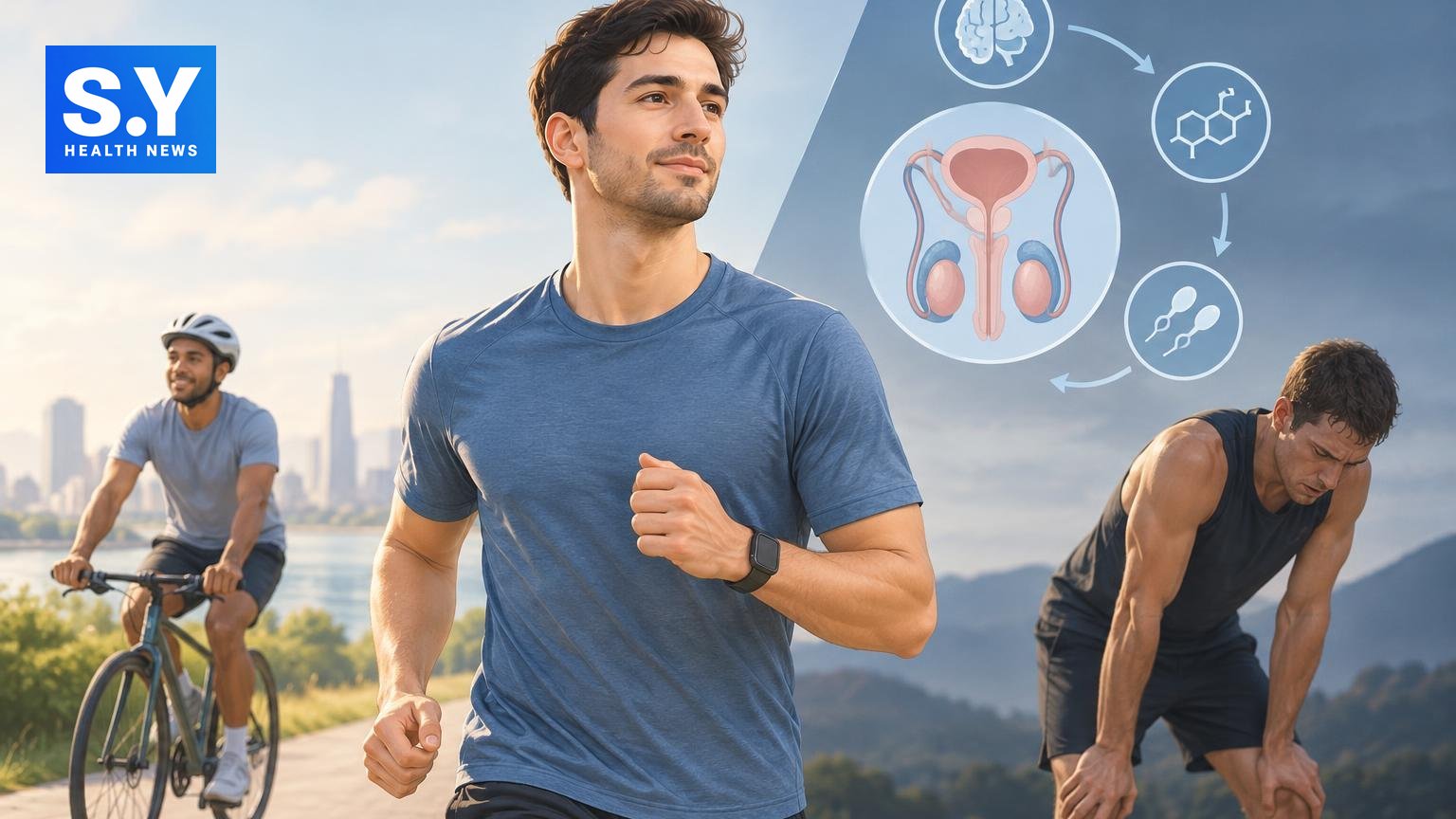
A narrative literature review examining exercise intensity and male fertility reports a two-sided picture. Physical activity is described as broadly good for general well-being and as a potential support for male fertility in cases where infertility is linked to obesity or diabetes. By contrast, the review proposes that excessive exercise might impair fertility through disruption of the hypothalamic-pituitary-testicular axis (the hormone-signaling system that regulates testosterone and sperm production), increased oxidative stress and chronic inflammation, with possible declines in testosterone production and semen quality.[1]
The review draws on both human and animal studies, so its claims mix observations from men with mechanistic findings from laboratory animals. The authors hedge their language throughout, using phrases such as might potentially, and the supplied text offers no threshold separating helpful from harmful exercise, no effect sizes and no pooled analysis. It is best read as a map of plausible mechanisms and research questions rather than as proof that a particular training load helps or harms fertility.
Why This Matters
The review frames male fertility as a large share of the infertility burden, noting that 15% of couples globally experience infertility and that approximately 50% of these cases involve male infertility. Those figures are background context cited in the review rather than new measurements, but they explain why everyday lifestyle factors such as exercise attract research attention.
Exercise is unusual among lifestyle exposures because both too little and too much are plausible concerns. Men receiving fertility advice may encounter conflicting messages, from encouragement to lose weight through activity to warnings that endurance training suppresses hormones. Understanding how the review separates these scenarios, and how tentative that separation is, helps readers judge what the evidence can and cannot support.
What Counts as Intensity Here
The review's organizing variable is exercise intensity rather than a single named programme. Its argument depends on a contrast between ordinary physical activity, which it treats as generally favorable for health, and excessive exercise, which it treats as a possible hazard. Neither end of that contrast is defined with a specific weekly volume, heart-rate zone or training duration in the supplied material.
That distinction matters for interpretation. A reader cannot take from this review a rule such as a number of weekly training hours that is safe for fertility. The review describes a directional hypothesis about dose, not a calibrated dose-response curve, and the absence of defined categories is a limitation rather than a detail to skip past.
| Element | How the review frames it | What the supplied text does not provide |
|---|---|---|
| Moderate or general physical activity | Broadly favorable for well-being; proposed to support fertility where infertility is linked to obesity or diabetes | A defined activity level, duration or energy expenditure |
| Excessive exercise | Proposed as a possible contributor to male infertility via hormonal, oxidative and inflammatory mechanisms | A threshold at which moderate becomes excessive |
| Hormonal pathway | Negative impact on hypothalamic-pituitary-testicular function, with possible decline in testosterone production | Quantified hormone changes in men at given training loads |
| Oxidative and inflammatory pathways | Increased oxidative stress and chronic inflammation proposed as mediators | Measured marker levels or effect sizes |
| Beneficial mechanisms | Increased testicular antioxidant defense, reduced pro-inflammatory cytokines, promoted steroidogenesis | Which findings come from human versus animal models |
Proposed Mechanisms on the Harmful Side
The review's case against excessive exercise rests on three interacting proposals. First, heavy training may disturb hypothalamic-pituitary-testicular function, the signaling axis that governs testosterone production and sperm generation. Second, it may raise oxidative stress, a state in which reactive molecules outpace antioxidant defenses and can damage cells. Third, it may sustain chronic low-grade inflammation. Together, the review suggests, these factors could drive declines in testosterone production and semen quality.
Each step in that chain is plausible from a physiological standpoint, but the review presents it with explicit uncertainty. The word may appears in the causal statements, and no human study in the supplied text is cited to show that a specific training load produced a measured fall in testosterone or sperm concentration. The mechanisms should therefore be treated as hypotheses to test, not as established explanations for an individual's fertility results.
Proposed Mechanisms on the Beneficial Side
The favorable side of the review is more specific about context. It suggests physical activity may enhance male fertility in cases of infertility caused by obesity and diabetes. The proposed routes are an increase in testicular antioxidant defense, a reduction in pro-inflammatory cytokines (signaling molecules that promote inflammation) and promotion of steroidogenesis, the production of steroid hormones such as testosterone. Through these routes, exercise is proposed to enhance spermatogenesis and semen quality in lifestyle-induced infertility.
An abstract record of the same review independently repeats the obesity and diabetes claim, which confirms the review's scope but does not add a second body of evidence. The mechanistic detail about antioxidant defense, cytokines and steroidogenesis appears to draw on animal as well as human work, so the translation from those findings to men with obesity- or diabetes-related infertility remains an inference.[2]
What the Evidence Shows and How Strong It Is
The single most important feature of this evidence base is its design. The paper is a literature review that surveys studies in humans and animal models; the supplied text describes no systematic search strategy, no eligibility criteria, no risk-of-bias assessment and no meta-analysis. There are therefore no pooled estimates, confidence intervals or numbers needed to treat. Any statement about benefit or harm is a narrative synthesis of heterogeneous work.
Within that design, the two claims differ in character. The harmful pathway is framed in the most tentative language, with might potentially and may doing the work, and it is described as a mechanism rather than a demonstrated outcome. The beneficial claim is conditional on a specific cause of infertility, namely obesity and diabetes, which limits how far it can be generalized to all men or all fertility problems.
Interpretation and Limitations
Several limitations follow directly from the review's structure. Human and animal findings are combined without, in the supplied text, a clear accounting of which claim rests on which type of study, and animal models of exercise and spermatogenesis do not automatically predict human reproductive outcomes. The lack of defined intensity categories means the central variable is conceptual rather than measured, so the same word, excessive, may cover very different training loads across the underlying studies.
There is also a selection question the review cannot resolve at abstract level. Men who exercise heavily may differ from less active men in body composition, diet, sleep, heat exposure or supplement use, any of which could influence semen quality independently of training. Without adjustment for such factors in the underlying studies, an association between intense training and poorer reproductive markers would not establish causation, and the review does not claim that it does.
Finally, the background prevalence figures describe couples and the share of cases involving male factors; they do not quantify how much fertility variation exercise explains. Statistical significance, where reported in the underlying studies, would not by itself indicate a clinically meaningful change in the chance of conception.
Research Outlook
The review's own framing points toward what would strengthen the field: prospective studies in men that record training volume and intensity objectively, measure reproductive hormones and semen parameters repeatedly, and separate men with obesity- or diabetes-related infertility from other causes. Defining intensity categories in advance, and reporting effect sizes rather than directions alone, would let future work test whether a genuine dose-response exists.
Mechanistic work could also clarify the proposed mediators. If oxidative stress and inflammatory cytokines are the link between excessive training and poorer semen quality, interventions that alter those markers should shift reproductive outcomes in parallel. Until such evidence exists, the review's contribution is to organize hypotheses, not to settle them.
Practical Understanding
For readers, the defensible conclusions are modest. Physical activity is presented as broadly beneficial for health, and it is proposed as a possible support for fertility when infertility is tied to obesity or diabetes. Excessive exercise is flagged as a possible risk to hormonal and semen parameters, but the review does not say where that line falls. Men with fertility concerns and unusually high training loads have a reasonable basis for a conversation with a clinician; they do not have a basis for a specific training prescription from this review alone.
Questions and Answers
How might exercise intensity affect male fertility and semen quality?
A narrative review proposes two directions. Regular physical activity is described as broadly beneficial and potentially supportive of fertility when infertility is linked to obesity or diabetes. Excessive exercise is proposed to impair hypothalamic-pituitary-testicular function, raise oxidative stress and inflammation, and possibly reduce testosterone production and semen quality. These are hypotheses with hedged wording, not demonstrated causal effects, and no intensity threshold is defined.
What does the review say about exercise helping infertility caused by obesity or diabetes?
The review suggests physical activity may enhance male fertility specifically in infertility caused by obesity and diabetes. Proposed mechanisms are increased testicular antioxidant defense, reduced pro-inflammatory cytokines and promoted steroidogenesis, which could improve spermatogenesis and semen quality. This is a conditional proposal for a defined group, not a general claim that exercise treats male infertility, and effect sizes are not reported in the supplied text.
How strong is the evidence linking excessive exercise to lower testosterone and poorer semen?
The evidence comes from a narrative literature review of human and animal studies rather than a systematic review or meta-analysis, and no pooled estimates are presented. The excessive-exercise pathway is stated with hedged language such as might potentially, and the review describes mechanisms rather than measured outcomes at defined training loads. It should be read as a research hypothesis awaiting targeted human studies.
Does the review give a safe amount or threshold of exercise for male fertility?
No. The review contrasts general physical activity with excessive exercise but defines neither in terms of weekly volume, duration or heart-rate zones in the supplied text. It therefore cannot tell a reader how many training hours are safe. The useful message is directional and uncertain: ordinary activity is treated as favorable, extreme loads as a possible concern, with the boundary unresolved.
What are the main limitations of research on exercise intensity and male reproductive health?
Key limitations include combining human and animal findings without clear separation in the supplied text, undefined intensity categories, and no systematic search, risk-of-bias assessment or pooled analysis. Men who train heavily may also differ in body composition, diet, sleep, heat exposure or supplement use, factors that could affect semen quality independently. These gaps mean associations cannot be read as causation.
What should men with fertility concerns understand about exercise from this review?
The review supports a balanced reading rather than a prescription. Physical activity is presented as generally good for health and possibly helpful when infertility is tied to obesity or diabetes, while excessive exercise is flagged as a possible hormonal and semen risk without a defined threshold. Men with fertility concerns and very high training loads can reasonably raise the question with a clinician.
Sources and References
- Abedpoor, Navid; Taghian, Farzaneh; Hajibabaie, Fatemeh. Exploring the dynamics of exercise intensity on male fertility and reproductive health: advancements and implications for fertility research. 2026
- Exploring the dynamics of exercise intensity on male fertility and reproductive health: advancements and implications for fertility research – DOAJ.
SANYUN Science Center explains published research on men's reproductive and sexual health, connecting scientific evidence with everyday questions while making sources and limitations clear.
Disclaimer: This article is for scientific education and research communication only. It does not provide medical advice, diagnosis, or individualized treatment recommendations, and does not endorse any medication, supplement, device, penile enlargement procedure, or other intervention. Decisions about sexual and reproductive health should be made in consultation with a qualified healthcare professional. Do not delay seeking professional care because of information in this article.
Original Content & Copyright Notice
- This article is prepared for SANYUN Science Center, drawing on published research and publicly available academic literature on men’s sexual and reproductive health. Its editorial explanations and presentation are developed for this platform.
- Copyright in the original editorial content, selection, and arrangement is reserved by SANYUN Science Center to the extent protected by applicable law. Referenced research, quotations, and third-party materials remain subject to the rights of their respective owners. This notice does not claim ownership of scientific facts or third-party research.
- Except where permitted by applicable law or an applicable license, prior written permission is required to reproduce, republish, translate, adapt, redistribute, or commercially reuse protected content. Attribution alone does not grant permission for such reuse.
- For permitted quotation or authorized reuse, clearly identify the source and retain a link to the original article.
- Source: SANYUN Science Center
- Original URL: Retain the original article URL on science.san-yun.com.
- Copyright Holder: SANYUN Science Center, for its own protected editorial content.
- Quotation, excerpts, or authorized reuse must not distort the scientific meaning, omit material limitations or disclaimers, or imply unverified medical claims, product efficacy, or endorsement by SANYUN Science Center.



