




Category: Reproductive Care
Core Research Direction: Narrative review of how physical activity (type, intensity, population) relates to semen quality, examining observational vs interventional evidence and proposed hormonal, oxidative-stress, and inflammatory mechanisms.
Search Intent: Does exercise improve semen quality, and does the effect depend on exercise type, intensity, or whether men are healthy or infertile?
Platform: SANYUN Science Center
Evidence reviewed through: 2026-11-11
Executive Summary
A 2025 narrative review examined how physical activity relates to semen quality across exercise types, intensities and populations. The authors state that global semen quality is declining and identify lack of physical activity as one contributing factor. They describe exercise in treatment-like terms and note that many studies have explored its effects on semen quality. Yet the review reports no consensus on the most effective exercise type or intensity for improving semen quality, because findings across studies are inconsistent.[1]
The authors propose that this inconsistency may reflect differences in study populations, such as healthy versus infertile men, and in research designs, such as observational versus interventional studies. They also summarize three proposed mechanisms: hormonal regulation, oxidative stress and inflammatory factors. The work is a narrative review drawing on literature from PubMed, Web of Science and Google Scholar, reclassifying articles by subject and design rather than performing a systematic review or meta-analysis.
Why This Matters
Semen quality is a central marker of male fertility, and the review places physical inactivity among the contributors to a reported global decline. Men who want to protect their fertility are routinely told to exercise, yet the evidence base does not yet specify which kind of exercise, at what intensity, or for which men. That gap matters for clinical conversations, because a recommendation that helps one group may not transfer to another.
The review describes exercise in treatment-like terms. That framing signals that exercise is being studied as an intervention with plausible biological effects; it is not a claim that any particular exercise prescription has been validated. The absence of consensus on type and intensity is itself a useful finding for readers who encounter confident online claims about the single best workout for sperm health.
Proposed Biological Mechanisms
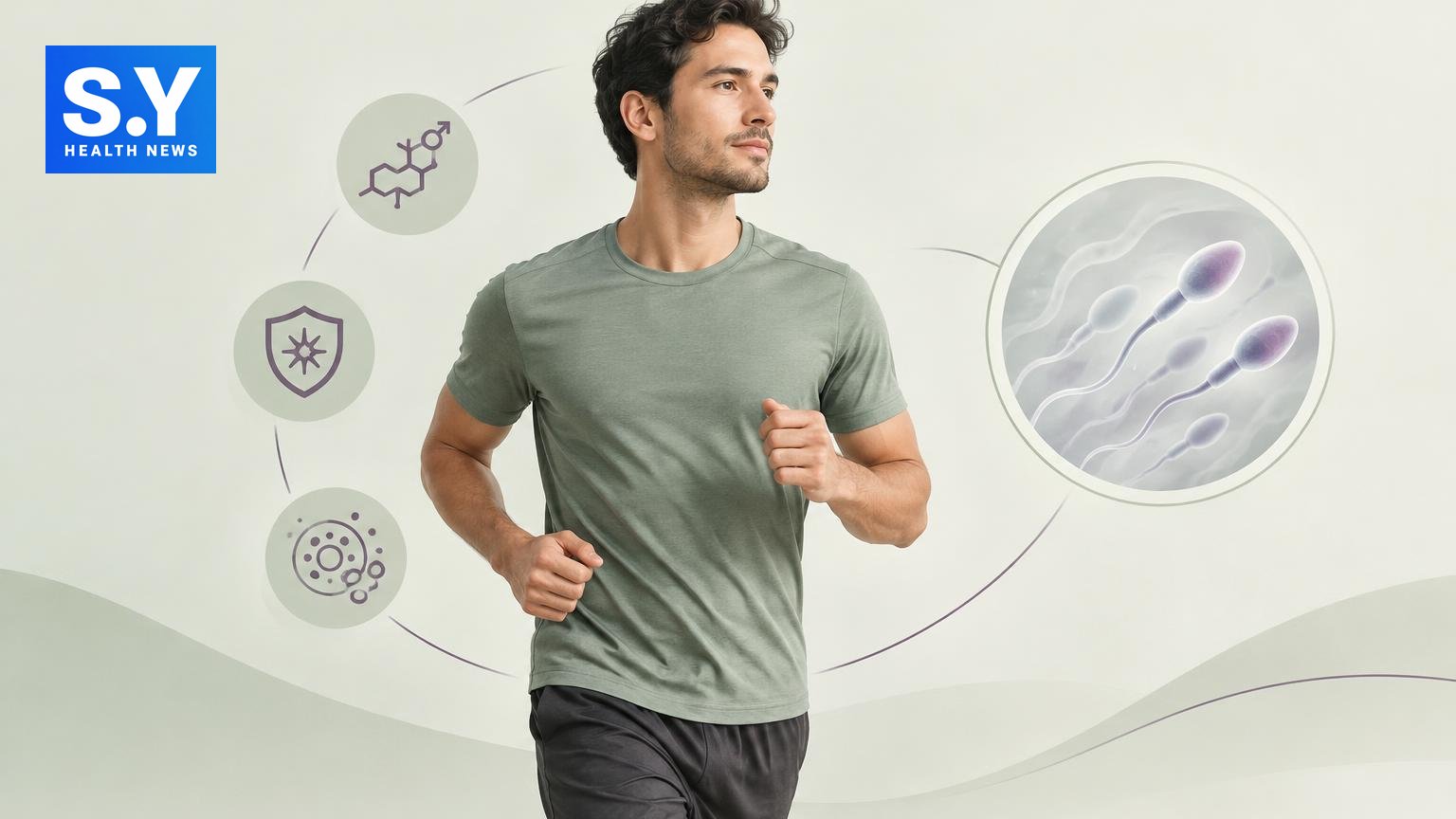
The review summarizes hormonal regulation, oxidative stress and inflammatory factors as pathways through which exercise may influence semen quality. These are proposed mechanisms, not demonstrated causal chains, and the supplied text does not specify the direction, magnitude or experimental support for each one.
- Hormonal regulation: exercise may alter reproductive hormone signaling relevant to sperm production, but the review presents this as a summarized pathway rather than a proven causal link.
- Oxidative stress: exercise may shift the balance between oxidant exposure and antioxidant capacity, a plausible route to sperm damage or protection depending on context.
- Inflammatory factors: exercise may influence inflammatory signaling, which could in turn affect reproductive tract function and semen parameters.
What the Evidence Shows
The review's central empirical message is one of inconsistency. Many studies have examined exercise and semen quality, but they do not converge on a best type or intensity. The authors attribute this disagreement to population differences and design differences: healthy men and infertile men may respond differently, and observational studies of habitual activity cannot easily separate exercise from other lifestyle and health factors. Interventional studies can test exercise more directly, but they may differ in duration, mode, dose and outcome measurement.
| Design or Population Factor | What It Captures | What It Cannot Establish |
|---|---|---|
| Observational study of habitual activity | Real-world activity patterns compared with semen parameters in everyday populations | That exercise itself caused any difference; activity is entangled with diet, body weight, smoking and other factors |
| Interventional exercise study | A defined exercise exposure tested against a comparison condition | A best type or intensity, because protocols differ in duration, mode and dose |
| Healthy men | Findings in men without known fertility problems | That the same response applies to men being evaluated for infertility |
| Infertile men | Findings in men with diagnosed fertility difficulties | That results generalize to the broader population of healthy men |
The supplied abstract does not report effect sizes, confidence intervals, participant counts or pooled estimates. Readers should therefore treat the review as a map of the evidence landscape rather than a source of quantitative guidance. The review itself emphasizes that the overall picture is unresolved.
Interpretation and Limitations
This is a narrative synthesis, not a systematic review with a registered protocol or a meta-analysis. Its search covered PubMed, Web of Science and Google Scholar, and it reclassified articles by subject and research design, but the supplied text does not provide search dates, inclusion criteria, study counts or risk-of-bias assessment. Those omissions limit how far a reader can judge whether the no-consensus conclusion reflects genuine heterogeneity or gaps in the review process.
The population and design explanations are hypotheses offered by the authors, not tested findings. It is plausible that healthy and infertile men differ, and that observational and interventional studies answer different questions, but the review does not quantify how much of the inconsistency these factors explain. Likewise, the hormonal, oxidative-stress and inflammatory pathways are summarized mechanisms; the abstract does not report direct tests of each pathway against semen outcomes.
The article was originally published on March 14, 2025, after being received on September 5, 2024, and accepted on January 13, 2025. Its evidence base should be read as current to that period. The global decline in semen quality and the contribution of physical inactivity are stated as review-level observations; the supplied text gives no underlying trend statistics or measure of the strength of the inactivity contribution.
Research Outlook
Resolving the uncertainty requires studies that separate healthy from infertile populations and that treat exercise type and intensity as defined exposures rather than broad activity categories. Interventional designs with standardized semen analysis outcomes, adequate duration and reported adherence would help distinguish causal effects from associations. Mechanistic work could clarify whether hormonal, oxidative-stress or inflammatory pathways mediate any observed changes, and in which direction. Until such evidence accumulates, the review's conclusion of no consensus remains the most defensible summary.
Key Takeaways
- A 2025 narrative review reports no consensus on the most effective exercise type or intensity for improving semen quality because findings across studies are inconsistent.
- The authors propose that differences between healthy and infertile populations, and between observational and interventional designs, may explain the conflicting results; these remain hypotheses.
- Hormonal regulation, oxidative stress and inflammatory factors are summarized as proposed mechanisms, not established causal pathways.
- The review states that global semen quality is declining and identifies physical inactivity as one contributing factor, without providing quantitative trend data in the supplied text.
- The evidence does not support a specific exercise prescription for semen quality; fertility concerns are best discussed with a qualified clinician who can assess personal context.
Questions and Answers
What biological mechanisms might link exercise to semen quality?
The 2025 review summarizes three proposed pathways: hormonal regulation, oxidative stress and inflammatory factors. Exercise could alter reproductive hormone signaling relevant to sperm production, shift the balance between oxidants and antioxidant defenses, or change inflammatory tone. All three are summarized mechanisms rather than demonstrated causal chains, and the supplied text does not specify which hormones, the direction of effect, or the size of any change in semen parameters.
What did the 2025 review find about the best type and intensity of exercise for sperm health?
It found no consensus on the most effective exercise type or intensity for improving semen quality, because findings across studies are inconsistent. The review notes that many studies have explored the question and describes exercise in treatment-like terms, but it does not identify a superior mode or dose. The supplied abstract reports no effect sizes or pooled estimates.
Why do studies on physical activity and semen quality reach different conclusions?
The review proposes that discrepancies may stem from variation in study populations, such as healthy versus infertile men, and in research methods, such as observational versus interventional designs. These are hypotheses rather than tested findings. The review does not quantify how much of the inconsistency these factors explain, so the explanation is plausible but unconfirmed.
Does exercise improve semen quality in infertile men specifically?
The review does not provide a separate answer for infertile men. It suggests that findings in healthy versus infertile populations may differ, which could contribute to inconsistent results across studies. Without population-specific results in the supplied text, it is not possible to say whether exercise improves semen quality in infertile men; the overall conclusion remains that no consensus exists on optimal exercise type or intensity.
What are the main limitations of the 2025 exercise and semen quality review?
It is a narrative review drawing on PubMed, Web of Science and Google Scholar, and the supplied text reports no systematic search strategy, inclusion criteria, study counts, risk-of-bias assessment or quantitative synthesis. Its population and design explanations are hypotheses, and its mechanism summary does not establish causal direction. It maps the evidence landscape rather than providing prescriptive guidance.
Is physical inactivity really linked to declining semen quality worldwide?
The review states that global semen quality is declining and identifies lack of physical activity as one contributing factor. This is a review-level observation, and the supplied text gives no trend statistics or measure of the strength of the inactivity contribution. Because the optimal exercise type and intensity remain unresolved, activity is best viewed as one part of general health rather than a proven fertility treatment.
Sources and References
- Chen, Jing; Guo, Jin-Ming; Jiang, Bang-Jian; Sun, Fan-Yuan; Qu, Yong-Cun. Asian Journal of Andrology. Asian Journal of Andrology. 2025 27(5):574–580 DOI: 10.4103/aja20252.
SANYUN Science Center explains published research on men's reproductive and sexual health, connecting scientific evidence with everyday questions while making sources and limitations clear.
Disclaimer: This article is for scientific education and research communication only. It does not provide medical advice, diagnosis, or individualized treatment recommendations, and does not endorse any medication, supplement, device, penile enlargement procedure, or other intervention. Decisions about sexual and reproductive health should be made in consultation with a qualified healthcare professional. Do not delay seeking professional care because of information in this article.
Original Content & Copyright Notice
- This article is prepared for SANYUN Science Center, drawing on published research and publicly available academic literature on men’s sexual and reproductive health. Its editorial explanations and presentation are developed for this platform.
- Copyright in the original editorial content, selection, and arrangement is reserved by SANYUN Science Center to the extent protected by applicable law. Referenced research, quotations, and third-party materials remain subject to the rights of their respective owners. This notice does not claim ownership of scientific facts or third-party research.
- Except where permitted by applicable law or an applicable license, prior written permission is required to reproduce, republish, translate, adapt, redistribute, or commercially reuse protected content. Attribution alone does not grant permission for such reuse.
- For permitted quotation or authorized reuse, clearly identify the source and retain a link to the original article.
- Source: SANYUN Science Center
- Original URL: Retain the original article URL on science.san-yun.com.
- Copyright Holder: SANYUN Science Center, for its own protected editorial content.
- Quotation, excerpts, or authorized reuse must not distort the scientific meaning, omit material limitations or disclaimers, or imply unverified medical claims, product efficacy, or endorsement by SANYUN Science Center.



