


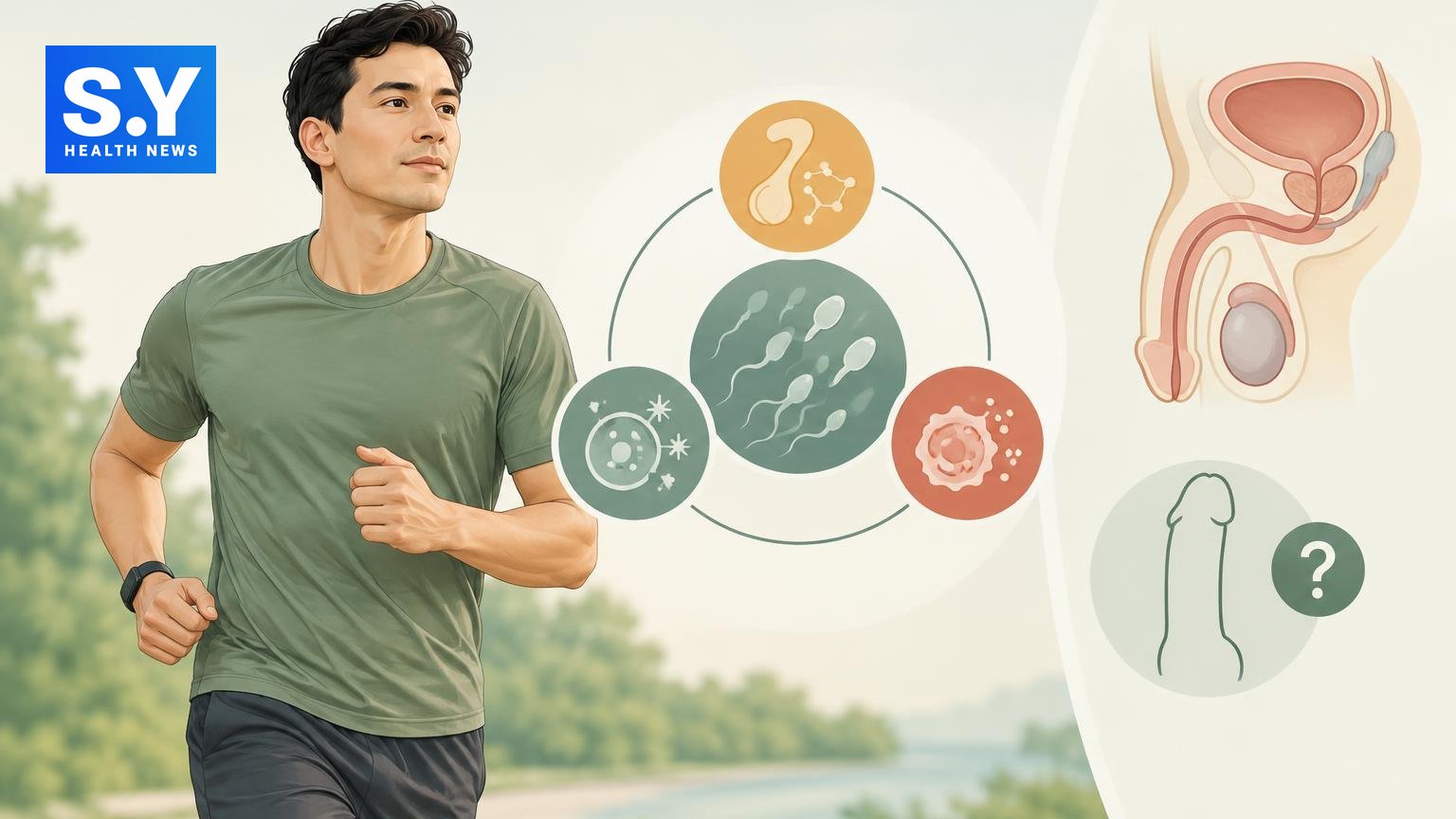


Category: Reproductive Care
Core Research Direction: Sources clarifying what physical activity does and does not do to semen quality, and how common assumptions about normal penile length and sexual function compare with the literature, for a general male reproductive-health explainer.
Search Intent: Does exercise improve semen quality, and do men have an accurate sense of what counts as normal penile length and sexual function?
Platform: SANYUN Science Center
Evidence reviewed through: 2026-11-06
Executive Summary
A 2025 narrative review on physical activity and semen quality reports that global semen quality is described as declining, with insufficient physical activity named as one contributing factor. Its central conclusion is nonetheless qualified: there is no consensus on the most effective type or intensity of exercise for improving semen quality, because findings across studies are inconsistent.[1]
The review drew on literature from three bibliographic databases and reclassified the retrieved articles by subject and by research design to describe the exercise–semen quality relationship. It also summarises proposed mechanisms through which exercise might act, including hormonal regulation, oxidative stress and inflammatory factors.
A second narrative review, published in 2026, asks whether men are aware of normal penile length and sexual function. The source material available here contains only its title and citation, so this article describes the question it poses without reporting its results. Readers should treat any claim about men's accuracy of self-perception as not established by the evidence presented below.[2]
Why This Matters
Reproductive health advice for men is often delivered with more confidence than the underlying studies support. Exercise is frequently framed as a straightforward fertility booster, yet a review of the field does not support a simple prescription for semen quality. The gap between a widely repeated lifestyle message and the state of the evidence matters for anyone making decisions based on headlines rather than on the strength of the data.
The second question in this article concerns perception rather than physiology: whether men's beliefs about normal penile length and sexual function align with what the literature describes. Such beliefs can drive anxiety and health-seeking behaviour, which is why a review devoted to the question is meaningful even before its findings are known. But the same discipline applies here as to exercise: a good question is not an answer.
For readers, the practical skill is separating three things that are easy to blur: a plausible biological mechanism, an observed association in a population, and a demonstrated causal effect of a specific behaviour. Keeping them distinct is the core of evidence literacy in reproductive care.
How Exercise Might Affect Semen Quality: Proposed Mechanisms
The exercise review summarises three routes through which physical activity could plausibly influence semen quality: hormonal regulation, oxidative stress and inflammatory factors. Each is biologically sensible in outline. Reproductive hormones shape sperm production, seminal fluid and sperm are vulnerable to oxidative damage, and inflammation has been associated with poorer reproductive parameters.
Two cautions follow. First, these are mechanisms summarised at review level; the available excerpt does not specify whether the underlying work is human, animal or cell-based, and the strength of each pathway is not quantified. Second, plausibility is not proof of clinical benefit. A pathway can be real while a given exercise programme still fails to move measured semen outcomes, because dose, baseline fitness, body composition, sleep and other exposures may dominate.
The review's framing links the topic to a reported global decline in semen quality, with physical inactivity among the contributing factors identified. That is a contextual assertion rather than a quantified result, and the excerpt supplies neither the data behind the decline nor an estimate of how much activity would matter.
What the Evidence Shows
The exercise paper is a narrative review, not a systematic review or meta-analysis. The available text describes searching three widely used databases and reclassifying articles by subject and research design, but does not state a formal search protocol or a count of included studies. Its contribution is therefore a structured map of a contested field rather than a pooled estimate of effect.
Its headline finding is deliberately negative. Findings across studies are inconsistent enough that no consensus exists on the most effective exercise type or intensity for improving semen quality. That is a statement about the state of the literature; it is not a claim that physical activity is irrelevant to reproductive health, nor a claim that any particular programme works.
The review offers an explanation for the inconsistency: studies differ in their populations, such as healthy men versus men with infertility, and in their methodologies, such as observational versus interventional designs. This is presented as a hypothesis about why results diverge, not as a tested conclusion about the size of any subgroup effect.
The awareness review sits at a different stage of the evidence pathway. It examines, in narrative form, whether men know what constitutes normal penile length and sexual function. Because only the title and citation are available here, the article can report the question but not the answer, and should not be read as saying that men are accurate or inaccurate in their self-assessments.
Interpreting the Findings and Their Limits
Both sources are narrative reviews. Narrative reviews are useful for mapping a field, framing hypotheses and identifying where studies disagree. They do not pool data into a single summary estimate, they can be sensitive to how authors select and weight studies, and they are a different kind of evidence from a systematic review or a controlled trial.
For the exercise review, the available text supplies abstract-level framing rather than the individual studies, effect sizes or participant numbers. It is therefore not possible to state how large any effect is, how semen quality was measured across the included studies, or over what time frame changes were assessed. Claims that a specific workout regimen improves sperm parameters should be described as plausible but unproven on this evidence.
The population and design divide the review highlights carries real interpretive weight. Observational studies can show that more active men tend to have different semen parameters, but they cannot establish that activity caused the difference; interventional studies can test causation but are often small and short. The review's explanation for inconsistent findings turns on exactly this distinction, and it is offered as a possible explanation rather than a demonstrated fact.
For the awareness question, the honest position is that the source material does not allow a conclusion. Asserting that men systematically underestimate, overestimate or accurately judge normal penile length and sexual function would go beyond the evidence supplied. The defensible statement is that a 2026 narrative review poses the question; readers seeking the answer must consult the full publication.
Research Outlook
The clearest agenda implied by the exercise review is well-designed interventional work in clearly defined populations, separating healthy men from men with infertility, using standardised exercise prescriptions and consistent semen outcomes. Until that evidence accumulates, exercise can be recommended for general health without being packaged as a proven fertility treatment.
For the awareness question, the next step is straightforward: read what the full review reports about men's knowledge of normal penile length and sexual function. That is a matter for the complete publication rather than something the available source can answer, and this article does not fill the gap with inference.
Key Takeaways
- A 2025 narrative review reports no consensus on the best exercise type or intensity for improving semen quality, because findings across studies are inconsistent.
- The review attributes that inconsistency to differences between healthy and infertile populations and between observational and interventional study designs, presented as a possible explanation rather than a tested conclusion.
- Proposed mechanisms for an exercise effect include hormonal regulation, oxidative stress and inflammatory factors, summarised at review level without quantification.
- A 2026 narrative review asks whether men are aware of normal penile length and sexual function; its findings are not available in the supplied source, so no conclusion about men's accuracy can be drawn here.
Questions and Answers
Does exercise improve semen quality, and is there a best type or intensity of physical activity?
A 2025 narrative review identifies insufficient physical activity as one contributing factor in a reported global decline in semen quality and summarises plausible hormonal, oxidative-stress and inflammatory mechanisms. However, it reports no consensus on the most effective exercise type or intensity, because findings across studies are inconsistent. It therefore does not establish that any specific programme improves semen quality.
Why do studies on physical activity and semen quality produce conflicting results?
The review proposes that discrepancies may be attributable to variations in study populations, such as healthy versus infertile individuals, and in research methodologies, such as observational versus interventional designs. This is offered as a possible explanation rather than a tested conclusion, so the inconsistency is not fully resolved by the available text, and no single study design answers the question alone.
What biological mechanisms could link exercise to sperm and semen quality?
The review summarises three proposed routes: hormonal regulation, oxidative stress and inflammatory factors. Reproductive hormones influence sperm production, oxidative balance affects sperm and seminal fluid, and inflammation has been linked to poorer reproductive parameters. The excerpt does not specify whether this mechanistic evidence comes from human, animal or cell studies, and biological plausibility alone does not demonstrate a measurable clinical effect.
Do men accurately understand normal penile length and sexual function?
A 2026 narrative review poses exactly this question about awareness of normal penile length and sexual function. However, only its title and citation are available in the source used here, so its findings about how accurate men's perceptions are cannot be summarised. Asserting that men overestimate or underestimate normal parameters would go beyond the evidence; the full review is needed before drawing conclusions.
How strong is the evidence in these narrative reviews of men's reproductive health?
Both are narrative reviews rather than systematic reviews, meta-analyses or controlled trials. The exercise review states no systematic search protocol or included-study count in the available text and gives abstract-level findings without effect sizes. The awareness review's results are not available at all in the supplied source. Neither can quantify effects, and neither should be read as new clinical trial evidence.
How should readers interpret claims that a specific workout routine improves male fertility?
Cautiously. The review maps a field in which findings conflict and where populations and study designs differ, and it explicitly withholds a consensus recommendation on exercise type or intensity for semen quality. Exercise may be reasonable for general health, but a specific fertility benefit from a named programme should be described as plausible and unproven until well-designed interventional studies with standardised outcomes support it.
Sources and References
- Chen, Jing; Guo, Jin-Ming; Jiang, Bang-Jian; Sun, Fan-Yuan; Qu, Yong-Cun. Asian Journal of Andrology. Asian Journal of Andrology. 2025 27(5):574-580 DOI: 10.4103/aja20252.
- Faizal, Yoonus; Wu, Winston; Chan, Vincent; Duns, Glenn; Schubach, Kathryn M; Katz, Darren J. Asian Journal of Andrology. Asian Journal of Andrology. 2026 28(3):223-229 DOI: 10.4103/aja202572.
SANYUN Science Center explains published research on men's reproductive and sexual health, connecting scientific evidence with everyday questions while making sources and limitations clear.
Disclaimer: This article is for scientific education and research communication only. It does not provide medical advice, diagnosis, or individualized treatment recommendations, and does not endorse any medication, supplement, device, penile enlargement procedure, or other intervention. Decisions about sexual and reproductive health should be made in consultation with a qualified healthcare professional. Do not delay seeking professional care because of information in this article.
Original Content & Copyright Notice
- This article is prepared for SANYUN Science Center, drawing on published research and publicly available academic literature on men’s sexual and reproductive health. Its editorial explanations and presentation are developed for this platform.
- Copyright in the original editorial content, selection, and arrangement is reserved by SANYUN Science Center to the extent protected by applicable law. Referenced research, quotations, and third-party materials remain subject to the rights of their respective owners. This notice does not claim ownership of scientific facts or third-party research.
- Except where permitted by applicable law or an applicable license, prior written permission is required to reproduce, republish, translate, adapt, redistribute, or commercially reuse protected content. Attribution alone does not grant permission for such reuse.
- For permitted quotation or authorized reuse, clearly identify the source and retain a link to the original article.
- Source: SANYUN Science Center
- Original URL: Retain the original article URL on science.san-yun.com.
- Copyright Holder: SANYUN Science Center, for its own protected editorial content.
- Quotation, excerpts, or authorized reuse must not distort the scientific meaning, omit material limitations or disclaimers, or imply unverified medical claims, product efficacy, or endorsement by SANYUN Science Center.



