




Category: Clinical Insights
Core Research Direction: Pharmacovigilance evidence on drug-associated male sexual dysfunction: what disproportionality analyses of spontaneous adverse-event reports (FAERS) can and cannot establish about statins and SSRIs, and how prescribing decisions should be framed around that uncertainty.
Search Intent: What do FAERS-based disproportionality analyses suggest about statins and SSRIs as contributors to male sexual dysfunction, and what can such data not tell a clinician or patient about individual risk or causality?
Platform: SANYUN Science Center
Evidence reviewed through: 2026-10-31
Executive Summary
Pharmacovigilance databases such as the FDA Adverse Event Reporting System (FAERS) are used to detect safety signals: drug–event pairs reported more often than expected relative to the rest of the database. Two analyses in this packet apply that logic to male sexual dysfunction, one for statins and one, as a stated objective, for six commonly prescribed selective serotonin reuptake inhibitors (SSRIs). The statin analysis searched reports in which a statin was the primary suspected drug and the event in a male patient was sexual dysfunction, and it extracted 2,408 reports involving 2,173 patients; three disproportionality methods together produced 28 high-risk signals for male sexual function.[1]
The SSRI analysis stated its objective as describing and comparing reporting patterns and signal strengths for male sexual dysfunction across six SSRIs: fluoxetine, paroxetine, sertraline, fluvoxamine, citalopram and escitalopram, a name truncated in the supplied record. That record contains no results, so this review can describe the design but cannot report what the analysis found. The asymmetry is itself the lesson: a large number of visible reports does not convert disproportionality into incidence, and an unreported result cannot be read as either confirmation or reassurance.[2]
The practical message is conservative. A FAERS signal can justify attention and further study; it does not establish that a statin or an SSRI caused one person's sexual difficulty, nor how likely that outcome is. Decisions should rest on the treated condition, expected benefit, timing, competing causes such as depression, vascular disease and other medicines, and a clear plan to review rather than an alarming or dismissive reading of a signal.[3]
Why This Matters
Male sexual dysfunction is common and multifactorial. It overlaps with cardiometabolic disease, depression, relationship stress and numerous medicines, so attribution in an individual is rarely straightforward. Statins prevent major vascular events in people at elevated cardiovascular risk, and untreated depression carries substantial morbidity. Both a missed adverse effect and an unnecessary discontinuation can cause harm, so the clinical task is to hold those risks together when the available evidence is a reporting signal rather than a controlled estimate.
A consumer drug-information article shows how easily this uncertainty is flattened. It states that roughly 30–60% of SSRI users may experience reduced libido, delayed ejaculation or anorgasmia, and that such effects are usually reversible on stopping. The supplied text cites no study, denominator or peer-reviewed source for that figure, so it should not be repeated as a verified rate. It is better read as an illustration of why controlled incidence data and clear provenance matter when discussing sexual side effects.
How Disproportionality Analyses Work
FAERS collects spontaneous reports submitted by clinicians, patients and manufacturers. It has no defined population denominator: the number of people exposed to a drug is unknown, reporting is voluntary and incomplete, and a submitted report does not require a judged causal link. Disproportionality methods therefore ask a narrower question — whether a given drug–event pair accounts for a larger share of reports than expected from the database's overall reporting pattern.
The statin analysis applied three such methods: the reporting odds ratio (ROR), the proportional reporting ratio (PRR) and the Bayesian confidence propagation neural network (BCPNN). Using several methods is a reasonable way to test whether a signal survives different statistical assumptions, but they share the same underlying limitation. They detect imbalance in reporting, not incidence, biological effect or causality. A signal can arise because a drug genuinely causes an event, because publicity prompts reporting, because the drug is used in people already at risk, or because a competing drug is under-reported.
This gap between statistical and clinical meaning is not unique to sexual health. A 2026 editorial on systematic reviews and meta-analyses of perioperative analgesia argued that sophisticated statistical analysis cannot compensate for inherent flaws or heterogeneity in the underlying studies, and that critical appraisal must precede use in guidelines and daily practice. That editorial concerns a different clinical field and is not direct evidence about statins or SSRIs; it is used here only for the general principle that a statistically robust statistic is not by itself a clinical risk estimate.[4]
What the Statin Analysis Reported
The statin study searched FAERS for reports from the first quarter of 2004 to the fourth quarter of 2023 in which a statin was the primary suspected drug and the adverse event was sexual dysfunction in a male patient. It retrieved 2,408 reports involving 2,173 patients, meaning some patients contributed more than one report. The unit of analysis is therefore the report, not a verified individual case with adjudicated causality.
The composition of those reports is descriptive rather than risk-related. Patients aged 18–65 accounted for 1,026 reports (47.22%), the United States contributed 897 reports (41.28%), and 2010 had the largest annual count at 183 reports (8.42%). Atorvastatin accounted for 990 reports (41.11%), rosuvastatin for 639 (26.54%) and simvastatin for 502 (20.85%). These counts reflect how often drugs are prescribed, how reporters behave and which products were marketed over the period; they are not rates per user and cannot rank drugs by per-patient risk.
Using all three methods, the authors identified 28 high-risk signals for male sexual function. Hypoesthesia signals involved seven statins: atorvastatin, rosuvastatin, simvastatin, pravastatin, fluvastatin, lovastatin and pitavastatin. Erectile dysfunction signals were described for a group listed by the source as atorvastatin, rosuvastatin, simvastatin, pravastatin, ezetimibe and lovastatin. That list is internally inconsistent: atorvastatin appears twice and ezetimibe is not a statin. The safest reading is that erectile dysfunction signals clustered across several lipid-lowering medicines in this dataset, without treating the exact enumeration as reliable.
The authors concluded that medication assessment should precede statin use, particularly in patients aged 18–65, with vigilance for male sexual dysfunction within 30 days of starting therapy, and that clinicians should attend to sexual adverse events beyond those listed in package inserts. A parallel abstract record of the same study reports the same conclusion. This is a reasonable clinical prompt derived from reporting patterns, but it is a recommendation rather than a demonstrated incidence or causal effect; the 30-day window should be presented as a proposed period of attention, not an established latency.[5]
What the SSRI Analysis Can and Cannot Tell Us
The SSRI paper set out to describe and compare reporting patterns and signal strengths of male sexual dysfunction associated with six commonly prescribed SSRIs in FAERS, naming fluoxetine, paroxetine, sertraline, fluvoxamine, citalopram and a sixth drug whose name is truncated in the record. Its design therefore parallels the statin study: spontaneous reports, a drug–event focus and disproportionality metrics. The supplied record contains no results, so any claim about which SSRI generated the strongest signal, or how the drugs compared, would be unsupported here.
That gap matters because SSRIs are widely used in depression, a condition that itself affects libido, arousal and orgasm. An association between an SSRI and sexual dysfunction in spontaneous reports is entangled with the indication, comorbidities, co-medication and reporting behaviour. A signal may still be clinically meaningful, but interpreting it requires controlled studies and clinical assessment rather than inference from a truncated abstract. This review makes no claim about the relative signal strength of individual SSRIs.
Evidence Table
| Measure / finding | Result | Population / follow-up | Limitations |
|---|---|---|---|
| The stated objective of the SSRI study was to describe and compare reporting patterns and signal strengths of male sexual dysfunction for six commonly prescribed SSRIs using FDA Adverse Event Reporting System (FAERS) data. | male sexual dysfunction adverse-event reports for six SSRIs in FAERS | Abstract is truncated; no results are visible in the supplied text. | |
| The SSRI analysis covered six representative SSRIs: fluoxetine, paroxetine, sertraline, fluvoxamine, citalopram and escitalopram (name truncated in source). | FAERS reports for six SSRIs | Text truncated at 'escital'; drug list only, no findings. | |
| The statin analysis collected FAERS reports from Q1 2004 to Q4 2023 in which a statin was the primary suspected drug and the adverse event in male patients was sexual dysfunction. | male FAERS reports with statin as primary suspected drug, event = sexual dysfunction; 2004 Q1 to 2023 Q4 | Spontaneous reporting data; reporting is voluntary and not population-denominator based. | |
| Signal detection used three disproportionality methods: reporting odds ratio (ROR), proportional reporting ratio (PRR) and Bayesian confidence propagation neural network (BCPNN). | FAERS statin reports | Disproportionality methods detect reporting imbalance, not causality or incidence. | |
| adverse-event reports | 2,408 reports; 2,173 patients reports / patients | male FAERS reports, statins as primary suspected drug; n=2,173 patients; 2004 Q1 to 2023 Q4 | Report counts, not incidence; spontaneous reporting. |
| share of reports | 1,026 (47.22%); 897 (41.28%); 183 (8.42%) reports (%) | male FAERS statin sexual-dysfunction reports; n=2,173 patients; 2004 Q1 to 2023 Q4 | Composition of a reporting database, not population risk. |
| report counts by statin | 990 (41.11%); 639 (26.54%); 502 (20.85%) reports (%) | male FAERS statin sexual-dysfunction reports; n=2,173 patients; 2004 Q1 to 2023 Q4 | Counts reflect prescribing volume and reporting behavior, not per-user risk. |
| number of signals | 28 signals | FAERS statin reports; n=2,173 patients; 2004 Q1 to 2023 Q4 | Signals indicate disproportional reporting, not confirmed causal effects. |
| Hypoesthesia signals involved seven statins (atorvastatin, rosuvastatin, simvastatin, pravastatin, fluvastatin, lovastatin, pitavastatin); erectile dysfunction signals involved six drugs listed by the source as atorvastatin, rosuvastatin, simvastatin, pravastatin, ezetimibe and lovastatin. | FAERS statin reports; n=2,173 patients; 2004 Q1 to 2023 Q4 | Source's drug list is internally inconsistent (repeats atorvastatin, includes ezetimibe, a non-statin); treat carefully. | |
| The authors recommend thorough medication assessment before statin use, particularly in patients aged 18–65, with vigilance for male sexual dysfunction within 30 days of starting therapy. | men prescribed statins; within 30 days of administration | Recommendation is inferred from spontaneous-report patterns, not from controlled incidence data. |
The table juxtaposes two analyses that answer different questions and should not be ranked head-to-head. The statin study reports observed counts and signals over a defined reporting window; the SSRI study reports a design and objective without visible results. Neither supplies a population denominator, neither estimates incidence, and neither establishes causality.
Interpretation and Limitations
The principal limitation is the absence of a denominator. No one knows how many men took each statin during the period, so the 990 atorvastatin reports cannot be converted into a risk per thousand users. Reporting is voluntary and subject to media attention, litigation and prescribing fashion; the 183 reports in 2010 may reflect publicity rather than a change in biological risk. The database also contains duplicate reports and variable case quality, so the distinction between 2,408 reports and 2,173 patients is a reminder that report counts are not patient counts.
Confounding by indication is substantial. Statins are prescribed to people with dyslipidaemia and vascular disease, and erectile dysfunction is itself a recognised marker of vascular risk; SSRIs are prescribed for depression, which affects sexual function independently. Disproportionality methods cannot adjust for these factors. At most they raise a hypothesis that deserves testing in designs with a denominator, an active comparator and prespecified outcome definitions. The unreliable drug list behind the erectile dysfunction signal is a further caution against over-reading product rankings.
The consumer drug-information article asserts that drug-associated sexual dysfunction is mostly reversible and that patients should not stop or change doses without physician guidance. The second point is sound as general advice, but neither statement is a research finding in the supplied materials. Reversibility varies with drug, duration and individual, so the claim cannot be used to reassure patients that a signal is benign.
The editorial on meta-analyses reinforces the same discipline. Its listed methodological problems include weak inclusion and exclusion criteria, absent critical quality appraisal, heterogeneity, bias, inadequate follow-up, fragility, spin and inaccurate interpretation. The sophistication of ROR, PRR or BCPNN does not overcome spontaneous-report bias, even though the editorial's own subject is perioperative analgesia rather than sexual medicine.
Research and Clinical Outlook
What would move this field beyond signals? Studies with a defined denominator and an active comparator are needed: cohort designs within linked prescribing and outcome databases, or adequately powered trials with prespecified sexual-function endpoints. Those designs can estimate incidence and adjust for age, vascular risk, depression severity and concomitant medicines. Signal detection remains useful for generating hypotheses and flagging unexpected events, but it should be reported alongside explicit statements of what the data cannot support.
For clinicians, the practical implication is a structured conversation rather than a verdict. Before starting a statin or an SSRI, it is reasonable to ask about current sexual function, explain that some people report changes, note that the underlying condition and other medicines can also contribute, and invite concerns to be raised rather than managed by stopping treatment independently. If a temporal association emerges, review the whole picture: indication control, competing causes, dose and alternatives. The statin authors' proposal to watch the first 30 days is a sensible follow-up prompt, provided it is framed as a precaution rather than a proven window.
For patients, the honest summary is that reporting databases have flagged male sexual dysfunction in association with statins and, as a planned comparison, with SSRIs, but they cannot say how likely it is for any one person or prove that the drug caused it. A signal is a reason to talk with a prescriber, not a reason to stop a medicine that may be protecting the heart or treating depression. The quality of the eventual decision depends on the full clinical context, which no spontaneous-report analysis can supply.
Key Takeaways
- FAERS disproportionality analyses detect reporting imbalance, not incidence or causation; a signal is a hypothesis-generating observation.
- The statin analysis extracted 2,408 reports involving 2,173 patients from 2004 through 2023, and three methods produced 28 male sexual-function signals; these are report counts, not risk estimates.
- Atorvastatin, rosuvastatin and simvastatin contributed the largest report counts, but this reflects prescribing and reporting patterns rather than per-user risk.
- The SSRI analysis covers six SSRIs and aims to compare reporting patterns and signal strengths, but the supplied record contains no results, so no SSRI ranking can be stated.
- The statin authors proposed assessment before prescribing and attention to sexual dysfunction within 30 days of starting therapy, particularly for patients aged 18–65; this is a recommendation, not a demonstrated latency or effect size.
- Consumer claims about a 30–60% SSRI sexual side-effect rate or general reversibility are not verified research findings in the supplied materials and should not be presented as established clinical facts.
- Clinical decisions should weigh the treated condition, competing causes and temporal plausibility, and should avoid either dismissing a signal or stopping effective treatment without review.
Questions and Answers
What is a disproportionality analysis in pharmacovigilance?
It is a statistical method applied to spontaneous adverse-event databases such as FAERS. It asks whether a drug–event pair accounts for a larger share of reports than expected from the database's overall reporting pattern. The statin study used the reporting odds ratio, proportional reporting ratio and Bayesian confidence propagation neural network. These methods flag reporting imbalance; they do not measure incidence, prove causation or replace controlled studies.
What did the statin FAERS analysis find?
It extracted 2,408 reports involving 2,173 patients in which a statin was the primary suspected drug and the event was male sexual dysfunction, covering 2004 to 2023. Atorvastatin had the most reports at 990, followed by rosuvastatin at 639 and simvastatin at 502. Three methods together produced 28 high-risk signals. These are reporting patterns, not incidence or proof that statins caused the events.
What did the SSRI FAERS analysis show?
The supplied record shows its objective was to describe and compare reporting patterns and signal strengths of male sexual dysfunction across six SSRIs: fluoxetine, paroxetine, sertraline, fluvoxamine, citalopram and a sixth name truncated in the source. However, the record contains no results. Therefore no claim about which SSRI had the strongest signal, or how the drugs compared, can be supported from this material.
How strong is this evidence for an individual patient?
It is hypothesis-generating, not individually predictive. Spontaneous reports lack a denominator and are subject to under-reporting, publicity and confounding by indication; erectile dysfunction overlaps with vascular disease and depression. A signal supports attention and further study but cannot estimate a person's probability of sexual dysfunction or establish that a specific drug caused it. Decisions need clinical assessment and, ideally, controlled studies.
Can these findings tell clinicians which statin or SSRI is safest for sexual function?
No. Report counts are shaped by prescribing volume, marketing and reporting behaviour, so atorvastatin's 990 reports cannot be read as a higher per-user risk than another statin. The erectile dysfunction drug list in the statin paper is internally inconsistent, repeating atorvastatin and including ezetimibe, a non-statin. The SSRI results are not visible. Product-level rankings would require denominator-based comparative studies.
How should a patient or clinician respond to these signals in practice?
Treat the signal as a prompt for a structured conversation, not a reason to stop treatment independently. Review the indication, competing causes, timing and other medicines. The statin authors proposed assessment before prescribing and vigilance within 30 days of starting, particularly for patients aged 18–65; this is a recommendation rather than a proven latency or effect size. Any concern should be raised with the prescriber.
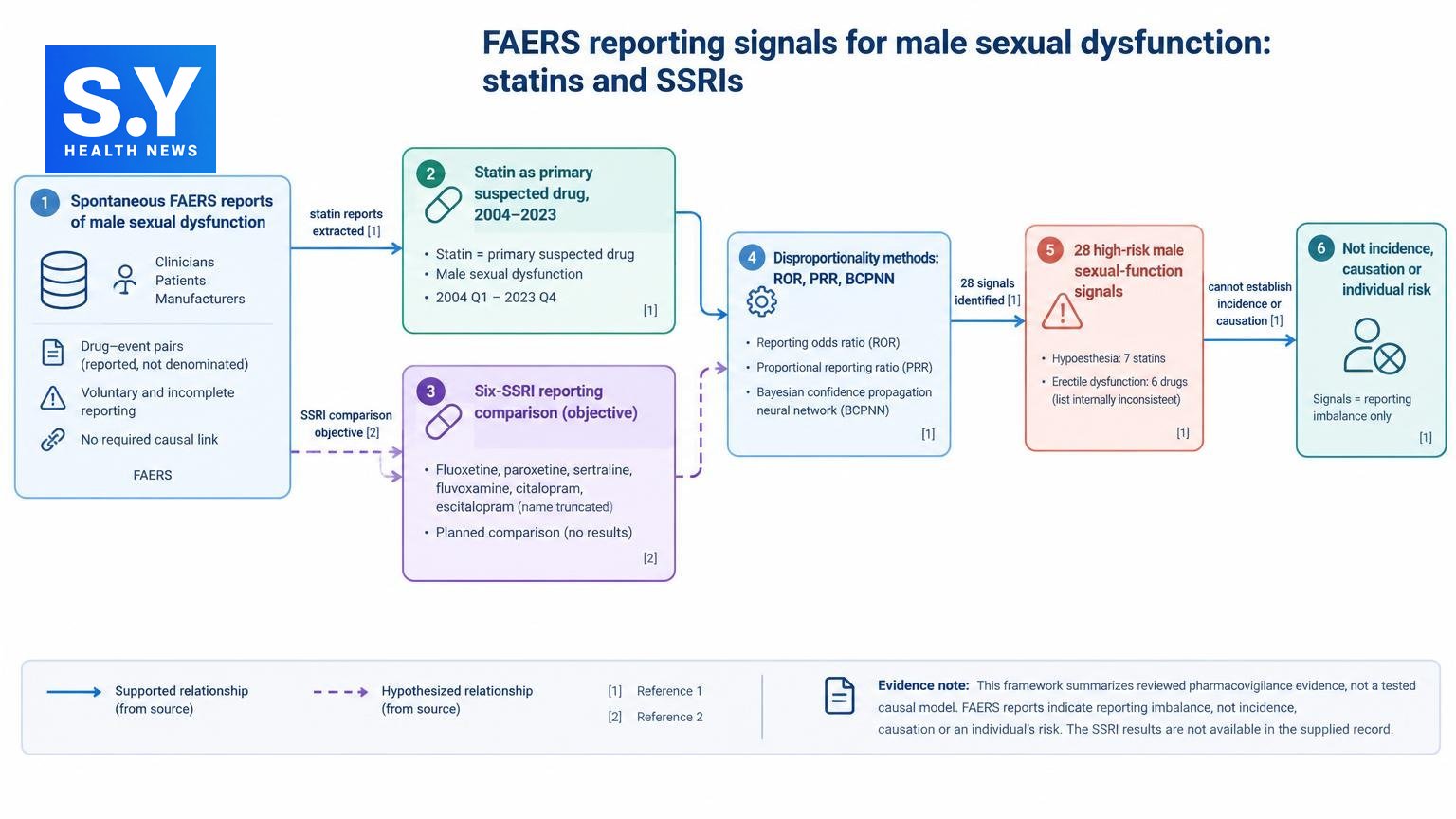
Conceptual framework: Conceptual framework summarizing the reviewed pharmacovigilance evidence, not a tested causal model. Spontaneous FAERS reports of male sexual dysfunction naming a statin as primary suspected drug (2004–2023) and a stated comparison across six SSRIs feed disproportionality methods (ROR, PRR, BCPNN); the statin analysis generated 28 high-risk signals. The framework marks the key limitation: signals indicate reporting imbalance, not incidence, causation or an individual's risk. The SSRI results are not available in the supplied record.
Academic References & Evidence
- 高雯; 孙玲; 安小通. 中华男科学杂志. 中华男科学杂志. 2026 32(02):153-159 DOI: 10.13263/j.cnki.nja.2026.02.009.
- 【期刊论文】 Male sexual dysfunction associated with selective serotonin reuptake inhibitors (SSRIs): A pharmacovigilance disproportionality analysis of FAERS data NSTL 国家科技图书文献中心. Journal of Affective Disorders. 2026 402:121336-121336 DOI: 10.1016/j.jad.2026.121336.
- 哪些药物会引起性功能减退六类药物影响性功能.
- Girish P. Joshi; Dileep N. Lobo; Henrik Kehlet. Challenges in interpretation of randomised clinical trials included in systematic reviews and clinical guidelines. British Journal of Anaesthesia. 2026 137(4):972-975 DOI: 10.1016/j.bja.2026.07.019.
- 基于FAERS数据库对他汀类药物致男性性功能障碍不良反应信号挖掘与分析. 中华男科学杂志. 2026 (2):153-159
SANYUN Science Center explains published research on men's reproductive and sexual health, connecting scientific evidence with everyday questions while making sources and limitations clear.
Disclaimer: This article is for scientific education and research communication only. It does not provide medical advice, diagnosis, or individualized treatment recommendations, and does not endorse any medication, supplement, device, penile enlargement procedure, or other intervention. Decisions about sexual and reproductive health should be made in consultation with a qualified healthcare professional. Do not delay seeking professional care because of information in this article.
Original Content & Copyright Notice
- This article is prepared for SANYUN Science Center, drawing on published research and publicly available academic literature on men’s sexual and reproductive health. Its editorial explanations and presentation are developed for this platform.
- Copyright in the original editorial content, selection, and arrangement is reserved by SANYUN Science Center to the extent protected by applicable law. Referenced research, quotations, and third-party materials remain subject to the rights of their respective owners. This notice does not claim ownership of scientific facts or third-party research.
- Except where permitted by applicable law or an applicable license, prior written permission is required to reproduce, republish, translate, adapt, redistribute, or commercially reuse protected content. Attribution alone does not grant permission for such reuse.
- For permitted quotation or authorized reuse, clearly identify the source and retain a link to the original article.
- Source: SANYUN Science Center
- Original URL: Retain the original article URL on science.san-yun.com.
- Copyright Holder: SANYUN Science Center, for its own protected editorial content.
- Quotation, excerpts, or authorized reuse must not distort the scientific meaning, omit material limitations or disclaimers, or imply unverified medical claims, product efficacy, or endorsement by SANYUN Science Center.



