




Category: Reproductive Care
Core Research Direction: A pilot randomized controlled trial of the Family-centered Adolescent Sperm banking values clarification Tool (FAST/FP-DAD) to support sperm banking communication and decision-making in adolescent males with newly diagnosed cancer, evaluating its feasibility/acceptability and its limited efficacy on banking attempts and decision quality
Search Intent: In adolescent males with a new cancer diagnosis, can a family-centered values clarification tool added to a standard fertility consult improve sperm banking attempts and decision quality, and is it feasible and acceptable?
Platform: SANYUN Science Center
Evidence reviewed through: 2026-11-23
Executive Summary
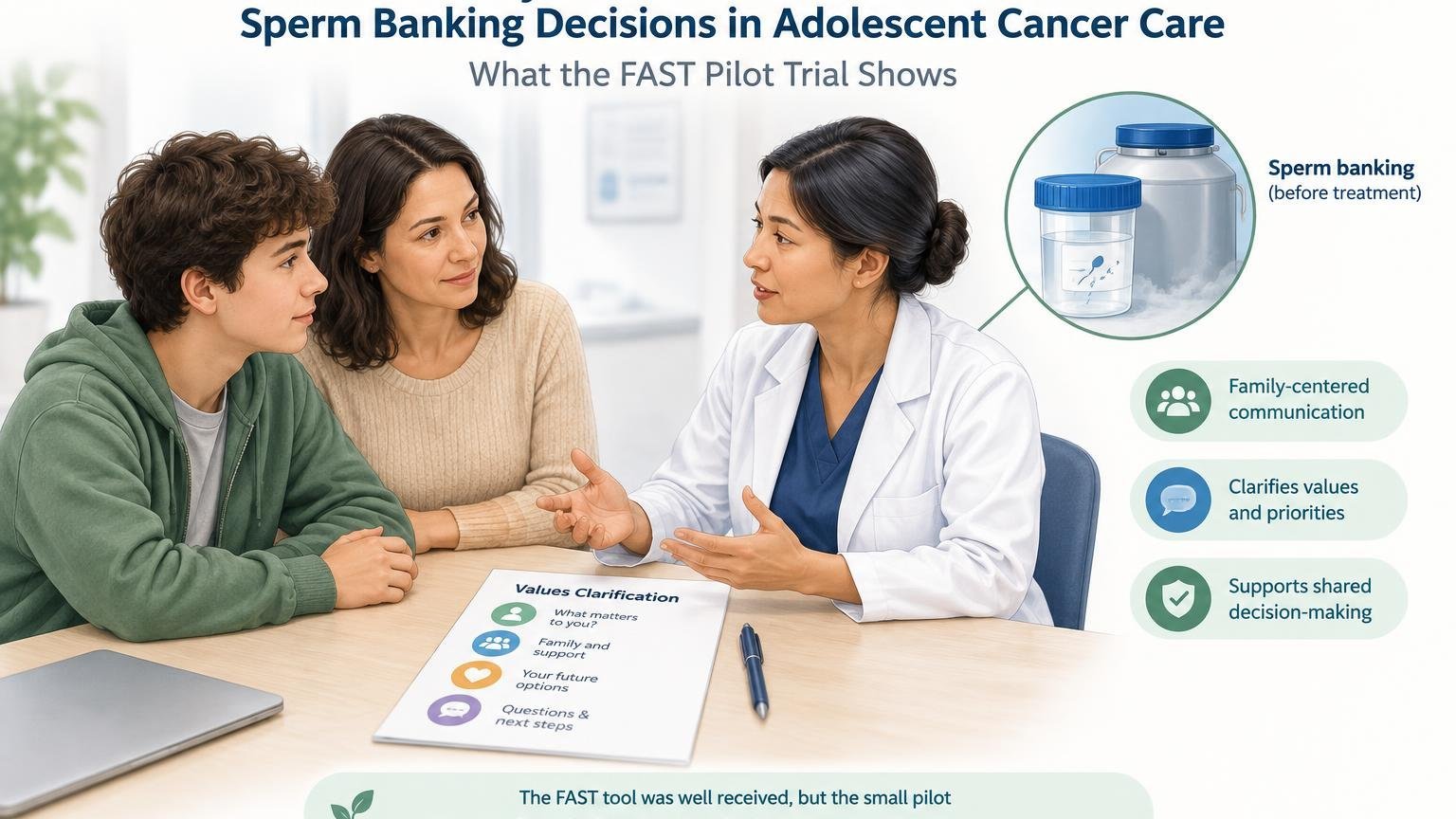
A new cancer diagnosis in an adolescent male creates a narrow window for fertility preservation before treatment begins. Sperm banking is a standard option, but families often need structured support to discuss it under time pressure. The Family-centered Adolescent Sperm banking values clarification Tool (FAST) was developed to facilitate sperm banking communication and decision-making before cancer treatment.[1]
The FP-DAD pilot trial, registered as NCT04268004, randomized males aged 12 to 25 years with a new cancer diagnosis and their caregivers to standard of care (a fertility consult) or to FP-DAD, which added the FAST tool and an interventionist-led discussion to the same consult. The stated aims were to assess feasibility and acceptability and to examine efficacy on banking attempts and decision quality.
Acceptability ratings were high, at 88% to 100% among FP-DAD participants. However, recruitment and participation challenges limited the final sample to 21 adolescents and 32 caregivers. Banking attempts were 67% in the standard-of-care arm and 82% in the FP-DAD arm, a difference the trial reported as not statistically significant. Decision quality did not differ significantly between groups, although several medium-to-large effect sizes were observed. The authors describe limited efficacy but suggest the effect sizes indicate the pilot was underpowered.
Why This Matters
Fertility counseling before cancer treatment is time-sensitive. For adolescent males, the decision is not only a medical one; it involves parents or caregivers, concerns about masturbation and sperm collection, beliefs about masculinity and future parenthood, and the emotional weight of a cancer diagnosis. Values clarification tools aim to surface those considerations so that a decision reflects the adolescent's and family's priorities rather than only the clinician's recommendation.
The FAST was designed specifically for this family context. Unlike a standard informational consult, it adds a structured process for clarifying values and an interventionist-led discussion. The pilot trial asked whether that addition was feasible and acceptable, and whether it showed promise for increasing banking attempts or improving the quality of the decision. Those are different questions from whether the tool is proven to improve fertility outcomes.
Biological and Clinical Context
Cancer treatments such as certain chemotherapy regimens and pelvic radiation can impair spermatogenesis. Sperm banking before treatment is a way to preserve the possibility of future biological fatherhood. For adolescent males who have reached spermatogenesis, collection and cryopreservation may be possible, but the practical and emotional barriers can be substantial, particularly when a diagnosis has just been delivered and treatment is scheduled quickly.
A standard fertility consult provides information about risk and options. The FAST intervention does not change the underlying biology or the cryopreservation process. Instead, it targets the communication and decision-making pathway: helping adolescents and caregivers articulate what matters to them, reducing ambiguity about the banking process, and supporting a shared decision. The mechanism is therefore behavioral and communicative, not pharmacological or procedural.
What the Pilot Trial Did
The FP-DAD trial was a pilot parallel randomized controlled trial. Males aged 12 to 25 years with a new cancer diagnosis and their caregivers were randomized to standard of care or to FP-DAD. The standard-of-care arm received a fertility consult. The FP-DAD arm received the same fertility consult plus the FAST tool plus an interventionist-led discussion. One month later, FP-DAD participants completed acceptability surveys, and both arms completed the Brief Subjective Decision Quality measure.
The trial had two stated aims: assess feasibility and acceptability of FP-DAD, and examine efficacy regarding banking attempts (yes or no) and decision quality. An additional exploratory analysis examined differences in decision quality by banking attempt. The trial was not designed as a definitive efficacy study; pilot trials are intended to test procedures, recruitment, and signal, not to provide confirmatory answers.
What the Evidence Shows
The acceptability data were strong. Among FP-DAD participants who completed the one-month survey, acceptability ratings ranged from 88% to 100%. This suggests that the tool and discussion were well received by the families who experienced them. However, acceptability is not the same as effectiveness, and high satisfaction can coexist with no measurable change in behavior.
The trial enrolled 21 adolescents and 32 caregivers after recruitment and participation challenges limited the final sample. That is small even for a pilot. Banking attempts were 67% in the standard-of-care arm and 82% in the FP-DAD arm. The difference did not reach statistical significance. The absolute difference looks sizable, but with such a small sample the uncertainty around those percentages is wide, and a chance finding cannot be excluded.
Decision quality did not differ significantly between groups. However, the authors reported medium-to-large effect sizes for four of six items among adolescents (d = 0.6 to −0.90) and two of six items among caregivers (d = 0.36 to −0.78). Effect sizes describe the magnitude of a difference in the sample; they do not by themselves establish a statistically reliable or clinically meaningful benefit. The authors interpreted these signals as consistent with limited power rather than absence of effect.
An exploratory analysis found that decision quality was significantly higher across several domains among those who banked. This is a cross-sectional association within the trial, not evidence that banking causes better decision quality. It is equally plausible that families who felt more confident and informed were more likely to proceed with banking, or that the banking process itself clarified values. The authors note that the relationship emphasizes banking benefits, but the design cannot separate these explanations.
| Outcome | Standard of care | FP-DAD (FAST plus consult) | Interpretation |
|---|---|---|---|
| Banking attempt rate | 67% | 82% | Difference not statistically significant in a 21-adolescent pilot sample. |
| Decision quality (adolescents) | Between-group difference not significant | Medium-to-large effect sizes for four of six items (d = 0.6 to −0.90) | Signal of possible benefit; underpowered pilot cannot confirm. |
| Decision quality (caregivers) | Between-group difference not significant | Medium-to-large effect sizes for two of six items (d = 0.36 to −0.78) | Signal of possible benefit; underpowered pilot cannot confirm. |
| Acceptability of FP-DAD | Not applicable | 88% to 100% among FP-DAD participants | High acceptability among those who completed surveys; small sample. |
| Decision quality by banking attempt | Explored across both arms | Significantly higher across several domains among those who banked | Exploratory association; cannot establish causation. |
Interpretation and Limitations
The most defensible conclusion is that FP-DAD was feasible enough to deliver and highly acceptable to the families who received it, but the pilot was too small to demonstrate efficacy. The trial's own authors describe limited efficacy and suggest that the effect sizes may reflect sample size rather than a true absence of benefit. That is a reasonable hypothesis, but it remains a hypothesis. A pilot that shows a promising signal does not prove that a larger trial will confirm it.
Feasibility was mixed. Time constraints and participation challenges limited full family participation, and recruitment difficulties reduced the final sample. These are common problems in pediatric oncology trials, where families are under acute stress and clinical schedules are tight. A tool that is acceptable in principle may still be difficult to deliver at the moment it is most needed. The authors state that findings will inform adaptations to the FAST for clinical implementation, which acknowledges that the current version is not yet ready for routine use.
Several other limitations matter for interpretation. The trial was unblinded, and both participants and interventionists knew which arm they were in. Acceptability surveys were completed only by FP-DAD participants, so there is no comparator for satisfaction. Decision quality was measured with a brief subjective instrument at one month, and the clinical significance of the observed effect sizes is uncertain. The banking attempt rates come from a small sample and should not be treated as stable estimates of what would happen in a larger population.
The exploratory finding that banked participants reported higher decision quality should be read cautiously. It is an association, and the direction of effect is ambiguous. It would be a mistake to conclude that banking improves decision quality or that families who decline banking made poorer decisions. Decision quality is subjective and context-dependent, and the trial was not designed to test that causal question.
Research Outlook
The FP-DAD pilot provides a foundation for a larger, adequately powered trial. Key adaptations likely include reducing time burden, improving recruitment workflows, and testing the intervention in a more diverse set of pediatric oncology centers. The authors explicitly state that findings will inform adaptations to FAST for clinical implementation. Future work should also clarify which components of the intervention, the values clarification exercise, the interventionist-led discussion, or both, drive any observed effects.
For clinicians, the trial reinforces that family-centered communication tools are acceptable and may help, but it does not provide evidence that they increase sperm banking uptake or improve decision quality in a definitive way. The conversation about sperm banking remains a clinical and ethical priority regardless of the tool used. Families should still receive timely, clear information about fertility risk and options, and decisions should reflect the adolescent's and family's values.
Key Takeaways
- The FAST is a family-centered values clarification tool developed to support sperm banking communication and decision-making before cancer treatment in adolescent males.
- The FP-DAD pilot randomized males aged 12 to 25 years with a new cancer diagnosis and their caregivers to standard fertility consult or to FP-DAD, which added FAST plus an interventionist-led discussion.
- Acceptability was high, at 88% to 100%, but the final sample was only 21 adolescents and 32 caregivers due to recruitment and participation challenges.
- Banking attempts were 67% in standard of care and 82% in FP-DAD, a non-significant difference in this small pilot.
- Decision quality did not differ significantly between groups, but medium-to-large effect sizes in several items suggest possible benefit that the study was underpowered to confirm.
- Higher decision quality among those who banked is an exploratory association, not proof that banking causes better decisions.
Questions and Answers
What is the FAST sperm banking values clarification tool for adolescent cancer patients?
The FAST is a family-centered values clarification tool developed to facilitate sperm banking communication and decision-making before cancer treatment. It is designed to be used with adolescent males with a new cancer diagnosis and their caregivers, adding a structured values discussion to a standard fertility consult. The pilot trial tested it as part of the FP-DAD intervention, but it is not yet a routine clinical standard.
Did the FP-DAD pilot trial increase sperm banking attempts in adolescent males with cancer?
The trial reported banking attempts of 67% in the standard-of-care arm and 82% in the FP-DAD arm. That difference was not statistically significant in a sample of only 21 adolescents. The numbers suggest a possible signal, but they do not establish that the FAST tool increases banking uptake. A larger trial is needed to answer that question reliably.
How strong is the evidence that a family-centered decision tool improves decision quality in adolescent sperm banking?
The evidence is preliminary. The pilot found no statistically significant difference in decision quality between groups, although medium-to-large effect sizes appeared in four of six adolescent items and two of six caregiver items. Those effect sizes are hypothesis-generating, not confirmatory. The small sample, unblinded design, and brief subjective measure limit how much confidence can be placed in the findings.
Was the FAST tool acceptable to families in the FP-DAD trial?
Yes, among those who completed the surveys. Acceptability ratings ranged from 88% to 100% among FP-DAD participants one month after randomization. However, only FP-DAD participants completed acceptability surveys, and the sample was small. High acceptability does not show that the tool changed banking behavior or improved decision quality.
What were the main limitations of the FP-DAD pilot trial?
The trial enrolled only 21 adolescents and 32 caregivers after recruitment and participation challenges. Time constraints limited full family participation. The design was unblinded, acceptability was measured only in the intervention arm, and decision quality was assessed with a brief subjective measure at one month. These limitations mean the results cannot support strong efficacy claims and should inform adaptations before a larger trial.
Does banking sperm improve decision quality for adolescent cancer patients?
The pilot found that decision quality was significantly higher across several domains among those who banked, but this was an exploratory association. It does not prove that banking causes better decision quality. Families who felt more informed or confident may have been more likely to bank, or the banking process itself may have clarified values. Causality cannot be inferred from this design.
Sources and References
- Leena Nahata; Charleen I. Roche; Megan M. Griffith; Tanvi Karkare; Gwendolyn P. Quinn; Sarah H. O'Brien; Kelly Boone; Anthony Audino; Nicholas Yeager; Stacy Whiteside; Jennifer English; James L. Klosky; Joseph R. Rausch; Cynthia A. Gerhardt. Fertility Preservation Discussions And Decisions: Results From a Pilot Randomized Controlled Trial Among Adolescent Males With Cancer. Pediatric Blood and Cancer. 2025 72(8):e31795 DOI: 10.1002/pbc.31795.
SANYUN Science Center explains published research on men's reproductive and sexual health, connecting scientific evidence with everyday questions while making sources and limitations clear.
Disclaimer: This article is for scientific education and research communication only. It does not provide medical advice, diagnosis, or individualized treatment recommendations, and does not endorse any medication, supplement, device, penile enlargement procedure, or other intervention. Decisions about sexual and reproductive health should be made in consultation with a qualified healthcare professional. Do not delay seeking professional care because of information in this article.
Original Content & Copyright Notice
- This article is prepared for SANYUN Science Center, drawing on published research and publicly available academic literature on men’s sexual and reproductive health. Its editorial explanations and presentation are developed for this platform.
- Copyright in the original editorial content, selection, and arrangement is reserved by SANYUN Science Center to the extent protected by applicable law. Referenced research, quotations, and third-party materials remain subject to the rights of their respective owners. This notice does not claim ownership of scientific facts or third-party research.
- Except where permitted by applicable law or an applicable license, prior written permission is required to reproduce, republish, translate, adapt, redistribute, or commercially reuse protected content. Attribution alone does not grant permission for such reuse.
- For permitted quotation or authorized reuse, clearly identify the source and retain a link to the original article.
- Source: SANYUN Science Center
- Original URL: Retain the original article URL on science.san-yun.com.
- Copyright Holder: SANYUN Science Center, for its own protected editorial content.
- Quotation, excerpts, or authorized reuse must not distort the scientific meaning, omit material limitations or disclaimers, or imply unverified medical claims, product efficacy, or endorsement by SANYUN Science Center.



