


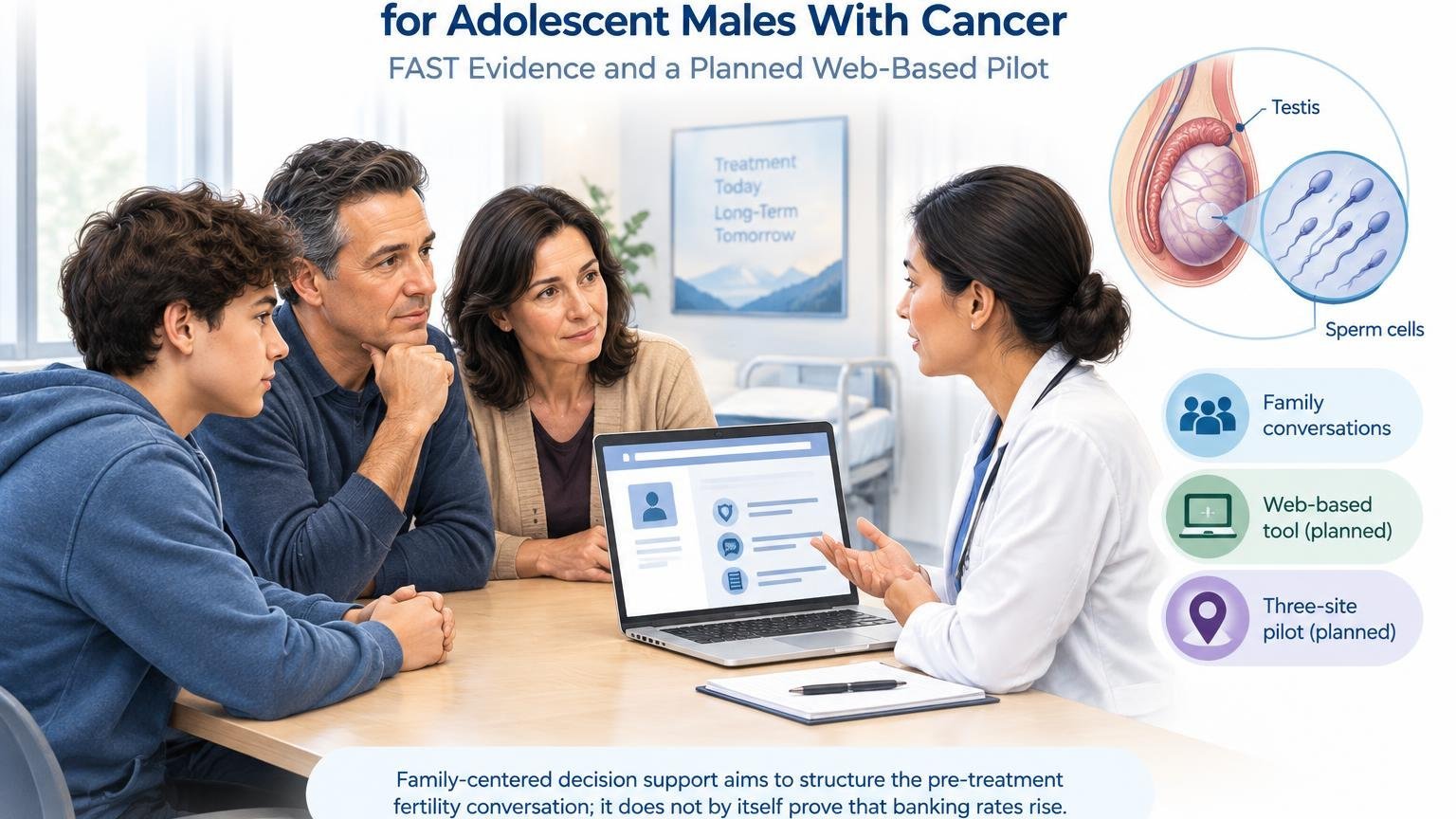


Category: Reproductive Care
Core Research Direction: Family-centered decision support for pre-treatment sperm banking in adolescent males with cancer: evidence for the FAST tool and a planned web-based adaptation and three-site pilot
Search Intent: What evidence supports family-centered sperm banking decision tools for adolescent males with cancer, and what is the planned web-based adaptation testing?
Platform: SANYUN Science Center
Evidence reviewed through: 2026-11-22
Executive Summary
For adolescent males newly diagnosed with cancer, the window for fertility preservation can close quickly once treatment begins. Sperm banking is described in the research background as an established and widely available option, and guidelines recommend it before treatment. Yet the same background states that banking remains underutilized among male adolescents with cancer, particularly at hospitals with low resources. The Family-centered Adolescent Sperm banking Tool, known as FAST, was developed to structure family conversations about parenthood goals and banking at exactly this pressured moment.[1]
The evidence base here is narrower than headlines sometimes imply. A grant summary reports that FAST was tested prospectively among families of adolescent males newly diagnosed with cancer, and that it prompted deeper thinking, facilitated family communication about parenthood goals and banking, and was followed by a significant increase in sperm banking rates. Those are encouraging but thinly reported findings: the available summary does not give the sample size, comparison group, effect magnitude or statistical detail. A separate, planned project now proposes to adapt FAST into a web-based tool, identify implementation strategies for high- and low-resource centers, and test the result in a three-site pilot enrolling a planned 110 families of adolescent males aged 13 to 21.
- FAST is a family-centered decision tool designed around the pre-treatment fertility conversation, not a diagnostic test or a treatment.
- Reported prior findings are directional: deeper family deliberation and higher banking rates, without published magnitudes in the quoted summary.
- The web-based adaptation and three-site pilot are planned work; the enrollment target of 110 families is not an observed sample.
Why This Matters
The population at stake is large and growing. The grant background states that advances in childhood cancer therapies have produced five-year survival rates above 80%, and that with nearly 500,000 childhood cancer survivors in the United States there is mounting need to address late effects of treatment. Fertility impairment is one of those late effects: the summary states it occurs in about half of male childhood cancer survivors and can negatively affect quality of life. For a teenager who survives cancer, the chance to have children later is not a peripheral concern but part of long-term survivorship.
The practical problem is timing and access. Fertility counseling may happen during a hospitalization, in an outpatient clinic, or in settings with little specialist support, and decisions must be made before cancer treatment starts. The background notes that adolescent males are more likely to bank sperm before treatment when their institution has dedicated fertility services, when their provider recommends banking, and when their parents recommend it. Each of those conditions is a system and communication factor rather than a purely personal choice, which is precisely why a structured family tool is worth studying.
The Biological and Clinical Context
Cancer treatment can impair spermatogenesis through several routes, including direct gonadal toxicity from chemotherapy and radiation and disruption of the hormonal signaling that supports sperm production. The available grant summary does not enumerate specific agents or dose thresholds, so this explainer does not attribute risk to particular regimens. What the summary does establish is the scale: fertility impairment affects about half of male childhood cancer survivors, which makes pre-treatment preservation a legitimate preventive health question rather than an optional add-on.
Sperm banking is the preservation route discussed here. In the adolescent context it involves practical and developmental questions: whether a sample can be produced under time pressure, how puberty stage affects feasibility, and how a minor's own preferences are weighed alongside parents' views. The summary frames banking as established and widely available, but availability in principle is not the same as uptake in practice, and the described underutilization among adolescents suggests the gap sits in counseling, logistics and family communication.
What the FAST Evidence Shows So Far
According to the grant summary, the research team developed FAST and tested it prospectively among families of adolescent males newly diagnosed with cancer. In that testing, the tool was reported to prompt deeper thinking and to facilitate family communication about parenthood goals and banking, and sperm banking rates were reported to increase significantly. This suggests a mechanism that operates through family deliberation and shared decision-making rather than through a simple instruction to bank.
Several cautions follow directly from how this evidence is described. The summary does not report the number of families, whether there was a concurrent comparison group, the baseline and follow-up banking rates, or the statistical test behind the word significant. Communication and deliberation outcomes are also described in general terms rather than with a validated measure. These omissions do not invalidate the findings, but they mean the result should be read as promising preliminary evidence rather than as proof that FAST reliably raises banking rates across settings.
| Element | What the source reports | How to interpret it |
|---|---|---|
| FAST design and testing | Developed by the research team and tested prospectively among families of adolescent males newly diagnosed with cancer | Indicates feasibility and family engagement in a prospective setting; sample size and comparator not stated in the summary |
| Reported outcomes of prior testing | Prompted deeper thinking, facilitated family communication about parenthood goals and banking, and sperm banking rates increased significantly | Experiential and utilization signals that are directionally positive but lack reported effect sizes and statistical detail |
| Planned web adaptation | Adapt FAST to a web-based tool usable in inpatient, outpatient and non-clinical settings | Intended expansion of access; usability, acceptability and feasibility are still to be tested |
| Planned pilot scope | Three sites, including one high-resource and one low-resource center, among a planned 110 families of adolescent males aged 13 to 21 | Targets equity and generalizability questions the original single-setting testing could not answer |
| Planned pilot design | Pre-/post design examining feasibility, acceptability and impact on banking rates | Useful for implementation learning; pre-/post cannot by itself establish causal effect |
What the Planned Web-Based Pilot Will Test
The proposal is for implementation-oriented work, not a repeat of the initial prospective testing. The stated objective is to adapt FAST into a web-based tool accessible in inpatient, outpatient and non-clinical settings, to identify implementation strategies tailored to high- and low-resource settings, and to test both in a three-site pilot. The first aim is design work: usability testing with patients and caregivers to produce a tool that is functional, acceptable to families and feasible to deliver before cancer treatment.
The second aim uses rapid contextual inquiry with clinicians to identify tailored implementation strategies for both high- and low-resource pediatric cancer centers, prepare for adoption into clinical pathways, and support fidelity and sustainability. The third aim is the pilot itself: the web-based tool and tailored strategies will be tested locally and at two additional sites, one high-resource and one low-resource, with a pre-/post design examining feasibility, acceptability and impact on banking rates. The plan describes this as preparation for a larger multi-site hybrid implementation-effectiveness trial.
The framing is explicitly about equity. The summary notes that banking depends on dedicated fertility services, provider recommendation and parental recommendation, and that underutilization is worst at low-resource hospitals. A web-accessible tool could in principle reduce dependence on specialist staffing, but that is a hypothesis to be tested, not a demonstrated effect. Whether a digital format preserves the interpersonal depth that made FAST effective in a face-to-face prospective test is one of the interesting open questions.
Interpretation and Limitations
Readers should separate three layers of evidence. First, there are background claims from the grant summary, such as survival above 80%, fertility impairment in about half of male childhood cancer survivors, and underutilization of banking; these are summary statements rather than studies reported in detail. Second, there is the completed prospective FAST testing, which reported favorable communication and utilization signals but without reported sample size, comparator or effect magnitude. Third, there is the planned web-based adaptation and pilot, which has not yet produced outcomes in the available source.
The planned pre-/post design is a further limitation worth stating plainly. Comparing banking rates before and after introducing a tool can be confounded by secular trends, changing staffing, guideline updates or heightened clinician attention; it cannot on its own prove that the tool caused any change. The 110-family figure is an enrollment target for three sites, not a completed sample, and small site-level numbers may limit subgroup inference about high- versus low-resource settings. Nothing in the available material reports cost, long-term parenthood outcomes or downstream use of banked samples.
Applicability also deserves care. The described work concerns adolescent males aged 13 to 21 in the United States, and the grant summary does not report the demographic composition, insurance context or baseline counseling practices of the participating sites. Findings may not transfer unchanged to younger boys, to adults, to health systems without sperm banking laboratories, or to countries with different legal frameworks for minors' consent. Decision aids support conversations; they do not replace individualized counseling about fertility risk and preservation options.
Research Outlook
The next milestones are concrete if not yet achieved. Usability testing should clarify whether a web-based FAST is functional and acceptable to families under real pre-treatment time pressure. The clinician contextual inquiry should make visible which implementation strategies are feasible in low-resource pediatric cancer centers. The three-site pilot should report feasibility and acceptability metrics and pre-/post banking rates, ideally with enough contextual detail to explain any change. Only after those steps does the larger hybrid implementation-effectiveness trial become a sensible next question.
A broader point travels beyond this one tool. Family-centered decision support is being studied across cancer prevention and control as a way to close the gap between evidence and practice, and usability-oriented adaptation methods are one emerging approach. Those parallels are methodological, not evidence that any specific decision tool improves clinical outcomes. For sperm banking, the honest current position is that a structured family conversation tool has shown promising prospective signals and is now being adapted and tested for wider and more equitable delivery.[2][3]
Key Takeaways
- FAST is a family-centered decision tool for the pre-treatment fertility conversation with adolescent males newly diagnosed with cancer.
- Prior prospective testing reported deeper family deliberation, better communication about parenthood goals and banking, and a significant increase in banking rates, without published magnitudes in the quoted summary.
- Sperm banking remains underutilized among adolescent males with cancer despite guidelines, especially at low-resource hospitals.
- Provider recommendation, parental recommendation and dedicated fertility services are each associated with higher likelihood of banking before treatment.
- A planned web-based adaptation and three-site pilot will enroll a planned 110 families of males aged 13 to 21 and examine feasibility, acceptability and pre-/post banking rates.
- The pilot is planned, not completed, and its pre-/post design cannot by itself establish causality.
Questions and Answers
What is the FAST sperm banking decision tool for adolescent males with cancer?
FAST, the Family-centered Adolescent Sperm banking Tool, is a decision aid developed by a research team and tested prospectively among families of adolescent males newly diagnosed with cancer. It is designed to structure the pre-treatment fertility conversation around parenthood goals and sperm banking. It is not a diagnostic test or a treatment; it supports shared family deliberation alongside clinical counseling.
Did the FAST tool increase sperm banking rates in earlier prospective testing?
The grant summary reports that in prospective testing FAST prompted deeper thinking and facilitated family communication about parenthood goals and banking, and that sperm banking rates increased significantly. However, the summary does not report the sample size, comparator, baseline and follow-up rates, or the statistical test. The direction is encouraging, but the magnitude and robustness cannot be judged from the available text.
How strong is the evidence that family-centered decision tools improve fertility preservation uptake?
For FAST specifically, the available evidence is a grant summary describing prospective testing with favorable communication and utilization signals but no reported effect sizes or comparison details. That supports further study rather than firm conclusions. Decision-tool research more broadly is still establishing which adaptations work in which settings, so claims of proven effectiveness across populations would outrun the evidence.
Which adolescent males with cancer are most likely to bank sperm before treatment?
According to the grant background, adolescent males are more likely to bank sperm before cancer treatment when their institution has dedicated fertility services, when their provider recommends banking, and when their parents recommend it. Banking remains underutilized overall and especially at low-resource hospitals. These are system and communication factors, which is why interventions target counseling and family decision-making rather than patients alone.
What are the limitations of the planned three-site web-based FAST pilot?
The pilot is planned work, with a planned enrollment of 110 families of adolescent males aged 13 to 21 across three sites, including one high-resource and one low-resource center. It uses a pre-/post design to examine feasibility, acceptability and banking rates, which cannot by itself establish causation because secular trends and changing staffing could confound results. Site-level sample sizes may also limit subgroup conclusions.
Can a web-based sperm banking decision tool improve access at low-resource hospitals?
That is the hypothesis the planned project intends to test. The proposal aims to adapt FAST for web access in inpatient, outpatient and non-clinical settings and to identify implementation strategies for both high- and low-resource pediatric cancer centers. Whether a digital format reduces dependence on specialist fertility staffing, while preserving the quality of family deliberation, is unknown until the usability work and pilot report results.
Sources and References
- Nahata, Leena; Griffith M.M.; Sezgin E.; Karkare T.; Roche C.I.; English J.; Audino A.; Montgomery K.E.; Saraf A.J.; Quinn G.P.; Housten A.J.. Division of Cancer Control & Population Sciences – Adaptation and Implementation of a Web-Based Family Centered Adolescent Sperm Banking Decision Tool for Adolescent Males with Cancer Grant Details. 2025 PMID: 41264361.
- Audrey A. Goldbaum; Caitlin P. Bailey; Amelia Willits-Smith; Jill Reedy; Kirsten A. Herrick; Dora Romaguera; Alice Chaplin; Mar Nafría; Marissa M. Shams-White. Adaptation and Usability of a Lifestyle Cancer Prevention Screener for US Populations: A Mixed Methods Study. Cancer Epidemiol Biomarkers Prev. 2026 :OF1–OF9 DOI: 10.1158/1055-9965.EPI-26-0495.
- Division of Cancer Control & Population Sciences – Identifying Mechanisms of Implementation Strategies for Cancer Control: an Implementation Mapping Approach Grant Details.
SANYUN Science Center explains published research on men's reproductive and sexual health, connecting scientific evidence with everyday questions while making sources and limitations clear.
Disclaimer: This article is for scientific education and research communication only. It does not provide medical advice, diagnosis, or individualized treatment recommendations, and does not endorse any medication, supplement, device, penile enlargement procedure, or other intervention. Decisions about sexual and reproductive health should be made in consultation with a qualified healthcare professional. Do not delay seeking professional care because of information in this article.
Original Content & Copyright Notice
- This article is prepared for SANYUN Science Center, drawing on published research and publicly available academic literature on men’s sexual and reproductive health. Its editorial explanations and presentation are developed for this platform.
- Copyright in the original editorial content, selection, and arrangement is reserved by SANYUN Science Center to the extent protected by applicable law. Referenced research, quotations, and third-party materials remain subject to the rights of their respective owners. This notice does not claim ownership of scientific facts or third-party research.
- Except where permitted by applicable law or an applicable license, prior written permission is required to reproduce, republish, translate, adapt, redistribute, or commercially reuse protected content. Attribution alone does not grant permission for such reuse.
- For permitted quotation or authorized reuse, clearly identify the source and retain a link to the original article.
- Source: SANYUN Science Center
- Original URL: Retain the original article URL on science.san-yun.com.
- Copyright Holder: SANYUN Science Center, for its own protected editorial content.
- Quotation, excerpts, or authorized reuse must not distort the scientific meaning, omit material limitations or disclaimers, or imply unverified medical claims, product efficacy, or endorsement by SANYUN Science Center.



