




Category: Reproductive Care
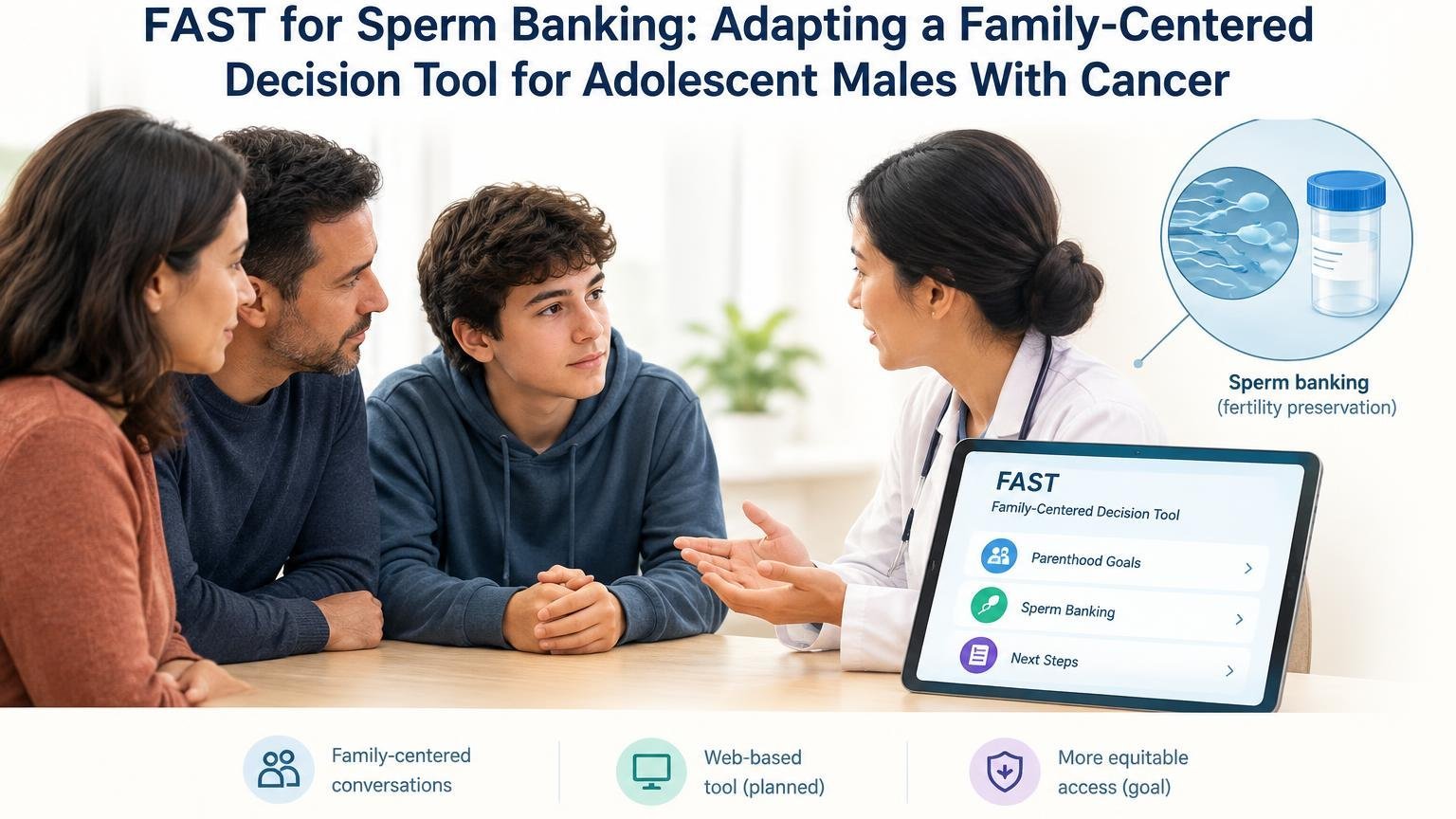
Core Research Direction: Adapting a family-centered sperm banking decision tool (FAST) into a web-based platform and pilot-testing its implementation for adolescent males newly diagnosed with cancer
Search Intent: What is the Family-centered Adolescent Sperm banking Tool (FAST) and how is it being adapted and piloted to improve sperm banking uptake among adolescent males with cancer?
Platform: SANYUN Science Center
Evidence reviewed through: 2026-11-23
Executive Summary
For adolescent males newly diagnosed with cancer, the window between diagnosis and the start of treatment is short, and fertility counseling must compete with urgent medical decisions. The Family-centered Adolescent Sperm banking Tool, or FAST, was developed to structure that conversation around family goals, parenthood and sperm banking. A grant record from the National Cancer Institute describes a next phase: adapting FAST into a web-based tool and testing it in a planned three-site pilot among 110 families of adolescent males aged 13 to 21. The record also reports that earlier prospective testing of FAST prompted deeper thinking, supported family communication and coincided with significantly increased sperm banking rates, although the record does not give the earlier study's design details, sample size or effect size.[1][2]
This article explains what FAST is, why sperm banking remains underused, what the planned web-based adaptation will test, and what the available grant records can and cannot tell us. The evidence here is a project description, not a completed trial report, so the pilot outcomes are unknown and the earlier findings are summarized rather than independently re-analyzed.
Why This Matters
Childhood cancer survival has improved substantially, with the grant background citing five-year survival rates above 80%. That success creates a growing population of survivors who need care for late effects of treatment. Fertility impairment is described as affecting about half of male childhood cancer survivors and as capable of negatively affecting quality of life. Sperm banking is presented as an established and widely available form of fertility preservation. The central problem is not that banking is unavailable or unknown; it is that banking remains underutilized among male adolescents with cancer, especially at hospitals with low resources.
The gap matters for equity. A decision tool that lives only in a well-resourced fertility clinic may not reach families who receive counseling in an inpatient ward, an outpatient oncology clinic or another non-clinical setting. The grant frames family-centered decision tools and implementation strategies as critical to improving equitable access to sperm banking opportunities. That framing treats the problem as one of delivery and communication, not simply of patient motivation.
What FAST Is and How It Works
FAST is a family-centered decision tool rather than a test or a treatment. In the grant description, it is meant to help adolescents and their caregivers think through parenthood goals and the option of banking sperm before cancer treatment. The earlier prospective testing is reported to have prompted deeper thinking and facilitated family communication about parenthood goals and banking. The tool does not appear to be designed to recommend banking for every family; its purpose is to support a shared decision within the family and care team.
The rationale comes partly from prior studies cited in the grant. Adolescent males were reported to be more likely to bank sperm before cancer treatment if their institution had dedicated fertility services, if their provider recommended banking, and if their parents recommended it. Those three factors point to a system and conversation problem: whether the option is normalized, recommended and made logistically reachable. FAST is intended to work on the family communication piece while the planned implementation work addresses institutional context and workflow.
A web-based version is planned to be accessible in inpatient, outpatient and non-clinical settings. That design choice reflects feasibility and equity concerns, including the short timeframe before treatment and the variety of settings in which fertility counseling happens. The adaptation is described as using patient and caregiver stakeholder feedback through usability testing, with the intention of producing a tool that is functional, acceptable to families and feasible to implement before treatment. Those characteristics are goals to be tested, not established outcomes in the available record.
What the Evidence Shows
| Component | What the grant record describes | Why it matters |
|---|---|---|
| Earlier FAST testing | Prospective testing among families of adolescent males newly diagnosed with cancer; reported deeper thinking, family communication and significantly increased sperm banking rates | Provides the rationale for the next study phase |
| Planned web adaptation | Adapt FAST design and delivery using patient and caregiver usability feedback | Aims to make the tool functional, acceptable and feasible before treatment |
| Planned implementation inquiry | Mixed-methods rapid contextual inquiry with clinician stakeholders in high- and low-resource centers | Tailors implementation strategies to different hospital contexts |
| Planned pilot | Three sites including one high- and one low-resource site; pre-/post design; feasibility, acceptability and banking rates | Tests whether the web tool can be implemented and whether banking rates change |
| Planned enrollment | 110 families of adolescent males aged 13 to 21 newly diagnosed with cancer | Indicates the intended scale of the pilot |
The strongest outcome statement in the record is that earlier FAST testing was followed by significantly increased sperm banking rates. That wording is encouraging but thin. The grant does not report the comparison group, the number of families studied, the absolute baseline or follow-up rates, or the duration of follow-up. Without those details, a significant increase cannot be translated into expected benefit for a new hospital or family. It is also unclear whether the increase reflects the tool itself, concurrent provider training, secular trends or site-level changes in fertility services.
The planned pilot addresses some of these gaps. It is described as a pre-/post design at three sites, including one high-resource and one low-resource center, examining feasibility, acceptability and impact on banking rates. Pre-/post designs are practical for implementation studies with short timelines, but they are vulnerable to temporal trends and regression to the mean and cannot by themselves establish that the web tool caused a change in banking. They can, however, show whether a tool can be delivered and used as intended, which is an important precondition for a later hybrid implementation-effectiveness trial.
Interpretation and Limitations
The available publications record contains no journal articles for this specific grant, and the funding record lists no outcomes or clinical studies. The article therefore relies on a project summary and its abstract, both of which describe aims and background rather than completed results. The earlier FAST findings are referenced internally but not presented with methods or numbers in these records. Readers should treat the phrase 'significantly increased' as a signal that a statistical test was reported in the underlying work, not as evidence that a clinically important or durable improvement has been demonstrated across settings.
Other limits are structural. The planned enrollment of 110 families is a target, and pilot samples often overestimate the precision a study can achieve, especially when the outcome is a binary decision such as whether a family banks sperm. The record does not specify how many eligible families will be approached, how many will decline, or how many adolescents will be too unwell or start treatment too quickly to participate. Those factors could strongly influence both feasibility and equity conclusions, particularly at a low-resource site where the burden of participation may be greatest.
There is also an ethical and practical ambiguity that the record does not resolve. A family-centered decision tool must balance adolescent autonomy, caregiver involvement and the clinical urgency of cancer treatment. The grant states that the tool facilitated family communication, which suggests a collaborative approach, but it does not describe how disagreement within families is handled or how the tool supports adolescents who may not yet be ready to discuss fertility. These are important questions for usability testing and for future effectiveness work.
Research Outlook
The project is funded through mid-2028, and the current record describes a sequenced program: usability testing and adaptation first, then rapid contextual inquiry with clinicians in high- and low-resource settings, then a three-site pre-/post pilot. If the pilot shows that the web-based FAST is feasible and acceptable and that banking rates move in the expected direction, the stated goal is to prepare for a larger multisite hybrid implementation-effectiveness trial. That next step would need stronger comparison designs and clearer reporting of absolute rates, equity outcomes and the sustainability of any change.
For clinicians and families, the practical message is that fertility preservation is not merely a matter of offering a sperm sample. It depends on whether the option is raised early, whether the family has space to discuss it, and whether the hospital can deliver the service before treatment begins. The FAST work is an attempt to improve those conditions. Its value will ultimately be judged not only by whether banking rates rise, but by whether the tool reaches families in low-resource settings and supports decisions that fit each family's own goals.
Key Takeaways
- FAST is a family-centered decision tool designed to help adolescent males with cancer and their caregivers discuss parenthood goals and sperm banking before treatment.
- Fertility impairment is described as affecting about half of male childhood cancer survivors, while sperm banking remains underutilized among adolescent males, especially at low-resource hospitals.
- Earlier prospective testing of FAST was reported to prompt deeper thinking, support family communication and coincide with significantly increased sperm banking rates, but the record does not provide the earlier study's design, sample size or effect size.
- A planned three-site pilot targets 110 families of adolescent males aged 13 to 21 and will examine feasibility, acceptability and banking rates using a pre-/post design at one high- and one low-resource site; these are planned objectives, not observed results.
Questions and Answers
What is the Family-centered Adolescent Sperm banking Tool (FAST)?
FAST is a structured decision tool for adolescent males newly diagnosed with cancer and their caregivers. It is designed to prompt discussion about parenthood goals and sperm banking before cancer treatment. In earlier prospective testing described in a grant record, FAST was reported to encourage deeper thinking and family communication, but the tool is not itself a fertility test or treatment.
How much does cancer treatment affect fertility in male childhood cancer survivors?
The grant background states that fertility impairment occurs in about half of male childhood cancer survivors and can negatively affect quality of life. That figure is a background summary rather than a primary result, and it should not be read as an individual prognosis. Sperm banking before treatment is described as an established fertility preservation option.
What did earlier testing of the FAST sperm banking tool show?
The investigators report that prospective testing of FAST among families of adolescent males newly diagnosed with cancer prompted deeper thinking, facilitated family communication about parenthood goals and banking, and was associated with significantly increased sperm banking rates. The grant record does not give the earlier study's sample size, comparison group or absolute rates, so the size and durability of the effect remain unclear.
What will the planned web-based FAST pilot measure?
The planned pilot will test a web-based version of FAST at three sites, including one high-resource and one low-resource center, using a pre-/post design. It aims to examine feasibility, acceptability and impact on sperm banking rates among families of adolescent males aged 13 to 21. The record describes these as planned objectives, not completed findings.
How strong is the evidence that FAST improves sperm banking uptake?
The evidence is promising but limited. The claim of a significant increase comes from a summary in a grant record, without the numbers, design details or comparison group needed to judge clinical importance. A planned pilot using a pre-/post design can show whether the web tool is feasible, but that design cannot establish causation. It is too early to say FAST reliably improves uptake across hospitals.
Why is a family-centered approach important for adolescent sperm banking decisions?
Prior studies cited in the grant suggest adolescent males are more likely to bank sperm when their provider recommends it and when their parents recommend it, alongside having dedicated fertility services. A family-centered tool addresses the communication gap between those influences. It does not replace clinical counseling, and it must still balance adolescent autonomy, caregiver involvement and the urgency of starting cancer treatment.
Sources and References
- NAHATA, LEENA. Adaptation and implementation of a web-based Family centered Adolescent Sperm banking decision Tool for adolescent males with cancer. 2026
- Nahata, Leena. Division of Cancer Control & Population Sciences – Adaptation and Implementation of a Web-Based Family Centered Adolescent Sperm Banking Decision Tool for Adolescent Males with Cancer Grant Details. 2025
SANYUN Science Center explains published research on men's reproductive and sexual health, connecting scientific evidence with everyday questions while making sources and limitations clear.
Disclaimer: This article is for scientific education and research communication only. It does not provide medical advice, diagnosis, or individualized treatment recommendations, and does not endorse any medication, supplement, device, penile enlargement procedure, or other intervention. Decisions about sexual and reproductive health should be made in consultation with a qualified healthcare professional. Do not delay seeking professional care because of information in this article.
Original Content & Copyright Notice
- This article is prepared for SANYUN Science Center, drawing on published research and publicly available academic literature on men’s sexual and reproductive health. Its editorial explanations and presentation are developed for this platform.
- Copyright in the original editorial content, selection, and arrangement is reserved by SANYUN Science Center to the extent protected by applicable law. Referenced research, quotations, and third-party materials remain subject to the rights of their respective owners. This notice does not claim ownership of scientific facts or third-party research.
- Except where permitted by applicable law or an applicable license, prior written permission is required to reproduce, republish, translate, adapt, redistribute, or commercially reuse protected content. Attribution alone does not grant permission for such reuse.
- For permitted quotation or authorized reuse, clearly identify the source and retain a link to the original article.
- Source: SANYUN Science Center
- Original URL: Retain the original article URL on science.san-yun.com.
- Copyright Holder: SANYUN Science Center, for its own protected editorial content.
- Quotation, excerpts, or authorized reuse must not distort the scientific meaning, omit material limitations or disclaimers, or imply unverified medical claims, product efficacy, or endorsement by SANYUN Science Center.



 supports sperm banking decisions for adolescent males with cancer and what a planned web-based pilot will test.)