




Category: Health Academy
Core Research Direction: Patient-facing explanation of what happens at a first testosterone replacement therapy (TRT) consultation, including how low testosterone is diagnosed and why testosterone and hematocrit are monitored during treatment
Search Intent: What should a man expect at a first TRT consultation, and how is low testosterone confirmed before treatment is considered?
Platform: SANYUN Science Center
Evidence reviewed through: 2026-11-21
Executive Summary
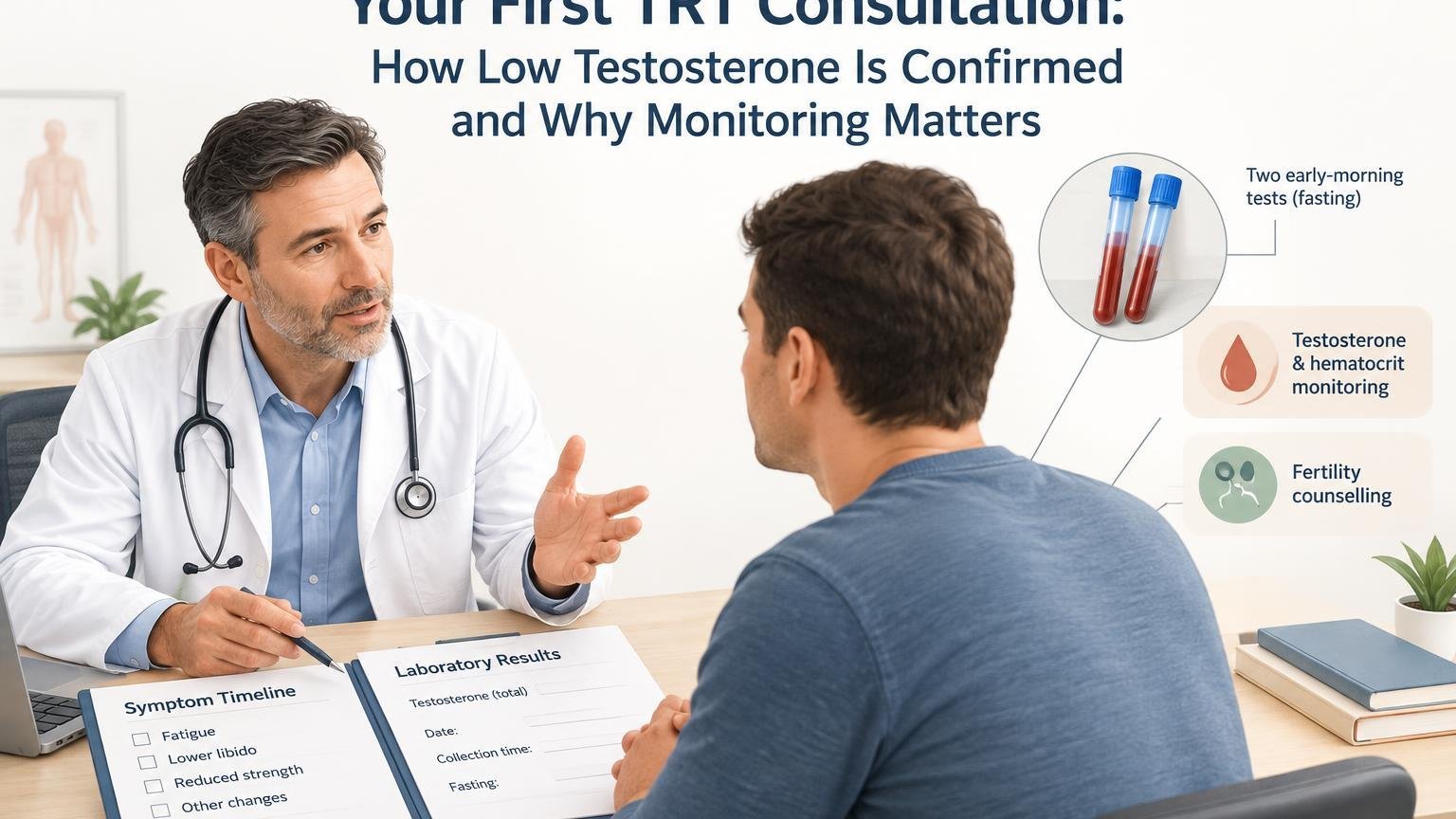
A first testosterone consultation is best understood as a health conversation rather than a commitment to start treatment, and a prescription is only one possible outcome. The stated aims of that visit are to clarify what has changed, consider what else could explain the symptoms, and establish whether testing actually supports testosterone deficiency.[1]
Diagnosis is the part patients most often misunderstand. Symptoms plus a single low laboratory value are not enough to establish testosterone deficiency; evaluation generally uses early-morning total testosterone on two separate days, with fasting collection as recommended by the Endocrine Society. The American Urological Association describes total testosterone below 300 ng/dL as a reasonable cutoff supporting diagnosis when combined with symptoms and repeat testing, while cautioning that a value just above or below that line is not a complete clinical answer.
Monitoring is the other half of the story. Testosterone can raise red blood cell concentration, so a baseline blood count provides a hematocrit reference before treatment. After initiation, testosterone and hematocrit are commonly reassessed around three to six months, with later checks of testosterone every six to twelve months and hematocrit at least annually once stable. A hematocrit reaching 54 percent generally calls for holding or adjusting treatment and evaluating contributing factors.
Why This Matters
Men usually arrive at a first TRT consultation with a symptom story rather than a diagnosis: fatigue, lower libido, reduced strength, or a laboratory result they do not understand. The risk is that the appointment gets treated as a formality before a prescription. That framing skips the question that matters most — whether the symptoms are actually explained by testosterone deficiency or by something else entirely.
Several conditions can mimic low testosterone, including depression, thyroid disease, anemia, sleep apnea, and inadequate sleep. Testosterone itself moves across the day and from one day to the next, so a single low value may reflect timing, acute illness, sleep disruption, or other temporary influences rather than a persistent deficiency. Getting this wrong in either direction has costs: unnecessary treatment with real monitoring burdens, or a missed alternative diagnosis that would have responded to different care.
Before the Visit: What to Bring and Why It Changes Interpretation
The medication list matters more than most patients expect. A full history of prescription medicines, over-the-counter products, supplements, allergies, and past reactions should include any current or past testosterone, anabolic steroids, or hormone-related medicines, even if obtained elsewhere, because these affect how laboratory results are interpreted and how safely a plan can be made.
Prior laboratory results should be shared with their collection date, time, reference range, and whether the sample was fasting or taken during illness. A screenshot containing only the testosterone number leaves out the context that makes the number interpretable. A short symptom timeline also helps: when symptoms began, whether they changed gradually or suddenly, which activities are affected, and concrete examples such as regularly falling asleep after work.
One detail worth separating deliberately is sexual desire versus erection quality. They are related but not the same complaint, and describing them separately gives the clinician a clearer signal. Recording sleep quality, snoring, stress, mood, exercise, and changes in weight or strength rounds out the picture and helps flag mimics such as sleep apnea or depression before anyone attributes everything to a hormone.
How Low Testosterone Is Actually Confirmed
The diagnostic pathway has three components: symptoms, timing, and repetition. Early-morning total testosterone is the usual starting measurement because levels vary through the day, and collection on two separate days reduces the chance that a single result reflects a transient dip. The Endocrine Society recommendation for fasting collection is part of the same effort to standardise conditions. Shift workers may need individualised timing, since a sample drawn after an overnight shift does not carry the same meaning as one drawn after normal sleep.
The 300 ng/dL figure deserves precise framing. The American Urological Association uses total testosterone below 300 ng/dL as a reasonable cutoff supporting diagnosis, in combination with symptoms and repeat testing. It is a threshold within a clinical process, not a pass-fail line. Assay quality, laboratory reference ranges, binding proteins, and the overall picture still matter, and a value just above or below the cutoff does not settle the question on its own.
Additional testing is chosen for a reason rather than bundled by default. Free testosterone and sex hormone-binding globulin may help when total testosterone is borderline or binding proteins are altered. Luteinizing hormone, and sometimes follicle-stimulating hormone, help distinguish a testicular problem from a signalling problem involving the pituitary or hypothalamus. In other words, a responsible evaluation asks why testosterone is low, not simply how to raise the number.
| Test or measure | When it is used | What it helps clarify |
|---|---|---|
| Early-morning total testosterone on two separate days | Initial diagnostic work-up, with fasting collection as recommended by the Endocrine Society | Whether a low result is consistent rather than a single fluctuation; symptoms alone are insufficient |
| Total testosterone below 300 ng/dL (AUA cutoff) | Interpretation alongside symptoms and repeat testing | A reasonable threshold supporting diagnosis; not a complete answer near the line |
| Free testosterone and sex hormone-binding globulin | Borderline total testosterone or suspected altered binding proteins | Whether the measured total reflects usable hormone |
| Luteinizing hormone and sometimes follicle-stimulating hormone | When the cause of a confirmed low result is unclear | Whether the problem is testicular or involves pituitary/hypothalamic signalling |
| Baseline blood count and hematocrit | Before starting treatment | A reference point, because testosterone can raise red blood cell concentration |
Fertility Is Part of the First Conversation
Exogenous testosterone can suppress the hormonal signals needed for sperm production, sometimes substantially, and recovery after stopping is variable, may take many months, and is not guaranteed on a particular schedule. That makes fertility planning a pre-treatment conversation rather than an afterthought. It applies even to men who are uncertain about future children, because uncertainty is itself relevant information.
Two related points are often misstated. First, testosterone therapy is not a dependable contraceptive, so it should not be relied on to prevent pregnancy. Second, adding another medication should not be assumed to eliminate fertility risk automatically. When preserving fertility is a priority, referral to a reproductive urologist or endocrinologist may help discuss alternatives and whether semen testing or sperm banking is appropriate.
When Treatment Starts: Why Testosterone and Hematocrit Are Tracked
Monitoring exists because treatment changes physiology in ways that are not fully captured by how a patient feels. Testosterone can raise red blood cell concentration, so hematocrit is tracked rather than assumed. Symptoms improving is welcome, but it does not substitute for the laboratory check — a hematocrit reaching 54 percent generally requires holding or adjusting treatment and evaluating contributing factors, not ignoring the result because energy has improved.
The practical schedule is a first reassessment of testosterone and hematocrit around three to six months after initiation, with timing adjusted for the formulation, dose changes, and individual risk. Once stable, testosterone is often checked every six to twelve months and hematocrit at least annually. These are general intervals, not a fixed protocol for every man, and prostate monitoring is described as individualised through shared decision-making.
Formulation choice also shapes what monitoring and counselling look like. Injections can cause peaks and troughs in hormone levels, while topical products require careful steps to avoid transfer to others. Neither point makes one method universally better; they are practical differences that belong in a shared decision about dosing routine, precautions, and monitoring needs.
Some findings argue against starting at all, or at least require specialist input. Active prostate or breast cancer, elevated hematocrit, untreated severe obstructive sleep apnea, and certain recent cardiovascular events are listed among the situations that can make starting therapy inappropriate. For men whose main concern is erectile function rather than hormones, erectile dysfunction care may be relevant alongside the hormone evaluation rather than after it.
Interpretation and Limitations
This explainer summarises a single practice-authored educational article that states it draws on the Endocrine Society testosterone therapy guideline, the American Urological Association testosterone deficiency guideline, and NIH/MedlinePlus testosterone injection information. The underlying guidelines were not supplied in the research packet, so thresholds and intervals here are reported secondhand rather than verified against primary texts. The article is not a clinical trial, systematic review, or new dataset, and it does not report outcome rates for symptom improvement or hematocrit elevation.
Several statements are general mechanistic or safety guidance without accompanying quantitative evidence in the source: that testosterone can raise red blood cell concentration, that exogenous testosterone can suppress sperm production, that recovery after stopping is variable, and that a hematocrit of 54 percent generally triggers a treatment review. These are reasonable clinical framings, but this article cannot tell you how often each occurs or how large the effect is in a given man.
There is also a commercial context to declare. The source article comes from a self-pay practice that offers telehealth consultations in specific states, notes that superbills are available for out-of-network reimbursement attempts without guaranteeing reimbursement, and describes its own care pathways. Those operational details describe one practice, not standards of care, and a virtual visit does not guarantee a prescription.
The source itself states that it does not document a separate completed medical review and does not replace consultation, examination, diagnosis, or treatment planning. Readers should therefore treat it as patient-facing education reflecting published guidance, not as an independently verified clinical protocol.
Research Outlook
The open questions are less about whether to measure testosterone and more about how to use measurements well. How should thresholds be applied in men with borderline values and altered binding proteins? How should monitoring intervals flex for different formulations and cardiovascular risk profiles? How should fertility preservation be discussed when patients are ambivalent? The source does not answer these; it simply flags that assay quality, individual risk, and shared decision-making matter alongside any fixed number.
Key Takeaways
- A first TRT consultation is an evaluation, not an automatic prescription; clarifying symptoms, alternatives, and test results comes first.
- Symptoms plus one low value are insufficient; early-morning total testosterone on two separate days with fasting collection is the usual diagnostic approach.
- The AUA cutoff of total testosterone below 300 ng/dL supports diagnosis only alongside symptoms and repeat testing, and values near the line are not decisive.
- Fertility should be discussed before any prescription, because exogenous testosterone can suppress sperm production and is not dependable contraception.
- After initiation, testosterone and hematocrit are commonly checked around three to six months, then testosterone every six to twelve months and hematocrit at least annually once stable.
- A hematocrit reaching 54 percent generally calls for holding or adjusting treatment and reviewing contributing factors, even when symptoms have improved.
Questions and Answers
What actually happens at a first TRT consultation?
It is framed as a health conversation rather than a commitment to treatment. The clinician clarifies what symptoms have changed, considers other explanations such as depression, thyroid disease, anemia, sleep apnea, or poor sleep, and reviews medications, prior labs, fertility goals, and relevant history. Testing may be arranged or repeated. A prescription is described as only one possible outcome of the visit.
Why is low testosterone tested on two separate mornings instead of once?
Testosterone changes across the day and can fluctuate between days, so a single low result may reflect collection timing, acute illness, sleep disruption, or another temporary influence rather than persistent deficiency. Early-morning total testosterone on two separate days, with fasting collection as recommended by the Endocrine Society, helps confirm that a low finding is consistent.
What does a total testosterone below 300 ng/dL mean for diagnosis?
The American Urological Association uses total testosterone below 300 ng/dL as a reasonable cutoff supporting diagnosis when combined with symptoms and repeat testing. It is a threshold inside a clinical process, not a standalone verdict. Values just above or below the line still need interpretation that accounts for assay quality, laboratory ranges, binding proteins, and the overall picture.
Why are testosterone and hematocrit monitored during TRT?
Testosterone can raise red blood cell concentration, so hematocrit needs tracking rather than assumption. Testosterone and hematocrit are commonly reassessed around three to six months after starting, then testosterone every six to twelve months and hematocrit at least annually once stable. A hematocrit reaching 54 percent generally requires holding or adjusting treatment and evaluating contributing factors.
Does testosterone therapy affect fertility, and should it be discussed first?
Yes, it should be discussed before treatment. Exogenous testosterone can suppress the hormonal signals needed for sperm production, and recovery after stopping is variable, may take many months, and is not guaranteed on a particular schedule. Testosterone is also not dependable contraception, and adding another medication should not be assumed to remove fertility risk automatically.
What are the limitations of this TRT consultation guidance?
It comes from one practice-authored educational article that reports Endocrine Society and American Urological Association guidance secondhand; the original guidelines were not independently verified here. Several statements, including the hematocrit threshold and fertility effects, are general safety and mechanistic guidance without outcome rates. The source also states it does not document a separate completed medical review.
Sources and References
- Simone Blount. First TRT Consultation | Stroudsburg PA. 2026
SANYUN Science Center explains published research on men's reproductive and sexual health, connecting scientific evidence with everyday questions while making sources and limitations clear.
Disclaimer: This article is for scientific education and research communication only. It does not provide medical advice, diagnosis, or individualized treatment recommendations, and does not endorse any medication, supplement, device, penile enlargement procedure, or other intervention. Decisions about sexual and reproductive health should be made in consultation with a qualified healthcare professional. Do not delay seeking professional care because of information in this article.
Original Content & Copyright Notice
- This article is prepared for SANYUN Science Center, drawing on published research and publicly available academic literature on men’s sexual and reproductive health. Its editorial explanations and presentation are developed for this platform.
- Copyright in the original editorial content, selection, and arrangement is reserved by SANYUN Science Center to the extent protected by applicable law. Referenced research, quotations, and third-party materials remain subject to the rights of their respective owners. This notice does not claim ownership of scientific facts or third-party research.
- Except where permitted by applicable law or an applicable license, prior written permission is required to reproduce, republish, translate, adapt, redistribute, or commercially reuse protected content. Attribution alone does not grant permission for such reuse.
- For permitted quotation or authorized reuse, clearly identify the source and retain a link to the original article.
- Source: SANYUN Science Center
- Original URL: Retain the original article URL on science.san-yun.com.
- Copyright Holder: SANYUN Science Center, for its own protected editorial content.
- Quotation, excerpts, or authorized reuse must not distort the scientific meaning, omit material limitations or disclaimers, or imply unverified medical claims, product efficacy, or endorsement by SANYUN Science Center.



