




Category: Latest Research
Core Research Direction: Why a phase 2 placebo-controlled trial of follitropin delta (FE 999049) for idiopathic male infertility with reduced semen quality was terminated early after enrolling only a handful of participants, and what its registry record can and cannot tell us about efficacy
Search Intent: What happened to the follitropin delta (FE 999049) trial for idiopathic male infertility, and does its tiny, terminated enrollment allow any conclusion about whether rFSH improves spontaneous pregnancy?
Platform: SANYUN Science Center
Evidence reviewed through: 2026-11-20
Executive Summary
The ADAM trial was registered as a randomised, double-blind, placebo-controlled phase 2 study of FE 999049 — follitropin delta, a recombinant follicle-stimulating hormone — in men with idiopathic infertility and unexplained reduced semen quality. Its stated purpose was to test whether a daily 12 µg dose given for six months could increase the chance of spontaneous pregnancy in the female partner compared with placebo. The primary endpoint was vital pregnancy within nine months of the man's randomisation.[1][2][3]
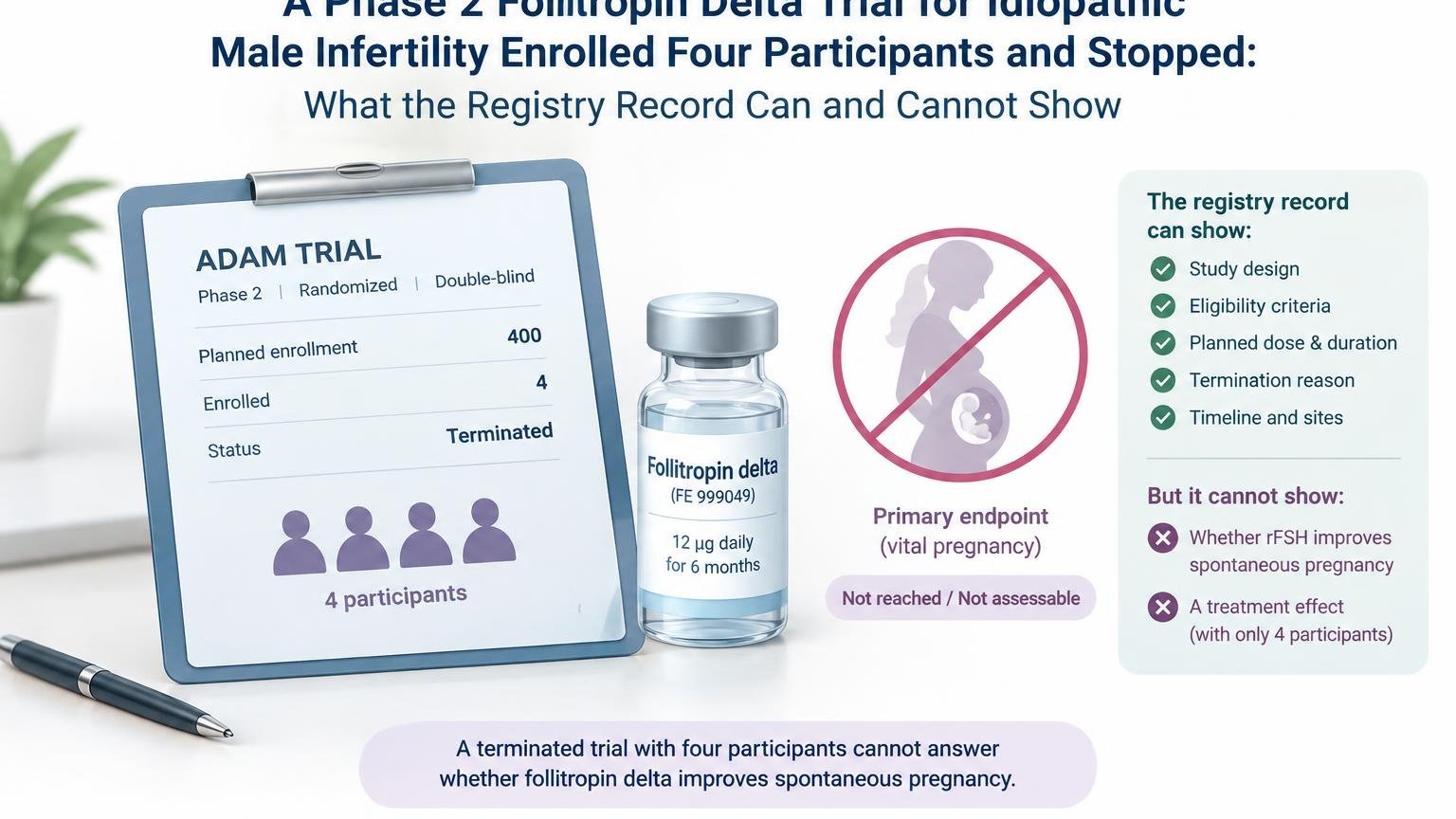
The trial did not produce usable efficacy evidence. It was terminated before completion, and the registry history shows the enrollment target was revised from an estimated 400 to a confirmed 4 participants. The sponsor's recorded reason was that the probability of enrolling participants within a reasonable timeframe was too low, and that the decision was not driven by safety concerns or a change in reproductive medicine strategy. A record of four participants cannot estimate a pregnancy-rate difference between treatment and placebo.[4]
The registry trail is genuinely useful for a different question: how hard it is to recruit couples into a trial where the man receives a daily injection for six months while the couple must attempt spontaneous conception rather than pursue assisted reproduction. The eligibility rules were narrow, spanning semen parameters, hormone ranges, partner age and menstrual history, and a commitment to avoid outside fertility treatment for six months. Those requirements explain a great deal about why a multinational site network still struggled to enroll.
Why This Trial Mattered
Male factor contributes to a substantial share of infertility presentations, yet the number of well-powered drug trials targeting sperm production or function is small compared with the volume of research in female reproduction. Idiopathic infertility with reduced semen quality is a particularly frustrating category because there is no structural, genetic or endocrine explanation to correct. A treatment that could measurably increase spontaneous conception would therefore fill a real gap.
The biological rationale for follicle-stimulating hormone in this setting is not arbitrary. FSH is a central driver of spermatogenesis: it acts on Sertoli cells to support germ cell development, and FSH signalling is required for quantitatively normal sperm output in many men. In men with hypogonadotropic hypogonadism, FSH combined with luteinising hormone or human chorionic gonadotropin can restore sperm production. The open question is whether raising FSH activity helps men whose endogenous FSH already falls within a broad normal range but whose sperm counts are low.
ADAM was designed to address that question with a placebo comparator. The eligibility window required a screening total sperm count of 5–39 million, confirmed by two samples at least two weeks apart, plus total motility of at least 10%, semen volume of at least 1.4 mL, and serum FSH between 2 and 12.0 IU/L. In other words, the trial deliberately excluded men with clear hypogonadotropic disease and focused on a borderline-to-low semen profile with hormones inside conventional reference limits.
How the Trial Was Designed
The registered design was a randomised, double-blind, placebo-controlled phase 2 trial. Men aged 18–50 were to receive either FE 999049 or placebo, with the active arm specified as a daily 12 µg dose for six months. Couples were required to have a history of infertility with the current partner of 12–60 months if the partner was under 35, or 6–60 months if the partner was 35–38. Female partners had to be premenopausal, aged 18–38, with regular cycles of 21–35 days and no history of pelvic inflammatory disease, advanced endometriosis or tubal ligation.
The primary outcome was spontaneous pregnancy in the female partner within nine months after the man's randomisation, with spontaneous pregnancy defined as vital pregnancy — documentation of at least one intrauterine gestational sac with a fetal heartbeat on ultrasound. Secondary endpoints included positive pregnancy tests, time to pregnancy, changes in semen volume, sperm concentration, total sperm count, total motile sperm count, sperm morphology and semen DNA fragmentation, plus hormonal changes and treatment-induced anti-FSH antibodies.
That endpoint hierarchy reflects a sensible distinction between sperm-level and couple-level outcomes. Sperm concentration and motility are intermediate measures that can change without any corresponding change in pregnancy rates. A trial powered only for semen parameters could produce an encouraging result that does not translate into births. ADAM was designed to measure the harder, more clinically relevant outcome first.
| Trial feature | Registry record | What it means for interpretation |
|---|---|---|
| Design | Randomised, double-blind, placebo-controlled phase 2 | The planned comparison could have separated drug effect from placebo response and natural conception, but only if enough participants were enrolled. |
| Intervention and duration | Daily 12 µg FE 999049 (follitropin delta) for 6 months versus placebo | A six-month exposure window is long enough to affect spermatogenesis, but adherence and burden may have influenced recruitment. |
| Primary endpoint | Vital pregnancy in the female partner within 9 months of the man's randomisation | A couple-level outcome avoids overinterpreting semen changes, but it requires many couples and time to accumulate events. |
| Enrollment target | Revised from an estimated 400 to a confirmed 4 | The final sample is far too small to estimate a treatment effect or its confidence interval meaningfully. |
| Termination reason | Probability of enrolling in a reasonable timeframe too low; not a safety decision | The trial stopped for operational reasons, not because the drug was found ineffective or unsafe. |
| Reporting timeline | Start Aug. 16, 2022; completion Oct. 5, 2024; results first posted Aug. 28, 2026 | Late reporting is a transparency issue separate from the scientific question, and it does not convert a tiny sample into usable evidence. |
Why Recruitment Collapsed
The sponsor's explanation is unusually direct: the probability of enrolling participants in a reasonable timeframe was too low. Registry history supports that account. The enrollment target moved from an estimated 400 to a confirmed 4, and the record shows a site network that expanded from a handful of locations to 22 sites across seven countries — 13 in the United States, two each in Germany, Italy and Sweden, and one each in Belgium, Denmark and Spain. Even that footprint did not produce enrollment.
The eligibility criteria likely contributed. Requiring a total sperm count between 5 and 39 million excludes men with azoospermia and also excludes men with mild reductions above that ceiling. Requiring FSH of 2–12.0 IU/L and LH of 1.2–7.5 IU/L excludes men with pronounced hormonal abnormalities who might be most likely to respond to FSH. On the female side, the partner had to be 18–38 with regular cycles and no significant pelvic disease, and couples had to agree to attempt spontaneous conception without outside fertility treatment for six months. Each criterion is defensible for internal validity, but their intersection is a narrow population.
A further structural problem is that the trial asked couples to forgo assisted reproduction during the treatment window. Many couples facing infertility are unwilling to pause active treatment for a placebo-controlled study with a 50% chance of inactive assignment, particularly when the male partner must self-administer daily injections. That is a recruitment environment problem rather than a failure of the drug hypothesis, but it is decisive for whether such a trial can ever be completed.
What the Registry Record Can Establish
The record establishes the trial's existence, design, planned dose, eligibility rules, endpoint definitions and termination. It also documents that results were first posted on Aug. 28, 2026, and that the trial was reported 58 days after its required reporting date according to FDAAA Trial Tracker. These are administrative and methodological facts, and they are reliable enough to describe without qualification.
The record does not establish whether follitropin delta improves spontaneous pregnancy in this population. With four participants split across two arms, the number of pregnancies would be so small that any observed difference could easily arise by chance. A trial of this size has essentially no power to detect a plausible treatment effect, and reporting a percentage difference from it would be misleading. The absence of a demonstrated benefit is not evidence of absence of benefit; it is evidence that the question was never properly tested.
The termination reason also matters for how the result should be read. Because the sponsor attributed the stop to slow enrollment and explicitly not to safety concerns, the episode does not flag a newly identified risk of follitropin delta in men. Nor does it show that the drug failed a futility analysis. The distinction between an operational stop and an efficacy or safety stop is essential, and registry summaries that report only 'terminated' can blur it.
Interpretation and Limitations
Several limitations constrain this analysis. It relies on secondary registry aggregators rather than a full read of the ClinicalTrials.gov results section, so the actual posted results — including any semen parameter changes or adverse events in the four participants — were not examined here. One source describes the figure of 4 as an enrollment target rather than a confirmed number of enrolled participants, and another describes it as total participants. Those descriptions may refer to the same figure, but the supplied material does not resolve the distinction.
The sponsor's stated reason for termination is also not independently verified. Registry narratives are self-reported, and a stated operational reason does not exclude other unstated factors. In addition, the trial's own history shows repeated protocol and endpoint revisions, which complicates any retrospective reading of what the final design actually tested.
Most importantly, no conclusion about clinical efficacy can be drawn from a terminated trial with four participants. The relevant evidence gap is not a marginal one; the question of whether recombinant FSH improves spontaneous conception in men with idiopathic infertility and borderline semen quality remains essentially unanswered by this study. Anyone citing ADAM as proof that follitropin delta does or does not work would be overreading the record.
Research Outlook
The ADAM episode illustrates a recurring tension in male reproductive medicine trials: strict eligibility and hard couple-level endpoints protect scientific validity but can make recruitment infeasible. Future trials in this area may need adaptive designs, shorter treatment windows, or intermediate endpoints with clearly pre-specified links to pregnancy outcomes. They may also need to enroll couples earlier in their infertility journey, before assisted reproduction becomes the preferred path.
For now, the practical takeaway is that the follitropin delta question remains open. The registry record is a useful case study in how operational realities can end a well-designed trial before it answers anything, and it is a reminder to read 'terminated' as a status, not a result.
Key Takeaways
- ADAM was a randomised, double-blind, placebo-controlled phase 2 trial of daily 12 µg follitropin delta for six months in men with idiopathic infertility and reduced semen quality.
- The primary endpoint was vital pregnancy in the female partner within nine months of the man's randomisation.
- The trial was terminated because the probability of timely enrollment was too low, not because of safety concerns or a strategic withdrawal from male infertility.
- The enrollment target dropped from an estimated 400 to a confirmed 4 participants, leaving the trial without any meaningful ability to estimate a treatment effect.
- The registry record documents design and operations but cannot answer whether follitropin delta improves spontaneous pregnancy rates.
Questions and Answers
What was the follitropin delta (FE 999049) ADAM trial for idiopathic male infertility designed to test?
ADAM was a randomised, double-blind, placebo-controlled phase 2 trial of daily 12 µg follitropin delta for six months in men aged 18–50 with idiopathic infertility and reduced semen quality. Its stated purpose was to see whether the drug increased the chance of spontaneous vital pregnancy in the female partner within nine months of the man's randomisation compared with placebo. It was sponsored by Ferring Pharmaceuticals.
Why was the follitropin delta male infertility trial stopped?
The sponsor's recorded reason was that the probability of enrolling participants in a reasonable timeframe was too low. The termination was explicitly not attributed to safety concerns or to a change in the company's reproductive medicine strategy. Registry history shows the enrollment target was revised from an estimated 400 to a confirmed 4, and the site network expanded to 22 sites across seven countries without producing adequate recruitment.
Does the terminated follitropin delta trial show whether rFSH improves spontaneous pregnancy in men with idiopathic infertility?
No. With a confirmed enrollment of four participants, the trial had essentially no statistical power to detect a plausible treatment effect, and any pregnancy-rate difference would be uninterpretable. The termination was operational, not an efficacy or futility finding. The question of whether recombinant FSH improves spontaneous conception in this population therefore remains unanswered by this study.
What were the eligibility criteria in the ADAM follitropin delta trial?
Men aged 18–50 needed a screening total sperm count of 5–39 million confirmed by two samples at least two weeks apart, total motility of at least 10%, semen volume of at least 1.4 mL, and serum FSH of 2–12.0 IU/L. Female partners had to be 18–38 with regular 21–35 day cycles and no significant pelvic disease. Couples had to attempt spontaneous conception in the trial for six months. These narrow criteria likely contributed to slow recruitment.
What is the difference between a terminated clinical trial and a trial that found no benefit?
A terminated trial stops before its planned completion, often for administrative or recruitment reasons. A no-benefit trial completes its planned follow-up and provides an estimate of effect, even if that estimate is close to zero. In ADAM, the sponsor cited slow enrollment, not safety or lack of efficacy. The record therefore documents an operational stop rather than evidence that follitropin delta does or does not work.
What can be learned from the ADAM trial registry record about male infertility research?
The record shows how strict eligibility plus a couple-level pregnancy endpoint and a six-month placebo-controlled window can make recruitment infeasible even across many sites. It also highlights a transparency point: results were first posted on Aug. 28, 2026, and the trial was reported 58 days after its required reporting date according to FDAAA Trial Tracker. These are methodological and reporting observations, not evidence about drug efficacy.
Sources and References
- NCT05403476: A trial that was reported late by Ferring Pharmaceuticals.
- A Trial to Compare Efficacy and Safety of Follitropin Delta Versus Placebo (Inactive Treatment) in the Treatment of Men With Idiopathic Infertility (Unexplained Reduction of Semen Quality) (ADAM).
- FE 999049 Phase 2 — 22 sites, updated Aug 2026 | DataLookout.
- NCT05403476 Clinical Trial | PlainTrial.
SANYUN Science Center explains published research on men's reproductive and sexual health, connecting scientific evidence with everyday questions while making sources and limitations clear.
Disclaimer: This article is for scientific education and research communication only. It does not provide medical advice, diagnosis, or individualized treatment recommendations, and does not endorse any medication, supplement, device, penile enlargement procedure, or other intervention. Decisions about sexual and reproductive health should be made in consultation with a qualified healthcare professional. Do not delay seeking professional care because of information in this article.
Original Content & Copyright Notice
- This article is prepared for SANYUN Science Center, drawing on published research and publicly available academic literature on men’s sexual and reproductive health. Its editorial explanations and presentation are developed for this platform.
- Copyright in the original editorial content, selection, and arrangement is reserved by SANYUN Science Center to the extent protected by applicable law. Referenced research, quotations, and third-party materials remain subject to the rights of their respective owners. This notice does not claim ownership of scientific facts or third-party research.
- Except where permitted by applicable law or an applicable license, prior written permission is required to reproduce, republish, translate, adapt, redistribute, or commercially reuse protected content. Attribution alone does not grant permission for such reuse.
- For permitted quotation or authorized reuse, clearly identify the source and retain a link to the original article.
- Source: SANYUN Science Center
- Original URL: Retain the original article URL on science.san-yun.com.
- Copyright Holder: SANYUN Science Center, for its own protected editorial content.
- Quotation, excerpts, or authorized reuse must not distort the scientific meaning, omit material limitations or disclaimers, or imply unverified medical claims, product efficacy, or endorsement by SANYUN Science Center.



