




Category: Latest Research
Core Research Direction: What a terminated Phase 2 trial (NCT05403476) of follitropin delta versus placebo in men with idiopathic infertility did — and did not — establish about improving semen quality and spontaneous pregnancy.
Search Intent: Did a Phase 2 trial of follitropin delta improve semen quality or spontaneous pregnancy in men with idiopathic infertility, and why was it stopped?
Platform: SANYUN Science Center
Evidence reviewed through: 2026-11-22
Executive Summary
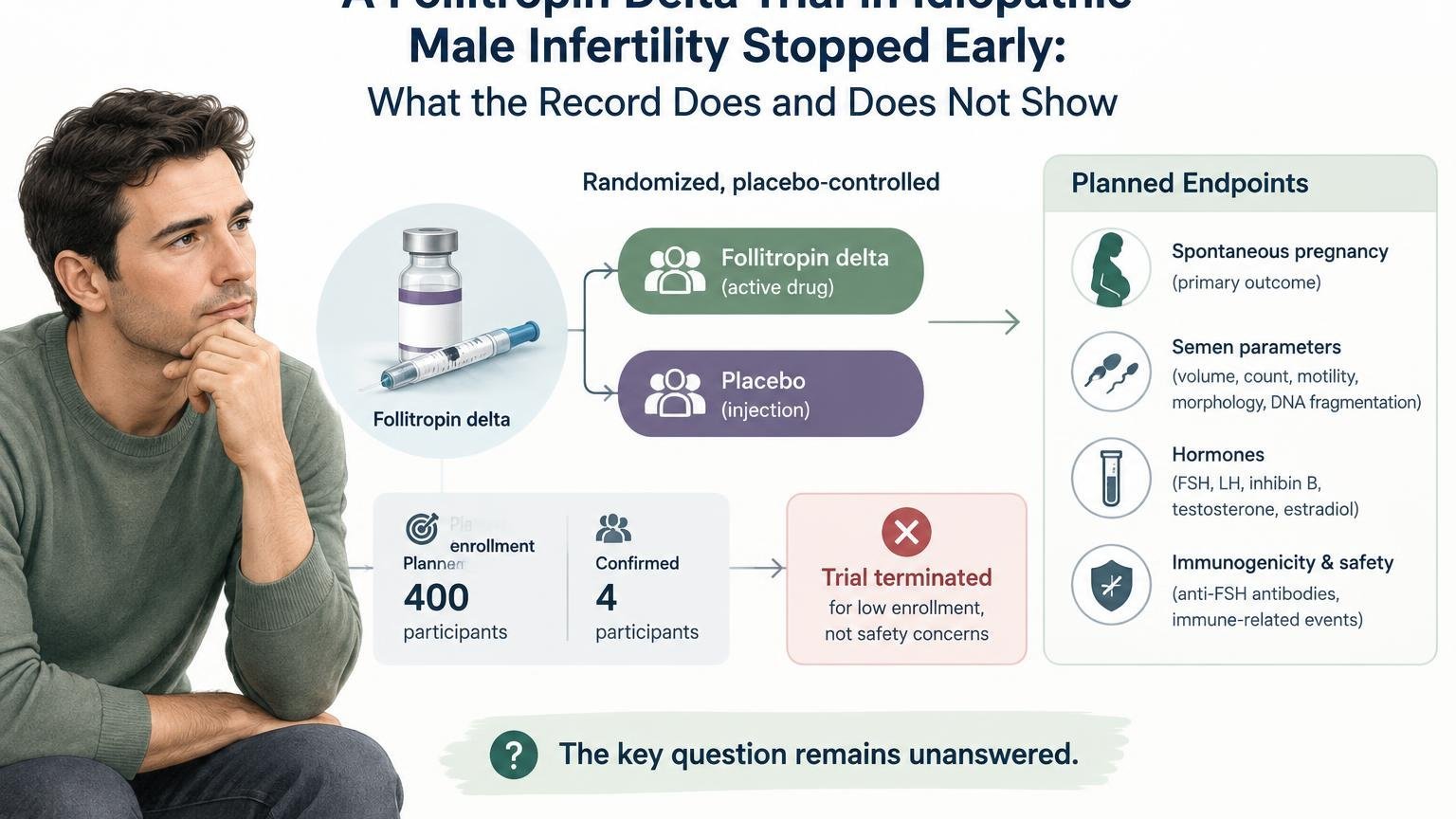
A registered Phase 2 randomized trial tested follitropin delta (FE 999049) against placebo in men with idiopathic infertility described as an unexplained reduction in semen quality. The record describes the study as terminated, and the stated reason was a low probability of enrolling enough participants within a reasonable timeframe, not safety concerns.[1]
The gap between plan and reality is the central finding. The enrollment target was estimated at 400 participants, while the record shows 4 confirmed. Results were first posted on Aug 28, 2026, but the source text does not state what those results contained, and no efficacy or safety conclusions can be drawn from it here.
What the record does offer is a carefully specified set of planned questions. The primary endpoint was spontaneous vital pregnancy in the female partner within 9 months of the man's randomization. Secondary endpoints covered semen volume, sperm concentration, total sperm count, total motile sperm count and morphology, plus semen DNA fragmentation, reproductive hormones and immune-related safety measures.
Why a Stopped Trial Still Matters
Male-factor contributions are common in infertility evaluation, yet few treatments have strong randomized support for improving semen parameters or natural conception. A well-designed placebo-controlled trial in this space would therefore be genuinely informative. The ADAM design is notable because it separated the biological question, whether sperm output and function change, from the clinical question, whether couples conceive without assistance.
Its termination also illustrates a practical reality of male reproductive research: recruiting men into a placebo-controlled injectable gonadotropin study is difficult. The record notes enrollment probability was too low for a reasonable timeframe, and that the decision was not attributed to safety concerns or to the sponsor's interest in male infertility treatment. That reasoning is as stated in the record and was not independently verified.
For readers weighing claims about hormone treatment for sperm quality, this is a useful case study in how to read a registry entry. A registered endpoint is a plan, not a result, and a terminated study usually cannot answer the question it posed. For broader background on interpreting semen results, see the explanation of abnormal semen analysis reference limits and repeat testing.
The Biological Rationale Behind Targeting FSH
Follitropin delta is a recombinant follicle-stimulating hormone. In men, FSH acts on Sertoli cells within the seminiferous tubules and supports spermatogenesis, partly through local signaling and androgen cooperation. The rationale for testing it in idiopathic infertility is that some men with unexplained poor semen quality might have a relative gonadotropin insufficiency or a sperm-production process that responds to additional FSH drive.
That rationale remains biologically plausible but clinically unproven at the level of live spontaneous pregnancy. Sperm production is a multi-hormonal process, and raising FSH does not necessarily increase output if the testes are already maximally stimulated or if the primary problem lies elsewhere. The trial's hormone endpoints, including FSH, luteinising hormone, inhibin B, testosterone and estradiol, reflect an attempt to observe whether the drug altered the reproductive axis at all.
Inhibin B is particularly relevant as a marker of Sertoli cell function, while semen DNA fragmentation addresses sperm genetic integrity rather than count alone. Including these measures suggests the investigators were prepared to test several distinct mechanisms by which sperm quality might improve. None of those mechanistic hypotheses were tested in a meaningful number of participants in this record.
What the Evidence Shows: A Design, Not an Answer
The trial was planned across 22 sites in 7 countries: 13 in the United States, 2 each in Germany, Italy and Sweden, and 1 each in Belgium, Denmark and Spain. It was randomized against placebo, a design that would have controlled for expectation and natural fluctuation in semen parameters, which are known to vary between samples.
The primary endpoint was not a semen parameter but spontaneous pregnancy in the female partner, defined as a vital pregnancy observed within 9 months of the male participant's randomization. A positive urine beta-hCG test and time to spontaneous pregnancy were listed as secondary outcomes. This hierarchy correctly placed a clinical outcome above laboratory surrogates.
Semen endpoints included change in semen volume from before randomization to 9 months after, plus sperm concentration, total sperm count, total motile sperm count and morphology. A composite responder definition allowed either spontaneous pregnancy or a 50% increase over average baseline in total sperm count or total motile sperm count at 6 and/or 9 months. Safety endpoints counted treatment-induced anti-FSH antibodies, including neutralizing capacity, and immune-related adverse events.
| Planned variable | Definition in the record | What it could have shown |
|---|---|---|
| Primary outcome | Spontaneous vital pregnancy in the female partner within 9 months of the man's randomization | Whether treatment increased unassisted conception, the clinically decisive question |
| Semen endpoints | Change in volume, sperm concentration, total sperm count, total motile count, morphology and DNA fragmentation | Whether sperm output or integrity shifted relative to placebo |
| Responder composite | Spontaneous pregnancy, or a 50% increase over average baseline in total or total motile sperm count at 6 and/or 9 months | A combined laboratory-or-clinical threshold for individual response |
| Hormonal endpoints | FSH, luteinising hormone, inhibin B, testosterone, free testosterone and estradiol | Whether the reproductive axis responded to exogenous FSH |
| Safety endpoints | Treatment-induced anti-FSH antibodies with neutralizing capacity; immune-related adverse events | Immunogenicity and immune safety signals during exposure |
| Enrollment | Estimated target of 400 participants; 4 confirmed | Whether the study could ever be adequately powered for its endpoints |
Interpretation and Limitations: Plan Versus Observed
Every outcome described above is a planned endpoint. The record does not report effect sizes, confidence intervals, group comparisons or adverse event counts in the supplied text. Results were first posted on Aug 28, 2026, so a formal results section may exist, but this analysis cannot characterize it and does not infer its contents from the posting date.
With 4 confirmed participants against a target of 400, the study is far too small to estimate treatment effects with useful precision, and a randomized comparison of a handful of men cannot separate drug effect from chance. Statistical significance would be uninterpretable at this scale, and clinical meaning even less so. The number 400 was a plan, not an achieved sample.
There are further limits to what this record can establish. A registry does not explain why men did not enroll, whether willingness, eligibility criteria, injection burden or competing fertility treatments played a role. The stated termination reason is a sponsor explanation rather than an audited finding. And the record history shows repeated revisions to endpoints and dates, a normal part of trial administration but a reminder that registry text evolves.
The most important interpretive caution is the one most easily lost: absence of a completed trial is not evidence of ineffectiveness. It means the question remains open. Men should be wary of claims that a terminated study proves follitropin delta does or does not work for sperm quality or conception.
Research Outlook
A definitive answer would need a completed randomized trial with adequate enrollment, a clinical pregnancy endpoint, and prespecified semen and hormonal outcomes. The ADAM protocol illustrates what such a study should measure, including DNA fragmentation and immunogenicity, and its fate illustrates the recruitment barrier that future male infertility trials must plan for, such as simpler designs, clearer patient-facing rationale or alternative recruitment channels.
Until then, the evidence base for gonadotropin therapy in idiopathic male infertility rests largely on smaller studies and indirect reasoning from reproductive physiology. That is a rationale for careful clinical evaluation and candid discussion, not for assuming benefit. Men concerned about semen quality can reasonably ask about repeat testing and appropriate male-factor evaluation before pursuing hormonal treatment.
Key Takeaways
- The ADAM trial was a Phase 2 randomized comparison of follitropin delta versus placebo in men with idiopathic infertility and unexplained reduced semen quality, and the record lists it as terminated.
- The stated termination reason was a low probability of enrolling participants in a reasonable timeframe, not safety concerns; this is the sponsor's explanation as recorded.
- The target was 400 participants, but 4 were confirmed, so no meaningful efficacy or safety conclusion can be drawn from this record.
- The primary endpoint was spontaneous vital pregnancy in the female partner within 9 months of the man's randomization; semen, hormone and immunogenicity measures were secondary.
- Results were first posted on Aug 28, 2026, but the supplied record does not report what they showed; the efficacy question remains unanswered.
Questions and Answers
What is follitropin delta and why was it tested in men with idiopathic infertility?
Follitropin delta is a recombinant follicle-stimulating hormone. Because FSH supports sperm production through Sertoli cell signaling, researchers hypothesized that additional FSH drive might improve semen quality in men with unexplained poor semen parameters. The terminated trial was designed to test that idea against placebo, including hormonal, semen and pregnancy endpoints, but it did not complete.
Did the follitropin delta trial improve semen quality or spontaneous pregnancy?
The supplied record cannot answer this. It lists spontaneous vital pregnancy within 9 months as the primary planned endpoint and semen parameters as secondary endpoints, but it does not report effect estimates. With 4 confirmed participants against a target of 400, the study could not provide a reliable efficacy result even if limited data were posted.
Why was the ADAM Phase 2 trial of follitropin delta terminated?
The record states the trial stopped because the probability of enrolling participants within a reasonable timeframe was too low. It explicitly notes the termination was not due to safety concerns or to the sponsor's interest in male infertility treatment. This is the sponsor's recorded reason and was not independently verified.
What endpoints did the terminated male infertility trial plan to measure?
Planned endpoints included spontaneous vital pregnancy in the female partner within 9 months as the primary outcome, plus change in semen volume, sperm concentration, total and total motile sperm count, morphology, DNA fragmentation, FSH, luteinising hormone, inhibin B, testosterone and estradiol. Safety measures included anti-FSH antibodies and immune-related adverse events.
Does a terminated trial mean follitropin delta does not work for male infertility?
No. Termination for slow enrollment means the question went unanswered, not that the treatment failed. The trial's design was placebo-controlled and included clinically meaningful endpoints, but without adequate recruitment no reliable efficacy or safety conclusion can be drawn. Claims in either direction go beyond this record.
How should readers interpret semen and pregnancy endpoints in a small stopped trial?
Semen parameters fluctuate naturally, so placebo controls and adequate numbers matter. Pregnancy is the more important clinical endpoint, and it requires enough couples and follow-up to detect differences. With 4 confirmed participants and a 400 target, neither laboratory changes nor pregnancy rates can be interpreted as evidence of benefit or harm.
Sources and References
SANYUN Science Center explains published research on men's reproductive and sexual health, connecting scientific evidence with everyday questions while making sources and limitations clear.
Disclaimer: This article is for scientific education and research communication only. It does not provide medical advice, diagnosis, or individualized treatment recommendations, and does not endorse any medication, supplement, device, penile enlargement procedure, or other intervention. Decisions about sexual and reproductive health should be made in consultation with a qualified healthcare professional. Do not delay seeking professional care because of information in this article.
Original Content & Copyright Notice
- This article is prepared for SANYUN Science Center, drawing on published research and publicly available academic literature on men’s sexual and reproductive health. Its editorial explanations and presentation are developed for this platform.
- Copyright in the original editorial content, selection, and arrangement is reserved by SANYUN Science Center to the extent protected by applicable law. Referenced research, quotations, and third-party materials remain subject to the rights of their respective owners. This notice does not claim ownership of scientific facts or third-party research.
- Except where permitted by applicable law or an applicable license, prior written permission is required to reproduce, republish, translate, adapt, redistribute, or commercially reuse protected content. Attribution alone does not grant permission for such reuse.
- For permitted quotation or authorized reuse, clearly identify the source and retain a link to the original article.
- Source: SANYUN Science Center
- Original URL: Retain the original article URL on science.san-yun.com.
- Copyright Holder: SANYUN Science Center, for its own protected editorial content.
- Quotation, excerpts, or authorized reuse must not distort the scientific meaning, omit material limitations or disclaimers, or imply unverified medical claims, product efficacy, or endorsement by SANYUN Science Center.



