




Category: Health Academy
Core Research Direction: Condom distribution in love hotels as a harm-reduction practice: what a field experiment in Lima found about brand and type effects on actual condom use
Search Intent: Does giving out free condoms at the point of sexual encounter increase condom use, and does the brand or type of condom matter?
Platform: SANYUN Science Center
Evidence reviewed through: 2026-10-31
The Short Answer
A peer-reviewed field experiment in a single love hotel in Lima, Peru, placed one free condom in randomly assigned rooms and measured actual use by searching rooms after clients left. Compared with a no-condom control group, measured use was significantly higher for several well-known commercial brands, but not for generic state-provided condoms. Condom type on its own did not show a consistent effect. The findings suggest that at the point of sexual encounter, what is supplied and how it is presented may matter, not only whether anything is supplied.[1]
That conclusion comes with important limits. The study involved 423 couples in one hostal (a short-stay love hotel), and its author calls for additional research. Used properly, condoms are an effective method of preventing sexually transmitted infections and pregnancy, according to NHS patient-education guidance; the Lima experiment is about the behavioural question of whether a free condom is actually used, not about whether condoms work.[2]
Why Point-of-Encounter Distribution Matters
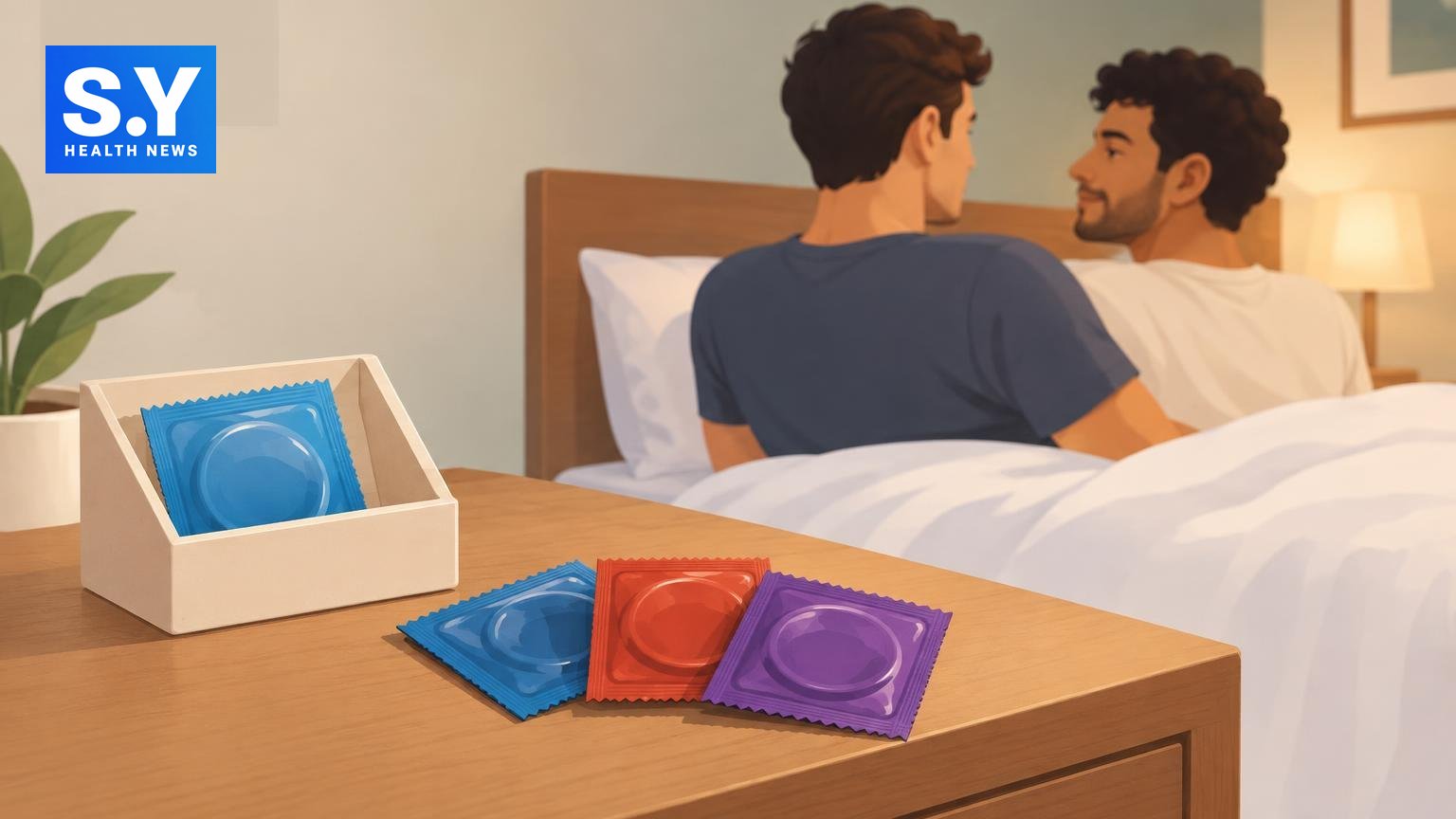
Condom promotion is usually organised around supply and education. Both matter, but they do not settle what happens in the final minutes before sex, when a couple decides whether to reach for a condom that is there. The Lima study was built on exactly that premise: the author proposed that a couple's last-minute decision to use a condom might be affected by the type and brand of condom provided.
The author also suggested that love hotels could serve as distribution points in a condom availability programme, and framed the work against low levels of contraceptive use in Peru while calling for new policies. Those are contextual and programmatic statements, not measured outcomes of this experiment.
For contrast, access schemes elsewhere are typically organised through health services. One local example is a free Safety C-Card for people under 25 in the Oxfordshire County Council area, which provides condom supplies and sexual health information. That is a service description, not evidence that the scheme changes behaviour. The Lima experiment is unusual in trying to measure use unobtrusively at the point of encounter rather than through a clinic or youth service.
How the Experiment Worked
The study examined how condom type and brand affected use within a free condom distribution intervention in love hotels. Rooms were divided across seven treatment groups combining brands (Durex, Piel and Generic/State-provided) with types (Extra-thin, Extra-safe and Textured), plus a control group. Clients were randomly assigned to a room with one free condom or to a control group with no condom provided, and 423 couples were studied.
The most distinctive methodological choice was the outcome measure. Instead of relying on self-reports, the researcher searched the recently vacated room for used condoms. The author argues that self-reported measures of use are unreliable and that new methods are needed; that is a methodological position, not a measured result, but it explains why this study looks different from most condom-promotion research.
Objective tracing has clear blind spots. A condom disposed of elsewhere or taken away would not be counted, and the method cannot explain why a couple did not use the condom. Randomisation at the room level strengthens the comparison, but blinding is not described in the available record, which matters because staff or clients who knew the study's purpose could in principle behave differently. The denominators for each treatment group are also not stated in the available excerpt, which limits precision assessment.
What the Evidence Shows
Measured condom use in the control group was 23%. Statistically significant higher use was found for Piel Extra-thin at 40%, Piel Extra-safe at 41%, Durex Extra-safe at 37% and Durex Textured at 34%. No statistically significant effect was identified for Generic/State-provided condoms at 29% or Durex Extra-thin at 25%. These are absolute percentages of couples in each group, not risk ratios or adjusted estimates.
| Measure / finding | Result | Population / follow-up | Limitations |
|---|---|---|---|
| Rooms were allocated across seven treatment combinations of condom brand (Durex, Piel, Generic/State-provided) and type (Extra-thin, Extra-safe, Textured), plus a control group. | 7 treatment groups plus control | couples using the hostal | Group structure described; allocation ratio not stated in the excerpt. |
| couples studied | 423 couples | couples in a hostal in Lima, Peru; n=423 | Number analysed per treatment arm is not stated in the excerpt. |
| condom use proportion | control 23%; Piel Extra-thin 40%; Piel Extra-safe 41%; Durex Extra-safe 37%; Durex Textured 34% % of couples | couples in a hostal in Lima, Peru; n=423 | Denominators per arm not stated in excerpt; single-site field experiment. |
| condom use proportion | Generic/State-provided 29%; Durex Extra-thin 25% % of couples | couples in a hostal in Lima, Peru; n=423 | Null results within the study's statistical power constraints; arm sizes not stated. |
The strongest signal is therefore a brand contrast rather than a type contrast. The author's summary is that providing well-known commercial brand condoms significantly increased use, whereas providing generic condoms did not. The generic result is the more policy-relevant of the two, because state-provided condoms are the kind most likely to be distributed through public programmes. The study also reports no effect from condom type overall and attributes the Durex Extra-thin null result to couples not perceiving the free condom; that perception explanation is an author interpretation, not a directly measured finding.
Statistical Versus Practical Meaning
Statistical significance here means the difference between a treatment group and the control was unlikely to arise by chance under the test used. It does not by itself mean the difference is large enough to change a public health programme's impact. The absolute gaps between the significant arms and the 23% control were 11 to 18 percentage points, but the arm-level denominators are not stated in the available excerpt, so the precision of each estimate is uncertain.
A null result for generic condoms should not be read as proof that generic condoms are never used. It may reflect insufficient statistical power in that group, or an effect too small to detect at this sample size. The study's framing of the generic result as a policy signal is therefore reasonable but provisional, especially because multiple groups were compared in a single site.
Nor is a brand effect a claim about latex quality. The design cannot separate packaging, familiarity, perceived quality or simple visibility of a known brand from anything about the product itself. The author's own explanation for the Durex Extra-thin null result invokes perception rather than performance, which is a reminder that the mechanism may sit in the couple's attention as much as in the condom.
Interpretation and Limitations
These findings come from a single hostal in Lima, so scale and setting are the main limits on generalising. The author's suggestion that love hotels could serve as distribution points is supported here in one venue only. Love hotels differ in clientele, privacy norms and regulation across countries, and the experiment tested a single free condom in a room rather than a full programme.
The outcome is use as detected in the room. Couples who brought their own condom, used one and removed it, or chose not to use the free one for reasons unrelated to brand would all be classified in ways the method may not capture. The experiment cannot distinguish a couple who noticed the condom and declined from one who never saw it, which is exactly the distinction needed to interpret the Durex Extra-thin result. The author concludes that additional research is needed.
Research Outlook
The obvious next questions follow from the study's gaps. Replication across multiple hotels, cities and countries would test whether the brand pattern persists. Larger groups would give the generic comparison more statistical power and allow tighter estimates. Measurement that captures whether clients noticed the free condom would test the perception hypothesis directly rather than inferring it from a null result.
Programme design also deserves attention. If familiarity or visibility drives use, distribution schemes might consider how a free condom is displayed and introduced, not only whether it is supplied. The Oxfordshire C-Card example shows that access schemes can combine supplies with information and a choice of condom type, but whether such features change behaviour is a separate empirical question from the Lima experiment.
Key Takeaways
- Used properly, condoms are an effective method of preventing STIs and pregnancy, according to NHS patient-education guidance.
- A Lima field experiment randomly assigned rooms in a love hotel to receive one free condom of varying brand and type or to a no-condom control, and measured use by searching vacated rooms for used condoms.
- Control-group use was 23%; significant increases were seen for Piel Extra-thin, Piel Extra-safe, Durex Extra-safe and Durex Textured, while Generic/State-provided condoms and Durex Extra-thin did not differ significantly from control.
- The author reports no effect from condom type overall and attributes the Durex Extra-thin null result to couples not noticing the free condom; that explanation is a hypothesis, not a measured finding.
- The study is single-site and its author calls for additional research; its brand signal should be read as provisional rather than as a purchasing recommendation.
Questions and Answers
What did the Lima field experiment actually test?
It tested whether providing one free condom in a love-hotel room changed measured condom use, and whether the brand or type of that condom mattered. Rooms covered combinations of Durex, Piel and Generic/State-provided condoms in Extra-thin, Extra-safe and Textured types, alongside a control group with no condom provided. Use was measured by searching vacated rooms for used condoms rather than by self-report.
What were the main findings on brand and type?
Compared with 23% use in the control group, significant increases were found for Piel Extra-thin (40%), Piel Extra-safe (41%), Durex Extra-safe (37%) and Durex Textured (34%). Generic/State-provided condoms (29%) and Durex Extra-thin (25%) did not differ significantly from control. The author reports no effect from condom type overall and attributes the Durex Extra-thin null result to couples not noticing the free condom.
How strong is this evidence?
It is a peer-reviewed field experiment with random assignment, which is stronger than a survey for behavioural outcomes. But it comes from a single hostal in Lima and involved 423 couples, and arm-level denominators are not stated in the available record. The author concludes that additional research is needed. Treat the brand pattern as a well-measured signal from one setting, not a definitive programme rule.
Can these results be applied to other countries or venues?
Only cautiously. The study took place in a hostal in Lima, and the author's suggestion that hostales could serve as distribution points is supported here in one venue. Love hotels differ in clientele, privacy norms and regulation across countries, and the experiment tested a single free condom in a room rather than a full programme. Replication across settings would be needed before generalising.
What are the main limitations and risks in interpreting it?
Searching vacated rooms can miss condoms disposed of elsewhere and cannot explain why a couple did not use one. The perception explanation for the Durex Extra-thin result is an author hypothesis, not a measured finding. A null generic result may reflect limited statistical power. Multiple groups were compared in a single site, and allocation ratios are not stated in the available material.
What is the practical takeaway for condom distribution?
The experiment suggests that at the point of sexual encounter, what is supplied and how it is presented may matter, not only whether anything is supplied. But it does not show that buying a particular brand will raise use in any given programme. Combined with NHS guidance that properly used condoms prevent STIs and pregnancy, the study supports further testing of distribution design rather than a settled purchasing decision.
Sources and References
- Franco Vega, I.. Any Port in a Storm? Assessment of the Effects of Type and Brand of Condom in Safe-Sex Practices Through a Field Experiment in a <i>Hostal</i> in Lima. Journal of Sex Research. 2026 DOI: 10.1080/00224499.2026.2664807.
- Condoms.
SANYUN Science Center explains published research on men's reproductive and sexual health, connecting scientific evidence with everyday questions while making sources and limitations clear.
Disclaimer: This article is for scientific education and research communication only. It does not provide medical advice, diagnosis, or individualized treatment recommendations, and does not endorse any medication, supplement, device, penile enlargement procedure, or other intervention. Decisions about sexual and reproductive health should be made in consultation with a qualified healthcare professional. Do not delay seeking professional care because of information in this article.
Original Content & Copyright Notice
- This article is prepared for SANYUN Science Center, drawing on published research and publicly available academic literature on men’s sexual and reproductive health. Its editorial explanations and presentation are developed for this platform.
- Copyright in the original editorial content, selection, and arrangement is reserved by SANYUN Science Center to the extent protected by applicable law. Referenced research, quotations, and third-party materials remain subject to the rights of their respective owners. This notice does not claim ownership of scientific facts or third-party research.
- Except where permitted by applicable law or an applicable license, prior written permission is required to reproduce, republish, translate, adapt, redistribute, or commercially reuse protected content. Attribution alone does not grant permission for such reuse.
- For permitted quotation or authorized reuse, clearly identify the source and retain a link to the original article.
- Source: SANYUN Science Center
- Original URL: Retain the original article URL on science.san-yun.com.
- Copyright Holder: SANYUN Science Center, for its own protected editorial content.
- Quotation, excerpts, or authorized reuse must not distort the scientific meaning, omit material limitations or disclaimers, or imply unverified medical claims, product efficacy, or endorsement by SANYUN Science Center.



