




Category: Clinical Insights
Core Research Direction: The supplied sources do not contain evidence on adult men's reproductive or sexual health; anchoring facts concern guideline concordance methods, guideline review of obesity management, and perioperative hemodynamic strategies, which are unrelated to testosterone testing or hypogonadism.
Search Intent: What does the supplied evidence actually show about the clinical topics it covers, and can any of it support claims about male reproductive and sexual health?
Platform: SANYUN Science Center
Evidence reviewed through: 2026-11-09
Executive Summary
The research packet assembled for this review does not contain studies of adult men's reproductive or sexual health. It contains three research syntheses about clinical methodology and perioperative care, plus one patient-facing knowledge-base explainer about testosterone testing. Those categories are not interchangeable, and the most important service this article can perform is to keep them apart rather than to build a male-hormone narrative on unrelated evidence.[1][2][3][4]
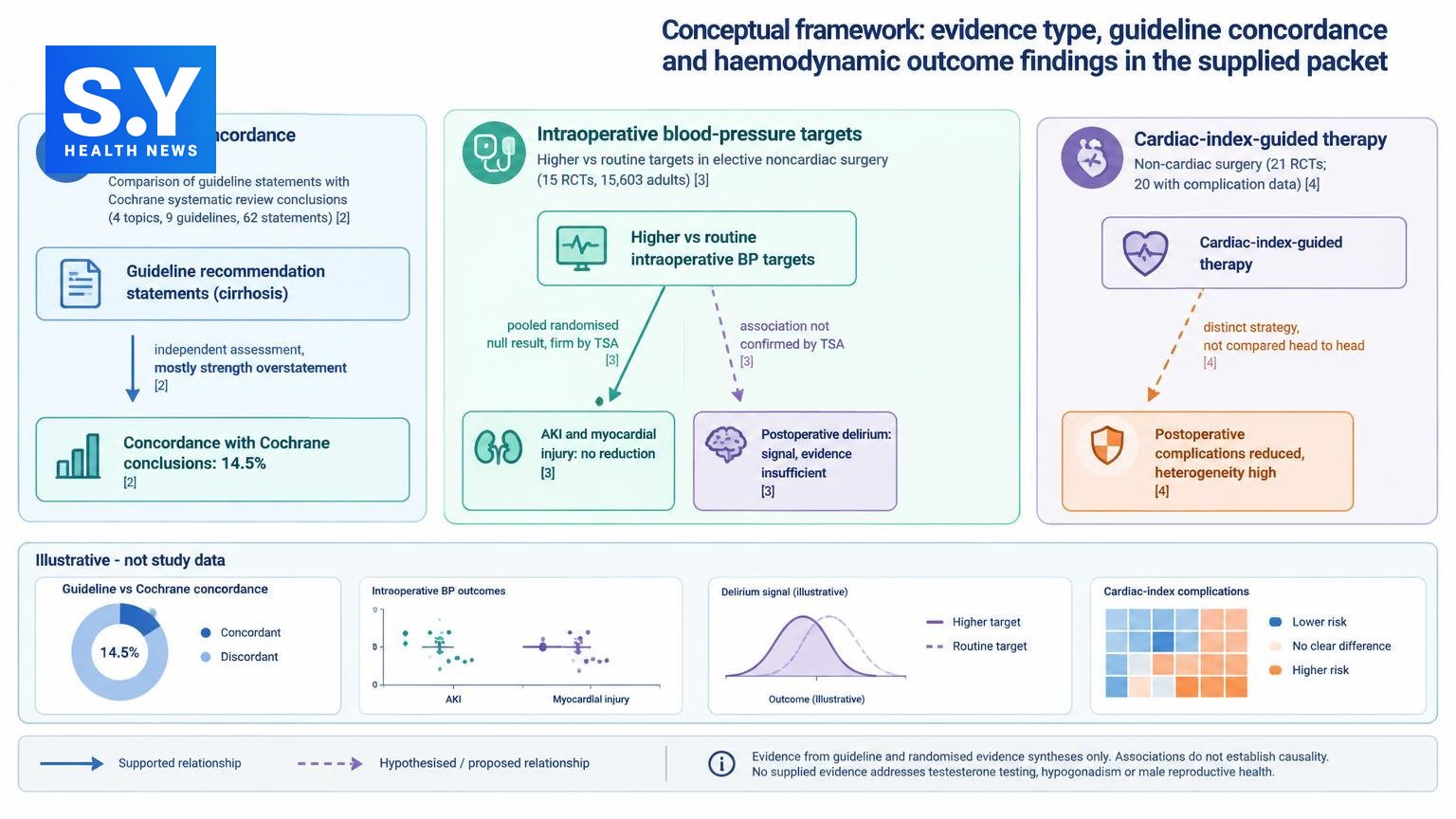
The first research source is an exploratory study asking how often clinical practice guideline statements agree with the conclusions of Cochrane systematic reviews. Across nine guidelines on four topics in decompensated cirrhosis, containing 62 statements also covered by seven Cochrane reviews, agreement between guideline authors and independent assessment was 14.5% (95% CI 7.7% to 25.6%). Most disagreements concerned the strength of recommendation, which guideline authors tended to overstate.
The second source is a systematic review and meta-analysis with trial sequential analysis of 15 randomized trials covering 15,603 adults undergoing elective noncardiac surgery under general anesthesia. Higher intraoperative blood-pressure targets, whether fixed thresholds or personalised to preoperative baseline, did not reduce acute kidney injury (RR 0.95; 95% CI 0.85 to 1.06) or acute myocardial injury (RR 1.02; 95% CI 0.94 to 1.12), with trial sequential analysis indicating firm evidence for those two null results. Postoperative delirium was lower with higher targets (RR 0.73; 95% CI 0.54 to 0.98), but the cumulative evidence was judged insufficient for firm conclusions. Mortality did not differ (RR 1.00; 95% CI 0.75 to 1.34).
The third source is a meta-analysis of 21 randomized trials of cardiac-index-guided goal-directed therapy in non-cardiac surgery, 20 of which contributed data on postoperative complications. The intervention was associated with fewer patients experiencing at least one postoperative complication (OR 0.59; 95% CI 0.45 to 0.78), with substantial heterogeneity (I2 = 62.9%) and a prediction interval (0.20 to 1.74) crossing the null. Mortality did not differ significantly (OR 0.77; 95% CI 0.57 to 1.05). The authors explicitly caution that the findings do not establish an independent advantage of cardiac-index targeting over other goal-directed therapy strategies.
A fourth record is a systematic review of national and international clinical guidelines for managing obesity in adults published since 2019. The supplied record is abstract-level only and reports no numerical findings, so it can be described but not interpreted. Separately, the testosterone explainer that supplied the packet's only hormones-related content is an unreferenced editorial knowledge-base article, not a study or guideline, and its assertions are reported here only as claims to be verified elsewhere.[5]
Why This Matters
Readers arrive at clinical evidence with reasonable expectations that a research summary will answer a health question. When a source collection does not address the question, the honest response is to say so and to explain what the collection does support. The packet's genuine methodological contribution concerns how guidelines relate to the systematic reviews beneath them and how randomised evidence is interpreted when effect estimates are imprecise or heterogeneous.
The concordance study is relevant to any field because it quantifies a gap between recommendation strength and the underlying evidence, and it reports that differences in search dates did not explain the disagreements. That is a statement about decompensated cirrhosis guidelines, not about testosterone guidelines. Generalising it to male hormone testing would require a separate study of those guidelines, which the packet does not contain.
The two haemodynamic reviews matter for a different reason: they illustrate how a plausible physiological rationale can coexist with neutral randomised results. Observational data link intraoperative hypotension to adverse outcomes, and contemporary international guidelines recommend maintaining mean arterial pressure at or above 60 to 65 mmHg on that basis. Whether pushing pressure above those thresholds helps was a separate question, and the randomised evidence answered it largely in the negative.
Biological or Clinical Mechanism
The mechanistic reasoning in the blood-pressure review runs from perfusion to organ injury: hypotension is proposed to compromise blood flow to kidney, heart and brain, so avoiding it should reduce injury. The authors describe observational evidence as consistent across definitions of hypotension and analytical approaches. They also state plainly that observational studies have substantial limitations for establishing causality. The randomised trials were designed to test whether raising the target above guideline-recommended values adds benefit once overt hypotension is avoided.
The cardiac-index review rests on a related but distinct rationale. Cardiac index quantifies flow rather than pressure, and goal-directed therapy titrates fluids and vasoactive drugs toward a flow target. The review's own discussion notes that its findings do not establish an independent advantage of cardiac-index targeting over other goal-directed therapy strategies, which is an important boundary: a benefit for the strategy as a package is not evidence that the specific monitored variable is the active ingredient.
No biological mechanism linking any packet source to testosterone production, androgen receptor signalling or hypogonadism is described in the supplied material. The testosterone explainer asserts that levels are sensitive to sleep, stress and acute illness and that a single low reading is often a false positive, but it cites no source and does not constitute mechanistic evidence. It should be read as a lay claim requiring verification against primary literature and current specialty guidance that were not supplied.
What the Evidence Shows
| Source and design | Population or unit of analysis | Main reported result | What it does not establish |
|---|---|---|---|
| Exploratory comparison of guideline statements with Cochrane review conclusions (nine guidelines, four cirrhosis topics; guidelines sampled until January 2022) | 62 guideline statements from major USA and European liver organisations | Agreement 14.5% (95% CI 7.7% to 25.6%); most disagreements involved overstated recommendation strength | Concordance in any other specialty, including male hormone testing guidelines |
| Systematic review and meta-analysis with trial sequential analysis of 15 randomised trials | 15,603 adults undergoing elective noncardiac surgery under general anaesthesia | Acute kidney injury RR 0.95 (95% CI 0.85 to 1.06); acute myocardial injury RR 1.02 (95% CI 0.94 to 1.12); both with firm evidence by trial sequential analysis | Benefit for any outcome not analysed; applicability to cardiac surgery or non-anaesthetised patients |
| Same meta-analysis, secondary and other outcomes | Adults undergoing elective noncardiac surgery | Postoperative delirium RR 0.73 (95% CI 0.54 to 0.98); trial sequential analysis judged evidence insufficient; mortality RR 1.00 (95% CI 0.75 to 1.34) | Firm delirium prevention; effects on major cardiovascular events, stroke and length of stay, which the authors considered inconclusive |
| Systematic review and meta-analysis of 21 randomised trials of cardiac-index-guided goal-directed therapy | Adults undergoing non-cardiac surgery; 20 trials contributed complication data | Postoperative complications OR 0.59 (95% CI 0.45 to 0.78; prediction interval 0.20 to 1.74; I2 = 62.9%); mortality OR 0.77 (95% CI 0.57 to 1.05) | Consistent benefit across settings; independent advantage of cardiac-index targeting over other goal-directed strategies |
| Systematic review of national and international obesity guidelines published since 2019 | Adults with obesity; number of guidelines not stated in the supplied record | No numerical findings reported at abstract level | Any treatment effect, guideline quality rating or comparative conclusion |
Across the three interpretable research sources, a consistent theme is that the credibility of a recommendation depends on the design beneath it. The cirrhosis study compared recommendation statements against Cochrane conclusions and found that disagreement clustered around strength rather than direction, with guideline authors overstating certainty. That distinction matters practically: a recommendation can cite relevant trials and still overstate how firmly they support action.
The blood-pressure review supplies the complementary case, in which large randomised evidence narrowed rather than expanded the indication. The pooled data covered more than fifteen thousand participants, and the two outcomes with firm evidence by trial sequential analysis were null for kidney and myocardial injury. The delirium signal points in a favourable direction but the same sequential method judged the cumulative information insufficient, which is a useful demonstration that a statistically significant pooled estimate can still be evidentially immature.
The cardiac-index review reports a pooled complication benefit alongside substantial heterogeneity and a prediction interval spanning both benefit and harm. The authors graded certainty high yet still warned that the benefit may not be consistent across clinical settings and that their findings do not establish an independent advantage over other goal-directed strategies. Grading certainty and judging transportability are separate tasks, and both appear in the same abstract.
Interpretation and Limitations
The cirrhosis concordance study is explicitly exploratory and used a purposive sample of guidelines from leading USA and European liver organisations covering four decompensated cirrhosis topics. The reported agreement proportion therefore describes that sample, and the authors note that differences in search dates did not explain the disagreements. It cannot be assumed that the same magnitude of overstatement exists among guidelines for testosterone evaluation, because no such comparison was supplied.
The blood-pressure meta-analysis was restricted to randomised trials in adults having elective noncardiac surgery under general anesthesia, and achieved separation between groups was modest, with an unweighted mean difference of about 6.8 mmHg where numerically reported. Fixed and personalised target strategies were pooled. The firm null results for kidney and myocardial injury should not be read as evidence that severe hypotension is harmless, since the comparator was routine guideline-based management rather than permissive hypotension.
The cardiac-index review is limited in this article by the supplied text being an abstract-level record: total participant numbers and the individual trial characteristics are not available here. Its pooled complication estimate carries a wide prediction interval, and the authors' own caution about non-independence from other goal-directed strategies limits how the result should be framed. The obesity guideline review is similarly limited to an abstract-level description with no results.
The testosterone explainer requires the strongest caveat. It presents specific testing intervals and monitoring schedules as if they were established protocol, but the supplied text cites no guideline, trial or systematic review, and its authorship includes a medical student with physician review of an editorial rather than research kind. In this review its statements about repeat testing and about sensitivity to sleep, stress and acute illness are recorded as claims, not findings. Any clinical conclusion about male hormone testing needs primary evidence that the packet does not contain.
Research Outlook
For the concordance question, the natural next step is replication beyond decompensated cirrhosis, including whether recommendation-strength overstatement appears in guidelines for endocrine and reproductive topics. Such a study would compare statements against the systematic reviews cited for them, using independent assessors, and would need to prespecify how strength is judged. The packet provides the method template but no such study in men's health.
For haemodynamic targets, the authors of the blood-pressure review concluded that a potential delirium reduction warrants confirmation in adequately powered trials. That is a specific, testable proposal rather than an established benefit. The cardiac-index authors note that their design cannot isolate the monitored variable from the broader goal-directed package, which points toward trials that compare monitoring strategies head to head rather than each against standard care.
For male reproductive and sexual health, the research gap is the headline. A defensible evidence review of testosterone testing frequency would need current specialty guidelines, diagnostic accuracy studies for repeat morning sampling, and randomised or high-quality observational data on monitoring during treatment. None of these were supplied. Until such material is assembled, claims about how often testosterone should be tested cannot be attributed to this packet.
Key Takeaways
- The packet contains no study of adult men's reproductive or sexual health; the only testosterone content is an unreferenced patient-facing explainer that this review treats as claims rather than evidence.
- In an exploratory comparison across nine decompensated cirrhosis guidelines, agreement with Cochrane review conclusions was 14.5% (95% CI 7.7% to 25.6%), with overstatement of recommendation strength accounting for most disagreements.
- Pooled randomised evidence from 15 trials and 15,603 surgical patients found no reduction in acute kidney injury or acute myocardial injury with higher intraoperative blood-pressure targets, with firm evidence by trial sequential analysis for both.
- A postoperative delirium reduction with higher targets (RR 0.73; 95% CI 0.54 to 0.98) remains evidentially immature, and mortality did not differ.
- Cardiac-index-guided therapy was associated with fewer postoperative complications (OR 0.59; 95% CI 0.45 to 0.78) but with substantial heterogeneity and no established independent advantage over other goal-directed strategies.
Questions and Answers
What does the supplied evidence packet actually show about male testosterone testing?
Nothing that qualifies as research evidence. The only testosterone-related source is a patient-facing knowledge-base explainer that asserts a repeat-testing approach and sensitivity to sleep, stress and acute illness without citing guidelines or studies. It is not a trial, systematic review or clinical guideline, so its testing intervals and monitoring schedules should be verified against primary specialty guidance that the packet does not contain.
How often did cirrhosis guideline statements agree with Cochrane review conclusions?
In an exploratory study of nine guidelines on four decompensated cirrhosis topics, 62 statements were also covered by seven Cochrane reviews. Agreement between guideline authors and independent assessment was 14.5% (95% CI 7.7% to 25.6%). Most disagreements concerned the strength of recommendation, with guideline authors overstating it, and differing search dates did not explain the disagreements.
Do higher intraoperative blood pressure targets reduce kidney injury in noncardiac surgery?
No, according to the pooled randomised evidence. Across 15 trials and 15,603 adults having elective noncardiac surgery under general anesthesia, higher targets did not reduce acute kidney injury (RR 0.95; 95% CI 0.85 to 1.06; I2 = 16%), and trial sequential analysis indicated firm evidence. Acute myocardial injury was likewise not reduced (RR 1.02; 95% CI 0.94 to 1.12).
Is the postoperative delirium reduction with higher blood pressure targets a firm finding?
Not yet. Higher targets were associated with fewer delirium cases (RR 0.73; 95% CI 0.54 to 0.98; P = 0.04; I2 = 26%), but the review's trial sequential analysis found the cumulative evidence insufficient to draw firm conclusions. The authors therefore describe the signal as warranting confirmation in adequately powered trials rather than as an established benefit.
Does cardiac-index-guided goal-directed therapy improve outcomes in non-cardiac surgery?
The pooled estimate suggests fewer patients with at least one postoperative complication (OR 0.59; 95% CI 0.45 to 0.78), but heterogeneity was substantial (I2 = 62.9%) and the prediction interval (0.20 to 1.74) crossed the null. Mortality did not differ significantly (OR 0.77; 95% CI 0.57 to 1.05). The authors state the findings do not establish an independent advantage over other goal-directed strategies.
Why can't this guideline concordance research be applied directly to male hormone guidelines?
The concordance study sampled only guidelines on decompensated cirrhosis from major USA and European liver organisations, covering variceal bleeding, spontaneous bacterial peritonitis, ascites and hepatorenal syndrome. Its 14.5% agreement figure describes that purposive sample. Extending the finding to testosterone or hypogonadism guidelines would require a separate comparison against the systematic reviews those guidelines cite, which the packet does not provide.
Conceptual framework: Conceptual framework for this evidence review. Three unrelated evidence streams are shown: guideline-concordance comparison in decompensated cirrhosis, randomised comparisons of higher versus routine intraoperative blood-pressure targets in elective noncardiac surgery, and cardiac-index-guided goal-directed therapy. Supported edges reflect reported pooled results; the delirium and cardiac-index edges are proposed readings, not tested mediation. No node addresses testosterone or hypogonadism, because the supplied research evidence does not.
Academic References & Evidence
- Harry Whitmore; Stefan Petrov. How Often to Test Testosterone Levels | Diagnosis and Monitoring 2026.
- Gurusamy, K; Roberts, D; Leung, J; O’Brien, A; Gluud, C; Pavlov, C; Davidson, BR. Clinical practice guidelines recommendations compared to the findings of the Cochrane systematic reviews on the management of decompensated liver cirrhosis in the USA and Europe. Frontline Gastroenterology. 2026 DOI: 10.1136/flgastro-2026-103856.
- Katie Chiou; Sovann Vikram; Kiana Rowshan; Smeet Shah; Dolly Modha; Edgard Engelman; David Guthrie; Anil Tiwari; Joseph Rinehart; Alexandre Joosten; Bernd Saugel; Sean Coeckelenbergh. Higher versus Routine Intraoperative Blood… : Anesthesiology. Anesthesiology. 2026 145(4):872-888 DOI: 10.1097/ALN.0000000000006190.
- Philipp Kazuo Omuro. Effect of cardiac-index guided intraoperative haemodynamic therapy on postoperative outcome in non-cardiac surgery patients – a systematic review and meta-analysis. Perioper Med (Lond) DOI: 10.1186/s13741-026-00760-8. PMID: 42995637.
- Paul Doody; Ruth Martin; Barrie Tyner; Marie Carrigan; Celine Larkin; Michelle O'Neill; Susan M. Smith; Máirín Ryan. National and International Clinical Guidelines for the Management of Obesity in Adults: A Systematic Review. Obesity reviews. 2026 :e70163 DOI: 10.1111/obr.70163.
SANYUN Science Center explains published research on men's reproductive and sexual health, connecting scientific evidence with everyday questions while making sources and limitations clear.
Disclaimer: This article is for scientific education and research communication only. It does not provide medical advice, diagnosis, or individualized treatment recommendations, and does not endorse any medication, supplement, device, penile enlargement procedure, or other intervention. Decisions about sexual and reproductive health should be made in consultation with a qualified healthcare professional. Do not delay seeking professional care because of information in this article.
Original Content & Copyright Notice
- This article is prepared for SANYUN Science Center, drawing on published research and publicly available academic literature on men’s sexual and reproductive health. Its editorial explanations and presentation are developed for this platform.
- Copyright in the original editorial content, selection, and arrangement is reserved by SANYUN Science Center to the extent protected by applicable law. Referenced research, quotations, and third-party materials remain subject to the rights of their respective owners. This notice does not claim ownership of scientific facts or third-party research.
- Except where permitted by applicable law or an applicable license, prior written permission is required to reproduce, republish, translate, adapt, redistribute, or commercially reuse protected content. Attribution alone does not grant permission for such reuse.
- For permitted quotation or authorized reuse, clearly identify the source and retain a link to the original article.
- Source: SANYUN Science Center
- Original URL: Retain the original article URL on science.san-yun.com.
- Copyright Holder: SANYUN Science Center, for its own protected editorial content.
- Quotation, excerpts, or authorized reuse must not distort the scientific meaning, omit material limitations or disclaimers, or imply unverified medical claims, product efficacy, or endorsement by SANYUN Science Center.



