




Category: Reproductive Care
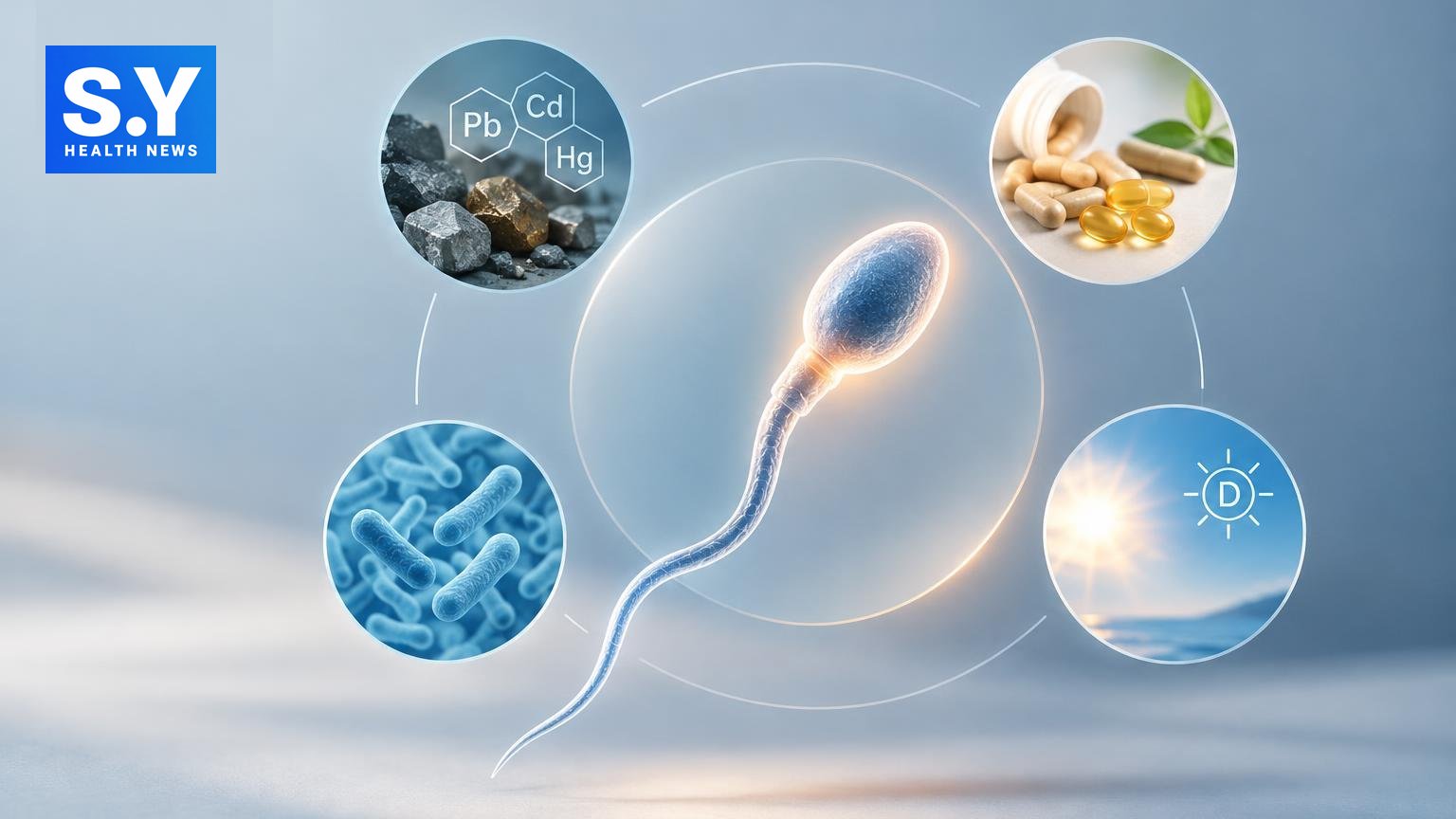
Core Research Direction: What systematic reviews and individual human studies say about associations between environmental heavy-metal exposure, supplemental antioxidant/probiotic use, and vitamin D status with semen parameters in men, and how uncertain and design-limited this evidence is
Search Intent: How strong is the human evidence that environmental or supplemental exposures measurably change sperm count, motility or morphology in adult men?
Platform: SANYUN Science Center
Evidence reviewed through: 2026-11-12
Executive Summary
Men seeking answers about sperm count, motility or morphology often encounter confident claims about environmental metals, antioxidant supplements, probiotics or vitamin D. The human evidence is far less settled. A 2026 systematic review and meta-analysis of observational studies included 18 studies with 4041 participants and found heterogeneous results, with significant findings concentrated on cadmium and lead, while most associations with reproductive hormones were non-significant.[1]
Only six of the 18 studies could be pooled, and the single statistically significant pooled finding was a small inverse association between seminal cadmium and sperm motility (pooled Fisher's z = -0.17, 95% CI -0.30 to -0.04), with no between-study heterogeneity. No significant pooled association was observed for seminal lead. The authors concluded that the current evidence does not demonstrate consistent associations between heavy-metal exposure and male reproductive parameters.
Supplement evidence is similarly preliminary. A three-month, three-arm comparison reported adjusted mean sperm concentration rising from 5.03 to 8.55 million/mL with antioxidant, 5.13 to 10.42 million/mL with probiotic and 4.79 to 4.91 million/mL with placebo. Motility rose from 22.16% to 26.58% with antioxidant, 23.54% to 46.65% with probiotic and 21.72% to 22.75% with placebo. These are short-term findings from a single trial whose population, randomization and sample size are not described in the available table, so they cannot be treated as established treatment effects.[2]
Why This Matters
Male reproductive health is a common clinical concern, and couples often ask whether lifestyle or environmental exposures can be modified to improve semen quality. Heavy metals such as cadmium, lead, mercury, chromium, arsenic and nickel are widespread through industrial emissions, contaminated food and water, and occupational exposure. The review's background notes that these metals are not biodegradable and can accumulate in tissues.
The appeal of supplements is understandable: they appear low-risk and are heavily marketed. But the underlying question is not whether an antioxidant or probiotic is biologically plausible; it is whether human studies show a reproducible, clinically meaningful improvement in sperm parameters or pregnancy rates. The available evidence does not yet answer that question with confidence.
Biological Mechanisms: Plausible but Not Proven in Men
Proposed mechanisms for heavy-metal reproductive toxicity include oxidative stress, inflammation, apoptosis, disruption of the blood-testis barrier, and dysfunction of Sertoli and Leydig cells. Experimental and epidemiological evidence also suggests that metals may affect the hypothalamic-pituitary axis and impair spermatogenesis, potentially altering semen parameters and circulating reproductive hormones including testosterone, follicle-stimulating hormone, luteinizing hormone and estradiol.
These mechanisms are biologically plausible, but they are derived largely from experimental models and do not establish that the same pathways operate at typical human exposure levels. Observational human studies measure metal concentrations in blood, urine or semen at a single time point and correlate them with semen parameters; such designs cannot show that a metal caused a change in sperm production.
What the Heavy-Metal Evidence Shows
The 2026 review searched PubMed, Scopus and Web of Science through 31 March 2025 and included observational studies published between 2004 and 2021. Designs were cohort, case-control and cross-sectional, with sample sizes from 42 to 746 participants. Heavy-metal concentrations were measured in various biological samples, including urine, blood and semen, and the populations ranged from male partners of infertile couples and men undergoing infertility evaluation to occupationally exposed men, sperm donors and general-population men.
Of 6482 records retrieved, 18 studies met inclusion criteria and only 6 contributed to quantitative pooling. The qualitative synthesis found significant findings mainly for cadmium and lead, but the direction and magnitude varied across studies. For cadmium and sperm concentration, for example, two of seven studies reported significant associations in opposite directions: one weak positive correlation (r = 0.316) and one negative correlation in an infertile population (r = -0.189).
The pooled result for seminal cadmium and motility was statistically significant but small. A Fisher's z of -0.17 corresponds to a weak inverse correlation, not a threshold effect or a clinical diagnosis. The confidence interval ranged from -0.30 to -0.04, and heterogeneity was reported as zero, which suggests the pooled estimate was consistent across the contributing studies but does not remove the limitations of cross-sectional exposure assessment.
Other metals produced mixed or null findings. For seminal lead, no significant pooled association was observed. Individual studies reported some negative associations between lead and sperm concentration or count, but the majority did not find significant results. Arsenic findings were contradictory: one study reported that men in the highest quartile of seminal arsenic had 16.58% higher sperm concentration than those in the lowest quartile (95% CI 1.95 to 35.60), while another reported a negative correlation (r = -0.328). The same high-arsenic quartile study also reported lower progressive motility (β = -6.49 percentage points, 95% CI -9.82 to -2.98) and lower total motility (β = -6.36, 95% CI -10.31 to -2.57).
For seminal cadmium and immotile sperm, one small Spanish case-control study of 61 men reported a 4.9 percentage-point increase in immotile sperm (95% CI 0.84 to 9.1), while blood cadmium showed no significant relation to motility. The contrast between seminal and blood matrices is a recurring theme and a source of inconsistency across the literature.
What the Supplement Evidence Shows
The supplement evidence in the available packet comes from a single three-month, three-arm comparison of antioxidant, probiotic and placebo. Adjusted mean sperm concentration rose in all arms, but the group-by-time interaction P value was 0.003, and the pairwise probiotic-versus-placebo comparison was reported as P = 0.007, whereas antioxidant versus placebo was P = 0.89.
Motility showed a larger separation: adjusted means rose from 22.16% to 26.58% with antioxidant, 23.54% to 46.65% with probiotic and 21.72% to 22.75% with placebo. The group-by-time P value was less than 0.001. Pairwise comparisons were antioxidant versus probiotic P = 0.009, antioxidant versus placebo P > 0.999 and probiotic versus placebo P = 0.001. Morphology also changed, from 1.47% to 2.21% with antioxidant, 1.60% to 4.31% with probiotic and 1.47% to 1.52% with placebo, but baseline morphology was very low and the clinical meaning of these absolute differences is unstated.
Semen volume did not differ significantly across arms or over time (group-by-time P = 0.710). The table does not state the trial's sample size, randomization method or baseline comparability, and the population is not described. Without those details, the large motility difference with probiotic cannot be assumed to be a reproducible treatment effect; it may reflect small group sizes, multiple comparisons or unmeasured differences between groups.
The packet does not contain a dedicated human trial of vitamin D and semen parameters. A prospective interventional study of 330 men in a summary table reported no significant association with sperm count, motility, morphology or pregnancy rate, but the intervention is not identifiable from the table, so it cannot be attributed to vitamin D or any other specific supplement. Claims that vitamin D improves sperm parameters should therefore be treated as unverified in this evidence set.[3]
Interpreting the Numbers: Statistical Versus Clinical Meaning
| Evidence area | What was measured | Key result | Interpretation |
|---|---|---|---|
| Heavy-metal review: scope | 18 observational studies, 4041 participants, published 2004-2021 | Only 6 studies could be pooled | Small poolable evidence base; most studies were narratively summarized rather than meta-analyzed |
| Seminal cadmium and motility | Pooled Fisher's z from observational correlations | z = -0.17 (95% CI -0.30 to -0.04); I² = 0% | Statistically significant but weak inverse association; cross-sectional design cannot establish causation |
| Seminal lead and sperm parameters | Pooled association from observational correlations | No significant pooled association | Current evidence does not support a consistent seminal lead effect |
| Antioxidant versus placebo: motility | Adjusted mean motility at baseline and 3 months | 22.16% to 26.58% versus 21.72% to 22.75%; pairwise P > 0.999 | No significant difference between antioxidant and placebo in this trial |
| Probiotic versus placebo: motility | Adjusted mean motility at baseline and 3 months | 23.54% to 46.65% versus 21.72% to 22.75%; pairwise P = 0.001 | Large short-term difference in one small trial; replication and sample-size details are needed |
| Semen volume across supplement arms | Adjusted mean semen volume at baseline and 3 months | Group-by-time P = 0.710 | No significant effect of antioxidant or probiotic on semen volume |
Statistical significance and clinical relevance are not the same. A pooled correlation of -0.17 is weak even if the confidence interval excludes zero; it does not tell a clinician how much a given man's motility would change if his cadmium exposure were reduced. Similarly, a motility difference in a three-month trial does not establish a durable benefit, a pregnancy benefit or safety over longer use. None of the included heavy-metal studies were randomized, and the supplement evidence is a single short trial.
Limitations and Conflicting Findings
The heavy-metal literature is limited by observational designs, heterogeneous exposure matrices and inconsistent outcome definitions. Some studies measured metals in semen, others in blood or urine, and the same metal could show opposite associations depending on the matrix. The review authors did not evaluate publication bias because too few studies were available per analysis, and they explicitly called for larger, well-designed prospective studies.
The supplement evidence is limited by the absence of key trial details in the available table. The population, sample size, randomization and baseline comparability are not described, and the three-month duration is short relative to the spermatogenic cycle and to any realistic clinical decision. The morphology changes occurred against baseline values near 1.5%, and the clinical relevance of small absolute changes in morphology is uncertain.
A further limitation is that the packet does not include a human vitamin D trial, so the article cannot evaluate vitamin D status against semen parameters. Any statement that vitamin D supplementation improves sperm quality would go beyond the evidence assembled here.
Research Outlook
The most useful next steps are prospective studies with repeated exposure and semen measurements, standardized biological matrices, and prespecified outcomes. For supplements, randomized trials need adequate sample sizes, longer follow-up, transparent reporting of randomization and baseline characteristics, and pregnancy or live-birth outcomes where feasible. Until such evidence exists, clinicians and readers should treat heavy-metal associations and supplement effects as uncertain and avoid drawing firm conclusions from single studies.
Key Takeaways
- The 2026 heavy-metal review included 18 observational studies with 4041 participants, but only 6 could be pooled, and findings were heterogeneous.
- The only significant pooled heavy-metal finding was a small inverse association between seminal cadmium and sperm motility (Fisher's z = -0.17, 95% CI -0.30 to -0.04); seminal lead showed no significant pooled association.
- A three-month three-arm trial reported a large motility increase with probiotic versus placebo, but the available table omits sample size, randomization and population details, so replication is needed.
- The packet contains no dedicated human vitamin D trial, so claims about vitamin D and semen parameters are not supported by this evidence set.
Questions and Answers
What does the 2026 systematic review say about heavy metals and sperm parameters?
It included 18 observational studies with 4041 participants and found heterogeneous results. Significant findings were concentrated on cadmium and lead, but the evidence did not show consistent associations across metals and sperm parameters. Only 6 studies could be pooled; the single significant pooled finding was a weak inverse association between seminal cadmium and sperm motility.
Is seminal cadmium associated with lower sperm motility in men?
A 2026 meta-analysis reported a small statistically significant inverse pooled association between seminal cadmium and sperm motility (Fisher's z = -0.17, 95% CI -0.30 to -0.04; I² = 0%). This is a weak correlation from cross-sectional studies, so it does not prove that cadmium causes reduced motility or indicate how much an individual man's motility would change.
Do antioxidant or probiotic supplements improve sperm count or motility?
A three-month three-arm trial reported adjusted mean sperm concentration and motility increases in all arms, with the largest motility change in the probiotic arm (23.54% to 46.65%) versus placebo (21.72% to 22.75%; pairwise P = 0.001). However, the available table does not describe the population, sample size or randomization, and the duration was short, so the findings are preliminary and need replication.
How strong is the human evidence that heavy-metal exposure changes semen parameters?
It is limited. All included heavy-metal studies were observational, exposure was often measured once in different biological matrices, and results were inconsistent. Only 6 of 18 studies could be pooled, publication bias was not assessed, and the review authors called for larger prospective studies. The evidence supports possible associations, not causal effects or clinical thresholds.
Does vitamin D improve sperm quality according to this evidence review?
This evidence set does not answer that question. The packet contains no dedicated human trial of vitamin D and semen parameters. A summary table lists one interventional study of 330 men with no significant associations across semen parameters or pregnancy rate, but the intervention is not identifiable, so it cannot be attributed to vitamin D.
What are the main limitations of studies linking environmental exposures to sperm parameters?
Most are observational and cross-sectional, measuring exposure and semen at a single time point, so they cannot establish causation or direction. Exposure matrices vary (blood, urine, semen), outcomes and assays differ, sample sizes are sometimes small, and publication bias is rarely assessed. Supplement trials add concerns about short duration, missing randomization details and multiple comparisons.
Sources and References
- Association of heavy metal with sperm parameters and sex hormones: A systematic review and meta-analysis of observational studies. 2026 32:100505 DOI: 10.1016/j.eurox.2026.100505.
- Table 2..
- Table 2. Effects on seminal parameters in humans..
SANYUN Science Center explains published research on men's reproductive and sexual health, connecting scientific evidence with everyday questions while making sources and limitations clear.
Disclaimer: This article is for scientific education and research communication only. It does not provide medical advice, diagnosis, or individualized treatment recommendations, and does not endorse any medication, supplement, device, penile enlargement procedure, or other intervention. Decisions about sexual and reproductive health should be made in consultation with a qualified healthcare professional. Do not delay seeking professional care because of information in this article.
Original Content & Copyright Notice
- This article is prepared for SANYUN Science Center, drawing on published research and publicly available academic literature on men’s sexual and reproductive health. Its editorial explanations and presentation are developed for this platform.
- Copyright in the original editorial content, selection, and arrangement is reserved by SANYUN Science Center to the extent protected by applicable law. Referenced research, quotations, and third-party materials remain subject to the rights of their respective owners. This notice does not claim ownership of scientific facts or third-party research.
- Except where permitted by applicable law or an applicable license, prior written permission is required to reproduce, republish, translate, adapt, redistribute, or commercially reuse protected content. Attribution alone does not grant permission for such reuse.
- For permitted quotation or authorized reuse, clearly identify the source and retain a link to the original article.
- Source: SANYUN Science Center
- Original URL: Retain the original article URL on science.san-yun.com.
- Copyright Holder: SANYUN Science Center, for its own protected editorial content.
- Quotation, excerpts, or authorized reuse must not distort the scientific meaning, omit material limitations or disclaimers, or imply unverified medical claims, product efficacy, or endorsement by SANYUN Science Center.



