




Category: Reproductive Care
Core Research Direction: How well does a high sperm DNA fragmentation (SDF) result predict pregnancy and miscarriage across natural conception and assisted reproduction (IUI, IVF, ICSI), and what limits its standalone predictive value?
Search Intent: If my sperm DNA fragmentation test comes back high, how much does that actually predict whether we will achieve a pregnancy or have a miscarriage?
Platform: SANYUN Science Center
Evidence reviewed through: 2026-11-07
Executive Summary
Sperm DNA fragmentation testing is increasingly used as an add-on to standard semen analysis in male fertility evaluation. The core question for couples is practical: if the result is high, how much does that change the probability of pregnancy or miscarriage? A systematic review and meta-analysis published in Human Fertility in 2026 addressed this directly. It included 52 trials with 19,930 subjects; all reported pregnancy outcomes and 41 reported miscarriage outcomes.[1]
The headline finding is a matter of diagnostic accuracy, not destiny. High sperm DNA fragmentation, defined as values above assay-specific cut-offs, showed low sensitivity and higher specificity across natural conception and after intrauterine insemination, in vitro fertilisation and intracytoplasmic sperm injection. Likelihood ratios and diagnostic odds ratios were modest, and summary ROC curves indicated only poor-to-moderate discrimination. For miscarriage specifically, sensitivity was low and specificity high, which the authors interpreted as poor prediction.
In plain terms, a high result is more useful for ruling pregnancy problems in than for ruling them out: many adverse outcomes occur despite lower fragmentation values, so a normal result does not guarantee success and a high result does not establish that conception will fail. The authors concluded that evaluating high sperm DNA fragmentation alone is limited and that its clinical value still needs to be determined through well-designed trials.
Why This Matters
Standard semen analysis remains the common starting point for male infertility, but unless abnormalities are marked it often cannot distinguish fertile from infertile men. That gap creates demand for tests that might add prognostic information, and sperm DNA fragmentation has moved into that role as a diagnostic aid. Couples and clinicians understandably want to know whether a high value should change expectations, treatment choices or the decision to move between natural conception, IUI, IVF and ICSI.
The stakes are high because the outcomes at issue, achieving a pregnancy and avoiding miscarriage, are emotionally and clinically consequential. A test that appears to predict these outcomes could influence how aggressively couples pursue treatment. The meta-analysis matters because it aggregates many studies and asks a different question from most primary reports: not whether fragmentation is statistically associated with outcomes, but how well a high result classifies or predicts them at the individual level.
What Sperm DNA Fragmentation Measures
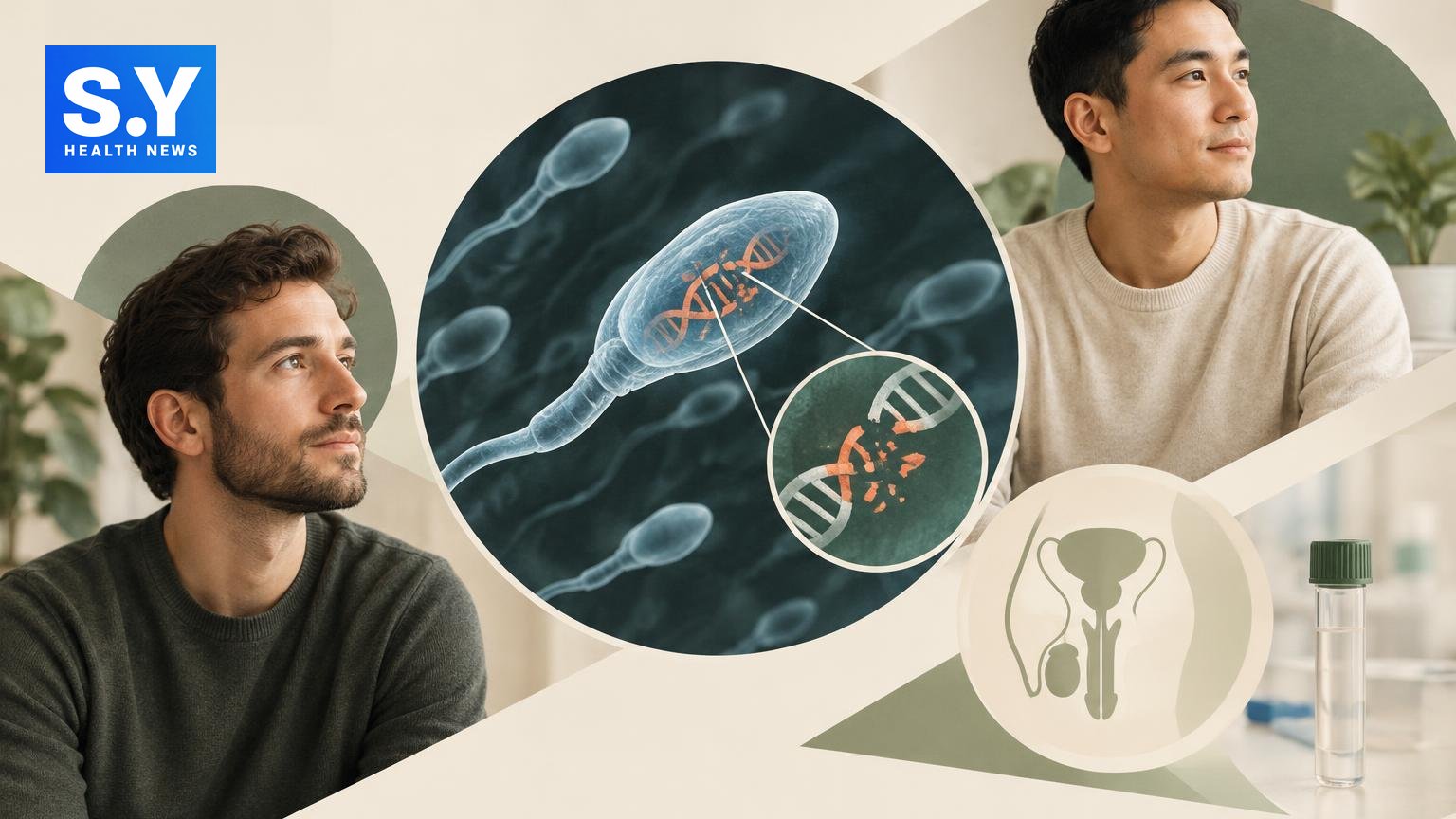
Sperm DNA fragmentation refers to breaks or damage in the DNA packaged inside sperm. Several assays are used to estimate the proportion of sperm with such damage, including COMET, SCSA, TUNEL and SCD. The review restricted its search to studies using these assays and reporting pregnancy or miscarriage, searching six databases from inception to March 2025. Because each assay has its own threshold, the review used assay-specific cut-offs to classify results as high or not high.
That methodological choice is important for interpretation. A single universal number does not define high fragmentation across laboratories; what counts as high depends on the assay and its cut-off. The review converted results into 2×2 tables and pooled sensitivity, specificity, likelihood ratios and diagnostic odds ratios using random-effects HSROC models following PRISMA and QUADAS-2 guidance. Pooling across different assays and thresholds inevitably introduces heterogeneity, which the authors observed and which limits how precisely the summary estimates can be applied to any one laboratory result.
What the Evidence Shows
The review body comprised 52 trials with 19,930 subjects. All included studies reported pregnancy outcomes, while 41 reported miscarriage. High fragmentation was associated with adverse reproductive outcomes in natural conception and after IUI, IVF and ICSI, consistent with the broad rationale for testing. But the diagnostic performance summary is the more revealing result: low sensitivity and higher specificity for pregnancy, with modest likelihood and diagnostic odds ratios and poor-to-moderate discrimination on HSROC curves.
For miscarriage, high fragmentation again showed low sensitivity and high specificity, which the authors described as poor prediction. This pattern has a practical consequence. A highly specific test is good at confirming that a problem is more likely when the result is positive, but a low-sensitivity test misses many people who will experience the outcome. If most miscarriages occur in couples without a high fragmentation result, the test cannot serve as a reliable screening tool for miscarriage risk.
| Measure or feature | What it describes | How to interpret the review finding |
|---|---|---|
| Sensitivity | Proportion of adverse outcomes correctly identified by a high result | Low across natural and assisted conception, so many adverse outcomes occur without a high result |
| Specificity | Proportion of favourable outcomes correctly identified as not high | Higher than sensitivity, but not sufficient for standalone prediction |
| Likelihood and diagnostic odds ratios | Summary measures of diagnostic discrimination | Modest, indicating limited ability to separate outcomes |
| HSROC discrimination | Summary curve of test performance across studies | Poor-to-moderate, with significant heterogeneity |
| Studies and subjects | Scope of the pooled evidence | 52 trials and 19,930 subjects; 41 trials reported miscarriage |
| Assay thresholds | Definition of a high result | Assay-specific cut-offs for COMET, SCSA, TUNEL or SCD, not one universal value |
Natural Conception, IUI, IVF and ICSI
The review covered natural conception and assisted reproduction, including IUI, IVF and ICSI. This breadth is a strength because it reflects the range of settings in which couples might encounter the test. It also creates a limitation: pooling studies across these pathways can obscure differences between them. The abstract reports low sensitivity and higher specificity across natural and assisted conception without presenting separate accuracy estimates for each pathway in the available text, so the article cannot claim that the test performs better or worse in one specific treatment setting.
That distinction matters clinically. ICSI, for example, bypasses many sperm-selection barriers, and the predictive value of a sperm DNA measure could plausibly differ from natural conception. The review's pooled conclusion is that standalone prediction is limited, but it does not resolve whether the test has a narrower role in particular pathways. Those pathway-specific questions require study designs and analyses that report results separately, which the abstract does not provide.
Interpretation and Limitations
The most important limitation is heterogeneity. The HSROC curves showed poor-to-moderate discrimination with significant heterogeneity, which means the included studies were not estimating one uniform relationship. Differences in assay type, cut-off, population, fertility treatment and outcome definition can all contribute. When heterogeneity is substantial, a pooled estimate is a summary of a mixed literature rather than a precise description of any single clinical scenario.
A second limitation concerns outcome reporting. All 52 trials reported pregnancy, but only 41 reported miscarriage, so the miscarriage analysis rests on a smaller subset. The review also used assay cut-offs to dichotomise continuous fragmentation values, which is necessary for diagnostic accuracy analysis but can discard information about severity. The abstract does not report separate estimates by treatment type, cause of infertility or female partner factors. Those are not minor omissions in an area where fertility outcomes depend on both partners.
Finally, the distinction between association and prediction deserves emphasis. That high fragmentation is associated with adverse outcomes in the pooled literature does not mean a high result accurately predicts an individual couple's outcome. The review directly assessed predictive performance through sensitivity, specificity, likelihood ratios and diagnostic odds ratios, and those measures were modest. The authors' own conclusion is cautious: evaluating high fragmentation alone to predict pregnancy or miscarriage is limited, and its clinical value needs to be determined through well-designed trials.
Research Outlook
The review authors called for well-designed trials to determine the clinical value of sperm DNA fragmentation testing. That is a logical next step because the current evidence base is dominated by diagnostic accuracy studies with heterogeneous designs and assays. Trials would need to test whether measuring fragmentation and acting on the result improves outcomes such as live birth or miscarriage compared with not measuring it. The abstract does not describe any such trial results, so this remains an open question rather than an established benefit.
A more realistic near-term research agenda may involve standardising assay thresholds, reporting pathway-specific accuracy, and evaluating whether fragmentation adds information beyond established clinical and semen parameters. The review's use of assay-specific cut-offs reflects current practice, but comparability across studies would improve if thresholds and reporting were harmonised. Until then, the test's role is best understood as an adjunct whose standalone predictive power is limited, not as a stand-alone verdict on a couple's reproductive future.
Key Takeaways
- A 2026 systematic review and meta-analysis pooled 52 trials with 19,930 subjects; all reported pregnancy and 41 reported miscarriage, and high sperm DNA fragmentation was associated with adverse outcomes in natural conception and after IUI, IVF and ICSI.
- High fragmentation had low sensitivity and higher specificity for pregnancy, with modest likelihood and diagnostic odds ratios and poor-to-moderate discrimination on HSROC curves.
- For miscarriage, high fragmentation again showed low sensitivity and high specificity, which indicates poor prediction and means many at-risk pregnancies would not be identified by the test.
- Assay-specific cut-offs for COMET, SCSA, TUNEL or SCD define what counts as high, so results are not directly comparable across laboratories without attention to method.
- The authors conclude that evaluating high fragmentation alone is limited and that its clinical value still needs to be determined through well-designed trials.
Questions and Answers
What does a high sperm DNA fragmentation test result mean for predicting pregnancy?
It means the measured proportion of sperm with DNA damage is above the assay-specific cut-off. In a 2026 meta-analysis, high fragmentation showed low sensitivity and higher specificity for pregnancy across natural and assisted conception, with modest discrimination. A high result is therefore not a reliable standalone predictor that pregnancy will or will not occur.
Does high sperm DNA fragmentation predict miscarriage risk accurately?
The review found low sensitivity and high specificity for miscarriage, which the authors interpreted as poor prediction. High specificity means a positive result is somewhat informative, but low sensitivity means many miscarriages occur in couples without a high result. It is not a dependable standalone screening test for miscarriage risk.
How strong is the evidence that sperm DNA fragmentation predicts IVF or ICSI outcomes?
The evidence is pooled from 52 trials with 19,930 subjects and shows an association with adverse outcomes, but predictive accuracy was limited. There was significant heterogeneity and only poor-to-moderate discrimination. The abstract does not provide separate accuracy estimates for IVF versus ICSI, and the authors say well-designed trials are still needed to establish clinical value.
Why can sperm DNA fragmentation results differ between laboratories?
Different assays, including COMET, SCSA, TUNEL and SCD, use different thresholds, and the review classified results using assay-specific cut-offs rather than one universal value. That means a number reported as high in one laboratory may not be directly comparable with a result from another method. Method details matter when interpreting a result.
What are the main limitations of using sperm DNA fragmentation alone in fertility assessment?
The main limits are low sensitivity, modest likelihood and diagnostic odds ratios, significant heterogeneity across studies, and only 41 of 52 trials reporting miscarriage. The review also pooled natural conception with IUI, IVF and ICSI rather than reporting separate accuracy for each. It concluded that standalone prediction is limited and that clinical value needs testing in well-designed trials.
Should a couple change fertility treatment based on a high sperm DNA fragmentation result?
This article cannot give personal treatment advice. The evidence indicates that a high result alone is a limited predictor of pregnancy or miscarriage, so it should not be treated as a definitive verdict. Decisions about IUI, IVF or ICSI should be discussed with a qualified fertility clinician who can consider the full clinical picture, including both partners and the specific assay used.
Sources and References
- Vitthala, S.; Nedelcu, S.; El-Toukhy, T.; Maheshwari, A.. Value of sperm DNA fragmentation (SDF) in predicting reproductive outcomes–a systematic review and meta-analysis. Human Fertility. 2026 DOI: 10.1080/14647273.2026.2618228.
SANYUN Science Center explains published research on men's reproductive and sexual health, connecting scientific evidence with everyday questions while making sources and limitations clear.
Disclaimer: This article is for scientific education and research communication only. It does not provide medical advice, diagnosis, or individualized treatment recommendations, and does not endorse any medication, supplement, device, penile enlargement procedure, or other intervention. Decisions about sexual and reproductive health should be made in consultation with a qualified healthcare professional. Do not delay seeking professional care because of information in this article.
Original Content & Copyright Notice
- This article is prepared for SANYUN Science Center, drawing on published research and publicly available academic literature on men’s sexual and reproductive health. Its editorial explanations and presentation are developed for this platform.
- Copyright in the original editorial content, selection, and arrangement is reserved by SANYUN Science Center to the extent protected by applicable law. Referenced research, quotations, and third-party materials remain subject to the rights of their respective owners. This notice does not claim ownership of scientific facts or third-party research.
- Except where permitted by applicable law or an applicable license, prior written permission is required to reproduce, republish, translate, adapt, redistribute, or commercially reuse protected content. Attribution alone does not grant permission for such reuse.
- For permitted quotation or authorized reuse, clearly identify the source and retain a link to the original article.
- Source: SANYUN Science Center
- Original URL: Retain the original article URL on science.san-yun.com.
- Copyright Holder: SANYUN Science Center, for its own protected editorial content.
- Quotation, excerpts, or authorized reuse must not distort the scientific meaning, omit material limitations or disclaimers, or imply unverified medical claims, product efficacy, or endorsement by SANYUN Science Center.



