




Category: Latest Research
Core Research Direction: Short-term efficacy and 4-week durability of Hongjing Qiwei Formula (HJQWF) as an add-on to once-daily tadalafil 5 mg for erectile dysfunction associated with type 2 diabetes (DMED), in a double-blind, single-dummy RCT
Search Intent: In men with type 2 diabetes-associated erectile dysfunction, does adding Hongjing Qiwei Formula to daily tadalafil 5 mg improve erectile function scores and successful intercourse more than tadalafil alone, and do any gains persist after treatment stops?
Platform: SANYUN Science Center
Evidence reviewed through: 2026-10-31
Executive Summary
A randomized controlled trial published in October 2026 tested whether adding a six-herb traditional Chinese medicine formula, Hongjing Qiwei Formula (HJQWF), to once-daily tadalafil 5 mg improves erectile function in men whose erectile dysfunction is associated with type 2 diabetes. The trial randomized 76 men in a 1:1 ratio to HJQWF plus tadalafil or matched HJQWF placebo plus tadalafil for a six-week intervention with a four-week off-treatment follow-up.[1]
Seventy-one participants completed the intervention. At week six, the mean change in the International Index of Erectile Function-5 (IIEF-5) from baseline was 5.53 points with HJQWF versus 3.26 points with placebo, a statistically significant between-group difference. The proportion reporting successful intercourse on SEP-3 was 72.22% versus 45.71%, also statistically significant. The authors note, however, that the group-by-time interaction for IIEF-5 was not statistically significant and describe time-point comparisons as exploratory rather than definitive.
These headline differences should be read with caution. The trial was single-center, the primary analysis was per protocol rather than intention-to-treat, and the confidence interval for the IIEF-5 difference was wide. Four weeks after treatment stopped, several outcomes still favored the HJQWF group versus control, but these week-10 comparisons are exploratory and cannot establish a durable biological effect.
Why Diabetes-Related ED Matters
Erectile dysfunction is a common chronic complication of diabetes. Background figures cited by the trial authors from prior literature state that erectile dysfunction is about 3.5 times more prevalent in men with diabetes than in non-diabetic men, reaching 52.5%. Those figures frame why diabetes-associated erectile dysfunction (DMED) matters, but they are not measurements from this trial and should not be read as a current population estimate.
Daily low-dose tadalafil is a standard option for DMED, but responses are often incomplete, which has motivated interest in add-on strategies including traditional Chinese medicine combinations. Randomized, placebo-controlled tests of such combinations specifically in diabetes-associated erectile dysfunction remain limited, so both the design and the limits of this trial deserve attention.
What the Trial Tested in Diabetes-Related ED
The trial enrolled men aged 22 to 65 with type 2 diabetes diagnosed before erectile dysfunction, a fixed sexual partner, and at least one act of sexual intercourse per week. It was conducted between June 2024 and February 2026. Randomization used a random number table with sequentially numbered opaque sealed envelopes, and physicians, participants, and statistical analysts were blinded. The planned sample size was 33 per group at 90% power and a two-sided alpha of 0.05, inflated to 76 total, or 38 per group, to allow for an assumed 15% dropout.
HJQWF granules were taken twice daily as two 10 g sachets dissolved in warm water after meals. The placebo contained 5% of the original HJQWF components plus maltodextrin and matched the appearance, dosage form, and usage. Both groups took tadalafil 5 mg orally once daily at bedtime. The primary outcome was IIEF-5 change from baseline at week six; secondary outcomes included erection hardness score (EHS), a Traditional Chinese Medicine syndrome score (TCMSS), Sexual Encounter Profile questions 2 and 3 (SEP-2 and SEP-3), and safety measures. Follow-up occurred before treatment and at weeks 2, 4, 6, and 10.
How the Proposed Mechanism Fits the Evidence
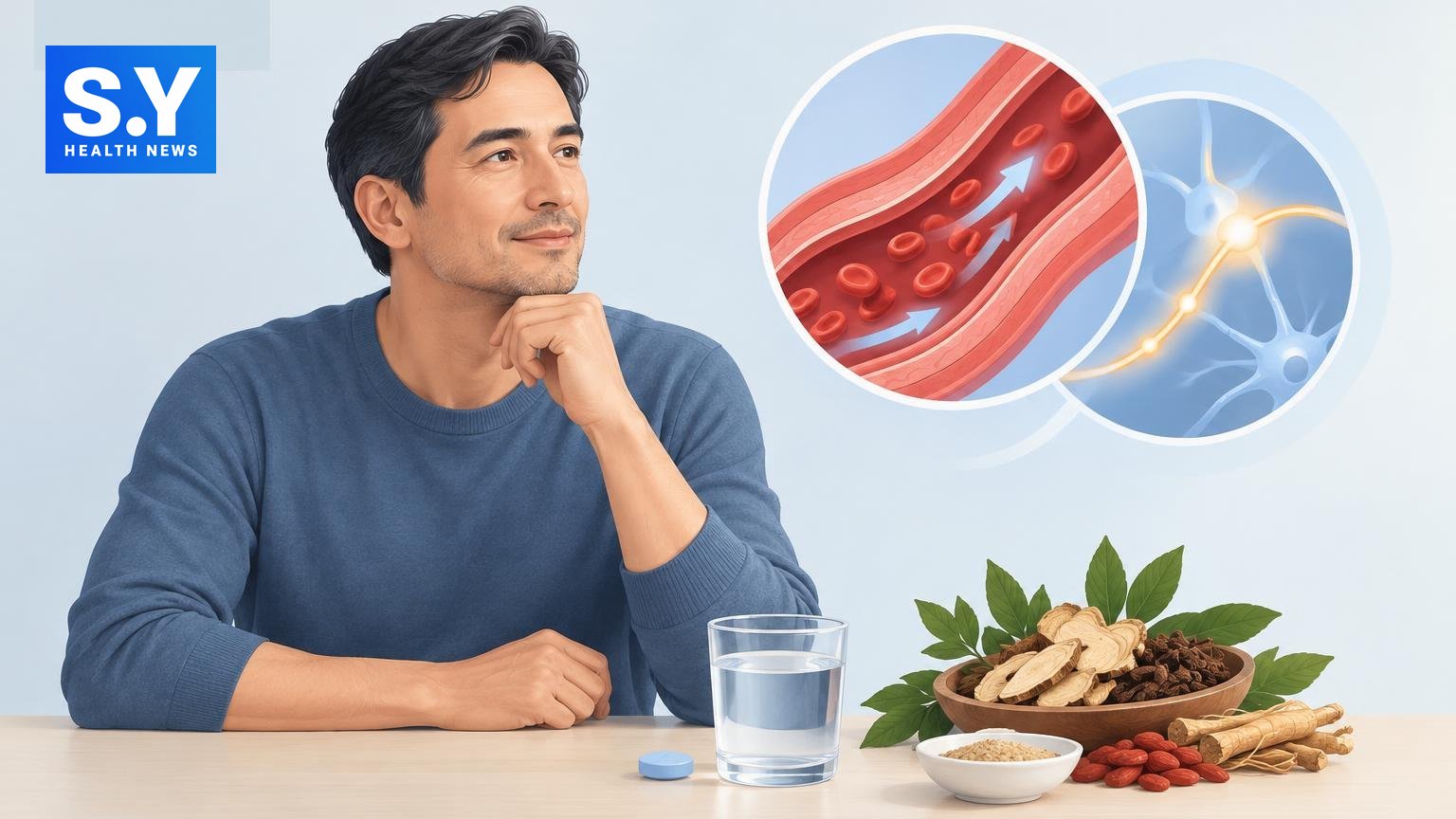
The trial's background links DMED to endothelial dysfunction driven by chronic hyperglycemia and oxidative stress, with impaired nitric oxide availability and reduced cavernosal blood flow. Phosphodiesterase type 5 (PDE5) inhibitors such as tadalafil work by preserving cyclic guanosine monophosphate (cGMP), a signaling molecule that relaxes penile blood vessels downstream of nitric oxide. When the endothelium and cavernosal tissue are damaged by diabetes, this pathway may be less responsive, which is one proposed explanation for limited efficacy of PDE5 inhibitor monotherapy in some patients.
HJQWF contains six Chinese herbal medicines, including Rhodiola rosea and Cistanche deserticola. The authors state that components derived from these herbs improved erectile function in rat models of erectile dysfunction by modulating programmed cell death and reducing oxidative stress. These are animal findings, not evidence of the same mechanisms in men, and the trial did not measure endothelial function, oxidative stress markers, or any pharmacological mechanism in participants.
The rationale for a sustained effect is hypothetical in this context. The authors propose that herbal therapy might act on vascular endothelial dysfunction and oxidative stress in ways that outlast the transient vasodilatory effect of a PDE5 inhibitor. The four-week post-treatment follow-up was designed to explore that possibility, but the trial was not powered or designed to establish a mechanism of durability.
Six-Week Results: IIEF-5, Erection Hardness, and Successful Intercourse
| Measure / finding | Result | Population / follow-up | Limitations |
|---|---|---|---|
| change in IIEF-5 from baseline | 5.53 vs 3.26 IIEF-5 points (mean ± SD) | Men with type 2 diabetes-associated ED completing the study; n=71 (36 vs 35); Baseline to week 6 | Per-protocol analysis; group-by-time interaction not significant, authors describe as exploratory |
| between-group difference in IIEF-5 change | 95% CI 0.45–4.10 IIEF-5 points | Men with type 2 diabetes-associated ED; n=71 (36 vs 35); Baseline to week 6 | Wide CI approaching zero; per-protocol |
| change in EHS from baseline | 0.92 vs 0.46 EHS grade (mean ± SD) | Men with type 2 diabetes-associated ED; n=71 (36 vs 35); Baseline to week 6 | Group-by-time interaction not significant; described as exploratory by authors |
| change in TCMSS from baseline | −16.14 vs −2.77 TCMSS points (mean ± SD) | Men with type 2 diabetes-associated ED; n=71 (36 vs 35); Baseline to week 6 | TCM syndrome score is a traditional-medicine-specific measure; per-protocol |
| SEP-3 yes proportion | 72.22% vs 45.71% percent of completers | Men with type 2 diabetes-associated ED; n=36 vs 35; Week 6 | Denominators correspond to per-protocol completers |
| SEP-2 between-group comparison | P > 0.05 | Men with type 2 diabetes-associated ED; n=71 (36 vs 35); Weeks 4, 6, and 10 | Null finding for a secondary outcome |
| serious adverse events | 0 reported | Men with type 2 diabetes-associated ED; n=76 randomized; Study period (6-week intervention plus 4-week follow-up) | Small sample; short duration |
| adverse events | 4 mild events participants | Men with type 2 diabetes-associated ED; n=76 randomized; Study period | Small numbers; causality not systematically assessed |
At week six, IIEF-5 improved by 5.53 points in the HJQWF group and 3.26 points in the placebo group. The between-group difference was statistically significant, with a 95% confidence interval of 0.45 to 4.10 points. That interval is wide and its lower bound is close to zero, meaning the data are compatible with a small advantage as well as a more substantial one. The result is a statistical signal in a small sample, not a precise estimate of clinical benefit.
Erection hardness improved by 0.92 grades with HJQWF versus 0.46 grades with placebo at week six, also a statistically significant between-group difference. The authors note that the group-by-time interaction for this outcome was not significant and describe the finding as exploratory. A difference of roughly half a grade on the EHS scale is modest in absolute terms and should be interpreted alongside the uncertainty inherent in a small trial.
The TCMSS fell by 16.14 points in the HJQWF group versus 2.77 points in the placebo group. This measure reflects traditional Chinese medicine symptom constructs and is not a conventional clinical endpoint; it is best read as evidence that the herbal formula produced its intended traditional-medicine effects, not as an independent measure of erectile function.
For SEP-3, the proportion reporting successful intercourse at week six was 72.22% with HJQWF versus 45.71% with placebo, a statistically significant difference. For SEP-2, the ability to insert the penis, within-group improvements occurred but there were no significant between-group differences at any time point. This divergence matters: the combination may have helped erections last long enough for intercourse without clearly improving the ability to achieve insertion, and the trial was not designed to explain why.
Four Weeks After Stopping: What the Follow-Up Can and Cannot Show
Four weeks after stopping treatment, at week 10, the HJQWF group still showed improvements versus baseline on IIEF-5, EHS, SEP-2, and SEP-3, and significant differences versus the control group on IIEF-5, EHS, TCMSS, and SEP-3. The control group did not show significant differences from baseline on EHS, SEP-2, or SEP-3 at week 10. These observations are consistent with a carryover effect — a treatment effect that persists after dosing stops — or a sustained effect, but they are exploratory post-hoc comparisons in a small trial, and they cannot exclude regression to the mean (the tendency of extreme values to move toward average on re-measurement), natural fluctuation, or differences in post-discontinuation behavior between groups.
A durability claim would require a trial designed and powered for the off-treatment period, with prespecified between-group comparisons at week 10 and control for confounding factors such as continued sexual activity, changes in diabetes control, or additional treatments. The present trial provides a hypothesis-generating signal, not proof that the herbal formula produces lasting biological change.
Safety and Tolerability in This Small Sample
No serious adverse events or clinically significant laboratory abnormalities were reported during the study. Four mild adverse events occurred: one case of diarrhea and one of nasal congestion in the HJQWF group, and two headaches in the placebo group. All resolved and the participants continued treatment. The small sample and six-week intervention mean uncommon or delayed adverse effects cannot be ruled out, and the trial did not systematically assess causality for individual events.
Interpreting the Evidence and Its Limits
Several features limit how far these results can be generalized. The analysis was per protocol, excluding dropouts rather than using intention-to-treat, which can overestimate treatment effects. The trial was single-center, enrolled a modest number of men, and used a six-week intervention with a four-week off-treatment follow-up. The group-by-time interaction for the primary outcome was not statistically significant, and the authors themselves frame the time-point comparisons as exploratory rather than definitive. The confidence interval for the IIEF-5 difference is wide and includes small effects.
The placebo contained 5% of the original HJQWF components, a design choice intended to preserve blinding by matching taste and appearance. Whether that small fraction could produce biological activity is not addressed, although it is unlikely to explain the observed separation. The trial also did not measure objective vascular or metabolic outcomes, so any mechanistic interpretation remains speculative.
Research Outlook
Confirming these findings would require a larger, multicenter trial with intention-to-treat analysis as the primary approach, prespecified off-treatment comparisons, and objective measures alongside validated questionnaires. A longer follow-up and a design that controls for diabetes control, concomitant medications, and sexual activity patterns would help separate a true sustained effect from noise. Until such evidence exists, the appropriate stance is cautious interest rather than clinical adoption.
Key Takeaways
- In a small single-center trial, adding HJQWF to daily tadalafil 5 mg produced a statistically significant but imprecisely estimated improvement in IIEF-5 at six weeks (5.53 vs 3.26 points; 95% CI for the difference 0.45 to 4.10).
- Successful intercourse at week six was more often reported with the combination (72.22% vs 45.71%), but SEP-2 showed no between-group difference, and the group-by-time interaction for IIEF-5 was not significant.
- Week-10 differences favoring the combination are exploratory and do not establish durable benefit after treatment stops.
- No serious adverse events were reported, but the sample was small and the intervention short, so safety conclusions remain provisional.
Questions and Answers
What is Hongjing Qiwei Formula and how was it tested in this trial?
HJQWF is a six-herb traditional Chinese medicine formula containing Rhodiola rosea and Cistanche deserticola, prepared as granules. In this double-blind, single-dummy trial, 76 men with type 2 diabetes-associated erectile dysfunction were randomized to HJQWF plus tadalafil 5 mg daily or HJQWF placebo plus tadalafil 5 mg daily for six weeks, followed by four weeks off treatment. The primary outcome was change in IIEF-5 score.
Did adding the herbal formula improve erectile function more than tadalafil alone?
At week six, IIEF-5 improved by 5.53 points with HJQWF versus 3.26 points with placebo, a statistically significant difference with a 95% confidence interval of 0.45 to 4.10 points. Successful intercourse was reported by 72.22% versus 45.71%. However, the group-by-time interaction was not significant and the authors describe the comparisons as exploratory, so the finding is a signal rather than a confirmed advantage.
How strong is the evidence from this trial?
The evidence is preliminary. It comes from a single-center trial of 71 completers, analyzed per protocol rather than by intention-to-treat, with wide confidence intervals around the primary difference. The group-by-time interaction was not significant, and several outcomes were labeled exploratory by the authors. These features mean the results are hypothesis-generating and should not be treated as definitive proof of superiority.
Do the benefits persist after stopping treatment?
Four weeks after stopping treatment, the HJQWF group still showed improvements versus baseline on several outcomes, and significant differences versus the control group on IIEF-5, EHS, TCMSS, and SEP-3. But these week-10 comparisons are exploratory post-hoc analyses in a small sample and cannot establish durable biological benefit. A trial designed and powered for the off-treatment period would be needed to answer this question.
Can these results be applied to all men with diabetes-related erectile dysfunction?
Not directly. The trial enrolled men aged 22 to 65 with a fixed sexual partner and at least weekly intercourse, at one center, and used a six-week intervention with a four-week off-treatment follow-up. Men with different diabetes control, other comorbidities, or different sexual activity patterns were not well represented. Generalization to broader populations or longer-term use requires confirmation in larger, more diverse trials.
What are the main limitations and safety considerations?
The main limitations are the small single-center sample, per-protocol analysis excluding dropouts, short intervention duration, and exploratory handling of several comparisons. No serious adverse events were reported, and the four mild events resolved, but a six-week trial cannot rule out uncommon or longer-term effects. The placebo contained a small fraction of the original formula, and the trial did not measure objective vascular or metabolic outcomes, so mechanistic claims remain speculative.
Sources and References
- Hao Wang; Yongqing Zhao; Hongyuan Chang; Dicheng Luo; Jiwei Zhang; Boda Guo; Jun Guo. Efficacy of Hongjing Qiwei Formula Combined with Tadalafil in the Trea | DMSO | Dove Medical Press. Dove Medical Press (Drug Design, Development and Therapy, DMSO). 2026 2026:19:644621
SANYUN Science Center explains published research on men's reproductive and sexual health, connecting scientific evidence with everyday questions while making sources and limitations clear.
Disclaimer: This article is for scientific education and research communication only. It does not provide medical advice, diagnosis, or individualized treatment recommendations, and does not endorse any medication, supplement, device, penile enlargement procedure, or other intervention. Decisions about sexual and reproductive health should be made in consultation with a qualified healthcare professional. Do not delay seeking professional care because of information in this article.
Original Content & Copyright Notice
- This article is prepared for SANYUN Science Center, drawing on published research and publicly available academic literature on men’s sexual and reproductive health. Its editorial explanations and presentation are developed for this platform.
- Copyright in the original editorial content, selection, and arrangement is reserved by SANYUN Science Center to the extent protected by applicable law. Referenced research, quotations, and third-party materials remain subject to the rights of their respective owners. This notice does not claim ownership of scientific facts or third-party research.
- Except where permitted by applicable law or an applicable license, prior written permission is required to reproduce, republish, translate, adapt, redistribute, or commercially reuse protected content. Attribution alone does not grant permission for such reuse.
- For permitted quotation or authorized reuse, clearly identify the source and retain a link to the original article.
- Source: SANYUN Science Center
- Original URL: Retain the original article URL on science.san-yun.com.
- Copyright Holder: SANYUN Science Center, for its own protected editorial content.
- Quotation, excerpts, or authorized reuse must not distort the scientific meaning, omit material limitations or disclaimers, or imply unverified medical claims, product efficacy, or endorsement by SANYUN Science Center.



