




Category: Penis Enlargement
Core Research Direction: Dermal filler (hyaluronic acid) penile augmentation: reported girth outcomes, complications, and limitations of retrospective case-series evidence
Search Intent: What does a large retrospective case series of hyaluronic acid dermal filler penile augmentation report about girth maintenance, side effects, and complications — and how limited is that evidence?
Platform: SANYUN Science Center
Evidence reviewed through: 2026-11-08
Executive Summary
A conference presentation summarizing a single practitioner's experience describes a retrospective review of 2,000 penile augmentation procedures using hyaluronic acid and other CE-approved dermal fillers. The report states that average girth increase was maintained over 12–18 months depending on filler type, that common side effects such as swelling and bruising were mild and self-limiting, and that less common complications such as nodules, asymmetry and migration were managed with massage, hyaluronidase or minor revisions.[1]
The same source frames the procedure as proven safe, effective and repeatable under strict medical protocols, and credits psychological screening with reducing dissatisfaction and medico-legal risk. Those are the author's interpretive conclusions from an uncontrolled case series, not comparative findings. No girth magnitude, no satisfaction instrument, no complication rates and no denominators are reported at abstract level, so the numbers cannot be translated into patient-level probabilities.
Why This Matters
Penile augmentation has long been surrounded by controversy, misinformation and inconsistent outcomes, which makes careful reading of any large case series worthwhile even when the design is weak. Demand for minimally invasive body contouring has grown, and injectable fillers are now promoted as an alternative to surgery in aesthetic practice. Men considering the procedure, and clinicians counselling them, need to know which claims rest on measured outcomes and which rest on accumulated experience.
The distinction matters because girth is a physical measurement that can be tracked, whereas satisfaction and safety are multidimensional and easy to overstate. A series of 2,000 procedures is large enough to surface uncommon complications, but only if those complications are counted and reported with a denominator. The abstract-level record here describes the shape of a practice rather than the performance of a procedure under controlled observation.
Biological and Clinical Mechanism
Hyaluronic acid is a naturally occurring glycosaminoglycan that binds water and provides volume when injected into soft tissue. In penile augmentation the filler is placed to increase circumferential girth, and over time the material is gradually degraded and resorbed by the body. That resorption is why maintenance duration is filler-dependent, and why repeat treatment is often discussed in this field. The review compared different filler types, volumes, injection planes and cannula versus needle techniques, which reflects the reality that outcomes depend heavily on product rheology and where the material is placed.
Reported side effects map onto the mechanics of injection: swelling and bruising follow needle or cannula trauma, while nodules, asymmetry and migration reflect product placement, volume distribution and tissue movement. The use of hyaluronidase to manage complications is consistent with the enzymatic breakdown of hyaluronic acid, and massage or minor revision addresses contour irregularities. These are plausible mechanisms, but the source does not provide imaging, histological or volumetric data to confirm them in this population.
What the Evidence Shows
The core reported outcomes are simple: high patient satisfaction, average girth increase maintained over 12–18 months depending on filler type, and a complications profile dominated by mild self-limiting events. Structured elements of care included patient screening, informed consent, psychological evaluation, procedural technique and aftercare, which the author presents as a protocol that supports safe practice. The author also reports no direct or indirect funding, which is relevant context for reading a single-authored body of work.
| Reported dimension | What the source states | How to interpret it |
|---|---|---|
| Design and scale | Retrospective review of 2,000 penile augmentation procedures using hyaluronic acid and other CE-approved fillers | Large experience base, but uncontrolled and single-presenter; abstract-level reporting only |
| Girth outcome | Average girth increase maintained over 12–18 months depending on filler type | Direction of effect is reported, but no measured girth change in centimetres, no variance and no per-filler breakdown |
| Common side effects | Mild and self-limiting swelling or bruising | Consistent with injection trauma, but no frequencies or denominators are given |
| Less common complications | Nodules, asymmetry and migration managed with massage, hyaluronidase or minor revisions | Suggests treatability in this practice, not a measured complication rate or a comparison with alternatives |
| Satisfaction | Described as high | No validated instrument, response rate or definition of satisfaction is reported |
| Psychological screening | Credited with preventing dissatisfaction and significantly reducing medico-legal risk | Plausible clinical reasoning, but no outcome measure or comparison supports the size of the effect |
One useful point of agreement with wider filler literature is that late or inflammatory complications are a recognized concern for injectable materials in aesthetic practice. However, the available packet does not contain penile-specific complication studies beyond this review, and general facial filler material should not be transplanted onto penile outcomes without caution, because tissue anatomy, movement and vascularity differ. The review's own contribution is therefore descriptive rather than comparative.[2][3]
Interpretation and Limitations
The central limitation is design. A retrospective case series without a comparator cannot establish that girth maintenance is caused by the filler rather than by selection, measurement practice, concomitant treatments or repeated sessions. It cannot quantify how many men experienced nodules, asymmetry or migration, because no denominators are reported. It cannot validate the satisfaction claim or the medico-legal benefit of psychological screening. And it cannot support the word proven in the conclusion, which is an interpretive claim from uncontrolled observation rather than an established comparative effect.
Reporting quality adds a second layer of uncertainty. The abstract is inconsistent about the title, mentioning both 2,000 and 8,000 cases, and contains an uncorrected editorial note, so the exact case count should be treated with caution until a full peer-reviewed report appears. There is no journal publication, no statistical analysis and no independent verification of the disclosures. This is a congress lecture recorded in 2026, and it should be read as expert experience rather than as a trial result.
Clinical relevance should therefore be framed conservatively. The review suggests that in one high-volume practice, filler augmentation was performed with a structured protocol and that reported complications were manageable. That is useful for hypothesis generation and for designing prospective studies with standardized girth measurement, validated satisfaction instruments and active complication surveillance. It is not sufficient to promise durability, safety or satisfaction to an individual patient.
Research Outlook
What the field needs is prospective data with predefined outcomes: standardized erect and flaccid girth measurement at fixed intervals, filler-specific durability curves, independent complication ascertainment and validated patient-reported outcome measures. A psychological screening pathway should be evaluated as an intervention with its own outcome measures rather than asserted as beneficial. Until such data exist, the appropriate summary is that a large single-operator case series reports favorable girth maintenance over 12–18 months with mostly mild side effects, while the comparative safety and effectiveness questions remain open.
Key Takeaways
- A retrospective review of 2,000 penile augmentation procedures using hyaluronic acid and other CE-approved fillers reports average girth increase maintained over 12–18 months depending on filler type, but no girth magnitude or variance is given.
- Common side effects were described as mild and self-limiting swelling or bruising, and less common complications such as nodules, asymmetry and migration were managed with massage, hyaluronidase or minor revisions, without reported rates.
- The conclusion that filler augmentation is proven safe, effective and repeatable is the author's interpretation of an uncontrolled case series, not a comparative finding.
- Psychological screening was credited with reducing dissatisfaction and medico-legal risk, but no outcome measure or comparison is provided to size that effect.
- Girth durability, complication frequency and satisfaction should be tested in prospective studies with standardized measurement before clinical claims are strengthened.
Questions and Answers
How does hyaluronic acid penile filler augmentation work?
Hyaluronic acid is injected into penile soft tissue to add circumferential volume. The material is gradually resorbed, so durability depends on filler type and placement. The reviewed series compared filler types, volumes, injection planes and cannula versus needle techniques, but it did not report measured girth change in centimetres, so the mechanism is described conceptually rather than quantified.
What girth outcomes did the 2,000-case penile filler review report?
The author reports high patient satisfaction and average girth increase maintained over 12–18 months depending on filler type. No absolute girth change, no variance and no per-filler breakdown are provided at abstract level, and there is no comparator group. The finding therefore describes one practice's experience rather than an established durability estimate.
What side effects and complications are reported with penile dermal filler?
Common side effects were described as mild and self-limiting swelling or bruising. Less common complications included nodules, asymmetry and migration, managed with massage, hyaluronidase or minor revisions. However, no frequencies, denominators or severity grading are reported, so patients and clinicians cannot estimate their personal risk from this source alone.
How strong is the evidence for hyaluronic acid penile augmentation safety and effectiveness?
The evidence is weak for comparative claims. It comes from a retrospective, single-presenter case series of 2,000 procedures presented as a conference lecture, without a control group, statistical analysis or peer-reviewed full report. The conclusion that the procedure is proven safe and effective is the author's interpretation, not a finding established by the design.
Who might the findings of this penile filler case series apply to?
The series describes men who underwent penile augmentation with hyaluronic acid or other CE-approved fillers in one practitioner's setting under a structured protocol including screening, consent, psychological evaluation and aftercare. Because selection criteria, patient characteristics and follow-up completeness are not reported, applicability to other clinics, populations or filler products is uncertain.
Does psychological screening improve satisfaction after penile filler augmentation?
The author states that psychological screening helped prevent dissatisfaction and significantly reduced medico-legal risk. This is a plausible clinical rationale, but no validated satisfaction measure, comparison group or quantified effect is reported. It should be treated as an expert recommendation for practice design rather than as demonstrated evidence of benefit.
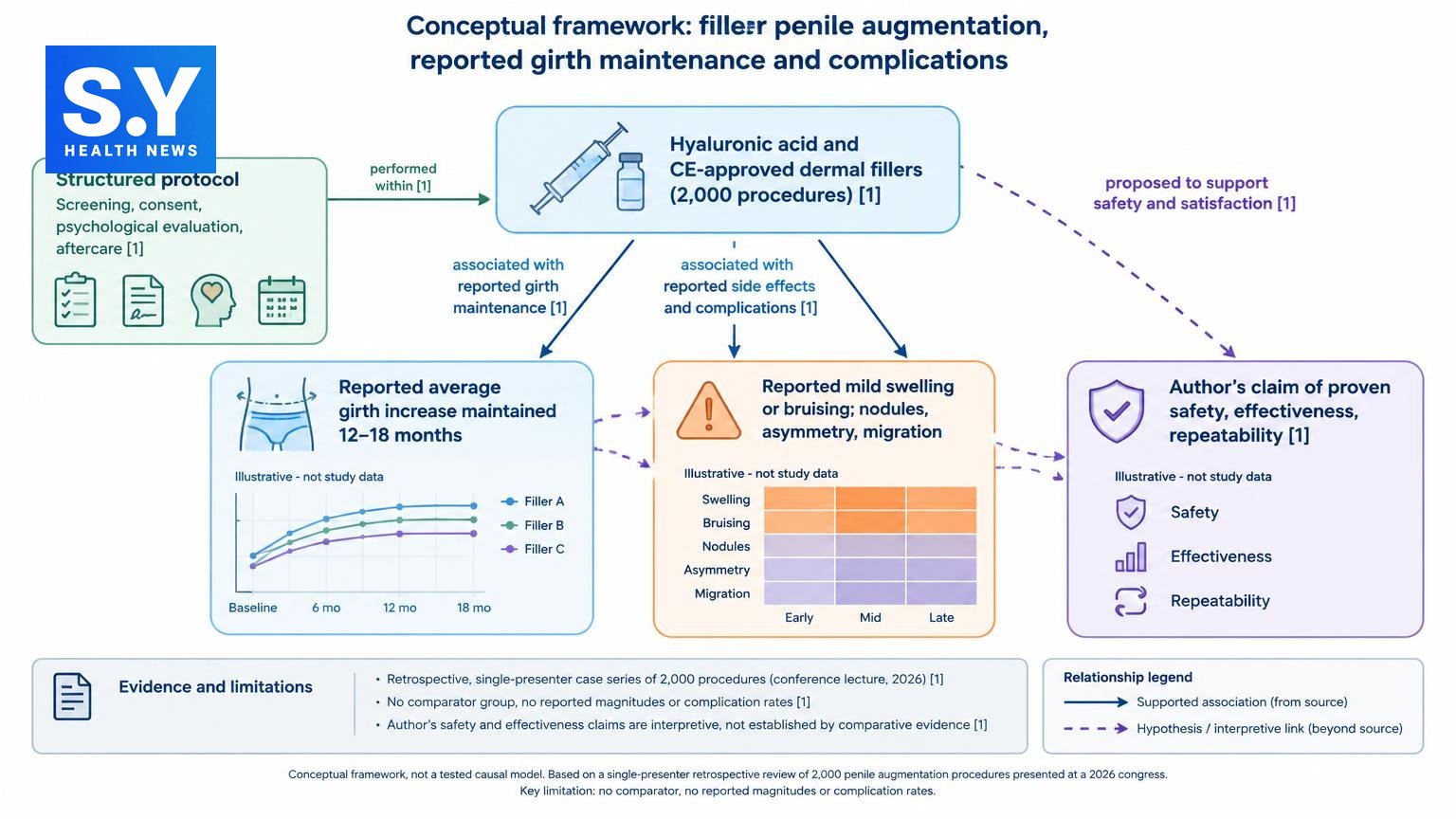
Conceptual framework: Conceptual framework, not a tested causal model. Based on a single-presenter retrospective review of 2,000 penile augmentation procedures presented at a 2026 congress. Solid links reflect reported associations; dashed interpretive links show where the author's safety and effectiveness claims extend beyond comparative evidence. Key limitation: no comparator, no reported magnitudes or complication rates.
Academic References & Evidence
- Sherif EL WAKIL. Penis augmentation: a focused review on dermal filler technique. 2026
- Video Library.
- Download the Prime app on your mobile device.
SANYUN Science Center explains published research on men's reproductive and sexual health, connecting scientific evidence with everyday questions while making sources and limitations clear.
Disclaimer: This article is for scientific education and research communication only. It does not provide medical advice, diagnosis, or individualized treatment recommendations, and does not endorse any medication, supplement, device, penile enlargement procedure, or other intervention. Decisions about sexual and reproductive health should be made in consultation with a qualified healthcare professional. Do not delay seeking professional care because of information in this article.
Original Content & Copyright Notice
- This article is prepared for SANYUN Science Center, drawing on published research and publicly available academic literature on men’s sexual and reproductive health. Its editorial explanations and presentation are developed for this platform.
- Copyright in the original editorial content, selection, and arrangement is reserved by SANYUN Science Center to the extent protected by applicable law. Referenced research, quotations, and third-party materials remain subject to the rights of their respective owners. This notice does not claim ownership of scientific facts or third-party research.
- Except where permitted by applicable law or an applicable license, prior written permission is required to reproduce, republish, translate, adapt, redistribute, or commercially reuse protected content. Attribution alone does not grant permission for such reuse.
- For permitted quotation or authorized reuse, clearly identify the source and retain a link to the original article.
- Source: SANYUN Science Center
- Original URL: Retain the original article URL on science.san-yun.com.
- Copyright Holder: SANYUN Science Center, for its own protected editorial content.
- Quotation, excerpts, or authorized reuse must not distort the scientific meaning, omit material limitations or disclaimers, or imply unverified medical claims, product efficacy, or endorsement by SANYUN Science Center.



