




Category: Penis Enlargement
Core Research Direction: Complication rates, risk profile, and clinical management principles of hyaluronic acid (HA) filler penile augmentation, including the limits of indirect comparative safety evidence
Search Intent: What complication rates and safety signals does current evidence show for hyaluronic acid penile filler augmentation, and how should complications be recognized and managed?
Platform: SANYUN Science Center
Evidence reviewed through: 2026-11-09
Executive Summary
Hyaluronic acid (HA) injections have become one of the most common materials used to increase penile circumference, partly because HA is a temporary filler that can be broken down by the enzyme hyaluronidase. That reversibility is a genuine advantage over permanent or non-medical materials, but it does not make the procedure risk-free, nor does it mean every irregularity can simply be dissolved away.[1]
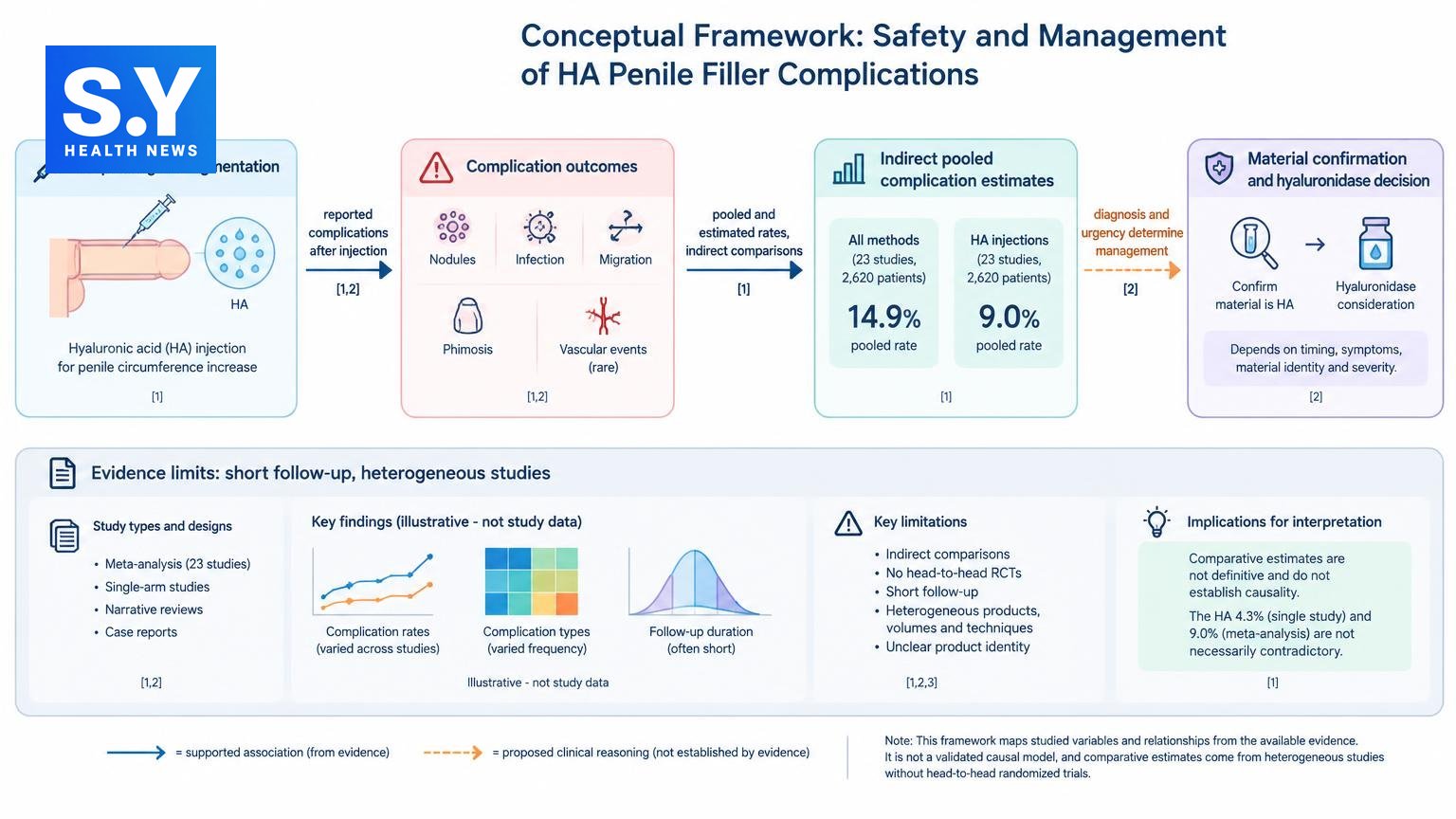
The most current pooled safety overview is a systematic review and meta-analysis published in August 2026, covering 23 primary studies with 2,620 patients. Across all penile augmentation methods combined, the pooled complication rate was 14.9%. For HA injections, the estimated rate was 9.0%.
That comparison deserves careful reading. The authors explicitly note that material comparisons rest on indirect comparisons across different studies rather than direct randomized trials, so the lower HA figure should be treated as a hypothesis-generating signal, not proof that HA is safer than alternatives in a head-to-head sense.
A separate study of 230 patients followed for six months after HA penile girth augmentation reported a total complication rate of 4.3%, with subcutaneous bleeding, nodules and infection observed. The gap between 4.3% and 9.0% illustrates how much product, volume, technique, patient selection and follow-up length vary between studies.
Why This Matters
Penile augmentation sits at an unusual intersection of cosmetic medicine, sexual function and psychological wellbeing. Unlike facial filler, the organ involved also affects urination, erections and skin integrity, so a complication is rarely purely aesthetic.
The guidance landscape is cautious rather than permissive. The European Association of Urology states that HA and some other soft-tissue fillers may be used for penile girth augmentation, but the recommendation is weak. The same guideline strongly recommends against performing HA or other filler procedures in men with penile dysmorphic disorder, and strongly recommends against silicone, paraffin and vaseline for girth augmentation.
The Fifth International Consultation on Sexual Medicine, published in 2026, similarly cites insufficient long-term data and calls for detailed evaluation and counseling. The Sexual Medicine Society of North America has likewise emphasized limited data and the need to assess expectations and psychological state before cosmetic penile procedures.
In practical terms, the safety question for HA penile filler is not answered by a single percentage. It depends on what counts as a complication, how long patients are followed, and whether the material injected was actually HA.
Biological and Clinical Mechanism
HA is a glycosaminoglycan that attracts water and adds volume where injected. Because hyaluronidase cleaves HA, filler placed in the penile shaft can, in principle, be partially or largely dissolved if a problem arises. A case series published in August 2026 described managing residual material with hyaluronidase in four patients previously treated with HA penile girth augmentation, reporting that the approach could correct asymmetry and reduce unwanted residual HA.[2]
The mechanism has boundaries. Hyaluronidase acts only on HA. If the injected substance was another filler, a mixture of products, or an unapproved material, dissolving is not a reliable strategy, and the patient may not know what was used. Penile-specific evidence on dosing, distribution and technique for hyaluronidase remains limited compared with the facial aesthetic literature.
Complications are usefully grouped by timing and by process. A 2025 review in Translational Andrology and Urology lists migration, subcutaneous nodules, Tyndall effect, phimosis and infection among problems reported after HA injections. Broader HA dermal filler literature classifies early events as ecchymosis, injection-site and hypersensitivity reactions, product displacement and vascular occlusion, and late events as biofilm-associated infection, delayed inflammatory nodules, granulomas and hyperpigmentation.[3]
Vascular occlusion is the most feared HA filler complication in the dermal literature, potentially progressing to skin necrosis, vision loss or stroke, with prompt recognition and high-dose hyaluronidase as central management. For penile girth augmentation specifically, vascular compromise is not frequently reported, although case reports describe glans ischemia after HA injection into the glans penis, a different anatomical application.
What the Evidence Shows
The evidence base is dominated by narrative reviews, single-arm prospective studies and a 2026 meta-analysis of heterogeneous designs. It does not contain the kind of head-to-head randomized comparisons that would be needed to rank materials confidently.
| Evidence source | Design and population | Key reported result | Main limitation |
|---|---|---|---|
| 2026 systematic review and meta-analysis | 23 primary studies; 2,620 patients; all penile augmentation methods | Pooled complication rate 14.9% overall; 9.0% for HA | Indirect comparisons; no direct head-to-head randomized trials |
| Single HA penile girth study | 230 patients; six-month follow-up | Total complication rate 4.3%; subcutaneous bleeding, nodules, infection | Single study; not generalizable across products, volumes or techniques |
| 2026 case series | 4 patients with prior HA penile girth augmentation | Residual material managed with hyaluronidase | Very small series; insufficient for a standard protocol |
| 2025 urology narrative review | Literature on penile enhancement procedures | Migration, nodules, Tyndall effect, phimosis and infection reported after HA | Narrative synthesis; individual frequencies not established |
| 2026 HA dermal filler review | Narrative review of peer-reviewed literature and surveillance data | Severe complications in fewer than 0.01% of injection sites | General dermal filler data, not specific to penile augmentation |
| Case reports | Single patients; HA penile injection | Glans ischemia after glans injection; fatal non-thrombotic pulmonary embolism after HA penile augmentation | Case reports cannot estimate population rates |
The single-study 4.3% figure and the meta-analytic 9.0% estimate are not necessarily contradictory. They describe different mixtures of products, injection volumes, patient selection and follow-up. The 2026 meta-analysis authors themselves suggest heterogeneity as one explanation for why the HA group's complication rate appeared higher than some individual series.
Rare severe events deserve separate treatment. A 2025 forensic case report described fatal non-thrombotic pulmonary embolism after penile augmentation with an HA-based material, and a separate case in Thailand in 2026 received international attention. These cases cannot be used to calculate overall mortality from penile HA filler, and the approximately 40 mL reported in the Thailand case is not a universal safety or danger threshold.
Interpreting Early Symptoms and Nodules
Some degree of early edema, bruising, tenderness and temporary contour difference can occur after penile filler and is not automatically a complication. The clinically meaningful question is the trajectory: is swelling resolving or increasing, is pain settling or escalating, is redness spreading, and are there systemic features?
Nodules and asymmetry are frequently described by patients, but they are not a single diagnosis. A nodule may represent concentrated product, migration, early edema or a later inflammatory response. Equating a palpable nodule directly with the need for hyaluronidase is an oversimplification; the decision depends on timing, tenderness, inflammatory signs, progression and confirmation that the material is HA.
Skin problems specific to the prepuce matter as well. Phimosis is listed among HA-related complications, and in uncircumcised men distal accumulation of filler or edema can affect retraction of the foreskin. A paraphimosis, where retracted foreskin cannot be returned, is not an aesthetic irregularity to observe.
Infection should not be managed as a cosmetic problem. Increasing pain, spreading redness, marked warmth, discharge, fever or progressive swelling warrant clinical assessment, with antimicrobial treatment and drainage where indicated, and surgical approaches for resistant problems.
Interpretation and Limitations
Several limitations constrain how far the numbers can be pushed. First, the comparative safety signal is indirect. Second, prospective HA studies appear to show better tolerability, but their follow-up durations are mostly short, which limits conclusions about late complications such as delayed nodules or biofilm-associated infection.
Third, product identity is often unclear. Different injectable materials have different biological behaviour, and a patient presenting with a complication may not know what was injected, which changes the treatment plan and makes hyaluronidase inappropriate as an automatic response.
Fourth, most management guidance is expert consensus rather than trial-tested. The widely cited six-step educational framework — prevent, identify, classify, trace, decide, follow up — is explicitly an educational decision model, not a validated clinical score or guideline.
Finally, HA dermal filler data showing severe complications in fewer than 0.01% of injection sites come from general dermal use and should not be transplanted directly onto penile augmentation, where tissue anatomy differs and injection volumes may be larger.
Research and Clinical Outlook
The clearest research need is direct, adequately powered comparison with consistent outcome definitions, standardized products and longer follow-up. Without that, claims that HA is safer than permanent materials remain plausible but unproven.
A second need is penile-specific evidence on hyaluronidase. The four-patient case series is clinically interesting but far too small to establish dosing, distribution strategy or which patients benefit most.
A third need is better documentation and traceability. Product name, manufacturer, lot, volume, date and prior procedures are clinical information, not administrative detail, particularly for patients treated abroad or by multiple practitioners.[4]
Clinically, the safest posture is pre-procedural: careful patient selection, explicit discussion of risks and benefits, screening for penile dysmorphic concerns, realistic volume planning, and a defined follow-up and escalation pathway. Prevention rests on anatomic knowledge, appropriate product selection and careful injection technique, with treatment tailored to the specific complication.
Key Takeaways
- In the 2026 meta-analysis of 23 studies and 2,620 patients, pooled complication rates were 14.9% across all penile augmentation methods and 9.0% for HA injections.
- That HA-versus-other-material comparison is indirect, based on different studies rather than direct randomized trials, so it cannot establish superior safety.
- A single six-month study of 230 HA patients reported a 4.3% complication rate, illustrating heterogeneity rather than contradicting the meta-analysis.
- Early edema, bruising and contour change are common and not automatically complications; the trajectory over time is more informative than a single snapshot.
- Hyaluronidase is valuable when HA is confirmed and dissolution is clinically sensible, but it is not an automatic response to every nodule or asymmetry.
- Rare fatal pulmonary embolism cases exist in the literature but cannot be used to estimate population mortality, and the reported 40 mL volume is not a universal threshold.
Questions and Answers
What is a hyaluronic acid penile filler and why is it considered reversible?
HA is a water-attracting filler injected under the penile skin to increase girth. Its polymer can be cleaved by the enzyme hyaluronidase, which distinguishes it from permanent or non-medical materials. However, reversibility only applies if the material is genuinely HA and if dissolution is clinically appropriate; it does not remove the risks of infection, nodules, migration or vascular events.
What complication rate does the 2026 meta-analysis report for penile augmentation with hyaluronic acid?
The August 2026 meta-analysis of 23 studies and 2,620 patients reported a pooled complication rate of 14.9% across all penile augmentation methods combined and an estimated 9.0% for HA injections. The authors stressed that material comparisons were indirect rather than direct randomized trials, so the HA figure is an estimate that cannot establish superiority over other materials.
How strong is the evidence that hyaluronic acid penile fillers are safer than permanent fillers?
It is weaker than often presented. The comparative signal comes from indirect comparisons across heterogeneous studies with different products, volumes, techniques and follow-up lengths. No head-to-head randomized trials between major materials were identified. Prospective HA studies show better apparent tolerability, but follow-up is mostly short, limiting conclusions about late complications.
Can hyaluronidase be used to reverse every penile filler complication?
No. Hyaluronidase only acts on HA, and it is appropriate only when the material is confirmed HA and the clinical problem meaningfully calls for dissolution. Nodules, asymmetry and contour problems have multiple causes, including concentrated product, migration, edema or inflammation. The penile-specific hyaluronidase evidence is limited to very small case series, so no standard protocol exists.
What are the serious risks of penile hyaluronic acid filler injections?
Reported problems include migration, subcutaneous nodules, Tyndall effect, phimosis and infection. Case reports describe glans ischemia after glans injection and fatal non-thrombotic pulmonary embolism after HA penile augmentation. These cases cannot be used to calculate overall mortality, and the approximately 40 mL reported in one case is not a universal safety or danger threshold.
How should early swelling or a lump after penile filler be interpreted?
Early edema, bruising, tenderness and temporary contour difference can be normal and are not automatically complications. The important signal is the trajectory: worsening pain, spreading redness, expanding swelling, discharge, fever or color change warrant prompt clinical assessment. A palpable lump has several possible causes, and equating it directly with hyaluronidase need is an oversimplification.
Conceptual framework: Conceptual framework. This figure maps studied variables rather than a biological pathway: HA penile girth augmentation, reported complication outcomes, indirect pooled complication estimates, the material-confirmation and hyaluronidase decision, and evidence limitations. Supported links reflect reported associations; the management link is proposed clinical reasoning. The framework is not a validated causal model, and comparative estimates come from heterogeneous studies without head-to-head randomized trials.
Academic References & Evidence
- Cem Özlük. Penil hyaluronik asit dolgularında komplikasyon yönetimi: Ne zaman izlem, ne zaman müdahale?.
- Cem Özlük. Penil Dolgu Komplikasyonları: Tanıma ve Yönetim İlkeleri | Apex.
- Payvand Kamrani; Sue Ellen Cox; Katie Beleznay; Shannon Humphrey. From Bruising to Blindness: A Practical Guide to… : Dermatologic Surgery. Dermatologic Surgery. 2026 DOI: 10.1097/DSS.0000000000005380.
- Powikłania po Wypełnianiu Prącia: Rozpoznawanie i Postępowanie | Apex.
SANYUN Science Center explains published research on men's reproductive and sexual health, connecting scientific evidence with everyday questions while making sources and limitations clear.
Disclaimer: This article is for scientific education and research communication only. It does not provide medical advice, diagnosis, or individualized treatment recommendations, and does not endorse any medication, supplement, device, penile enlargement procedure, or other intervention. Decisions about sexual and reproductive health should be made in consultation with a qualified healthcare professional. Do not delay seeking professional care because of information in this article.
Original Content & Copyright Notice
- This article is prepared for SANYUN Science Center, drawing on published research and publicly available academic literature on men’s sexual and reproductive health. Its editorial explanations and presentation are developed for this platform.
- Copyright in the original editorial content, selection, and arrangement is reserved by SANYUN Science Center to the extent protected by applicable law. Referenced research, quotations, and third-party materials remain subject to the rights of their respective owners. This notice does not claim ownership of scientific facts or third-party research.
- Except where permitted by applicable law or an applicable license, prior written permission is required to reproduce, republish, translate, adapt, redistribute, or commercially reuse protected content. Attribution alone does not grant permission for such reuse.
- For permitted quotation or authorized reuse, clearly identify the source and retain a link to the original article.
- Source: SANYUN Science Center
- Original URL: Retain the original article URL on science.san-yun.com.
- Copyright Holder: SANYUN Science Center, for its own protected editorial content.
- Quotation, excerpts, or authorized reuse must not distort the scientific meaning, omit material limitations or disclaimers, or imply unverified medical claims, product efficacy, or endorsement by SANYUN Science Center.



