




Category: Premature Ejaculation
Core Research Direction: The 2024 ICSM revision of premature ejaculation definitions: expanded applicability to penetrative sexual activity beyond vaginal intercourse, more flexible latency thresholds, and how these changes affect diagnosis and treatment recommendations, including invasive options
Search Intent: How do the latest ICSM consensus definitions change how premature ejaculation is diagnosed, who should be treated, and which treatments are recommended versus experimental?
Platform: SANYUN Science Center
Evidence reviewed through: 2026-11-02
Executive Summary
The Fifth International Consultation on Sexual Medicine (ICSM 2024) released consensus papers, published in 2026, that revise how premature ejaculation (PE) is defined and how its treatments are ranked. Two changes matter most for clinical practice. First, the assessment context is broadened from vaginal intercourse to penetrative sex, explicitly including vaginal and anal penetration. Second, the latency wording for lifelong PE is made more flexible, with one committee writing that ejaculation usually occurs within less than 1 or 2 minutes and another writing usually less than 1 minute but possibly extending to 2 minutes. These are definitional revisions from a consensus process, not new outcome trials.[1][2]
The revisions matter because they change who fits the diagnostic frame and which treatments are offered. Men who have sex with men, and men whose presenting concern falls outside vaginal intercourse, now have a definition that recognizes their sexual activity. At the same time, the consensus keeps the three core dimensions: short latency, impaired control, and negative personal or relationship consequences. Treatment recommendations preserve first-line drug and psychological options, keep glans hyaluronic acid injection as a weak, low-quality-evidence conditional choice, and classify selective dorsal penile neurectomy as experimental only.
Why This Matters
Premature ejaculation is common and carries a substantial impact on quality of life and relationships. The ICSM review frames PE and delayed ejaculation as conditions that deserve systematic evaluation and management rather than a single-number judgment. For clinicians, the practical question is not whether a man lasts longer than a fixed cut-off, but whether his ejaculatory pattern is persistent, whether he can control it, and whether it produces distress or avoidance.[3]
Definitions drive access. A man whose sexual activity does not include vaginal intercourse may previously have been assessed with borrowed, approximate methods that did not match his situation. The revised terminology of penetrative sex is intended to address that gap. It is a consensus framing change, not proof that the new wording improves outcomes. The supporting evidence base for assessment tools remains largely built on vaginal intercourse, and the ICSM discussion itself notes that latency reference values for anal sex, and the influence of condom use, still need research before tools fully match the new definition.
Biological and Clinical Mechanism
PE is not a single biological lesion. The consensus review synthesizes evidence on etiology, epidemiology, evaluation and management without proposing one mechanism for all cases. Clinically, the diagnosis rests on a recurring pattern of ejaculation that occurs sooner than the man wishes, is difficult to control, and generates distress. Latency is influenced by age, abstinence duration, mood, fatigue and partner cooperation, so a single short episode is not equivalent to a diagnosis. These statements describe clinical reasoning and known modifiers, not a proven pathway.
Some men present with acquired PE, in which previously normal latency shortens over time. The consumer literature mentions possible associations with mood, prostatitis, thyroid dysfunction and erectile dysfunction, but these are hypotheses listed without effect sizes or cited primary studies in the supplied sources. The consensus does not establish them as causes. The clinical implication is that acquired PE warrants a review of prior state and contributing factors rather than a stand-alone stopwatch reading.
What the Evidence Shows
| Element | ICSM 2024 position | Practical meaning |
|---|---|---|
| Assessment context | Vaginal and anal penetration included under penetrative sex; earlier 2014 ISSM definition used vaginal intercourse as the context. | Definitions now cover a wider range of sexual activity, but assessment tools are still mainly validated for vaginal intercourse. |
| Lifelong PE latency | Definitions panel: usually less than 1 or 2 minutes; ninth committee: usually less than 1 minute but may extend to 2 minutes. | The older simplified 'under 1 minute' rule is now explicitly flexible, but latency remains one of three dimensions. |
| Acquired PE latency | Definitions panel: usually 2 minutes or less versus a prior normal, non-distressing state; ninth committee: often 3 minutes or less. | Clinicians must establish the prior state; the two consensus documents do not use identical wording. |
| First-line treatment | Dapoxetine and local anesthetics are first-line drugs; some other SSRIs are first-line but off-label and require risk disclosure; psychological and behavioral interventions may be used alone or with medication. | Drug and psychological options remain central; invasive treatments are not broadly moved earlier. |
| Glans hyaluronic acid injection | Conditional offer in experienced centers with informed consent for lifelong or acquired PE; weak recommendation, low-quality evidence. | Neither absorbable nor degradable means risk-free or guaranteed benefit. |
| Selective dorsal penile neurectomy | Classified as experimental, to be performed only in ethics-committee-approved clinical trials; irreversible nerve-destructive procedure with insufficient efficacy evidence and not first-line. | Surgery is not recommended outside research settings by the ICSM position summarized here. |
| Natural variable and subjective PE | Explanation, education and psychological intervention advised; consensus does not recommend drugs or invasive treatment for these presentations. | Distinguishing occasional shortness or performance dissatisfaction from PE avoids unnecessary treatment. |
The strongest practical message from the ICSM 2024 documents is that latency should not be read alone. The 2014 ISSM definition already required inability to delay ejaculation and negative consequences alongside the latency criterion. The revision keeps that structure but relaxes the numerical expression and widens the sexual context. For lifelong PE, the two committees use slightly different wording: the definitions panel states usually less than 1 or 2 minutes, while the ninth committee states usually less than 1 minute but may extend to 2 minutes. For acquired PE, the definitions panel uses usually 2 minutes or less versus a prior normal non-distressing state, while the ninth committee uses often 3 minutes or less. These differences are not resolved by the sources supplied and should be read as consensus wording under discussion rather than as competing trial results.
The evidence for broadening the sexual context includes a 2022 study in Sexual Medicine of 3878 men, which found that ejaculatory control, latency and distress also help assess PE in gay men, and that latency distributions differ by sexual activity, with anal intercourse latency relatively longer. That study is supportive of the conceptual change, but it does not validate a new threshold for anal sex. The commonly used Premature Ejaculation Diagnostic Tool and its evidence are based mainly on vaginal intercourse, and latency reference values for anal sex, plus condom effects, need further research. The consensus therefore changes the definition before the measurement tools have caught up.
On treatment, the ICSM position keeps dapoxetine and local anesthetics as first-line drugs for men with lifelong or acquired PE who need treatment. Some other SSRIs are also listed as first-line but are off-label and require full risk disclosure. Psychological and behavioral interventions may be used alone or combined with medication. Glans hyaluronic acid injection is conditionally offered in experienced, high-volume centers with informed consent, at weak recommendation strength and low evidence quality. The source cautions that absorbable and degradable does not mean risk-free and does not guarantee benefit. The 2026 European Association of Urology guideline similarly weakly recommends cautious hyaluronic acid injection while still advising against dorsal neurectomy.
Selective dorsal penile neurectomy has moved in classification but not toward routine use. It was previously listed as not recommended, and the ICSM 2024 position now explicitly classifies it as experimental treatment to be conducted only in clinical trials approved by an institutional ethics committee. The procedure cuts selected dorsal penile nerve branches to reduce sensory input and attempt to prolong latency, and it causes permanent nerve change, so efficacy and long-term safety remain central concerns. A Chinese expert consensus describes it as an irreversible nerve-destructive operation with insufficient evidence of efficacy, not first-line, and subject to requirements for hospital qualification, operator training, pathology checks and long-term follow-up.
Interpretation and Limitations
These conclusions come from consensus documents and a news report summarizing them, not from a new randomized trial or a systematic review conducted for this article. The consensus review synthesizes existing findings on etiology, epidemiology, evaluation and management, and its stated aim is to present evidence-based recommendations for definition, classification and treatment. That is a different kind of evidence from a controlled experiment. The latency statements are consensus wording, and the two committees do not use identical numbers for lifelong or acquired PE.
Several practical gaps remain. Assessment tools such as the PEDT are mainly grounded in vaginal intercourse, so the broader definition is ahead of validated measurement for anal sex. The effect of condom use on latency is not settled in the supplied sources. Masturbation was not included in the revised definition, which means men whose main concern is solo sexual activity may still lack a formal diagnostic frame. The natural variability of latency with mood, fatigue, abstinence and partner factors further complicates any single cut-off. These are evidence gaps and measurement problems, not reasons to dismiss the consensus, but they limit how far the new wording can be applied as a checklist.[4]
The treatment recommendations also carry limits. The hyaluronic acid recommendation is explicitly weak and based on low-quality evidence. The neurectomy position is restrictive, but the existence of an experimental category is not evidence of benefit. The statement that psychological and behavioral interventions may be used alone or with medication is a recommendation summary, not a comparative trial result. Clinicians should present these options with their uncertainty intact and avoid implying that a consensus listing proves effectiveness.
Research Outlook
The next step is measurement that matches the broader definition. The supplied source notes that latency reference values for anal sex and the influence of condom use need more research before assessment tools align with the new wording. It also notes that a masturbation-related diagnostic tool has been developed and validated in an Indonesian sample, suggesting a possible route for including solo sexual activity in future definitions. Those are research directions, not current diagnostic standards. The consensus process itself is described as iterative: definitions change when high-level research accumulates, not before. For now, the ICSM 2024 revision is best read as a clinically grounded reframing that widens the context and loosens the numbers while keeping control and distress at the center.
Key Takeaways
- ICSM 2024 replaced vaginal intercourse with penetrative sex as the assessment context, explicitly including vaginal and anal penetration.
- Lifelong PE latency is now worded flexibly, with one committee saying usually less than 1 or 2 minutes and another saying usually less than 1 minute but possibly up to 2 minutes.
- Acquired PE wording differs between the two consensus documents: usually 2 minutes or less versus a prior normal state, or often 3 minutes or less.
- Latency alone does not diagnose PE; control and distress or relationship consequences remain essential, and natural variable or subjective PE should be handled with education and psychological support rather than drugs or surgery.
- Dapoxetine, local anesthetics and some off-label SSRIs remain first-line drug options, with psychological and behavioral interventions usable alone or combined.
- Glans hyaluronic acid injection is a weak, low-quality-evidence conditional offer, and selective dorsal penile neurectomy is experimental only, not first-line.
Questions and Answers
What is the ICSM 2024 definition of premature ejaculation?
The ICSM 2024 consensus keeps three core dimensions: ejaculation that is too soon, impaired control over ejaculation, and negative personal or relationship consequences. It broadens the assessment context from vaginal intercourse to penetrative sex, including vaginal and anal penetration. For lifelong PE, one committee writes usually less than 1 or 2 minutes and another writes usually less than 1 minute but possibly up to 2 minutes. These are consensus definitions, not new trial results.
How did the ICSM 2024 revision change the one-minute rule for premature ejaculation?
The older simplified 'under 1 minute' standard is now expressed more flexibly. The definitions panel writes that lifelong PE ejaculation usually occurs in less than 1 or 2 minutes, while the ninth committee writes usually less than 1 minute but may extend to 2 minutes. For acquired PE, the panels use about 2 minutes or less versus a prior normal state, or often 3 minutes or less. Latency remains one of three dimensions, not a stand-alone diagnosis.
Does the revised premature ejaculation definition apply to anal sex and gay men?
Yes, the ICSM 2024 terminology uses penetrative sex and explicitly includes vaginal and anal penetration, replacing the 2014 focus on vaginal intercourse. A 2022 study of 3878 men found that control, latency and distress also help assess PE in gay men, and that anal intercourse latency is relatively longer. However, the PEDT and most latency reference values are still based mainly on vaginal intercourse, so assessment tools have not fully caught up.
What treatments does ICSM 2024 recommend for premature ejaculation?
For men with lifelong or acquired PE who need treatment, dapoxetine and local anesthetics remain first-line drug options. Some other SSRIs are also first-line but off-label and require full risk disclosure. Psychological and behavioral interventions may be used alone or with medication. Glans hyaluronic acid injection is conditionally offered in experienced centers at weak recommendation strength and low evidence quality. Selective dorsal penile neurectomy is classified as experimental only, to be performed in ethics-approved trials.
How strong is the evidence behind hyaluronic acid injection for premature ejaculation?
The ICSM 2024 position gives glans hyaluronic acid injection a weak recommendation based on low-quality evidence. It is conditionally offered to lifelong or acquired PE patients in experienced, high-volume centers with informed consent. The source cautions that being absorbable and degradable does not mean the injection is risk-free and does not guarantee benefit. The 2026 European Association of Urology guideline similarly weakens its position to cautious use. This is not strong evidence of efficacy.
Why is selective dorsal penile neurectomy still considered experimental for premature ejaculation?
The ICSM 2024 position explicitly classifies selective dorsal penile neurectomy as experimental treatment, to be conducted only in clinical trials approved by an institutional ethics committee. The procedure cuts selected dorsal penile nerve branches to reduce sensory input, causing permanent nerve change, so efficacy and long-term safety remain central concerns. A Chinese expert consensus calls it an irreversible nerve-destructive operation with insufficient evidence of efficacy and says it should not be first-line. The 2026 EAU guideline still advises against it.
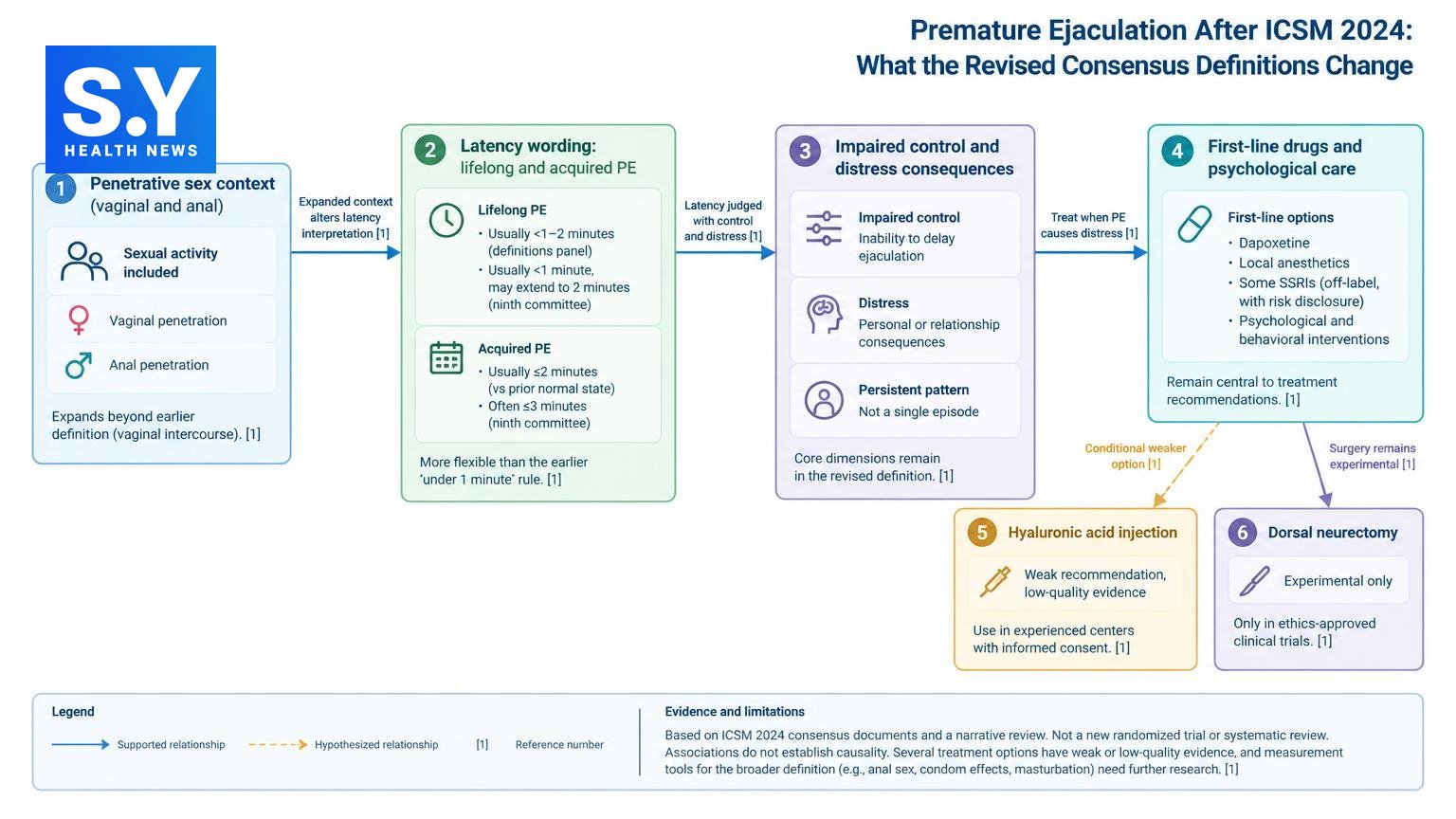
Conceptual framework: Conceptual framework of premature ejaculation constructs and treatment evidence discussed in this review. The figure shows the expanded penetrative sex context, flexible latency wording, impaired control and distress, and the graded treatment positions from first-line options to conditional hyaluronic acid injection and experimental neurectomy. Relations are conceptual, not tested causal pathways; the evidence base is consensus and narrative review, with weak or low-quality evidence for several interventions.
Academic References & Evidence
- 早泄定义变了,别再盯着“一分钟”.
- Contemporary consensus and emerging directions in premature and delayed ejaculation: recommendations from the 5th International Consultation on Sexual Medicine.. Sexual medicine reviews PMID: 42855438.
- 坚持多长时间不算早泄?判断标准一文说清.
- 时间长短难判断!多久时间不属于早泄.
SANYUN Science Center explains published research on men's reproductive and sexual health, connecting scientific evidence with everyday questions while making sources and limitations clear.
Disclaimer: This article is for scientific education and research communication only. It does not provide medical advice, diagnosis, or individualized treatment recommendations, and does not endorse any medication, supplement, device, penile enlargement procedure, or other intervention. Decisions about sexual and reproductive health should be made in consultation with a qualified healthcare professional. Do not delay seeking professional care because of information in this article.
Original Content & Copyright Notice
- This article is prepared for SANYUN Science Center, drawing on published research and publicly available academic literature on men’s sexual and reproductive health. Its editorial explanations and presentation are developed for this platform.
- Copyright in the original editorial content, selection, and arrangement is reserved by SANYUN Science Center to the extent protected by applicable law. Referenced research, quotations, and third-party materials remain subject to the rights of their respective owners. This notice does not claim ownership of scientific facts or third-party research.
- Except where permitted by applicable law or an applicable license, prior written permission is required to reproduce, republish, translate, adapt, redistribute, or commercially reuse protected content. Attribution alone does not grant permission for such reuse.
- For permitted quotation or authorized reuse, clearly identify the source and retain a link to the original article.
- Source: SANYUN Science Center
- Original URL: Retain the original article URL on science.san-yun.com.
- Copyright Holder: SANYUN Science Center, for its own protected editorial content.
- Quotation, excerpts, or authorized reuse must not distort the scientific meaning, omit material limitations or disclaimers, or imply unverified medical claims, product efficacy, or endorsement by SANYUN Science Center.



