




Category: Premature Ejaculation
Core Research Direction: What intravaginal ejaculatory latency time (IELT) distributions and comparative effectiveness evidence (physiotherapy vs dapoxetine, guideline updates) show about defining and treating premature ejaculation, and what these study designs can and cannot establish
Search Intent: How long is intravaginal ejaculatory latency time in men with versus without premature ejaculation, and does the evidence favor physiotherapy or dapoxetine for prolonging it?
Platform: SANYUN Science Center
Evidence reviewed through: 2026-11-25
Executive Summary
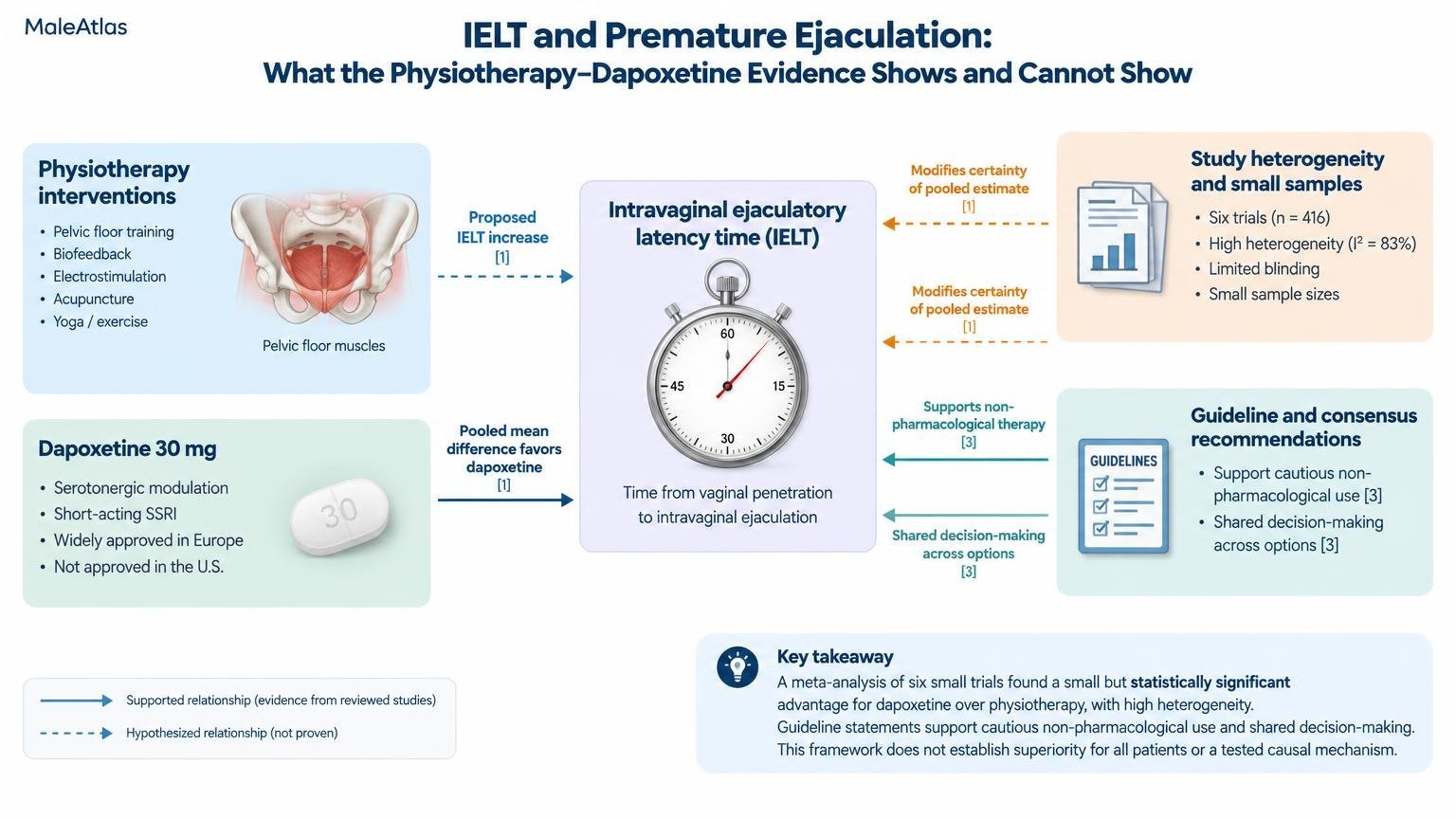
A 2026 systematic review and meta-analysis of six clinical trials reported that dapoxetine 30 mg produced a statistically significant but very small pooled advantage over physiotherapy for prolonging intravaginal ejaculatory latency time (IELT) in men with lifelong premature ejaculation. The pooled mean difference was −0.80 seconds (95% CI −1.53 to −0.06), with high between-study heterogeneity (I2 = 83%). The same review concluded that physiotherapy may be a safe alternative for men who cannot tolerate medication and suggested that combined therapy produced the largest IELT improvements, although that combined signal came from qualitative review rather than pooled analysis.[1]
IELT remains the core outcome in this literature, but the evidence base is small and methodologically uneven. A registry record for a multinational observational study describes a plan to characterize IELT distributions in 1,115 men with and without premature ejaculation using stopwatch-timed intercourse over 8 weeks; the record documents design and enrollment but does not report the resulting distributions. Recent guideline activity has revised statements on non-pharmacological therapy and added caveated options, while making shared decision-making the central principle. This article interprets what these designs can and cannot establish; it is not a new systematic review or clinical experiment.[2][3]
Why IELT and the Definition of Premature Ejaculation Matter
IELT is defined as the time from vaginal penetration to intravaginal ejaculation. In the 2026 review, premature ejaculation is clinically defined as an IELT of 1 minute or less, a threshold that primarily characterizes lifelong premature ejaculation, in which ejaculation occurs prematurely from the first sexual experiences in nearly all instances of vaginal penetration. The same review describes acquired premature ejaculation as a later-onset form, often associated with physical, psychological or comorbid sexual disorders, with a reported threshold around 3 minutes. These are clinical conventions informed by distributions, not diagnostic laboratory values.
The observational study record illustrates how IELT is intended to be captured in research. Participants and their partners were expected to attempt intercourse at least twice weekly during an 8-week study period and to record IELT with a stopwatch, with the stated aim of estimating the distribution of average IELT values in men with and without premature ejaculation. The record describes a multinational, multicenter design with screening and enrollment plus observation visits at 1 and 2 months. Because it is a registry record rather than a results paper, it does not report the observed distributions or the validity of the patient-reported outcomes.
That gap matters for interpretation. Without reported distributions, a reader cannot quantify how much IELT overlap exists between men with and without premature ejaculation, or how well a single cutoff separates them. A related evidence review on how premature ejaculation symptoms are classified and measured may help readers follow the distinction between a research endpoint and a clinical diagnosis.
Mechanistic Rationales for Dapoxetine and Physiotherapy
Dapoxetine is a short-acting selective serotonin reuptake inhibitor developed for premature ejaculation. The review describes it as intervening in ejaculation through serotonergic modulation and notes that it is widely approved in Europe but not the United States. The mechanistic description in the source is brief; it does not establish a single final ejaculatory pathway, and mechanistic plausibility is not the same as demonstrated comparative clinical superiority.[4]
Physiotherapy approaches rest on a different rationale: strengthening or retraining pelvic floor muscles involved in sexual function, on the hypothesis that weakness or hypertonicity may contribute to ejaculatory disorder. The interventions pooled in the review were heterogeneous and included pelvic floor muscle strengthening, biofeedback, electrostimulation, acupuncture, yoga and general exercise. Treating these as one class is a practical simplification; the trials did not test a single standardized physiotherapy protocol.
For readers who want more detail on specific pelvic floor modalities, a focused review of pelvic floor training, biofeedback and electromagnetic stimulation for premature ejaculation examines how these interventions are delivered and what the current evidence can support. The mechanistic framing remains hypothesis-generating; it should be read alongside the trial results rather than as proof of a superior approach.
What the Comparative Evidence Shows
The 2026 systematic review searched multiple databases for clinical trials published within the previous 10 years that compared physiotherapy with pharmacological treatment and used IELT as the primary outcome in men with premature ejaculation. Six studies with a total of 416 participants met the inclusion criteria for the meta-analysis. The included trials were small, with sample sizes ranging from 18 to 120 participants and a mean participant age of about 43 years. The review notes that the same qualitative synthesis elsewhere describes a total sample of 466 men, an internal inconsistency that the source does not reconcile.
The pooled comparison of physiotherapy with dapoxetine 30 mg found a statistically significant effect (P = .03) with a mean difference in IELT of −0.80 seconds favoring dapoxetine and a 95% confidence interval of −1.53 to −0.06 seconds. Heterogeneity was high. The authors describe the standardized pooled difference as large by Cohen's criteria, but the absolute difference in seconds is small relative to the IELT changes observed within individual trials, and the confidence interval sits close to zero. Statistical significance and clinical importance are distinct questions here.
| Comparison | Key IELT observation | Design and timeframe | Interpretation and limits |
|---|---|---|---|
| Dapoxetine 30 mg versus physiotherapy (pooled) | Mean difference −0.80 s (95% CI −1.53 to −0.06), favoring dapoxetine | Meta-analysis of six trials, 416 participants | Statistically significant but very small absolute difference; high heterogeneity (I2 = 83%) |
| Dapoxetine 30 mg and 60 mg (Pastore et al.) | Mean IELT 37.2 s at baseline to 168.2 ± 36.6 s with 30 mg and 193.2 ± 43.8 s with 60 mg | Single trial, 6 weeks | Within-group change; small subsamples; not a pooled head-to-head estimate |
| Dapoxetine 30 mg, 60 mg and acupuncture (Sahin et al.) | Baseline around 44–45 s; at 4 weeks 127.52 s with 60 mg, 103.21 s with 30 mg and 87.21 s with acupuncture | Single four-arm trial, 4 weeks | Small groups; dose ordering observed but not definitive |
| Moderate versus minimal physical activity (Kilinc et al.) | Moderate activity 39.3 ± 8.8 s to 188.6 ± 82.9 s; minimal activity 33.8 ± 14.7 s to 50.3 ± 19.1 s | Single trial, 4 weeks | Intensity-dependent signal; small samples |
| Pelvic floor training, dapoxetine and combined therapy (Mantovani et al.) | Responders: 25% with pelvic floor training and 75% with dapoxetine at 3 months; at 6 months 25% with pelvic floor training and 25% with dapoxetine; combined therapy 75% at 3 months and 50% at 6 months | Single trial, 3 and 6 months | Excluded from the meta-analysis because standard deviations were missing and IELT was self-reported rather than stopwatch-measured |
Individual trials showed larger within-group changes than the pooled between-group difference suggests. In one trial, dapoxetine treatment began at a mean IELT of 37.2 seconds and rose at 6 weeks to 168.2 ± 36.6 seconds with 30 mg and 193.2 ± 43.8 seconds with 60 mg. In a four-arm trial, baseline IELT was around 44–45 seconds and at 4 weeks reached 127.52 seconds with dapoxetine 60 mg, 103.21 seconds with 30 mg and 87.21 seconds with acupuncture. In an exercise-intensity trial, moderate physical activity raised IELT from 39.3 to 188.6 seconds, while minimal activity changed it only from 33.8 to 50.3 seconds.
The qualitative review adds a practical nuance: a combined therapeutic approach was suggested to yield the most significant IELT improvements, and one trial reported that the combined physiotherapy plus dapoxetine group showed a statistically significant IELT increase compared with other groups. That is a hypothesis-level observation from qualitative synthesis, not a pooled meta-analytic estimate. A separate evidence review comparing psycho-behavioural and pharmacological treatment approaches examines how combined strategies have been studied and where the evidence remains uncertain.
What the Pooled IELT Difference Means in Practice
The meta-analysis rests on six small trials with significant methodological and population differences, a limitation the authors acknowledge. On the PEDro quality scale, three studies were rated high quality, one medium and two low, with blinding of participants, therapists and assessors scoring lowest. This pattern is expected when exercise, acupuncture or behavioral training is compared with an oral drug; participants cannot easily be blinded to whether they are exercising or taking a tablet.
Tolerability shapes the clinical picture. The review notes that SSRI use is frequently limited by adverse effects such as nausea and dizziness and by discontinuation rates ranging from 70.6% to 89.6% after the first year of treatment, citing earlier literature rather than the included trials. Denominators for those figures are not given, so they signal adherence difficulty rather than precise rates for any single population. This context helps explain why a small pooled IELT advantage for dapoxetine does not automatically translate into a uniform first-choice recommendation.
The design of these studies limits what can be concluded. A meta-analysis of small, heterogeneous, mostly unblinded trials cannot prove that dapoxetine is superior for all men with premature ejaculation, cannot separate drug effects from expectancy and measurement effects, and cannot establish that physiotherapy's apparent safety translates into durable satisfaction. The combined-therapy signal is observational and hypothesis-level. The registry record cannot demonstrate IELT distributions because its results are not reported in the available source.
How Recent Guidelines Treat Non-Drug Options
The AUA/SMSNA guideline amendment searched MEDLINE and Embase for studies published between January 1, 2020 and December 19, 2024. The search identified 727 abstracts, of which 89 met inclusion criteria, and quality assessment covered outcomes from 25 studies to inform statement updates. A statement on non-pharmacological therapies for premature ejaculation was revised to reflect new evidence that some of these therapies may be effective. This is a broadening of options rather than a declaration that physiotherapy is equivalent to medication.
The amendment also added an expert opinion on the potential use of PDE5 inhibitors for premature ejaculation and supported new statements on daily or on-demand clomipramine and glans hyaluronic acid injection, while emphasizing informed consent and use by a trained clinician for the latter two. These recommendations come with caveats and do not establish comparative superiority. Separately, the Fifth International Consultation on Sexual Medicine produced a consensus review synthesizing evidence on the etiology, epidemiology, evaluation and management of premature and delayed ejaculation, with recommendations for definition, classification and treatment.
The panel ultimately recommends shared decision-making as the fundamental principle in managing ejaculatory disorders regardless of treatment option. For readers tracking how these recommendations evolved, an evidence review of the 2027 AUA/SMSNA amendment and the Fifth ICSM consensus examines what the updated guidance now supports and where uncertainty remains. Guideline consensus is not the same as trial-proven superiority, and the recommendations should be read alongside the modest effect sizes in the comparative literature.
Research Outlook
The most valuable next steps would be adequately powered, assessor-blinded trials with stopwatch-measured IELT and validated patient-reported outcomes reported side by side. The current literature has not resolved whether combined physiotherapy plus drug therapy is superior to either alone; the qualitative suggestion of benefit needs direct randomized testing. The reviewed designs cannot establish causal mediation, cannot prove an optimal treatment sequence, and cannot determine whether the observed IELT differences translate into meaningful improvements in control, distress or relationship satisfaction.
This article is an evidence review updated to the 2026-11-25 cutoff; it interprets published research and consensus guidance rather than reporting original data. Where sources report planned methods or registry enrollment without results, those should be treated as design descriptions, not findings. Where reported effects are small, statistically significant and heterogeneous, the appropriate reading is cautious and shared decision-making remains the guideline-endorsed anchor.
Key Takeaways
- IELT is the core outcome in premature ejaculation research, but the registry record describing a planned observational study of 1,115 men does not report the resulting IELT distributions or the validity of patient-reported outcomes.
- A 2026 meta-analysis of six trials and 416 participants found dapoxetine 30 mg significantly better than physiotherapy for IELT, with a pooled mean difference of −0.80 seconds and high heterogeneity.
- Individual trials show larger within-group IELT gains, such as 37.2 to 168.2 seconds at 6 weeks with dapoxetine 30 mg, but these are single-trial observations, not pooled comparative effects.
- Tolerability and adherence limit pharmacological treatment; the review cites discontinuation rates of 70.6% to 89.6% after the first year from earlier literature, and positions physiotherapy as a safer alternative and possible adjunct.
- Recent guidelines revise non-pharmacological statements, add caveated options and endorse shared decision-making, but the evidence remains too limited to declare a universal first-line treatment for all men with premature ejaculation.
Questions and Answers
What is intravaginal ejaculatory latency time (IELT) and how is it measured in premature ejaculation research?
IELT is the time from vaginal penetration to intravaginal ejaculation. In the reviewed literature, premature ejaculation is clinically defined as an IELT of 1 minute or less, primarily characterizing lifelong premature ejaculation, while acquired forms are described with a later threshold around 3 minutes. Research typically uses stopwatch timing during intercourse, and the observational study record describes planned measurement across an 8-week period. IELT varies between men and occasions, so it is a clinical convention rather than a fixed biological cutoff.
Did the physiotherapy versus dapoxetine meta-analysis find a statistically significant difference in IELT?
Yes. The 2026 meta-analysis of six trials and 416 participants reported a statistically significant pooled mean difference of −0.80 seconds favoring dapoxetine 30 mg over physiotherapy (95% CI −1.53 to −0.06), with high heterogeneity. The authors also describe the standardized effect as large, but the absolute difference in seconds is small relative to within-trial IELT changes, and the confidence interval sits close to zero. Statistical significance does not by itself establish a large clinical advantage.
How strong is the evidence comparing physiotherapy with dapoxetine for premature ejaculation?
The evidence is limited. The meta-analysis included only six small trials with 416 participants, significant methodological differences and high heterogeneity. On the PEDro quality scale, three studies rated high, one medium and two low, with blinding items scoring lowest. The authors acknowledge these limitations and caution against definitive conclusions. The suggestion that combined therapy yields the largest IELT improvements came from qualitative review rather than pooled analysis, so it remains a hypothesis.
Does dapoxetine prolong IELT in men with lifelong premature ejaculation according to individual trials?
Individual trials suggest it can. In one trial, mean IELT rose from 37.2 seconds at baseline to 168.2 seconds with 30 mg and 193.2 seconds with 60 mg at 6 weeks. In another, IELT reached 127.52 seconds with 60 mg and 103.21 seconds with 30 mg at 4 weeks. These are within-group changes from small trials, not proof of superiority for every patient, and tolerability limits long-term use in some men.
What are the side effects and discontinuation risks of SSRI treatment for premature ejaculation?
The review notes nausea and dizziness as common adverse effects and cites discontinuation rates ranging from 70.6% to 89.6% after the first year of treatment. These figures come from earlier literature rather than the included trials, and denominators are not given. They should be read as signals of adherence difficulty rather than precise estimates. Physiotherapy is presented as having fewer adverse reactions, which is one reason some patients and clinicians consider it, especially when drug tolerance is poor.
How do recent premature ejaculation guidelines frame non-drug options and shared decision-making?
The AUA/SMSNA amendment revised its statement on non-pharmacological therapies to reflect evidence that some may be effective, added caveated statements on clomipramine and glans hyaluronic acid injection, and emphasized shared decision-making as fundamental. The Fifth International Consultation provides a parallel consensus synthesis on definition, classification and treatment. These updates broaden options but do not declare a universal first-line treatment or prove that physiotherapy equals medication.
Conceptual framework: Conceptual framework, not a tested causal model. In a meta-analysis of six small trials, dapoxetine 30 mg showed a small but statistically significant pooled advantage over physiotherapy for IELT, alongside high heterogeneity and limited blinding. Guideline statements support cautious non-pharmacological use and shared decision-making. The framework does not establish superiority for all patients or a tested causal mechanism.
Academic References & Evidence
- Esther M Medrano-Sánchez; Ana López-del-Castillo; Maud Boisseau; Juan C Fernández-Domínguez; Esther Díaz-Mohedo. Effectiveness of physiotherapy in male premature… : The Journal of Sexual Medicine. The Journal of Sexual Medicine. 2026 23(5) DOI: 10.1093/jsxmed/qdag096.
- A Study to Evaluate Intravaginal Ejaculation Time in Men With and Without Premature Ejaculation.
- Disorders of Ejaculation: AUA/SMSNA Guideline (2027) | Journal of Urology. Journal of Urology DOI: 10.1097/JU.0000000000005378.
- Contemporary consensus and emerging directions in premature and delayed ejaculation: recommendations from the 5th International Consultation on Sexual Medicine.. Sexual medicine reviews PMID: 42855438.
SANYUN Science Center explains published research on men's reproductive and sexual health, connecting scientific evidence with everyday questions while making sources and limitations clear.
Disclaimer: This article is for scientific education and research communication only. It does not provide medical advice, diagnosis, or individualized treatment recommendations, and does not endorse any medication, supplement, device, penile enlargement procedure, or other intervention. Decisions about sexual and reproductive health should be made in consultation with a qualified healthcare professional. Do not delay seeking professional care because of information in this article.
Original Content & Copyright Notice
- This article is prepared for SANYUN Science Center, drawing on published research and publicly available academic literature on men’s sexual and reproductive health. Its editorial explanations and presentation are developed for this platform.
- Copyright in the original editorial content, selection, and arrangement is reserved by SANYUN Science Center to the extent protected by applicable law. Referenced research, quotations, and third-party materials remain subject to the rights of their respective owners. This notice does not claim ownership of scientific facts or third-party research.
- Except where permitted by applicable law or an applicable license, prior written permission is required to reproduce, republish, translate, adapt, redistribute, or commercially reuse protected content. Attribution alone does not grant permission for such reuse.
- For permitted quotation or authorized reuse, clearly identify the source and retain a link to the original article.
- Source: SANYUN Science Center
- Original URL: Retain the original article URL on science.san-yun.com.
- Copyright Holder: SANYUN Science Center, for its own protected editorial content.
- Quotation, excerpts, or authorized reuse must not distort the scientific meaning, omit material limitations or disclaimers, or imply unverified medical claims, product efficacy, or endorsement by SANYUN Science Center.



