




Category: Clinical Insights
Core Research Direction: Interpretation of treatment-risk tradeoffs and evidence quality relevant to men's reproductive and sexual health decisions
Search Intent: How do men weigh treatment risks such as urinary incontinence versus impotence, and how reliable is the trial evidence underpinning such clinical recommendations?
Platform: SANYUN Science Center
Evidence reviewed through: 2026-11-25
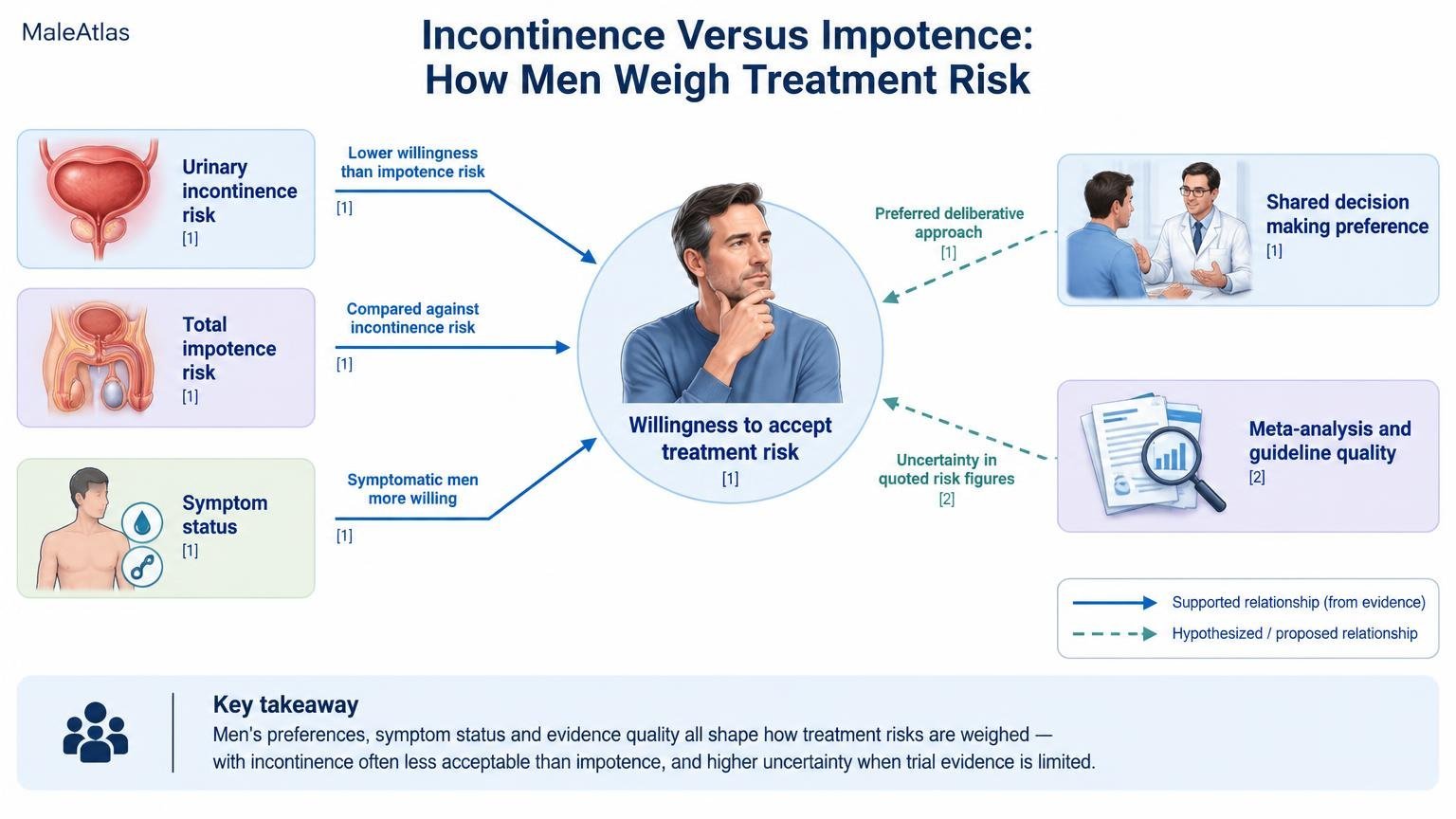
In the summarized patient-preference study at the centre of this review, men were less willing to accept the risk of urinary incontinence than the risk of total impotence. The same summary reports that men who were already symptomatic with incontinence or impotence were more willing to accept treatment risks than asymptomatic men.[1]
Executive Summary
For men facing pelvic or prostate-directed treatment, the two harms most often set against each other are urinary incontinence and erectile loss. Clinicians sometimes assume sexual function dominates that tradeoff. The summarized preference research points the other way: the men studied ranked incontinence risk as harder to accept than total impotence, and their baseline symptom burden appeared to shift how much treatment risk they would take on.
That is a directional signal about values, not a measured exchange rate. The finding is reported only as a summary on an author profile page; the original study design, sample size, setting and measurement approach are not available in the supplied material. Nothing in it quantifies how much incontinence risk a given man would trade for a given reduction in impotence risk, and nothing establishes that the same ordering holds across ages, cultures or treatment types.
A separate source in this review is a 2026 critical appraisal of challenges in interpreting randomised clinical trials included in systematic reviews and clinical guidelines. Its authors argue that most systematic reviews and meta-analyses assessing perioperative analgesic interventions carry critical limitations—weak inclusion and exclusion criteria, poor quality assessment, heterogeneity, bias, inadequate follow-up, fragility and spin—and that guidelines built on such reviews may be inaccurate because sophisticated statistical methods cannot compensate for inherent study flaws.[2]
Why This Tradeoff Matters
Urinary incontinence and erectile dysfunction are not interchangeable harms. Incontinence can involve pads, odour, skin irritation, restricted activity and visible disruption of daily life; erectile loss affects sexual function and intimacy and can carry substantial psychological weight. Which one a man would rather risk is a values question, and the summarized study suggests clinicians should not answer it on the patient's behalf.
Symptom status adds a second layer. A man already living with incontinence or erectile difficulty has direct experience of the burden he is trying to reduce, which may explain why symptomatic men in the summary were more willing to accept treatment risks than asymptomatic men. For counselling, that implies the same probability statement can land differently depending on what the patient has already lived through—an argument for eliciting experience before quoting numbers.
Evidence quality is not a background technicality in this discussion. If the trials and pooled analyses behind a quoted risk figure are heterogeneous, at risk of bias or fragile, then the percentage a clinician offers may carry more apparent precision than it deserves. That is the practical bridge between the preference evidence and the appraisal literature: preferences tell us what men value, and appraisal tells us how much confidence to place in the numbers used to describe the options.
How Patients Read Probability
Risk communication sits between evidence and decision. In the summarized communication research, patients' numerical interpretations of probability terms fell into identifiable patterns, but patients varied in the actual values they assigned to those terms, while the relative meanings of terms showed consistent trends. Words such as "uncommon" are therefore not read as fixed numbers, and individual variation is substantial even when the ordering of terms is broadly shared.
Format may also shape engagement. Among male veterans considering invasive medical interventions, shared patient-physician decision making was consistently preferred, and patients who preferred to discuss risk information in terms of numbers tended toward patient-based or shared decision making. That pattern supports offering structured numeric disclosure alongside a deliberative conversation, rather than delivering a single verbal risk statement and moving on.
| Variable or construct | What the evidence reports | How to interpret it |
|---|---|---|
| Willingness to accept incontinence risk versus total impotence risk | Men were less willing to accept the risk of urinary incontinence than of total impotence | Suggests incontinence may be weighted heavily in some preference contexts; magnitude and generalisability are unknown |
| Symptom status | Symptomatic men with incontinence or impotence were more willing to accept treatment risks than asymptomatic men | Baseline burden may modify risk tolerance, so the same disclosure can be received differently |
| Preferred decision role | Male veterans considering invasive interventions consistently preferred shared patient-physician decision making | Supports a deliberative rather than directive communication style in this population |
| Probability language | Numerical meanings of probability terms followed identifiable patterns but varied between patients | Words and numbers are not interchangeable; numeric formats may support shared decisions |
| Meta-analysis and guideline quality | Commentary reports limitations including weak inclusion criteria, heterogeneity, bias and spin | Guideline certainty may be overstated when reviews rest on flawed or heterogeneous trials |
What the Evidence Shows
The direct evidence on the incontinence–impotence tradeoff is a single summarized preference finding with three parts: patients distinguished severity of morbidity, men were less willing to accept the risk of urinary incontinence than of total impotence, and symptomatic men were more willing to accept treatment risks than asymptomatic men. These are reported as observed results in the summary, in a population described only as men (patients), with no sample size or timeframe reported.
The remaining preference summaries add context rather than hard outcomes. Male veterans preferred shared decision making for invasive medical interventions, and those who preferred numeric risk information tended toward patient-based or shared decision making. Interpretations of probability terms showed identifiable patterns with individual variation. These findings support a communication approach; they do not establish which treatment is better for any individual.
The 2026 appraisal is a different category of evidence: a commentary and critical appraisal rather than a primary study. Its central claim is that many perioperative analgesic reviews carry limitations that make their conclusions clinically uncertain, and that guideline recommendations resting on them may be inaccurate. It also sets out a normative standard—a properly conducted meta-analysis would involve a meticulous systematic review of homogeneous randomised trials, critically assessed for current clinical relevance including well-defined early mobilisation, basic analgesic use, functional pain and recovery, and clinically relevant reductions in pain and opioid use. That standard is a recommendation for future work, not an observed result.
The appraisal's conclusion is that critical appraisal, careful interpretation and judicious application of meta-analyses are necessary before their use in guidelines and routine practice. Applied to men's health conversations, that means the risk figures quoted for incontinence or erectile outcomes should be read alongside the trials behind them, not treated as fixed properties of a procedure.
Interpretation and Limitations
The preference finding should not become a universal rule. It reports relative willingness, not a measured tradeoff rate, and it does not state how much incontinence risk a man would accept to avoid impotence. Because original methods and sample details are unavailable in the supplied material, selection bias, confounding and measurement problems cannot be assessed. Nor is it clear which interventions the men were considering—surgery, medication or something else—and preference orderings can differ by context.
The appraisal has its own limits. It is a commentary rather than a quantified audit, and the assertion that most reviews carry these flaws is argued rather than measured in the supplied text. Its focus is perioperative analgesic evidence, not urological surgery directly, so applying it to prostate or pelvic treatment is an analogy about guideline reliability, not a finding about those procedures.
The communication summaries are summary-level and draw mainly on male veterans or general patient groups. Preferences may differ by age, education, culture, baseline function, prior treatment experience and partner circumstances. Separately, a summarized educational-intervention finding—improved physician self-efficacy for physical activity counselling without a clear increase in patient physical activity—is not a reproductive-health result, but it is a general caution that clinician confidence does not automatically translate into changed patient behaviour.
What This Means for Clinical Conversations
The practical implication is not that one outcome matters more than the other, but that the clinician should ask. A man facing treatment with both urinary and sexual risks may weight them differently from the clinician's default assumption, and a symptomatic man may weight them differently again. Structured numeric disclosure paired with explicit exploration of values is consistent with the summarized preference evidence, and it avoids presenting a personal hierarchy as a medical fact.
Candidacy about certainty belongs in the same conversation. When underlying trials are heterogeneous or at risk of bias, a precise-looking percentage can imply confidence the evidence does not support. The appraisal's call for critical appraisal before guideline use is a reminder to distinguish statistical significance from clinical relevance and to say plainly when a recommendation rests on fragile evidence.
Research Outlook
Better decision support would need preference studies that report their methods, populations and measured tradeoffs, ideally across different urological and pelvic treatment contexts rather than one setting. Trials and reviews should assess outcomes that matter to patients—functional recovery and clinically relevant change—rather than surrogate measures alone. The proposed standard of homogeneous randomised trials with critical relevance assessment is a reasonable direction, though it remains a recommendation rather than a demonstrated result.
Key Takeaways
- In the summarized preference study, men were less willing to accept the risk of urinary incontinence than of total impotence, suggesting some men weight incontinence heavily.
- Symptomatic men were more willing to accept treatment risks than asymptomatic men, so baseline burden may modify risk tolerance.
- Male veterans considering invasive interventions preferred shared decision making, and numeric risk formats tended to align with that preference.
- Probability terms are interpreted variably, so verbal labels and numbers should not be treated as interchangeable.
- A 2026 critical appraisal argues that flawed or heterogeneous meta-analyses can feed inaccurate guidelines despite sophisticated statistics, but it is commentary focused on perioperative analgesia.
- The overall evidence is summary-level and commentary-level: it supports careful shared decision making but does not establish a universal risk hierarchy.
Questions and Answers
Why might men be less willing to accept urinary incontinence risk than impotence risk after treatment?
In the summarized preference study, men were less willing to accept the risk of urinary incontinence than of total impotence, which suggests incontinence may be weighted heavily by some men. This is a direction of preference from summary-level evidence without published methods or sample size, so it should inform conversation rather than define a universal hierarchy of harms.
Does being symptomatic change how willing men are to accept treatment risks for incontinence or impotence?
The summarized study reports that men who were symptomatic with incontinence or impotence were more willing to accept treatment risks than asymptomatic men. This suggests existing symptom burden may modify risk tolerance, but the difference is not quantified in the supplied material, so it should be treated as a prompt to explore experience rather than as a fixed rule.
Do male veterans considering invasive procedures prefer shared decision making about treatment risk?
In the summarized research, male veterans considering invasive medical interventions consistently preferred shared patient-physician decision making, and those who preferred numeric risk information tended toward patient-based or shared decision making. The finding is summary-level without original methods, so it supports offering a deliberative discussion but does not establish that all men share this preference.
How strong is the evidence behind urinary incontinence and impotence risk figures quoted in guidelines?
It depends on the trials and reviews behind each figure, and the supplied material cannot verify specific urological estimates. A 2026 critical appraisal argues that many meta-analyses of perioperative analgesic interventions have limitations such as weak inclusion criteria, heterogeneity, bias and spin, and that guidelines built on them may be inaccurate. That is commentary, and its scope is perioperative pain rather than urological surgery.
What are the main limitations of the patient preference evidence on incontinence versus impotence?
The key finding appears only as a summary on an author profile page. Original methods, sample size, setting and measurement are unavailable, and it is unclear which treatments the men were considering. It does not quantify how much incontinence risk men would accept to avoid impotence, and preferences may vary by age, culture, baseline function and prior treatment experience.
How can clinicians present incontinence and impotence risk numbers without overstating certainty?
Patients' numerical interpretations of probability terms vary, although relative meanings show consistent trends, and male veterans tended to prefer shared decision making. Clinicians can pair plain numbers with a values conversation, explain what is known and unknown about the underlying trials, and avoid implying precision when the evidence is heterogeneous. The appraisal literature supports critical appraisal before a pooled estimate is presented as settled.
Conceptual framework: Conceptual framework, not a tested causal model. In a summarized preference study, men were less willing to accept urinary incontinence risk than total impotence risk, and symptomatic men were more willing to accept treatment risks than asymptomatic men. Shared decision making preference and meta-analysis quality appear as contextual factors. Evidence is summary-level and commentary-level; arrows show conceptual association, not proven causation.
Academic References & Evidence
- David H. Hickam. Mph David H. Hickam MD | Semantic Scholar.
- Girish P Joshi; Dileep N Lobo; Henrik Kehlet. Challenges in interpretaion of randomised clinical trials included in systematic reviews and clinical guidelines. British Journal of Anaesthesia. 2026
SANYUN Science Center explains published research on men's reproductive and sexual health, connecting scientific evidence with everyday questions while making sources and limitations clear.
Disclaimer: This article is for scientific education and research communication only. It does not provide medical advice, diagnosis, or individualized treatment recommendations, and does not endorse any medication, supplement, device, penile enlargement procedure, or other intervention. Decisions about sexual and reproductive health should be made in consultation with a qualified healthcare professional. Do not delay seeking professional care because of information in this article.
Original Content & Copyright Notice
- This article is prepared for SANYUN Science Center, drawing on published research and publicly available academic literature on men’s sexual and reproductive health. Its editorial explanations and presentation are developed for this platform.
- Copyright in the original editorial content, selection, and arrangement is reserved by SANYUN Science Center to the extent protected by applicable law. Referenced research, quotations, and third-party materials remain subject to the rights of their respective owners. This notice does not claim ownership of scientific facts or third-party research.
- Except where permitted by applicable law or an applicable license, prior written permission is required to reproduce, republish, translate, adapt, redistribute, or commercially reuse protected content. Attribution alone does not grant permission for such reuse.
- For permitted quotation or authorized reuse, clearly identify the source and retain a link to the original article.
- Source: SANYUN Science Center
- Original URL: Retain the original article URL on science.san-yun.com.
- Copyright Holder: SANYUN Science Center, for its own protected editorial content.
- Quotation, excerpts, or authorized reuse must not distort the scientific meaning, omit material limitations or disclaimers, or imply unverified medical claims, product efficacy, or endorsement by SANYUN Science Center.



