




Category: Health Academy
Core Research Direction: Clinic page describing injectable (intracavernosal) erectile dysfunction therapy: claimed mechanism, indications, and duration of effect, for an educational explainer on what such treatment pages do and do not establish
Search Intent: What does a commercial clinic page claim about injectable ED treatment, and what evidence or study data does it provide to support those claims?
Platform: SANYUN Science Center
Evidence reviewed through: 2026-11-24
Executive Summary
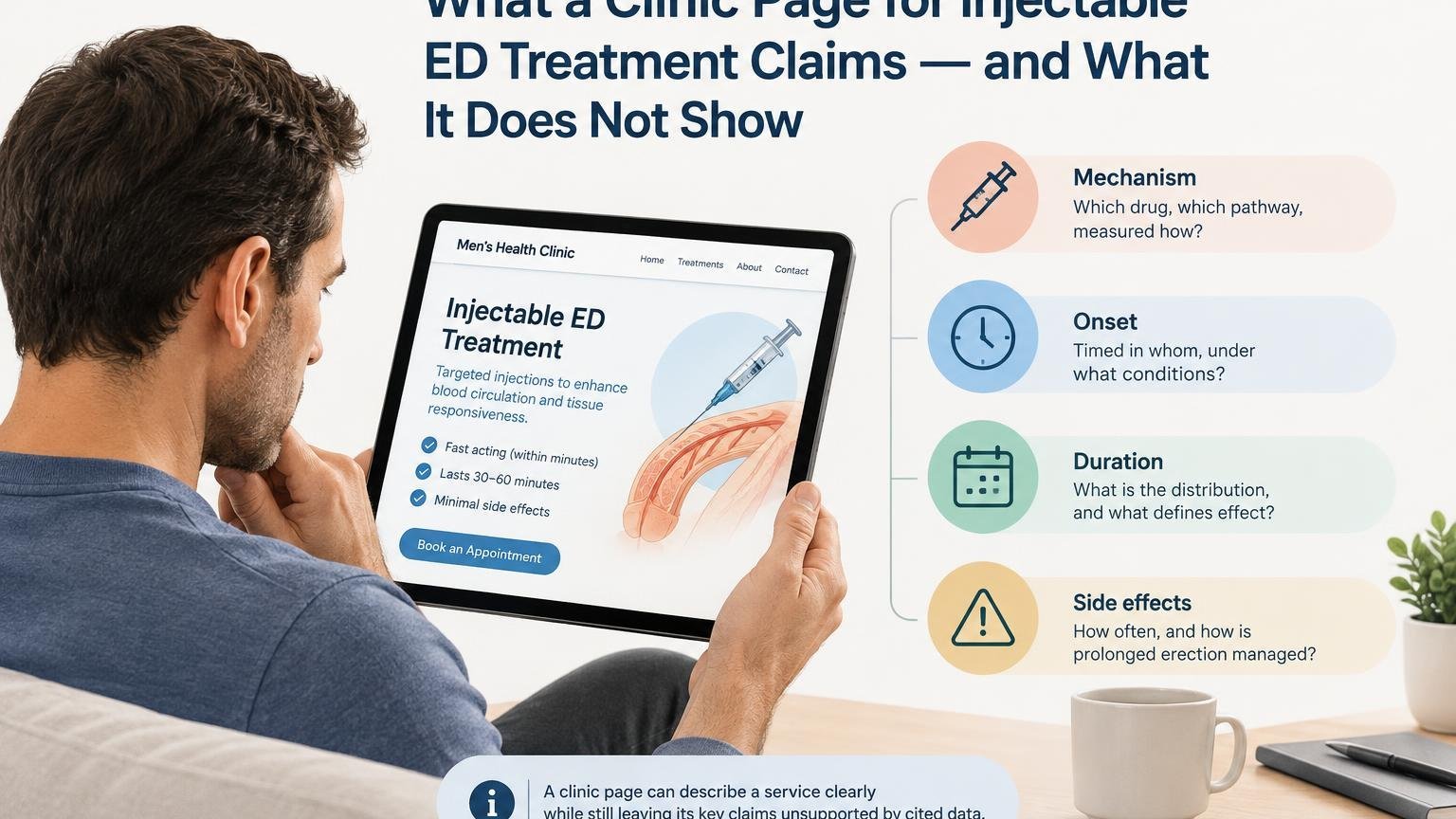
A commercial men's health clinic page describes a non-surgical erectile dysfunction (ED) service built around penile self-injection. It states that its specialists administer targeted penile injections intended to enhance blood circulation and promote tissue responsiveness, and that the medications act directly on the erectile mechanism with results typically within minutes of stimulation (F1, F2). It reports that effects typically last 30 minutes to 1 hour, sometimes longer depending on dosage and responsiveness (F3), and it lists temporary redness, mild swelling and prolonged erection as rare but possible effects (F4).[1]
The page is a service description, not a study. It cites no trial, no sample, no comparison group, no incidence figures and no clinical guideline. Its claims are therefore best read as marketing assertions about what the clinic offers — not as evidence that injectable therapy works, that it is safer than alternatives, or that its stated duration applies to any given patient. The distinction matters because the same therapy can be legitimately evidence-based at the level of the drug class while a particular page's promotional language remains unverified.
Why This Matters
Men searching for ED treatment often encounter clinic pages before they encounter clinical guidance, and the two are written for different purposes. A provider page is designed to describe a service, reduce hesitation and prompt a booking; it is not designed to quantify benefit, disclose absolute risk or identify who should not be treated. Educational reading therefore needs a simple habit: separate the treatment from the page that advertises it.
- The page's mechanism statement — injections that enhance blood circulation and promote tissue responsiveness — is presented without cited mechanism data or any supporting study (F1).
- The claim of action 'directly on the erectile mechanism' with results typically within minutes of stimulation has no measurement, study or comparison group attached (F2).
- The stated effect window of 30 minutes to 1 hour, sometimes longer depending on dosage and responsiveness, is a clinic assertion with no underlying data, sample or measurement method reported (F3).
- Side effects are described as 'minimal', while the page separately lists temporary redness, mild swelling and prolonged erection as rare but possible, without frequency data or a cited source (F4, F7).
Biological and Clinical Mechanism: What the Page Says and What It Leaves Out
Erection depends on blood flow into the penis and on the tissue's capacity to respond to that flow, so a page that talks about circulation and tissue responsiveness is using the right general vocabulary. The clinic states that targeted penile injections enhance blood circulation and promote tissue responsiveness (F1). That sentence, however, describes an intended effect rather than an explained one: it does not name the drug, the dose, the injection site, the physiological pathway, or any study in which the effect was measured.
The same gap appears in the onset claim. The page says the medications act directly on the erectile mechanism and produce fast-acting, natural-feeling results, typically within minutes of stimulation (F2). 'Within minutes' is a testable statement, but the page offers no measurement, no timing protocol and no comparison with any alternative. A reader cannot tell whether the figure comes from clinic observation, published literature, or a general impression of how the drug class behaves.
The duration claim is more specific and therefore more informative — and more consequential. The page states that effects typically last between 30 minutes and 1 hour, with some lasting longer depending on dosage and responsiveness (F3). This implies a dose-response and an individual-variability component, but supplies no distribution, no range beyond 'some', and no definition of what counts as an effect. Because penile injection therapy is a real clinical category with its own pharmacology, safety monitoring and contraindications, a general explanation is possible; what the page does not do is connect its specific numbers to any documented dataset.
Mechanism descriptions on commercial pages also tend to omit the part that matters most for safety: what can go wrong and how it is managed. The page acknowledges temporary redness, mild swelling and prolonged erection as rare but possible (F4) and elsewhere calls side effects minimal (F7). Prolonged erection is precisely the adverse event that makes injection therapy a monitored treatment rather than a casual one, so pairing it with 'minimal' without any incidence figures is the kind of framing that should prompt questions rather than reassurance.
What the Evidence Shows — and What the Page Actually Provides
Judged as a source, the page sits at the lowest level of the evidence hierarchy: it is a service advertisement. The table below summarises each claim, what kind of claim it is, and what the page supplies to support it. The pattern is consistent: assertions of mechanism, onset and suitability are stated as facts but contain no supporting data, while the one quantified statement — duration of effect — is quantified without any reported sample, method or uncertainty.
| Claim on the page | Claim type | What the page supplies | What a reader should ask |
|---|---|---|---|
| Injections enhance blood circulation and tissue responsiveness | Mechanism assertion | No cited mechanism data or study | Which drug, which pathway, measured how? |
| Acts directly on the erectile mechanism; results typically within minutes of stimulation | Onset assertion | No measurement, study or comparison group | Timed in whom, under what conditions? |
| Effects typically last 30 minutes to 1 hour, sometimes longer by dose and responsiveness | Quantified duration claim | No sample, method or range data reported | What is the distribution, and what defines effect? |
| Temporary redness, mild swelling, prolonged erection are rare but possible | Safety assertion | No frequency data, no cited source | How often, and how is prolonged erection managed? |
| Suitable for men who cannot take oral ED medication | Suitability claim | No clinical criteria or evidence cited | Which contraindications define this group? |
| Ideal for men who have not responded to Viagra or similar medications | Candidate-profile claim | No response-rate data cited | What response rate, in which population? |
| Side effects described as minimal | Unquantified safety claim | No comparative or incidence data | Minimal compared with what, measured how? |
The candidate profiles deserve particular scrutiny. The page markets the treatment as suitable for men who cannot take oral ED medications (F5) and identifies men who have not responded to Viagra or similar medications as an ideal group (F6). Both statements map onto clinically recognisable situations, but the page provides no clinical criteria for the first and no response-rate data for the second. It also says the treatment addresses ED related to diabetes, stress or vascular issues while reporting no subgroup data for any of these causes (F8). Taken together, the page implies broad applicability across several distinct causes of ED without distinguishing among them.
One practical consequence follows. A reader who wants to know whether injection therapy is likely to help them — and how its benefits and risks compare with tablets or other options — will not find that answer on this page, because the page was not built to provide it. Nor does the absence of evidence on the page mean the therapy itself lacks evidence; it means the page cannot be used as proof either way. Clarifying which non-oral options exist and how well each is supported is a separate question that depends on published comparative data rather than advertising copy.
Interpretation and Limitations
The central limitation is one of source type. Everything reported here comes from a single commercial clinic page, and the page includes no references, no patient numbers, no time frame and no outcome definitions. Its claims are recorded as claims: the mechanism statement is an assertion without cited data (F1), the onset statement lacks any measurement (F2), the duration statement gives a figure without a method (F3), and the safety statements give no frequencies (F4, F7). None of this should be presented as clinical evidence, and none of it establishes comparative safety or effectiveness against oral therapy or any other approach.
A second limitation concerns interpretation. Statements such as 'natural-feeling', 'minimal side effects' and 'restores confidence and relationship satisfaction' are promotional characterisations rather than measurable outcomes. They may reflect genuine clinical experience, but without definitions and data they cannot be evaluated. Similarly, listing diabetes, stress and vascular ED as target conditions is plausible in principle yet unsupported on the page by any subgroup analysis (F8). Readers should also note that a clinic page has an inherent incentive to understate inconvenience and risk and to present the service as widely suitable.
There is also a distinction between statistical and clinical meaning that the page blurs. 'Typically lasts 30 minutes to 1 hour' (F3) sounds like a clinical result, but without a sample, a distribution and a definition of effect it functions as a general expectation. A man whose response falls outside that window has no way to judge, from this page, whether he is unusual or simply within normal variation. That is a counselling question, not a marketing one.
Research Outlook
Commercial treatment pages are unlikely to disappear from search results, so the useful outlook is methodological rather than experimental. The relevant questions are ones a well-designed clinical study would answer: what proportion of men achieve a satisfactory erection with injection therapy, how long the effect lasts across doses, how often prolonged erection occurs and how it is reversed, which causes of ED respond best, and how outcomes compare with oral agents. This page answers none of those questions, and it does not claim to.
Until such data are cited directly on a provider page — or until a reader consults independent clinical guidance — the honest position is that the page describes a service and asserts benefits. That is not the same as demonstrating them. A reader can still act on the page usefully: by treating its mechanism, onset, duration and safety statements as questions to raise in consultation rather than as settled facts.
Key Takeaways
- The clinic page describes injectable ED therapy as enhancing blood circulation and tissue responsiveness, but cites no mechanism data or study for that statement (F1).
- The page claims action typically within minutes of stimulation without any measurement, timing protocol or comparison group (F2).
- It states that effects typically last 30 minutes to 1 hour, sometimes longer depending on dosage and responsiveness, but reports no sample, method or distribution behind that figure (F3).
- Temporary redness, mild swelling and prolonged erection are listed as rare but possible, with no frequency data, while side effects overall are described as minimal (F4, F7).
- Candidate groups include men who cannot take oral ED medications and men who have not responded to Viagra or similar drugs, but no clinical criteria or response rates are given (F5, F6).
- Because a clinic page is a service advertisement rather than a study, it cannot establish effectiveness, safety or comparative benefit; those judgements require independent clinical evidence.
Questions and Answers
How is injectable ED treatment described as working on this clinic page?
The page states that specialists administer targeted penile injections that enhance blood circulation and promote tissue responsiveness, and that the medications act directly on the erectile mechanism with results typically within minutes of stimulation (F1, F2). It does not name the drug, dose, injection site or physiological pathway, and it cites no study or mechanism data to support the description.
How long does the clinic page say injectable ED treatment lasts?
The page states that effects typically last between 30 minutes and 1 hour, with some lasting longer depending on dosage and responsiveness (F3). No sample, measurement method or distribution is reported, so the figure should be read as a clinic's general expectation rather than a documented clinical result. Individual responses may fall outside that window.
Does the clinic page provide study data for its injectable ED treatment claims?
No. The page is a commercial service description that cites no trial, sample size, comparison group or incidence figures. Its mechanism, onset, candidate-group and safety statements are assertions without supporting data (F1, F2, F5, F6, F7). The duration statement gives a figure but no method (F3). The page therefore cannot establish effectiveness or safety.
Which men does the clinic page say are suitable for penile injection therapy?
The page markets the treatment as suitable for men who cannot take oral ED medications (F5) and identifies men who have not responded to Viagra or similar medications as ideal candidates (F6). It also says it addresses ED related to diabetes, stress or vascular issues without reporting subgroup data (F8). No clinical criteria or response rates accompany these profiles.
What side effects does the clinic page list for injectable ED treatment?
The page lists temporary redness, mild swelling and prolonged erection as rare but possible, and separately describes side effects as minimal (F4, F7). It provides no frequency data or cited source, so the actual incidence is unknown from the page. Prolonged erection in particular warrants clinical monitoring rather than reassurance from an unquantified claim.
Why does a clinic's injectable ED treatment page not count as clinical evidence?
A clinic page is a service advertisement written to describe an offering and prompt bookings, not to quantify benefit or risk. This page cites no references, patient numbers, time frames or outcome definitions (S1), so its claims are assertions rather than findings. Independent clinical guidance and comparative data are needed to judge effectiveness, safety and suitability.
Sources and References
SANYUN Science Center explains published research on men's reproductive and sexual health, connecting scientific evidence with everyday questions while making sources and limitations clear.
Disclaimer: This article is for scientific education and research communication only. It does not provide medical advice, diagnosis, or individualized treatment recommendations, and does not endorse any medication, supplement, device, penile enlargement procedure, or other intervention. Decisions about sexual and reproductive health should be made in consultation with a qualified healthcare professional. Do not delay seeking professional care because of information in this article.
Original Content & Copyright Notice
- This article is prepared for SANYUN Science Center, drawing on published research and publicly available academic literature on men’s sexual and reproductive health. Its editorial explanations and presentation are developed for this platform.
- Copyright in the original editorial content, selection, and arrangement is reserved by SANYUN Science Center to the extent protected by applicable law. Referenced research, quotations, and third-party materials remain subject to the rights of their respective owners. This notice does not claim ownership of scientific facts or third-party research.
- Except where permitted by applicable law or an applicable license, prior written permission is required to reproduce, republish, translate, adapt, redistribute, or commercially reuse protected content. Attribution alone does not grant permission for such reuse.
- For permitted quotation or authorized reuse, clearly identify the source and retain a link to the original article.
- Source: SANYUN Science Center
- Original URL: Retain the original article URL on science.san-yun.com.
- Copyright Holder: SANYUN Science Center, for its own protected editorial content.
- Quotation, excerpts, or authorized reuse must not distort the scientific meaning, omit material limitations or disclaimers, or imply unverified medical claims, product efficacy, or endorsement by SANYUN Science Center.



