




Category: Erectile Dysfunction
Core Research Direction: Couple-based psychological and internet-delivered sexual counseling for erectile dysfunction after localized prostate cancer treatment: comparative randomized evidence against a waitlist control
Search Intent: For couples coping with erectile dysfunction after localized prostate cancer treatment, does internet-based sexual counseling work as well as face-to-face sex therapy, and how do outcomes compare with no active counseling?
Platform: SANYUN Science Center
Evidence reviewed through: 2026-11-02
Executive Summary
A randomized controlled trial compared a 3-month waitlist period, a three-session face-to-face couple counseling format, and an internet-based couple counseling format for sexual difficulties after localized prostate cancer treatment. A second internet group was later added to examine how website use related to outcomes. The trial enrolled 115 couples in the face-to-face and first internet arms and 71 couples in the added internet group, and reported a 34% overall dropout rate.[1]
Outcomes did not change during the waitlist period. Across the three treatment groups, neither dropout nor improvement in outcomes differed significantly. In a mixed model including all participants, mean International Index of Erectile Function (IIEF) scores rose from 29.7 ± 17.9 at baseline to 36.2 ± 22.4 at 12 months (P < .001), and Female Sexual Function Index (FSFI) scores rose from 15.4 ± 8.5 to 18.2 ± 10.7 (P = .034). The authors concluded that the internet format was as effective as the brief face-to-face format in producing lasting improvements.
The finding is best described as the absence of a significant between-group difference rather than demonstrated equivalence, especially given one in three couples dropping out and a pooled analysis that cannot by itself separate counseling effects from time and concurrent medical treatment.
Why This Matters
Erectile dysfunction after localized prostate cancer treatment is common and often persistent, and it affects both members of a couple. Standard urologic management focuses on the mechanics of erection, whereas couple-based sexual rehabilitation addresses the relational and psychological dimensions that shape whether and how a couple resumes sexual activity.
The trial authors argued that multidisciplinary sexual rehabilitation involving couples was more promising than conventional urologic ED treatment after prostate cancer, and designed their randomized comparison around that premise. This framing, from the 2010s and updated in this 2026 review, reframes the clinical question: if both partners' sexual outcomes matter, then a treatment that improves only the man's erections may miss a substantial part of the problem.
Access is a second reason the question matters. Face-to-face sex therapy requires trained clinicians, scheduled sessions, and travel. An internet-based program could extend reach to couples in areas with limited specialty services, provided that engagement is adequate and outcomes are comparable.
Study Design and What Was Measured
Couples were adaptively randomized to a 3-month waitlist, a three-session face-to-face format, or an internet-based format. A second internet group was added later to examine the relationship between website use and outcomes. Outcomes were assessed at baseline, after the waitlist period, after treatment, and at 6- and 12-month follow-up.
Four instruments were used: the IIEF for male erectile function, the FSFI for female sexual function, the Brief Symptom Inventory-18 for emotional distress, and the abbreviated Dyadic Adjustment Scale for relationship adjustment. All are patient-reported; the trial did not report objective physiological endpoints such as nocturnal penile tumescence or vascular imaging.
What the Evidence Shows
The waitlist comparison provides the most direct signal about untreated trajectory. Outcomes did not change during the waitlist period, which argues against substantial spontaneous recovery over three months in this population.
Between-group comparisons found no significant differences in dropout or in outcome improvement across the three treatment groups. The authors interpreted this as the internet format being as effective as the brief face-to-face format.
The pooled mixed-model analysis showed statistically significant improvement over time in male erectile function, with IIEF scores rising from 29.7 ± 17.9 at baseline to 36.2 ± 22.4 at 12 months (P < .001). Female partners' FSFI scores also improved significantly, from 15.4 ± 8.5 to 18.2 ± 10.7 (P = .034).
Two secondary observations refine interpretation. Better IIEF scores were associated with finding an effective medical treatment for ED and with normal female sexual function at baseline; these are associations, not causal claims. Within the second internet group, men who completed more than 75% of the intervention improved significantly more on the IIEF, a dose–engagement pattern that could reflect either a true dose–response effect or higher motivation among completers.
| Measure | Baseline mean ± SD | 12-month mean ± SD | Reported significance |
|---|---|---|---|
| IIEF (male erectile function) | 29.7 ± 17.9 | 36.2 ± 22.4 | P < .001 |
| FSFI (female sexual function) | 15.4 ± 8.5 | 18.2 ± 10.7 | P = .034 |
Interpretation and Limitations
Three cautions shape how far the conclusion should be carried. First, a non-significant between-group difference is not a formal demonstration of equivalence. The trial reported no significant differences and described the internet format as as effective as the face-to-face format, but the design does not appear to have specified an equivalence margin for the between-group comparison.
Second, 34% of couples dropped out across the trial. Attrition of this size can bias longitudinal estimates in either direction if dropout is related to outcome, and the quote does not provide the between-group dropout distribution. Third, the pooled mixed-model improvement includes all participants, so the gain over 12 months cannot be attributed solely to counseling; the association with finding an effective medical ED treatment indicates that concurrent medical management made an independent contribution.
The sample size of 115 couples in the face-to-face and first internet arms, plus 71 in the added internet group, is modest for detecting small between-group differences. The second internet group was added after randomization began, so its comparison with the other arms is not a clean randomized contrast. The dose–response observation in that group is a within-group association rather than a randomized comparison of adherence strategies.
Finally, the trial was designed and reported more than a decade ago. Internet-delivered behavioral interventions have changed substantially since, so the delivery format evaluated then may not represent current digital care. This 2026 review interprets the published evidence; it is not a new trial or a systematic review conducted with original methods.
Research Outlook
The most informative next step would be an adequately powered trial with a prespecified equivalence margin, better retention strategies, and separate reporting of male, female, and dyadic outcomes. Trials should also prespecify how concurrent medical ED treatment is captured, since that was associated with better erectile function here.
The dose–engagement finding in the second internet group is worth pursuing in a randomized design comparing different intensities or adherence-support strategies. Until such evidence exists, the current trial supports offering couple-based counseling through either format while acknowledging that comparable average outcomes do not guarantee comparable outcomes for every couple.
Key Takeaways
- Outcomes did not change over a three-month waitlist period, suggesting limited spontaneous improvement in sexual function in this population without intervention.
- Internet-based and brief face-to-face couple counseling did not differ significantly in dropout or outcome improvement; the authors described the formats as comparably effective.
- Pooled IIEF scores improved from 29.7 to 36.2 and FSFI scores from 15.4 to 18.2 over 12 months, but both improvements reflect all groups combined and are statistically, not necessarily clinically, defined by the reported P values.
- A 34% dropout rate and the absence of a formal equivalence test limit confidence in the equivalence conclusion and in the durability of observed gains.
- Better erectile function was associated with finding an effective medical ED treatment and with normal baseline female sexual function, underscoring that counseling sits alongside medical and partner factors rather than replacing them.
Questions and Answers
What is couple-based sexual counseling after prostate cancer treatment?
It is a rehabilitation approach that involves both the man treated for localized prostate cancer and his partner, addressing erectile difficulties alongside relational and psychological factors. In the reviewed trial, it was delivered either as three face-to-face sessions or through an internet-based program. The trial authors framed this multidisciplinary approach as potentially more promising than conventional urologic ED treatment alone, a rationale rather than a tested outcome of the trial.
Did internet-based couple counseling work as well as face-to-face sex therapy for erectile dysfunction after prostate cancer?
In the reported trial, internet-based and brief face-to-face counseling did not differ significantly in dropout or in outcome improvement, and the authors concluded the internet format was as effective as the face-to-face format. This conclusion rests on the absence of a significant difference, not on a formal equivalence test, and 34% of couples dropped out overall, which limits confidence.
How strong is the evidence that couple counseling improves sexual function after prostate cancer treatment?
The randomized design and 12-month follow-up support a moderate but not definitive signal. Pooled mixed-model IIEF scores improved significantly from 29.7 to 36.2 and FSFI scores from 15.4 to 18.2, but these pooled gains include all groups and cannot be attributed to counseling alone. Better erectile function was also associated with finding effective medical ED treatment, and the waitlist period showed no spontaneous change.
Does the amount of internet program use affect erectile function outcomes?
Within the second internet group, men who completed more than 75% of the intervention had significantly greater IIEF improvement. This is a within-group association in a group added after randomization began, so it could reflect a genuine dose–response effect or higher motivation among completers. It does not establish that enforcing higher completion would improve outcomes for all couples.
What are the main limitations of the prostate cancer couple counseling trial?
Key limitations include a 34% dropout rate, a modest sample of 115 couples in the original randomized arms plus 71 in a later-added internet group, and reliance on patient-reported questionnaires. The second internet group was not part of the original randomization, and the absence of significant between-group differences is not the same as demonstrated equivalence. The trial was also conducted well before current digital care formats.
Should couples choose internet-based or face-to-face counseling for sexual difficulties after prostate cancer?
The trial did not find one format clearly superior, so the choice can reasonably reflect access, preference, and local availability rather than an expectation that one is more effective. Couples should also know that concurrent medical ED treatment was associated with better erectile function in this trial, and that counseling and medical care were not framed as alternatives to each other.
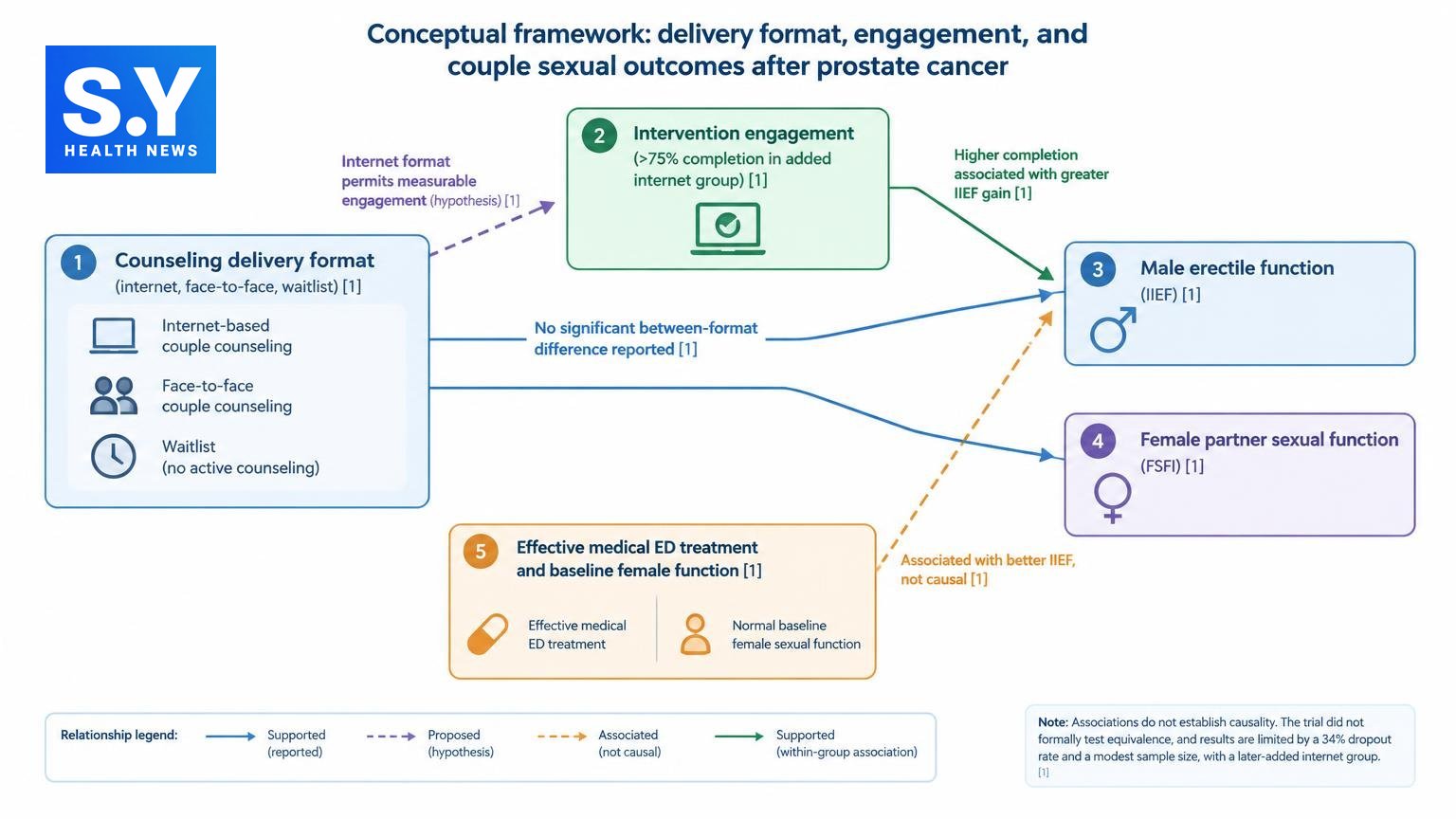
Conceptual framework: Conceptual framework of variables examined in a randomized trial of couple sexual counseling after localized prostate cancer treatment. Delivery format (internet, face-to-face, waitlist) is shown with its reported non-significant between-group differences in male and female sexual outcomes; engagement above 75% in the later-added internet group is linked to greater IIEF improvement as a within-group association; effective medical ED treatment and baseline female sexual function are shown as associated contextual factors. Edges are reading aids, not tested causal pathways, and the trial did not formally test equivalence.
Academic References & Evidence
- Leslie R. Schover; Andrea L. Canada; Ying Yuan; Dawen Sui; Leah Neese; Rosell Jenkins; Michelle M. Rhodes. A randomized trial of internet-based versus traditional sexual counseling for couples after localized prostate cancer treatment. Cancer. 2012 118(2):500-509 DOI: 10.1002/cncr.26308.
SANYUN Science Center explains published research on men's reproductive and sexual health, connecting scientific evidence with everyday questions while making sources and limitations clear.
Disclaimer: This article is for scientific education and research communication only. It does not provide medical advice, diagnosis, or individualized treatment recommendations, and does not endorse any medication, supplement, device, penile enlargement procedure, or other intervention. Decisions about sexual and reproductive health should be made in consultation with a qualified healthcare professional. Do not delay seeking professional care because of information in this article.
Original Content & Copyright Notice
- This article is prepared for SANYUN Science Center, drawing on published research and publicly available academic literature on men’s sexual and reproductive health. Its editorial explanations and presentation are developed for this platform.
- Copyright in the original editorial content, selection, and arrangement is reserved by SANYUN Science Center to the extent protected by applicable law. Referenced research, quotations, and third-party materials remain subject to the rights of their respective owners. This notice does not claim ownership of scientific facts or third-party research.
- Except where permitted by applicable law or an applicable license, prior written permission is required to reproduce, republish, translate, adapt, redistribute, or commercially reuse protected content. Attribution alone does not grant permission for such reuse.
- For permitted quotation or authorized reuse, clearly identify the source and retain a link to the original article.
- Source: SANYUN Science Center
- Original URL: Retain the original article URL on science.san-yun.com.
- Copyright Holder: SANYUN Science Center, for its own protected editorial content.
- Quotation, excerpts, or authorized reuse must not distort the scientific meaning, omit material limitations or disclaimers, or imply unverified medical claims, product efficacy, or endorsement by SANYUN Science Center.



