




Category: Reproductive Care
Core Research Direction: Maintaining gonadotropin function and spermatogenesis in hypogonadal men using intranasal testosterone (Natesto) versus conventional testosterone therapy, with an emphasis on whether a registry-based phase 4 design can support the claim of preserved spermatogenesis.
Search Intent: Can a short-acting intranasal testosterone formulation preserve pituitary gonadotropin activity and sperm production in hypogonadal men who need testosterone, and how strong is the evidence behind this claim?
Platform: SANYUN Science Center
Evidence reviewed through: 2026-11-05
Executive Summary
Conventional testosterone therapy relieves hypogonadal symptoms but suppresses the hypothalamus-pituitary-gonadal axis, and that suppression can reduce sperm production. A short-acting intranasal testosterone gel has been proposed as a way to restore near-normal serum testosterone between doses while leaving enough pituitary signalling intact to support spermatogenesis.[1][2]
The evidence behind this claim is thinner than the marketing language suggests. The headline figure is that intranasal testosterone maintained spermatogenesis in more than 95% of men at 3 and 6 months, reported as the primary outcome of a phase 4, single-site, open-label, single-arm trial of 60 men.
Separately, a completed phase 4 registry study at the University of Florida was designed to test whether intranasal testosterone could relieve hypogonadal symptoms while preserving recovery of spermatogenesis in men who had become azoospermic or severely oligospermic on conventional therapy. Its registry entry lists 13 total participants and no results.[3]
Neither design can establish that intranasal testosterone preserves fertility better than another approach. Both lack a concurrent comparator, and one has no published outcome data in the sources reviewed. The regulatory label itself still warns that exogenous androgens, including this product, may suppress spermatogenesis at large doses and states that the product is not indicated for infertility or azoospermia.
Why This Matters
Testosterone prescribing has expanded among men of reproductive age, and many of those men either want children now or may want them later. The clinical problem is genuinely awkward: the treatment that relieves fatigue, low libido and other hypogonadal symptoms is the same treatment that can shut down the signal driving sperm production.
Stopping testosterone is one option, but the background material notes that spontaneous recovery of spermatogenesis after cessation is possible yet may take months to years, and can be accompanied by new severe hypothalamic hypogonadal symptoms. That trade-off is what makes a formulation that might do both jobs simultaneously attractive.
Men facing this decision are often given confident-sounding statements about intranasal products preserving fertility. Understanding what kind of evidence sits behind those statements, and what it cannot show, is directly relevant to informed consent and to conversations with a clinician.
The Biology: Why Exogenous Testosterone Suppresses Sperm Production
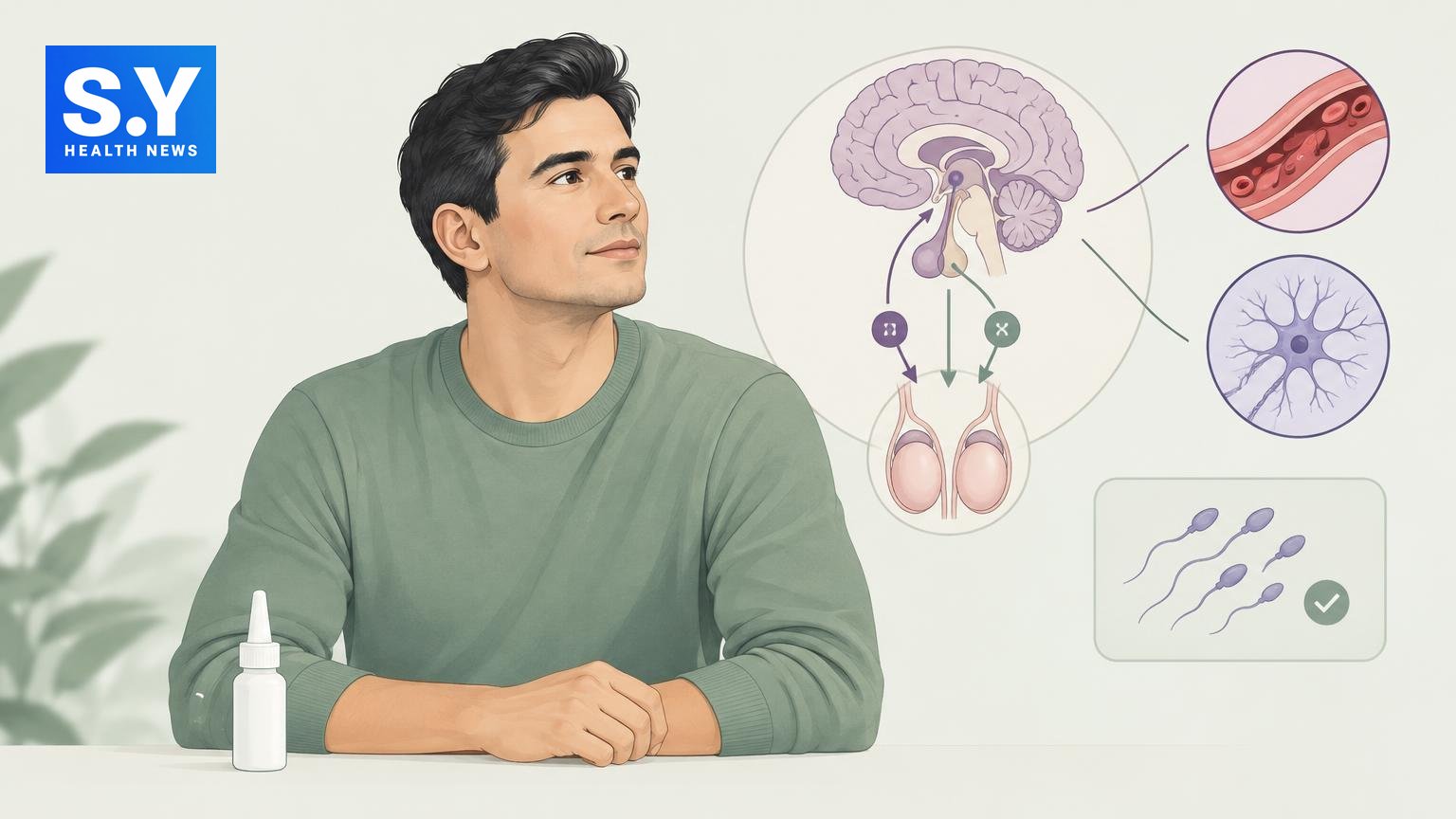
In normal physiology the hypothalamus releases gonadotropin-releasing hormone, which prompts the anterior pituitary to release luteinizing hormone and follicle-stimulating hormone. Luteinizing hormone stimulates testicular Leydig cells to produce endogenous testosterone, while follicle-stimulating hormone acts on Sertoli cells to support the differentiation and maturation of sperm.
Testosterone itself feeds back negatively on this axis, inhibiting release of gonadotropin-releasing hormone and luteinizing hormone. When exogenous testosterone is supplied steadily, the pituitary senses adequate androgen and reduces its own signalling output. Less gonadotropin support means less intratesticular testosterone production and reduced Sertoli cell stimulation, which is the pathway by which sperm output can fall.
The intranasal product is a 4.5% testosterone gel delivered by a manual pump with a nasal applicator, giving 5.5 mg of testosterone in 125 microliters per actuation. Prior pharmacokinetic summaries describe rapid absorption after a single nasal dose, with peak concentration around 60 minutes and a half-life reported between 10 and 100 minutes.
That short half-life is the mechanistic rationale. Three to four daily doses are intended to approximate the pulsatile pattern of endogenous testosterone release rather than the sustained high levels produced by longer-acting injections or topical products. In theory, trough periods allow the pituitary to retain some gonadotropin output, so the axis is suppressed less completely. This is a plausible pharmacological argument, but plausibility is not the same as demonstrated fertility benefit.
What the Evidence Shows
The published trial record in these sources consists of a phase 3 programme and a phase 4 single-arm trial. The phase 3 study was a 90-day, open-label, multicentre pivotal study; the safety assessment drew on 306 participants. At day 90, most men using the nasal product had luteinizing hormone and follicle-stimulating hormone levels within the normal reference range.
That gonadotropin finding is the strongest direct human signal in the packet for the axis-preservation hypothesis. It is a biochemical endpoint, however, and the source describes the proportion only as "most," without a specific figure. Normal-range luteinizing hormone and follicle-stimulating hormone is consistent with preserved pituitary signalling but does not by itself quantify sperm production or pregnancy outcomes.
The spermatogenesis figure comes from a different study: a phase 4, single-site, open-label, single-arm clinical trial of 60 men. In that trial, the manufacturer's healthcare-professional material reports that intranasal testosterone maintained spermatogenesis in more than 95% of men at 3 and 6 months, described as the trial's primary outcome.
The completed University of Florida registry study was designed to address a related but distinct question: whether the product can alleviate hypogonadal symptoms while preserving recovery of spermatogenesis in men with a history of testosterone therapy who had become azoospermic or severely oligospermic and were trying to establish paternity. The registry lists a prospective, non-blinded design, 13 total participants, a start date of June 1, 2022 and an estimated completion date of April 21, 2025, but reports no results.
Eligibility for that study required serum total testosterone below 350 ng/dL on two consecutive morning samples 1 to 4 weeks apart after androgen washout, together with hypogonadal symptoms and/or a sperm count below 20 million sperm per millilitre. Those criteria define who was studied, not what happened to them.
| Study or source | Design and population | Reported finding | Main limitation |
|---|---|---|---|
| Phase 3 pivotal study (as summarized by manufacturer) | 90-day, open-label, multicentre; safety assessment in 306 men | At day 90, most men had LH and FSH within normal range | Open-label, no comparator; proportion not specified in the source summary |
| Phase 4 single-arm trial (as summarized by manufacturer) | Single-site, open-label, single-arm; 60 men | Spermatogenesis maintained in more than 95% of men at 3 and 6 months | Single-arm, no concurrent control; denominator and definition of maintenance not fully described in the source |
| University of Florida registry study | Prospective, non-blinded; 13 total participants listed; men previously azoospermic or severely oligospermic on testosterone | No results reported in the registry listing; designed to test symptom relief alongside recovery of spermatogenesis | Registry listing only; small non-blinded single-arm design |
| Second registry entry | Recorded as withdrawn; early phase 1; 0 participants enrolled | No efficacy data generated | Study withdrawn, so it contributes no outcome evidence |
Interpreting the Numbers Carefully
A figure of more than 95% sounds decisive. The interpretive problem is what the denominator means and what "maintained spermatogenesis" required. The source summary of that phase 4 trial does not give the full definition, the baseline sperm characteristics, or the proportion of men who entered the trial with severely impaired semen parameters. Without those details, the percentage cannot be translated into an expected outcome for an individual patient.
The population matters as well. Men who have become azoospermic on conventional testosterone are a different group from men starting treatment for the first time. The University of Florida study was specifically designed around the harder recovery scenario, which is why its absence of reported results leaves the most clinically relevant question open.
The label language should be read alongside the promotional language. The prescribing information warns that at large doses of exogenous androgens, including this product, spermatogenesis may be suppressed through feedback inhibition of pituitary follicle-stimulating hormone, potentially affecting semen parameters including sperm count. It also states that the product is indicated only for replacement therapy in adult males with testosterone deficiency and not for infertility or azoospermia.
Those two statements are not contradictory. A class warning describes what can happen at large doses, while a short-acting formulation given at replacement doses may behave differently. But the warning is a reminder that the default expectation for exogenous androgen therapy is suppression, and that any exception needs robust demonstration rather than mechanistic storytelling.
Can a Registry-Based Phase 4 Design Support the Claim?
Registry listings are useful for mapping what was planned, who was eligible and when a study ran. They are not a substitute for results. The University of Florida entry tells us the design was prospective and non-blinded, and that 13 total participants were listed, but it contains no effect estimates, no semen outcome data and no pregnancy outcomes.
A single-arm, open-label design has specific vulnerabilities for this question. Semen parameters vary substantially within individuals over time, so some improvement after stopping conventional testosterone would be expected simply from removing the suppressive agent, regardless of what replaced it. Without a concurrent comparison group, that natural recovery cannot be separated from any drug effect.
Open-label designs also invite expectation effects on symptom reporting and on adherence, and small samples produce wide uncertainty around any proportion. A 13-participant study can suggest a signal, but it cannot provide a precise estimate of how often spermatogenesis is preserved, and it is underpowered to detect uncommon harms.
The contrast with the larger single-arm trial is instructive. That trial enrolled 60 men and still lacked a comparator; a 13-participant registry study is smaller again. Calling either design a test of preserved spermatogenesis is fair as a description of intent, but not as a demonstration of comparative effectiveness.
Safety and Tolerability Context
Safety data in the packet come mainly from the phase 3 programme and the prescribing information. Among 306 subjects who received the product at any dose across the 90-day study and its 90- and 180-day extension periods, 6 withdrew for adverse reactions, one each for nasal discomfort, headache, dysgeusia, prostate-specific antigen increase, allergic reaction, and a combined musculoskeletal and febrile reaction with petechiae.
The label also lists nasal adverse reactions including nasopharyngitis, rhinorrhoea, epistaxis, nasal discomfort and nasal scabbing, and notes that long-term nasal safety data are limited. Patients with a history of nasal disorders, nasal or sinus surgery, recent nasal fracture or sinus disease are not recommended for use because of the lack of clinical data in those groups.
Other labelled cautions include worsening of benign prostatic hyperplasia, monitoring for polycythaemia, venous thromboembolism, cardiovascular risk, gynecomastia, sleep apnoea and lipid changes. Allergy to product excipients including castor oil is a contraindication, and the registry protocol excluded men with significant sensitivity to androgens or excipients.
Research Outlook and Evidence Gaps
The central gap is a randomized or otherwise controlled comparison of intranasal testosterone against an alternative strategy, with semen analysis and pregnancy outcomes as prespecified endpoints rather than secondary observations. Until such data exist, the claim that this formulation preserves spermatogenesis is supported mainly by a single-arm trial summary and by a mechanistic rationale about short half-life and pulsatile exposure.
A second gap concerns the recovery population. Men who have become azoospermic after conventional therapy are often counselled that recovery may take months to years, and adjunctive gonadotropin-based regimens have been reported to restore sperm in the ejaculate in about 4.6 months in prior studies summarized in the withdrawn protocol. How a short-acting testosterone formulation compares with those approaches is unknown from this packet.
A third gap is outcome granularity. Sperm concentration, total motile count, morphology, DNA fragmentation and time to recovery are distinct endpoints, and a single "maintained spermatogenesis" percentage collapses them. Future reporting should state the definition, the baseline distribution and the confidence interval around any proportion.
Finally, the packet includes a second registry entry recorded as withdrawn and early phase 1, with 0 participants enrolled. Its existence illustrates how preliminary enthusiasm can precede completed evidence; it contributes nothing to the efficacy question and should not be cited as supportive data.
Key Takeaways
- Conventional testosterone suppresses the hypothalamus-pituitary-gonadal axis, reducing gonadotropin signalling and potentially sperm production; short-acting intranasal dosing is proposed to limit that suppression.
- The most cited spermatogenesis figure, more than 95% maintained at 3 and 6 months, comes from a phase 4 single-site, open-label, single-arm trial of 60 men with no concurrent comparator.
- At day 90 of a 90-day open-label multicentre phase 3 study, most men had LH and FSH within normal range; the source does not give a specific proportion, and gonadotropins are a biochemical rather than a fertility endpoint.
- A completed University of Florida phase 4 registry study of 13 listed participants was designed to test symptom relief alongside recovery of spermatogenesis in previously azoospermic or severely oligospermic men, but the registry reports no results.
- The prescribing information still warns of possible spermatogenesis suppression at large exogenous androgen doses and states the product is not indicated for infertility or azoospermia.
Questions and Answers
How does intranasal testosterone differ from conventional testosterone therapy in its effect on the HPG axis?
Conventional testosterone delivers sustained androgen exposure that suppresses gonadotropin-releasing hormone, luteinizing hormone and follicle-stimulating hormone. Intranasal testosterone has a short half-life, reported between 10 and 100 minutes with peak levels around 60 minutes, so three to four daily doses aim to mimic pulsatile release. The hypothesis is that trough periods let the pituitary retain some gonadotropin output, although preserved sperm production is not thereby proven.
What did the phase 4 trial report about intranasal testosterone maintaining spermatogenesis?
Manufacturer material reports that at 3 and 6 months, intranasal testosterone maintained spermatogenesis in more than 95% of men, described as the primary outcome of a phase 4, single-site, open-label, single-arm trial of 60 men. The source summary does not fully define "maintained spermatogenesis," give the baseline semen characteristics, or provide a concurrent control group.
How strong is the evidence that intranasal testosterone preserves sperm production?
The evidence is preliminary and largely single-arm. The headline percentage comes from an open-label trial without a comparator, and the completed University of Florida registry study lists 13 participants but reports no results. Gonadotropin data from a 90-day phase 3 study are supportive but use a biochemical endpoint described only as "most" men. No randomized fertility or pregnancy outcome data appear in these sources.
Is intranasal testosterone appropriate for men who want to father a child?
It is not approved for that purpose. The prescribing information states the product is indicated only for testosterone replacement in adult males with deficiency or absence of endogenous testosterone, not for infertility or azoospermia, and warns that large exogenous androgen doses may suppress spermatogenesis. Men seeking fertility should discuss the trade-offs with a clinician rather than assume a short-acting formulation protects sperm production.
What are the main limitations of the University of Florida Natesto spermatogenesis study?
The registry lists a prospective, non-blinded, single-arm design with 13 total participants, no reported results and no effect estimates. Without a concurrent comparator, natural recovery after stopping conventional testosterone cannot be separated from any drug effect, and the small sample cannot precisely estimate how often spermatogenesis is preserved or detect uncommon harms.
What side effects and safety concerns are associated with intranasal testosterone?
Reported nasal effects include nasopharyngitis, rhinorrhoea, epistaxis, nasal discomfort and nasal scabbing, with limited long-term nasal safety data. Among 306 subjects across the 90-day study and extensions, 6 withdrew for adverse reactions, one each for nasal discomfort, headache, dysgeusia, PSA increase, allergic reaction, and a febrile musculoskeletal reaction with petechiae. The label also cautions about polycythaemia, venous thromboembolism and cardiovascular risk.
Sources and References
- HPG Axis Function | Natesto® (testosterone) nasal gel healthcare professional website.
- The Effects of Natesto For Treatment Of Hypogonadism.
- Natesto Spermatogenesis Reboot.
SANYUN Science Center explains published research on men's reproductive and sexual health, connecting scientific evidence with everyday questions while making sources and limitations clear.
Disclaimer: This article is for scientific education and research communication only. It does not provide medical advice, diagnosis, or individualized treatment recommendations, and does not endorse any medication, supplement, device, penile enlargement procedure, or other intervention. Decisions about sexual and reproductive health should be made in consultation with a qualified healthcare professional. Do not delay seeking professional care because of information in this article.
Original Content & Copyright Notice
- This article is prepared for SANYUN Science Center, drawing on published research and publicly available academic literature on men’s sexual and reproductive health. Its editorial explanations and presentation are developed for this platform.
- Copyright in the original editorial content, selection, and arrangement is reserved by SANYUN Science Center to the extent protected by applicable law. Referenced research, quotations, and third-party materials remain subject to the rights of their respective owners. This notice does not claim ownership of scientific facts or third-party research.
- Except where permitted by applicable law or an applicable license, prior written permission is required to reproduce, republish, translate, adapt, redistribute, or commercially reuse protected content. Attribution alone does not grant permission for such reuse.
- For permitted quotation or authorized reuse, clearly identify the source and retain a link to the original article.
- Source: SANYUN Science Center
- Original URL: Retain the original article URL on science.san-yun.com.
- Copyright Holder: SANYUN Science Center, for its own protected editorial content.
- Quotation, excerpts, or authorized reuse must not distort the scientific meaning, omit material limitations or disclaimers, or imply unverified medical claims, product efficacy, or endorsement by SANYUN Science Center.



