




Category: Premature Ejaculation
Core Research Direction: Efficacy and limits of combined pharmacologic/psychosexual adjunct approaches (Jiaotai Gujing Formula plus psychosexual therapy) versus formula alone for premature ejaculation, and how these fit within contemporary ICSM consensus on definition, subtyping, and treatment of PE
Search Intent: Does adding structured psychosexual counseling to an adjunctive oral formula meaningfully prolong intravaginal ejaculatory latency time and reduce anxiety/depression in men with premature ejaculation, and what can a single 120-patient RCT actually establish?
Platform: SANYUN Science Center
Evidence reviewed through: 2026-11-13
Executive Summary
Premature ejaculation is one of the most common sexual complaints in men and is defined by consensus criteria that combine short latency, impaired control and personal or relational distress rather than by a single time threshold. Contemporary guidance divides it into lifelong, acquired, variable and subjective subtypes and lists selective serotonin reuptake inhibitors, topical anesthetics and psychotherapy among treatment options. A 2025 randomized controlled trial asked whether adding structured psychosexual counseling to an oral traditional Chinese medicine formula, Jiaotai Gujing Formula, outperforms the formula alone.[1][2]
The trial enrolled 120 men and allocated them equally to the formula plus psychosexual therapy or the formula alone. Of 110 completers, 56 were in the combined arm and 54 in the formula-only arm. Post-treatment intravaginal ejaculatory latency time was 211.11 ± 103.22 seconds in the combined group versus 174.74 ± 86.82 seconds in the formula-alone group, a statistically significant difference in favor of the combined approach. Post-treatment Hamilton Anxiety and Depression scores were also lower in the combined group, while Clinical Global Impression scores did not differ significantly between arms. No severe adverse events were reported.[3]
These findings are promising but preliminary. The trial is small and single-country, reports completer outcomes rather than an intention-to-treat analysis, does not describe baseline latency or the duration of treatment in the available summary, and measured anxiety and depression partly through the same counseling program being tested. The absolute latency difference is modest in clinical terms, and both post-treatment averages remain below the roughly one-minute threshold often associated with lifelong PE. The result supports further study of combined pharmacological and psychosexual strategies rather than a confident claim of superiority.
Why This Matters
Premature ejaculation carries a substantial burden on quality of life and relationships, and men often seek help only after considerable delay. The consensus framing emphasizes distress and control alongside timing, which means a treatment that only adds a few seconds without improving confidence or reducing anxiety may not deliver what patients actually value. That is why trials pairing a pharmacological or herbal intervention with structured counseling are conceptually attractive: they target both the timing complaint and the psychological distress that frequently accompanies it.
The trial authors also note that selective serotonin reuptake inhibitors are commonly used first-line treatments but carry adverse effects and limited efficacy, which motivates alternative and adjunctive approaches. That framing is a rationale, not a quantitative comparison, and it should be read as the investigators' motivation rather than proof that the tested formula is safer or more effective than established drugs.
How Premature Ejaculation Is Defined and Subtyped
The Fifth International Consultation on Sexual Medicine produced evidence-based recommendations on the definition, classification and treatment of premature and delayed ejaculation, synthesizing evidence on etiology, epidemiology, evaluation and management. The consensus process used a modified Delphi method and the GRADE system. Its definitional criteria incorporate time, distress and control, which reflects the clinical reality that a man who ejaculates quickly but is neither bothered nor impaired does not necessarily meet the threshold for a diagnosis.
The consensus describes four subtypes: lifelong, acquired, variable and subjective. Lifelong and acquired forms differ mainly in whether the problem has been present since sexual debut or developed after a period of satisfactory function. The variable form occurs inconsistently, and the subjective form involves distress about perceived rapid ejaculation without consistently short latency. Treatment recommendations include selective serotonin reuptake inhibitors, topical anesthetics and psychotherapy. The trial under review does not report how its participants were distributed across these subtypes, which limits how precisely its results can be mapped onto the consensus framework.
The consensus also notes that delayed ejaculation is comparatively understudied with limited treatment options, and it calls for more evidence-based treatment research overall. That broader context matters: premature ejaculation has a far larger evidence base than delayed ejaculation, yet even here many trials are small and short, so incremental studies such as this one should be interpreted as steps in an evolving literature rather than definitive answers.
The Biological and Psychological Rationale
Support for Jiaotai Gujing Formula before this trial is described by the authors as preclinical, meaning laboratory or animal work rather than demonstrated human efficacy. Preclinical promise is a starting point, not proof: many compounds that look active in early models fail to show clinically meaningful effects in randomized human trials, and the supplied summary does not specify which preclinical models were used or what outcomes they measured.
The psychosexual component is more straightforwardly grounded in clinical practice. In this trial it consisted of structured counseling plus assessments of anxiety and depression. Sexual anxiety and negative sexual cognitions are plausible maintaining factors in premature ejaculation, and psychotherapy is a recognized treatment category in consensus guidance. However, the number and frequency of counseling sessions are not specified in the available summary, so the dose of the psychological intervention cannot be compared with other programs.
There is an important overlap to keep in mind: the intervention being tested includes anxiety and depression assessments, and the trial's secondary outcomes are anxiety and depression scores. When the active intervention contains measurement and contact that the control arm lacks, some of the between-group difference in those scores may reflect attention, monitoring or expectation rather than a specific therapeutic effect of counseling. This is a design limitation, not a dismissal of the finding.
What the Evidence Shows
The trial randomized 120 men with premature ejaculation, split equally between the combined arm and the formula-alone arm. A total of 110 men completed, 56 in the combined group and 54 in the control group. That completer count is what the reported outcome analyses appear to rest on, and the available summary does not describe an intention-to-treat analysis, so the results should be understood as completer outcomes.[4]
Intravaginal ejaculatory latency time increased significantly in both arms, reaching 211.11 ± 103.22 seconds with combined therapy and 174.74 ± 86.82 seconds with the formula alone, with a statistically significant advantage for the combined group. The large standard deviations indicate considerable overlap between the arms: many men in the formula-alone group likely did better than some men in the combined group. A statistically significant mean difference of roughly half a minute is not the same as a clinically meaningful difference for an individual couple, and the summary does not report baseline latency, so the change from baseline cannot be calculated from the available text.
Anxiety and depression scores followed a similar pattern. Post-treatment Hamilton Anxiety scores were 7.70 ± 3.25 in the combined group versus 9.89 ± 3.94 in the formula-alone group, and Hamilton Depression scores were 6.45 ± 1.92 versus 8.59 ± 4.47, both statistically significant. Without baseline values, it is not possible to tell how much of this reflects improvement versus pre-existing group differences. Both sets of post-treatment scores fall in ranges generally considered mild, which is reassuring but also means the clinical margin between groups is narrow.
Chinese Medicine Symptom Score decreased significantly from baseline in both groups, but the two groups did not differ significantly on Clinical Global Impression scores. That null global-impression finding is important because it tempers the overall positive framing: a clinician-rated global measure did not separate the arms, even though latency and mood scales did. Safety was described as favorable, with no severe adverse events reported, though the summary does not describe how adverse events were ascertained or for how long.
| Outcome | Combined therapy | Formula alone | Reported difference |
|---|---|---|---|
| Post-treatment IELT | 211.11 ± 103.22 seconds | 174.74 ± 86.82 seconds | Significant, favoring combined (p < 0.05) |
| Post-treatment HAM-A | 7.70 ± 3.25 | 9.89 ± 3.94 | Significant, favoring combined (p < 0.05) |
| Post-treatment HAM-D | 6.45 ± 1.92 | 8.59 ± 4.47 | Significant, favoring combined (p < 0.05) |
| CMSS | Lower than baseline | Lower than baseline | Within-group improvement in both arms |
| CGI | Reported | Reported | No significant between-group difference |
| Severe adverse events | None reported | None reported | Favorable safety profile described |
Interpreting the Numbers Carefully
The most common error in reading trials like this is to treat statistical significance as proof of clinical importance. A p value below 0.05 indicates that the observed difference is unlikely under a no-difference assumption; it says nothing about whether couples would notice or value the difference. With roughly half a minute of mean latency separating the arms and wide standard deviations, the practical benefit for an individual man is uncertain. The trial also does not report whether the improvement crossed a threshold that patients or partners would recognize as satisfactory.
A second interpretive issue is the choice of comparator. The control arm received the formula alone, not placebo, so the trial cannot isolate how much of either arm's improvement came from the formula, from counseling, or from nonspecific effects such as time, attention and expectancy. A placebo-controlled or counseling-alone arm would be needed to partition those contributions. This design answers a narrow question, whether adding counseling to the formula helps, and even that answer is provisional given the sample size.
Finally, the absence of baseline values in the available summary is a real limitation for interpretation. The authors describe latency as increased in both groups and anxiety and depression as decreased more markedly with combined therapy, which implies within-group change, but without baseline means and standard deviations the reader cannot judge effect size or the magnitude of regression to the mean. The CJI null result also suggests that global clinician impression may not have tracked the scale-level improvements.
Limitations of a Single 120-Patient Trial
Sample size is the central constraint. With 110 completers split roughly evenly, the trial is powered to detect moderate between-group differences on continuous scales but not to detect small differences, rare adverse events or subgroup effects by PE subtype. A trial of this size can generate a hypothesis that combined therapy is superior, but it cannot establish that superiority robustly across populations. The absence of severe adverse events in 110 completers is reassuring but far from a comprehensive safety database.
The supplied summary does not describe the randomization method, allocation concealment or blinding, so the risk of selection and performance bias cannot be assessed. Blinding is inherently difficult when one arm includes counseling, since participants know whether they are receiving it, and that awareness can inflate self-reported outcomes such as anxiety scores. The absence of an intention-to-treat analysis also means that dropout, which affected 10 of 120 enrolled men, is not reflected in the reported comparisons.
Generalizability is another boundary. The trial was conducted in China with a traditional Chinese medicine formula whose composition, standardization and regulatory status are not described in the available summary, so clinicians elsewhere cannot readily replicate the intervention. The trial also does not report how participants were distributed across lifelong, acquired, variable and subjective subtypes, which matters because these subtypes may respond differently to combined therapy. The findings therefore speak to a specific formula-plus-counseling package in a specific setting, not to psychosexual therapy in general.
Where This Fits in Contemporary Consensus
The ICSM consensus lists psychotherapy alongside selective serotonin reuptake inhibitors and topical anesthetics as treatment options for premature ejaculation, and it emphasizes individualized treatment informed by pathophysiology. The trial is consistent with that framework insofar as it tests an integrated approach rather than a single modality. It does not, however, test the consensus-recommended pharmacological standards head to head, so it cannot displace selective serotonin reuptake inhibitors or topical anesthetics from their evidence-based positions.
The consensus acknowledges that evidence for treatment of ejaculatory disorders remains incomplete and calls for more rigorous research, particularly for delayed ejaculation. For premature ejaculation, the priority is not simply more trials but better trials: placebo or active comparators, blinded outcome assessment where feasible, intention-to-treat analysis, prespecified subtypes and validated patient-reported outcomes that capture distress and control rather than latency alone. A single 120-patient study with a completer analysis is a contribution to that literature, not a conclusion.
Research Outlook
Several specific questions follow from this trial. Does the combination outperform the formula alone when both arms receive equivalent attention and monitoring? Does the benefit persist beyond the treatment period, and does it translate into higher satisfaction for partners as well as men? Are effects concentrated in particular subtypes, such as acquired or subjective PE, where anxiety and relational factors may be more prominent? And how does the formula compare with established first-line options in both efficacy and tolerability?
The field would also benefit from harmonized outcome reporting. The consensus definition rests on time, distress and control, yet many trials report latency as the dominant endpoint. Future studies that pair latency with validated measures of control, distress and relationship satisfaction would align better with what the consensus considers clinically meaningful, and would make small trials more interpretable and easier to pool. Until such evidence accumulates, the appropriate clinical reading is cautious: combined pharmacological and psychosexual strategies are plausible and worth discussing, but this trial does not prove that one formula-plus-counseling package is superior to established care.
Key Takeaways
- A 2025 randomized trial of 120 men with premature ejaculation found that adding structured psychosexual therapy to Jiaotai Gujing Formula was associated with longer post-treatment intravaginal ejaculatory latency and lower anxiety and depression scores than the formula alone.
- Reported post-treatment latency was 211.11 ± 103.22 seconds with combined therapy versus 174.74 ± 86.82 seconds with the formula alone; the difference was statistically significant but modest in absolute terms.
- Post-treatment Hamilton Anxiety scores were 7.70 ± 3.25 versus 9.89 ± 3.94 and Hamilton Depression scores were 6.45 ± 1.92 versus 8.59 ± 4.47, both favoring the combined group, though baseline values were not reported in the available summary.
- Clinical Global Impression scores did not differ significantly between groups, and no severe adverse events were reported.
- The trial is small, reports completer outcomes, and does not isolate the effects of counseling from attention or expectancy, so it supports further research rather than a firm claim of superiority over established treatments.
- ICSM consensus defines premature ejaculation using time, distress and control criteria and subdivides it into lifelong, acquired, variable and subjective forms, with SSRIs, topical anesthetics and psychotherapy among the recommended options.
Questions and Answers
What is premature ejaculation and how does the ICSM consensus define it?
Premature ejaculation is one of the most common male sexual complaints. The ICSM consensus defines it using time, distress and control criteria rather than a single latency cutoff, and classifies it into lifelong, acquired, variable and subjective subtypes. Recommended treatment options include SSRIs, topical anesthetics and psychotherapy, with individualized care favored.
Did adding psychosexual therapy to Jiaotai Gujing Formula improve intravaginal ejaculatory latency time?
In a 120-patient randomized trial, post-treatment intravaginal ejaculatory latency time was 211.11 ± 103.22 seconds with combined therapy versus 174.74 ± 86.82 seconds with the formula alone, a statistically significant difference. The half-minute mean gap is modest clinically, standard deviations were wide, and baseline latency was not reported in the available summary.
How strong is the evidence that Jiaotai Gujing Formula plus counseling reduces anxiety and depression in premature ejaculation?
Post-treatment Hamilton Anxiety and Depression scores were significantly lower with combined therapy than with the formula alone, but the trial is small and reports completer outcomes. Because the counseling program itself included anxiety and depression assessments, some of the difference may reflect attention or monitoring rather than a specific treatment effect, and baseline values were not provided.
Who might the combined Jiaotai Gujing Formula and psychosexual therapy approach apply to?
The trial enrolled men with premature ejaculation in China, but did not report how they were distributed across lifelong, acquired, variable and subjective subtypes. Applicability to other populations and to men with specific subtypes is therefore uncertain. The formula's composition and standardization are also not described in the available summary, limiting replication elsewhere.
What are the main limitations of the premature ejaculation trial?
Key limitations include the small sample of 110 completers, a per-protocol-like completer analysis rather than intention-to-treat, and no description of randomization or blinding in the available summary. The control arm received the formula alone rather than placebo, so the trial cannot separate formula effects from counseling or nonspecific effects, and Clinical Global Impression scores showed no significant between-group difference.
Does this trial mean Jiaotai Gujing Formula should replace standard premature ejaculation treatments?
No. The trial did not compare the formula with SSRIs, topical anesthetics or psychotherapy alone, and the authors' support for the formula before this study was preclinical. ICSM guidance continues to list SSRIs, topical anesthetics and psychotherapy as treatment options. The trial supports further research into combined pharmacological and psychosexual strategies rather than replacing established care.
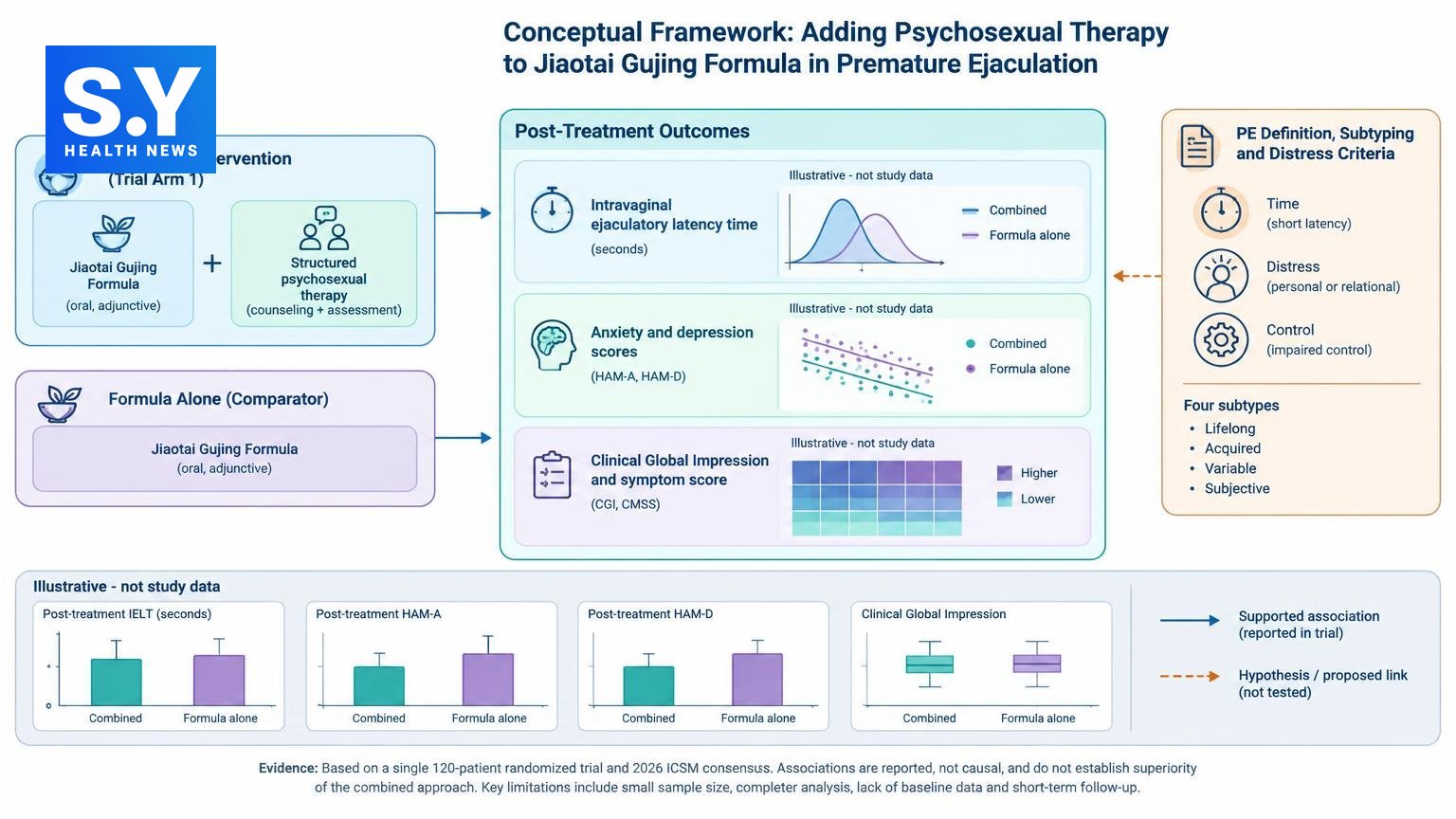
Conceptual framework: Conceptual framework of the trial's studied variables: combined Jiaotai Gujing Formula and structured psychosexual therapy versus formula alone, with post-treatment ejaculatory latency, anxiety and depression scores, and global impression as outcomes. Arrows reflect reported associations in one small randomized trial; the consensus definition node is a proposed framing of outcome choice, not a tested causal pathway.
Academic References & Evidence
- Contemporary consensus and emerging directions in premature and delayed ejaculation: recommendations from the 5th International Consultation on Sexual Medicine.. Sexual medicine reviews PMID: 42855438.
- 2026 ICSM专家共识:早泄和延迟射精的当代共识与新兴方向. Sex Med Rev. 2026 14(4)
- Di Sun; Yaowu Wang; Shuhong Wang; Guanchao Du; Wenxiao Yu; Jun Guo; Fan Zhao. Efficacy of Jiaotai Gujing Formula combined with psychosexual therapy for premature ejaculation: a randomized controlled trial. Journal of Men's Health. 2025 21(10):20-26 DOI: 10.22514/jomh.2025.123.
- Sun, D.; Wang, Y.; Wang, S.; Du, G.; Yu, W.; Guo, J.; Zhao, F.. Efficacy of Jiaotai Gujing Formula combined with psychosexual therapy for premature ejaculation: a randomized controlled trial. Journal of Men's Health. 2025 21(10):20-26 DOI: 10.22514/jomh.2025.123.
SANYUN Science Center explains published research on men's reproductive and sexual health, connecting scientific evidence with everyday questions while making sources and limitations clear.
Disclaimer: This article is for scientific education and research communication only. It does not provide medical advice, diagnosis, or individualized treatment recommendations, and does not endorse any medication, supplement, device, penile enlargement procedure, or other intervention. Decisions about sexual and reproductive health should be made in consultation with a qualified healthcare professional. Do not delay seeking professional care because of information in this article.
Original Content & Copyright Notice
- This article is prepared for SANYUN Science Center, drawing on published research and publicly available academic literature on men’s sexual and reproductive health. Its editorial explanations and presentation are developed for this platform.
- Copyright in the original editorial content, selection, and arrangement is reserved by SANYUN Science Center to the extent protected by applicable law. Referenced research, quotations, and third-party materials remain subject to the rights of their respective owners. This notice does not claim ownership of scientific facts or third-party research.
- Except where permitted by applicable law or an applicable license, prior written permission is required to reproduce, republish, translate, adapt, redistribute, or commercially reuse protected content. Attribution alone does not grant permission for such reuse.
- For permitted quotation or authorized reuse, clearly identify the source and retain a link to the original article.
- Source: SANYUN Science Center
- Original URL: Retain the original article URL on science.san-yun.com.
- Copyright Holder: SANYUN Science Center, for its own protected editorial content.
- Quotation, excerpts, or authorized reuse must not distort the scientific meaning, omit material limitations or disclaimers, or imply unverified medical claims, product efficacy, or endorsement by SANYUN Science Center.



