




Category: Clinical Insights
Core Research Direction: Using baseline LH alongside total testosterone to classify hypogonadism burden in men with cardiometabolic abnormalities, and how such classification frames secondary vs primary hypogonadism
Search Intent: In men with cardiometabolic abnormalities, does adding LH to total testosterone reveal whether low testosterone reflects a central (secondary) or testicular (primary) defect, and how strong is the association between cardiometabolic burden and secondary hypogonadism?
Platform: SANYUN Science Center
Evidence reviewed through: 2026-11-22
Executive Summary
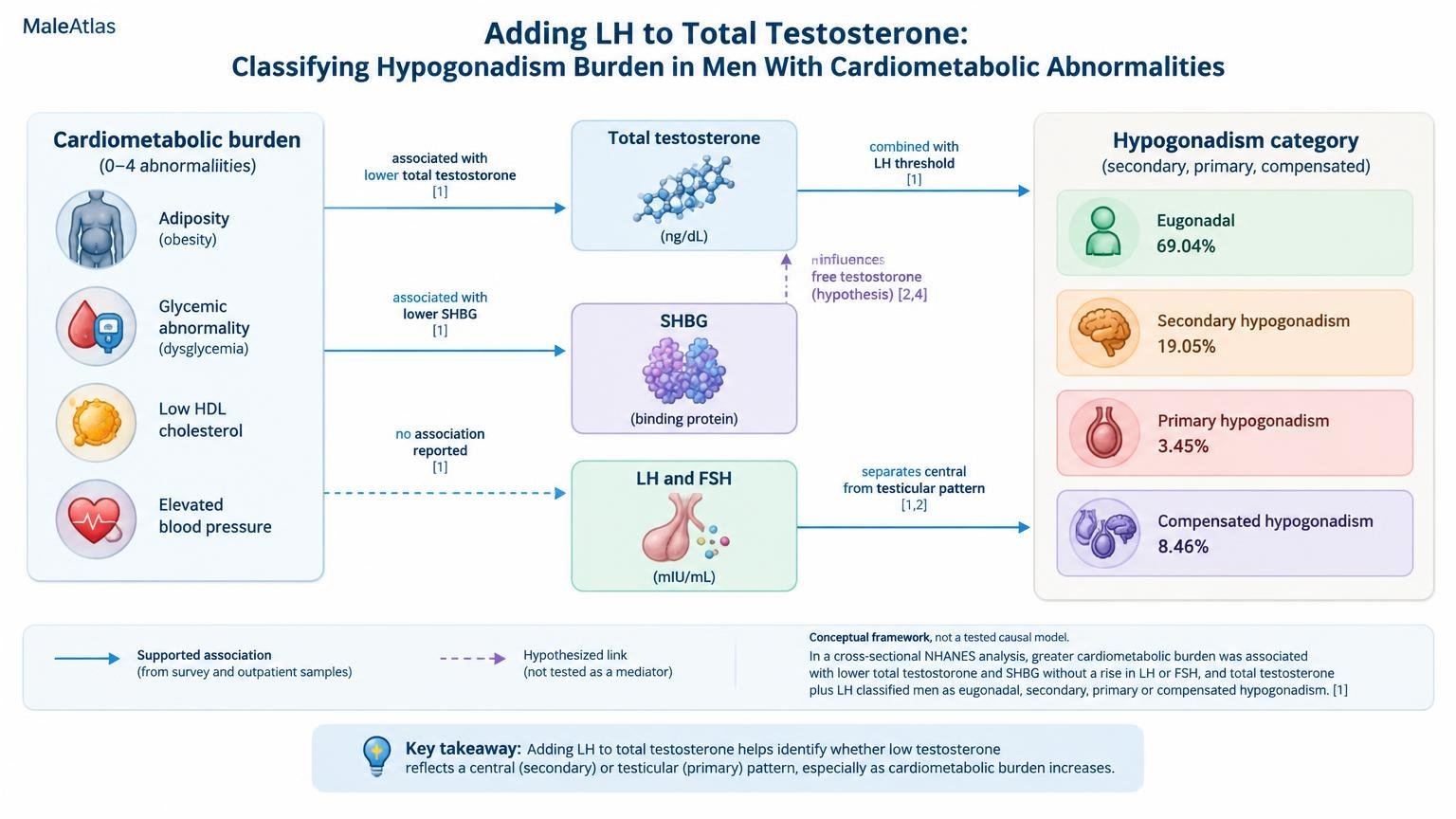
Men with cardiometabolic abnormalities frequently have low total testosterone, but a testosterone value alone cannot show whether the testes are failing or the hypothalamic-pituitary signal is inadequate. A 2026 cross-sectional analysis addressed this gap by measuring total testosterone, sex hormone-binding globulin, luteinizing hormone and follicle-stimulating hormone in 2,390 US men aged 20 years or older from the National Health and Nutrition Examination Survey between August 2021 and August 2023, then classifying them by total testosterone and LH thresholds.[1]
In weighted estimates, 69.04% of men were eugonadal, 19.05% had secondary hypogonadism, 3.45% had primary hypogonadism and 8.46% had compensated hypogonadism. Each additional cardiometabolic abnormality was associated with 11.82% lower total testosterone and 12.71% lower SHBG, while LH and FSH were not associated with the number of abnormalities. The odds of secondary hypogonadism rose with each additional abnormality (OR 1.96), and the weighted proportion reached 34.25% in men with three or more abnormalities.
A separate retrospective Chinese andrology outpatient sample of 767 men showed a directionally consistent pattern: each additional documented condition among diabetes and hypertension was associated with 8.04% lower total testosterone and higher odds of secondary hypogonadism (OR 1.55), but not with LH. The findings support using LH alongside total testosterone to frame whether low testosterone looks central or testicular, but the cross-sectional design cannot prove that cardiometabolic burden causes secondary hypogonadism.
Why This Matters
Low total testosterone is common in men with obesity, dysglycemia, low HDL cholesterol and elevated blood pressure, and these abnormalities often coexist. Clinical guidelines recommend measuring LH and FSH in men with confirmed hypogonadism to distinguish primary from secondary hypogonadism, yet the supplied analysis reports that only 12% of men starting testosterone therapy had LH or FSH measured beforehand. That gap matters because the category of hypogonadism changes the clinical conversation: a central pattern raises questions about reversible metabolic, medication, sleep or pituitary contributors, while an elevated LH pattern points toward testicular dysfunction.[2]
The practical question is not simply whether testosterone is low, but at which level of the hypothalamic-pituitary-gonadal axis the deficit arises. Patient-education sources describe the same logic: high LH with low testosterone suggests primary hypogonadism, whereas low or non-elevated LH with low testosterone suggests secondary hypogonadism. The 2026 analysis tests how often that central pattern appears as cardiometabolic burden accumulates.[3]
Biological and Clinical Mechanism
LH from the pituitary stimulates Leydig cells to produce testosterone. When testicular function fails, testosterone falls and the pituitary normally increases LH, producing the high-LH, low-testosterone pattern of primary hypogonadism. When hypothalamic or pituitary signaling is inadequate, both testosterone and LH remain low or inappropriately normal, the pattern of secondary hypogonadism. Compensated hypogonadism describes normal testosterone maintained by elevated LH.
SHBG adds another layer because it binds testosterone and influences the free fraction. The education sources note that high SHBG can leave total testosterone looking normal while free testosterone is low, and that low SHBG is often seen with obesity and insulin resistance. In the 2026 analysis, SHBG fell as cardiometabolic burden rose, which is consistent with the expected metabolic direction but also means total testosterone and free testosterone may tell different stories.[4]
The source article describes obesity-related secondary hypogonadism as reversible with substantial weight loss and links visceral adiposity and insulin resistance to the central pattern. Those statements are background mechanism claims rather than results of the new cross-sectional analysis, and the supplied text does not include the underlying trial data. They frame a plausible pathway in which metabolic dysfunction suppresses the central signal, but they do not establish that pathway in this dataset.
What the Evidence Shows
The analysis classified 2,390 men using a total testosterone threshold of 300 ng/dL and an LH threshold of 9.4 mIU/mL. The weighted distribution was heavily eugonadal, with secondary hypogonadism about five times more common than primary hypogonadism and compensated hypogonadism intermediate. These proportions are descriptive of the survey cycle and depend on the chosen thresholds and single measurements.
| Measure | Reported finding | What it suggests | Key limitation |
|---|---|---|---|
| Weighted hypogonadism categories in NHANES | 69.04% eugonadal, 19.05% secondary, 3.45% primary, 8.46% compensated | Secondary pattern dominates among men with low testosterone in this survey cycle | Single testosterone and LH measurements used for epidemiologic classification |
| Total testosterone per additional cardiometabolic abnormality | 11.82% lower (95% CI 9.24–14.33%) | More abnormalities track with lower total testosterone | Observational association, not causal |
| SHBG per additional cardiometabolic abnormality | 12.71% lower (95% CI 11.10–14.29%) | Metabolic burden tracks with lower binding protein | Does not directly measure free testosterone in the main model |
| LH and FSH per additional abnormality | No association reported | The fall in testosterone was not accompanied by a rise in gonadotropins | Null findings do not exclude subtle axis changes |
| Odds of secondary hypogonadism per additional abnormality | OR 1.96 (95% CI 1.67–2.29) | Higher cardiometabolic burden tracks with the central pattern | Cross-sectional odds ratio cannot establish temporal order |
| Secondary hypogonadism proportion with three or more abnormalities | 34.25% weighted | Burden accumulation identifies a higher-frequency group | Survey-weighted estimate from a single cycle |
| Chinese andrology outpatient sample | Each additional documented condition: 8.04% lower total testosterone (95% CI 3.25–12.59%); OR 1.55 (95% CI 1.08–2.22) for secondary hypogonadism; no LH association | Directionally consistent signal in a clinical sample | Retrospective records; burden limited to diabetes and hypertension |
The independent clinical sample adds a second setting, but it is not a replication with the same exposure definition. In that sample, cardiometabolic burden meant the number of documented conditions among diabetes and hypertension, ranging from 0 to 2, rather than the four-component count used in the survey. The direction was similar, with lower total testosterone and higher odds of secondary hypogonadism per additional condition and no association with LH, but the confidence interval for the odds ratio was wide and the record-based design introduces different sources of error.
Interpretation and Limitations
The central interpretation is that cardiometabolic burden appears to lower total testosterone without the compensatory LH rise expected in primary testicular failure. That pattern pushes the classification toward secondary hypogonadism and away from primary hypogonadism. Because LH did not rise with burden, the data do not suggest that cardiometabolic abnormalities are primarily injuring the testes in this sample; they suggest a central or combined picture.
Several limitations temper that interpretation. The survey analysis is cross-sectional, so reverse causation and confounding by unmeasured factors remain possible. Classification relied on a single total testosterone and LH measurement, whereas clinical diagnosis generally requires confirmatory morning testing with symptoms. The principal analyses were not adjusted for multiple comparisons, and the thresholds are epidemiologic conventions rather than individual diagnoses. The outpatient sample was retrospective, used a narrower burden definition and had a wide confidence interval for its odds ratio.
The education sources add practical cautions that the analysis itself does not test. Morning sampling between 7:00 AM and 10:00 AM is recommended for accuracy, and separate morning tests are described as necessary to confirm a low testosterone diagnosis. Prolactin is relevant because marked elevation can indicate a pituitary lesion such as a prolactinoma, and pituitary imaging is described as indicated only when secondary hypogonadism is confirmed with high prolactin or severe testosterone suppression, often below 5.2 nmol/L. These are clinical evaluation steps, not findings of the cardiometabolic analysis.
Free testosterone and SHBG complicate any total-testosterone classification. A man with high SHBG may have normal total testosterone but low free testosterone, and a man with low SHBG may have a total value that overstates or understates the free fraction depending on context. The 2026 analysis measured SHBG and calculated free testosterone in exploratory analyses, but the main classification used total testosterone, so the categories should be read as a research framework rather than a complete clinical assessment.
Research and Clinical Outlook
The most useful next step is longitudinal measurement. Cohort studies that track testosterone, LH and cardiometabolic components over time could clarify whether accumulating abnormalities precede the central pattern, whether weight loss or glycemic improvement restores LH signaling, and whether the classification predicts symptoms or treatment response. The current analysis can generate those hypotheses but cannot answer them.
For clinical reading, the analysis supports a simple discipline: when total testosterone is low in a man with several cardiometabolic abnormalities, adding LH helps frame whether the pattern is central or testicular. That framing should trigger appropriate confirmatory testing and a search for reversible contributors rather than an immediate assumption about treatment. Fertility intentions also matter, because the education sources note that secondary hypogonadism in a man wishing to preserve fertility may warrant alternatives to exogenous testosterone, which suppresses LH and FSH further.
Key Takeaways
- In a 2026 cross-sectional analysis, higher cardiometabolic burden was associated with lower total testosterone and lower SHBG without a rise in LH or FSH.
- Secondary hypogonadism became progressively more common with accumulating abnormalities, reaching a weighted proportion of 34.25% in men with three or more abnormalities.
- A directionally consistent pattern appeared in an independent Chinese andrology outpatient sample, but the design was retrospective and the burden definition narrower.
- The findings support using LH alongside total testosterone to distinguish central from testicular patterns, not to diagnose or treat an individual man.
- Cross-sectional associations cannot establish causation, and confirmatory morning testing, symptom assessment and evaluation for reversible causes remain necessary.
Questions and Answers
Why measure LH alongside total testosterone when evaluating hypogonadism in men with cardiometabolic abnormalities?
Total testosterone shows that testosterone is low but not whether the testes or the hypothalamic-pituitary signal is responsible. LH clarifies the pattern: low testosterone with elevated LH suggests primary testicular failure, while low testosterone with low or non-elevated LH suggests secondary hypogonadism. In the 2026 analysis, cardiometabolic burden was associated with lower testosterone without a corresponding LH rise, pointing toward the secondary pattern.
What did the 2026 cardiometabolic burden and secondary hypogonadism analysis find?
In 2,390 US men from NHANES 2021–2023, each additional cardiometabolic abnormality was associated with 11.82% lower total testosterone and 12.71% lower SHBG, without an LH or FSH association. The odds of secondary hypogonadism rose with each abnormality (OR 1.96), and 34.25% of men with three or more abnormalities had the secondary pattern. A Chinese outpatient sample showed a directionally similar signal.
How strong is the evidence that cardiometabolic abnormalities cause secondary hypogonadism?
The evidence is cross-sectional and observational, so it shows association rather than causation. The survey analysis used single testosterone and LH measurements for classification, and the outpatient sample was retrospective with a narrower burden definition. Reverse causation and unmeasured confounding remain possible. The findings are consistent with a central pattern and useful for generating hypotheses, but they do not prove that cardiometabolic burden causes secondary hypogonadism.
Does the LH-based classification apply to an individual man with obesity, diabetes and low testosterone?
The classification was developed for epidemiologic grouping, not individual diagnosis. A clinician would still confirm low testosterone with repeat morning testing and symptoms, measure SHBG and consider free testosterone, and look for reversible causes such as obesity, sleep apnea, medications or hyperprolactinemia. LH helps frame whether the pattern is central or testicular, but it does not by itself establish a diagnosis or determine treatment.
What are the limitations of using total testosterone and LH thresholds to classify hypogonadism?
Thresholds such as 300 ng/dL for total testosterone and 9.4 mIU/mL for LH are conventions applied to single measurements. They do not capture free testosterone, symptoms, diurnal variation or confirmatory testing. SHBG changes with metabolic health, so total testosterone may misrepresent the free fraction. The principal analyses were also not adjusted for multiple comparisons, and the study cannot establish temporal order.
Why does the distinction between primary and secondary hypogonadism matter for fertility and treatment discussions?
The category changes the clinical conversation. Primary hypogonadism points toward testicular dysfunction, while secondary hypogonadism raises questions about central signaling and reversible metabolic or pituitary contributors. In men wishing to preserve fertility, education sources note that secondary hypogonadism may warrant alternatives to exogenous testosterone because testosterone suppresses LH and FSH further. These are general considerations requiring individualized clinical assessment.
Conceptual framework: Conceptual framework, not a tested causal model. In a cross-sectional NHANES analysis, greater cardiometabolic burden was associated with lower total testosterone and SHBG without a rise in LH or FSH, and total testosterone plus LH classified men as eugonadal, secondary, primary or compensated hypogonadism. Supported arrows reflect reported associations; the SHBG-to-testosterone link is proposed and not tested as a mediator in this analysis.
Academic References & Evidence
- Frontiers | Association between cardiometabolic burden and secondary hypogonadism in men: a cross-sectional analysis of a US national survey and a Chinese andrology outpatient sample. Front. Endocrinol.. 2026 DOI: 10.3389/fendo.2026.2023881.
- Harry Whitmore; Stefan Petrov. Essential Blood Tests for Hypogonadism | LH, FSH, and SHBG 2026.
- Low Testosterone Symptoms in Men: What Labs Show (2026).
- Harry Whitmore; Stefan Petrov. Diagnosing Low Testosterone | Blood Test Guide and Protocols 2026.
SANYUN Science Center explains published research on men's reproductive and sexual health, connecting scientific evidence with everyday questions while making sources and limitations clear.
Disclaimer: This article is for scientific education and research communication only. It does not provide medical advice, diagnosis, or individualized treatment recommendations, and does not endorse any medication, supplement, device, penile enlargement procedure, or other intervention. Decisions about sexual and reproductive health should be made in consultation with a qualified healthcare professional. Do not delay seeking professional care because of information in this article.
Original Content & Copyright Notice
- This article is prepared for SANYUN Science Center, drawing on published research and publicly available academic literature on men’s sexual and reproductive health. Its editorial explanations and presentation are developed for this platform.
- Copyright in the original editorial content, selection, and arrangement is reserved by SANYUN Science Center to the extent protected by applicable law. Referenced research, quotations, and third-party materials remain subject to the rights of their respective owners. This notice does not claim ownership of scientific facts or third-party research.
- Except where permitted by applicable law or an applicable license, prior written permission is required to reproduce, republish, translate, adapt, redistribute, or commercially reuse protected content. Attribution alone does not grant permission for such reuse.
- For permitted quotation or authorized reuse, clearly identify the source and retain a link to the original article.
- Source: SANYUN Science Center
- Original URL: Retain the original article URL on science.san-yun.com.
- Copyright Holder: SANYUN Science Center, for its own protected editorial content.
- Quotation, excerpts, or authorized reuse must not distort the scientific meaning, omit material limitations or disclaimers, or imply unverified medical claims, product efficacy, or endorsement by SANYUN Science Center.



