




Category: Penis Enlargement
Core Research Direction: Regulatory assessment of unsubstantiated 'permanent penis enlargement' marketing claims for a supplement (Libido 7) and the absence of recognized scientific evidence for them
Search Intent: What evidence did a Dutch advertising-ruling body find for claims that a supplement permanently enlarges the penis, and what was the outcome?
Platform: SANYUN Science Center
Evidence reviewed through: 2026-11-07
Executive Summary
A Dutch advertising ruling examined marketing for a supplement called Libido 7 that promised permanent penis enlargement, a harder and longer-lasting erection, and better sex. The complaint challenged whether any evidence supported the enlargement claim, and the advertising committee concluded that no recent recognized scientific research on the product or its ingredients had been shown. It judged the advertising misleading and unfair under the Dutch Advertising Code and advised the advertiser to stop advertising in that manner.[1]
The case is a regulatory assessment of advertising, not a clinical trial or systematic review. It documents an evidentiary failure for specific claims: the advertiser relied on personal experience and a proposed blood-flow mechanism rather than recognized published research. Understanding this distinction helps readers interpret similar supplement marketing without treating one ruling as either proof of efficacy or proof of universal ineffectiveness.
Why This Matters
Men looking for information about penis size encounter a crowded market of supplements, devices and creams promising permanent change. The appeal of a product that promises enlargement without surgery is obvious, and marketing often borrows scientific-sounding language about blood flow, hormones and herbal ingredients. Regulatory decisions are one way that such claims are tested: an advertiser must be able to substantiate what it says about expected results, not merely assert it.
The value of this ruling is that it shows what happened when an evidentiary standard was applied to a specific enlargement claim. The committee did not conduct clinical research; it assessed whether the advertiser had provided adequate support for the advertised effect. That makes the ruling useful as a case study in claim substantiation, while leaving open the broader clinical questions that it could not answer.
The Claims Under Review
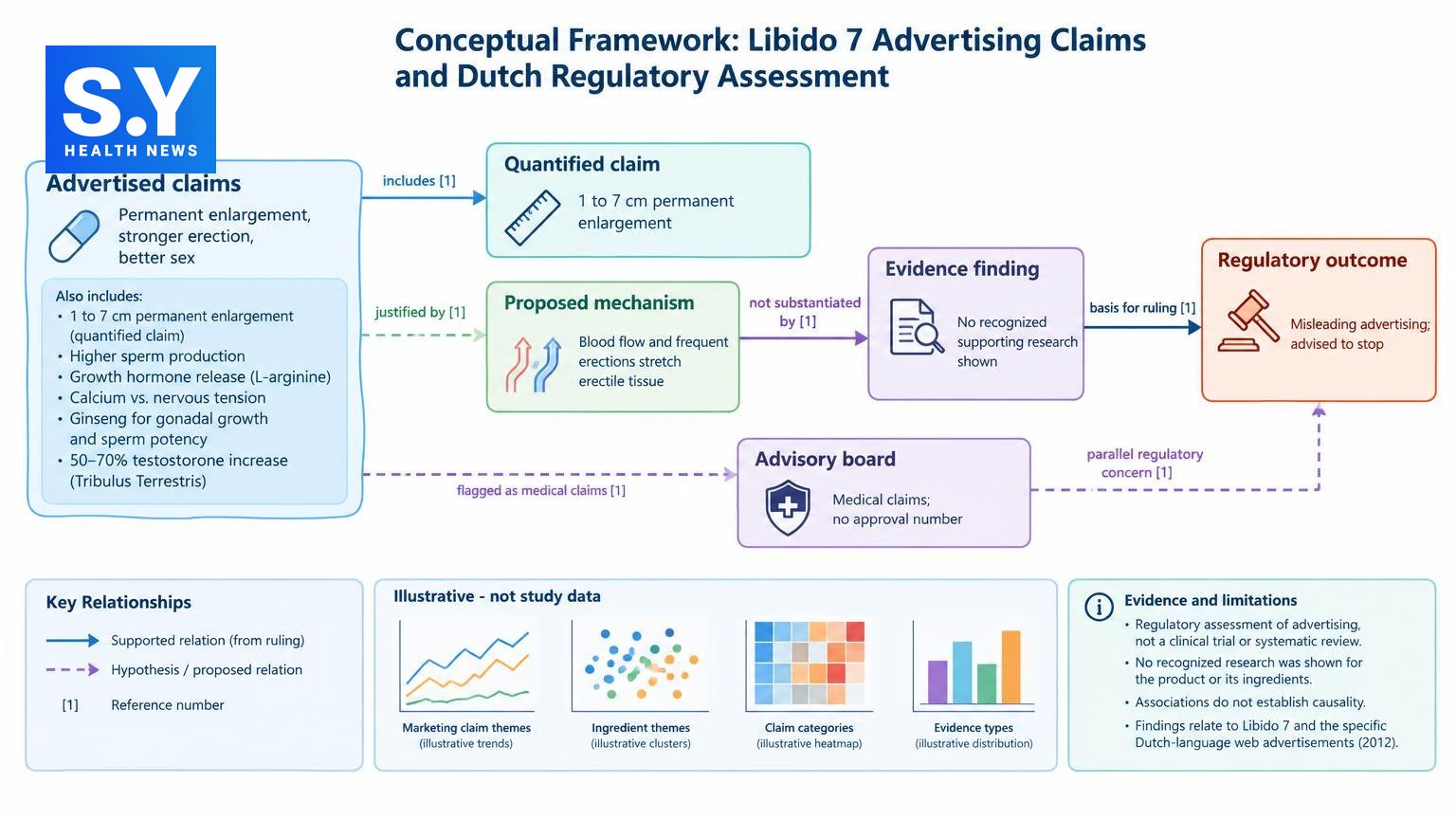
The advertisements promoted Libido 7 with claims including permanent penis enlargement, a harder and longer-lasting erection, and better sex. One flagged advertisement specified permanent enlargement of between 1 and 7 centimeters in length and thickness — a precise-sounding quantitative claim that the review board treated as misleading. Another flagged line suggested that a man need not be ashamed of his penis size because a thick, long and muscular penis could be his within several weeks.
The marketing also included other health-related statements. The advisory review board identified examples such as higher sperm production, growth hormone release attributed to L-arginine, calcium acting against nervous tension, ginseng promoting gonadal growth and sperm potency, resolution of reduced libido in a stated proportion of subjects within two weeks, and a claimed 50% to 70% rise in testosterone production attributed to Tribulus Terrestris. The board flagged these as medical claims, a regulatory category that is distinct from whether the statements are factually correct.
The Advertiser's Proposed Mechanism
The advertiser's defense offered a mechanistic explanation. The writer stated from personal experience that the product causes enlargement, arguing that improved blood flow means more blood enters the penis during erection. The ingredients were said to make a man more frequently aroused and to produce erections very often, and the resulting repeated erections were said to stretch the spongy cells in the erectile bodies of the penis until it eventually becomes larger.
That mechanism is a hypothesis, not a demonstrated outcome. Physiologically, erection involves temporary increased blood flow and engorgement of erectile tissue, which returns toward baseline after detumescence. A claim that repeated engorgement produces lasting tissue expansion and permanent size increase is a specific proposition that requires controlled evidence, and the ruling records that such evidence was not provided. The mechanism language also mixes several distinct propositions — that ingredients increase arousal and erection frequency, that more frequent erections alter erectile tissue over time, and that any such change produces measurable permanent enlargement. Each link would need independent support.
What the Evidence Shows
The evidence here is a regulatory assessment of advertising, not a clinical study. The complainant reported finding no evidence, for Libido 7 or its ingredients, supporting permanent penis enlargement. The advertiser responded with personal experience and a mechanistic explanation rather than study data. The committee then found that no recent recognized scientific research on the effect of Libido 7 or its ingredients had been shown, and that no relevant articles in recognized scientific journals had been submitted.
On that basis the committee concluded that the effect attributed to Libido 7 in the advertisements had not been made plausible and that the advertiser had provided incorrect information about the results to be expected from using the product. It judged the advertising misleading and therefore unfair under article 7 of the Dutch Advertising Code, and recommended that the advertiser no longer advertise in that manner. Because it had already found breaches on the substantiation ground, the committee did not need to decide whether the specific phrases constituted medical claims.
The advisory review board's input adds a separate regulatory dimension. It stated that had the advertisements been submitted for prior review, it would not have granted an approval number, citing the use of medical claims. This is a regulatory characterization about claim categories under the Dutch health products advertising code and medicines law, not a finding that any ingredient does or does not work.
| Element | What the ruling records | Interpretation |
|---|---|---|
| Core advertising claims | Permanent penis enlargement, a harder and longer-lasting erection, and better sex were claimed. | Describes the marketing content under review, not verified effects. |
| Quantified enlargement claim | Permanent enlargement of 1 to 7 centimeters in length and thickness was advertised. | A marketing claim treated as misleading; no measured result is reported. |
| Complainant's evidence search | No evidence found for the product or its ingredients supporting permanent enlargement. | The complainant's search, not a systematic review of all literature. |
| Advertiser's proposed mechanism | Improved blood flow and frequent erections were said to stretch erectile tissue and enlarge the penis. | An asserted hypothesis based on personal experience, without recognized supporting research in the record. |
| Committee's evidence finding | No recent recognized research on Libido 7 or its ingredients and no recognized journal articles were shown. | An evidentiary conclusion about submitted materials, not an exhaustive literature review. |
| Committee's conclusion | The claimed effect was not made plausible and the advertising was misleading and unfair. | A finding about advertising substantiation, not a clinical efficacy verdict. |
| Disposition | The advertiser was recommended not to advertise in that manner again. | A recommendation rather than a court order. |
Interpretation and Limitations
The central interpretive point is that this ruling establishes an evidentiary failure for a specific set of advertising claims at a specific time. It does not establish that penis enlargement supplements are universally ineffective, nor does it quantify any effect. The committee's task was to assess whether the advertiser had substantiated the claims in the advertising, and it concluded that they had not been made plausible. That is a regulatory judgment about advertising conduct, not a controlled clinical finding about the product.
Several limitations should be kept in view. The ruling is dated 2012, so it is not a current-year study and should not be described as new research; it reflects the evidence and regulatory framework at the time. The committee assessed the materials presented to it rather than conducting a systematic review, so its finding about absent research is an evidentiary conclusion rather than proof that no relevant research exists anywhere. The complainant's search and the committee's finding are related but distinct, and neither is a meta-analysis.
The ruling also leaves some questions open. The committee did not decide whether the specific phrases constituted medical claims, so that question was resolved only at the advisory review board level. The board's examples of medical claims, including the testosterone percentage attributed to Tribulus Terrestris, were flagged as advertising content rather than tested for accuracy. This packet contains no clinical trial, no measurement protocol and no patient-level outcome data for penis size, so no numerical effect on size can be reported from this evidence.
Readers should also avoid overgeneralizing from one product and one campaign. The ruling concerns Libido 7 and its advertised ingredients as presented in specific Dutch-language web advertisements. Other products, formulations, doses and marketing contexts would require their own evidence. Conversely, the reasoning that a plausible physiological premise about blood flow does not by itself substantiate a permanent anatomical change is transferable: mechanism language is not outcome evidence.
Research Outlook
The broader question suggested by this ruling is what kind of evidence would be needed to support a permanent enlargement claim for any oral supplement. It would require a clearly defined outcome measure for penile size, a controlled comparison, an adequate follow-up period, independent replication, and safety monitoring. This ruling does not supply such evidence, and the packet contains no clinical trial data on this question. That absence is the most important research gap for readers to recognize when evaluating similar marketing.
Regulatory scrutiny of advertising claims is one route by which unsupported statements are challenged, but it is not a substitute for clinical evidence. A useful outlook for readers is to treat regulatory decisions as signals about claim substantiation rather than as efficacy data in either direction. Where a product's marketing cites studies, the relevant questions remain the design, the population, the measured outcome, the duration and whether the result was independently replicated.
Key Takeaways
- Advertisements for Libido 7 claimed permanent penis enlargement, a harder and longer-lasting erection, and better sex; one flagged advertisement specified permanent enlargement of between 1 and 7 centimeters in length and thickness, which the review board treated as misleading.
- The committee found no recent recognized scientific research on Libido 7 or its ingredients and no articles in recognized scientific journals, so the claimed effect was not made plausible.
- The advertiser's proposed mechanism — that improved blood flow and frequent erections stretch erectile tissue and eventually enlarge the penis — was asserted from personal experience rather than demonstrated by research in the record.
- The advertising was judged misleading and unfair under the Dutch Advertising Code, and the advertiser was recommended not to advertise in that manner; this is a regulatory finding, not a clinical efficacy verdict.
- An advisory review board indicated that the advertisements would not have received an approval number because medical claims were used, including a claimed 50% to 70% testosterone rise attributed to Tribulus Terrestris.
- Because the ruling does not report clinical outcomes or measured penile size changes, it cannot quantify any effect; it documents an evidentiary failure for specific advertising claims.
Questions and Answers
What did the Libido 7 advertisements claim about permanent penis enlargement?
The advertisements claimed that Libido 7 would produce permanent penis enlargement, a harder and longer-lasting erection, and better sex. One flagged advertisement specified permanent enlargement of between 1 and 7 centimeters in length and thickness. These are marketing claims that were under regulatory review; the review board treated the quantified enlargement claim as misleading rather than as a measured result.
What evidence did the Dutch advertising committee find for the Libido 7 permanent enlargement claims?
The committee found no recent recognized scientific research on the effect of Libido 7 or its ingredients, and no relevant articles in recognized scientific journals were shown. The advertiser relied on personal experience and a proposed blood-flow mechanism. The committee therefore concluded that the claimed effect had not been made plausible and that the advertising provided incorrect information about expected results. This is a regulatory evidentiary finding, not an exhaustive literature review.
What was the outcome of the Dutch ruling on Libido 7 advertising?
The committee judged the advertising misleading and therefore unfair under article 7 of the Dutch Advertising Code, and it recommended that the advertiser no longer advertise in that manner. An advisory review board separately indicated that the advertisements would not have received an approval number because medical claims were used. The recommendation is a regulatory action, not a court order or a clinical verdict.
Does the Dutch ruling establish that penis enlargement supplements do not work?
No. The ruling assessed whether one advertiser had substantiated specific advertising claims, and it concluded that the claimed effect was not made plausible. It did not test the product in a clinical trial, measure penile size, or compare it with placebo. It therefore documents an evidentiary failure for those claims rather than proving that all supplements are ineffective.
What are the limitations of the Libido 7 advertising ruling as evidence?
The committee assessed the materials presented to it rather than conducting a systematic review, so its finding about absent research is an evidentiary conclusion, not proof that no relevant research exists anywhere. The ruling dates to 2012 and reflects the evidence and framework at that time. It also did not decide whether the phrases were medical claims, leaving that question at the advisory board level.
Does the proposed blood-flow mechanism establish that Libido 7 permanently enlarges the penis?
No. The advertiser argued that improved blood flow and frequent erections would stretch erectile tissue and eventually enlarge the penis. That is an asserted mechanism, not a demonstrated outcome; erection-related engorgement is temporary, and a lasting size change would require controlled evidence that the ruling states was not provided. A plausible physiological premise does not by itself substantiate a permanent anatomical change.
Conceptual framework: Conceptual framework, not a tested causal model. It maps the advertising claims, the advertiser's proposed blood-flow mechanism, the committee's finding of no recognized supporting research, and the regulatory outcomes in a Dutch advertising ruling on Libido 7. Relations are conceptual; arrows do not imply proven causation or clinical effect.
Academic References & Evidence
SANYUN Science Center explains published research on men's reproductive and sexual health, connecting scientific evidence with everyday questions while making sources and limitations clear.
Disclaimer: This article is for scientific education and research communication only. It does not provide medical advice, diagnosis, or individualized treatment recommendations, and does not endorse any medication, supplement, device, penile enlargement procedure, or other intervention. Decisions about sexual and reproductive health should be made in consultation with a qualified healthcare professional. Do not delay seeking professional care because of information in this article.
Original Content & Copyright Notice
- This article is prepared for SANYUN Science Center, drawing on published research and publicly available academic literature on men’s sexual and reproductive health. Its editorial explanations and presentation are developed for this platform.
- Copyright in the original editorial content, selection, and arrangement is reserved by SANYUN Science Center to the extent protected by applicable law. Referenced research, quotations, and third-party materials remain subject to the rights of their respective owners. This notice does not claim ownership of scientific facts or third-party research.
- Except where permitted by applicable law or an applicable license, prior written permission is required to reproduce, republish, translate, adapt, redistribute, or commercially reuse protected content. Attribution alone does not grant permission for such reuse.
- For permitted quotation or authorized reuse, clearly identify the source and retain a link to the original article.
- Source: SANYUN Science Center
- Original URL: Retain the original article URL on science.san-yun.com.
- Copyright Holder: SANYUN Science Center, for its own protected editorial content.
- Quotation, excerpts, or authorized reuse must not distort the scientific meaning, omit material limitations or disclaimers, or imply unverified medical claims, product efficacy, or endorsement by SANYUN Science Center.



