




Category: Premature Ejaculation
Core Research Direction: Evidence-based definition and clinical classification of lifelong versus acquired premature ejaculation, and what consensus guidance says about evaluation and management
Search Intent: How do experts define and distinguish lifelong from acquired premature ejaculation, and what does that mean for evaluation and treatment?
Platform: SANYUN Science Center
Evidence reviewed through: 2026-11-03
Executive Summary
Premature ejaculation has a long history of inconsistent definitions, which made both clinical care and research difficult to compare. The International Society for Sexual Medicine addressed this in stages: its first ad hoc committee produced the first evidence-based definition of lifelong PE in 2007, but concluded that objective published data were then insufficient to define acquired PE. A second committee, convened in April 2013 using the same systematic literature approach, produced a unified definition covering both subtypes.[1]
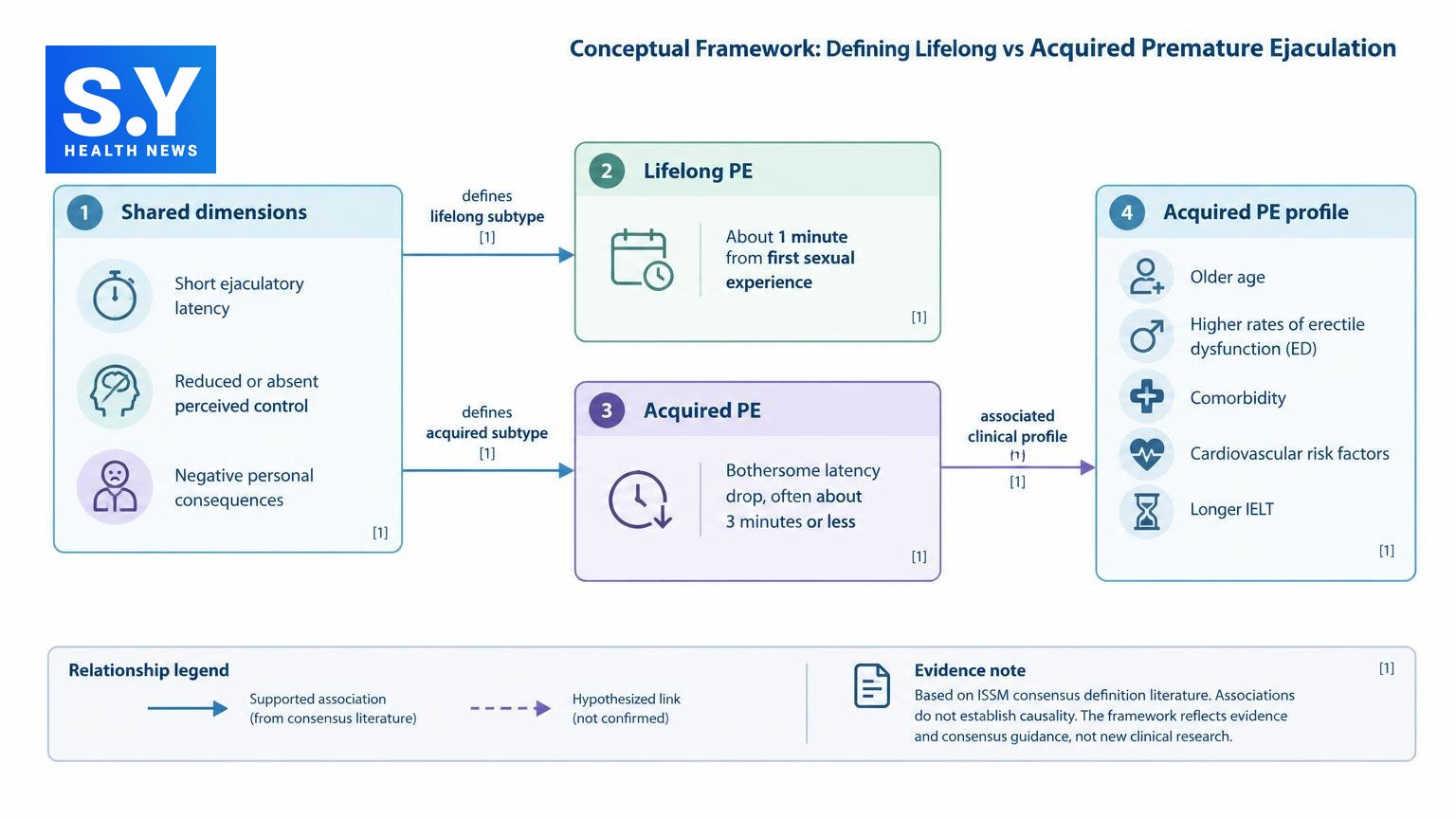
The committee agreed that lifelong and acquired PE share three dimensions: short ejaculatory latency, reduced or absent perceived ejaculatory control, and negative personal consequences. The subtypes are separated by timing and threshold: lifelong PE involves ejaculation always or nearly always within about 1 minute of vaginal penetration from the first sexual experience, whereas acquired PE involves a clinically significant, bothersome reduction in latency, often to about 3 minutes or less.
Clinical profiling also differs. Men with acquired PE tend to be older and to show higher rates of erectile dysfunction, comorbid disease and cardiovascular risk factors, and they have a longer intravaginal ejaculation latency time than men with lifelong PE. A self-estimated or stopwatch IELT of 3 minutes was judged a valid cut-off for diagnosing acquired PE.
This review is an interpretation of published consensus documents, not new clinical research. The available packet text gives the definitional structure in detail but only limited, keyword-level signals about treatment evidence, so management is discussed in terms of what consensus scope includes rather than specific effect sizes.[2]
Why the Definition Problem Mattered
Ejaculatory disorders, including premature ejaculation and delayed ejaculation, are described as common conditions with a substantial impact on men's quality of life and their relationships. That general statement frames why a workable definition matters: a condition that is common and burdensome needs consistent criteria so that clinicians agree on whom they are treating and researchers agree on whom they are studying.
The historical difficulty was specific to acquired PE. The 2007 committee could define lifelong PE on the basis of evidence but explicitly found insufficient published objective data to do the same for acquired PE. This is an important distinction for interpreting later documents: the gap in 2007 reflected the state of the evidence base rather than a judgment that acquired PE did not exist.
When the second committee met, it adopted the same evidence-based systematic approach to literature search, retrieval and evaluation as the original committee. Using a consistent method across both committees means the later definition was built on a comparable evidentiary footing rather than a fresh, incompatible process.
The Three Shared Diagnostic Dimensions
The unified definition rests on three elements that the committee judged to be shared across lifelong and acquired PE. The first is short ejaculatory latency. The second is reduced or absent perceived ejaculatory control. The third is the presence of negative personal consequences. These dimensions are not alternatives; the definition treats them as jointly characterizing the condition.
The control and consequence dimensions deserve emphasis because they push the definition beyond a stopwatch reading. The full criteria require the inability to delay ejaculation on all or nearly all vaginal penetrations, together with negative personal consequences such as distress, bother, frustration or avoidance of sexual intimacy. A man who ejaculates quickly but reports no loss of control and no distress does not meet the definition as written.
That structure reflects a clinical rather than purely statistical logic. Latency is a measured or estimated variable, but the definition also incorporates the man's experience of control and the personal impact of the problem. It is a definitional convention agreed by a committee, not a laboratory threshold with independent biological validation in the available text.
Separating Lifelong From Acquired Premature Ejaculation
The subtypes are distinguished primarily by onset and by the latency threshold applied. In lifelong PE, ejaculation always or nearly always occurs prior to or within about 1 minute of vaginal penetration from the first sexual experience. In acquired PE, the defining feature is a clinically significant and bothersome reduction in latency time, often to about 3 minutes or less, in a man whose earlier sexual experience was different.
The wording carries two practical implications. First, lifelong PE is anchored to the first sexual experience, so a history of consistently short latency from the outset is central. Second, acquired PE is anchored to change: the latency reduction must be clinically significant and bothersome, which places the man's own trajectory and distress within the diagnostic criteria rather than relying on a single number alone.
The committee also identified a self-estimated or stopwatch IELT of 3 minutes as a valid cut-off for diagnosing acquired PE. The fact that self-estimation is accepted alongside stopwatch measurement matters for feasibility in routine practice, although the cut-off itself is a diagnostic convention derived from reviewed evidence rather than an absolute biological boundary.
How the Subtypes Differ Clinically
Beyond timing, the two groups differ in clinical profile. Compared with men with lifelong PE, men with acquired PE are older, have higher incidences of erectile dysfunction, comorbid disease and cardiovascular risk factors, and have a longer IELT. These are group-level comparisons drawn from the reviewed literature; they describe tendencies across populations, not predictions about any individual man.
The association with erectile dysfunction and cardiovascular risk factors in acquired PE is clinically relevant because it suggests that new-onset or worsened ejaculatory latency may warrant attention to broader sexual and general health. The available text reports these as associations observed across reviewed studies; it does not establish that one condition causes the other, and the direction of any relationship is not resolved by the definitional literature alone.
What Consensus Guidance Says About Evaluation and Management
| Element | What the consensus literature specifies | How to interpret it |
|---|---|---|
| Latency threshold, lifelong PE | Ejaculation prior to or within about 1 minute of vaginal penetration from the first sexual experience | Onset-anchored criterion; refers to vaginal penetrative sex |
| Latency threshold, acquired PE | Clinically significant, bothersome reduction in latency, often to about 3 minutes or less | Change-anchored criterion; requires documented or reported reduction |
| IELT measurement for acquired PE | Self-estimated or stopwatch IELT of 3 minutes accepted as a valid cut-off | Practical diagnostic convention, not an absolute biological boundary |
| Control criterion | Inability to delay ejaculation on all or nearly all vaginal penetrations | Required element; not optional |
| Consequence criterion | Distress, bother, frustration and/or avoidance of sexual intimacy | Required element; distinguishes clinically significant from incidental fast ejaculation |
| Clinical profile, acquired vs lifelong | Older age; higher rates of erectile dysfunction, comorbid disease and cardiovascular risk factors; longer IELT | Group-level association from reviewed literature, not an individual prediction |
On management, the available consensus text is less detailed. A more recent consultation document aimed to present evidence-based recommendations for definition, classification and treatment of premature and delayed ejaculation, and its listed topics include dapoxetine, selective serotonin reuptake inhibitors, psychotherapy and penile hypersensitivity alongside acquired and lifelong PE and IELT. These keywords indicate the scope the review covers; the available packet text does not provide treatment effect estimates.
That limitation matters for how this review should be read. It is accurate to say that consensus guidance addresses both definition and treatment, and that the treatment landscape discussed includes pharmacologic and psychological approaches. It is not accurate, on the available text, to state how effective any specific option is, for which subtype, or with what magnitude of benefit.
Interpretation and Limitations
The unified definition was characterized by its authors as the first evidence-based definition covering both lifelong and acquired PE. That is a meaningful step for standardizing research eligibility and clinical communication, but it is also a self-characterization by the committee rather than independent external validation. The definition is a consensus product built on systematic literature review, not a diagnostic test validated against an independent gold standard.
A second limitation is scope. The criteria are written explicitly in terms of vaginal penetration, which means the definition does not directly specify how to classify men whose sexual activity does not include vaginal intercourse. This should be understood as a boundary of the definition as written, not a claim that such difficulties are unimportant.
A third limitation concerns the evidence base itself. The 2007 committee's inability to define acquired PE reflected insufficient objective published data at that time, and the later definition was built through the same systematic review approach rather than through new primary studies reported in the available text. The definition also incorporates subjective elements such as perceived control and bother, which are clinically important but inherently dependent on self-report.
Finally, the clinical profile differences between subtypes are described at group level. The higher rates of erectile dysfunction, comorbid disease and cardiovascular risk factors in acquired PE are associations from reviewed literature; they should inform clinical curiosity rather than be read as causal mechanisms or as individualized risk predictions.
Research Outlook
The committee that produced the unified definition framed it partly as an enabling step, noting that a shared definition would allow researchers to design methodologically rigorous studies to improve understanding of acquired PE. Later consultation work continued the effort to synthesize evidence on etiology, epidemiology, evaluation and management of ejaculatory disorders.
For readers tracking this field, the practical research questions follow from the definition's structure: how reliably the 1-minute and 3-minute thresholds perform across settings and measurement methods, how self-estimated IELT compares with stopwatch measurement in practice, and how the association between acquired PE and cardiometabolic comorbidity should inform evaluation. The available packet text does not report answers to these questions, so they remain open directions rather than settled findings.
Key Takeaways
- Lifelong and acquired PE share three dimensions: short ejaculatory latency, reduced or absent perceived ejaculatory control, and negative personal consequences.
- Lifelong PE is defined by ejaculation always or nearly always within about 1 minute of vaginal penetration from the first sexual experience; acquired PE by a clinically significant, bothersome reduction in latency, often to about 3 minutes or less.
- The definition requires inability to delay ejaculation on all or nearly all vaginal penetrations plus negative consequences such as distress or avoidance of intimacy.
- Men with acquired PE are older and show higher rates of erectile dysfunction, comorbid disease and cardiovascular risk factors, with a longer IELT than men with lifelong PE.
- The unified definition is a consensus product from systematic literature review, characterized by its authors as the first evidence-based definition; it is not an independently validated diagnostic test.
Questions and Answers
What is the ISSM definition of premature ejaculation?
The ISSM unified definition describes PE as short ejaculatory latency combined with reduced or absent perceived ejaculatory control and negative personal consequences. The full criteria require ejaculation always or nearly always within about 1 minute of vaginal penetration from the first sexual experience for lifelong PE, or a clinically significant bothersome reduction often to about 3 minutes or less for acquired PE, plus inability to delay ejaculation and negative consequences.
How is lifelong premature ejaculation different from acquired premature ejaculation?
Lifelong PE is anchored to the first sexual experience, with ejaculation always or nearly always within about 1 minute of vaginal penetration. Acquired PE is anchored to change: a clinically significant and bothersome reduction in latency, often to about 3 minutes or less, in a man whose prior experience differed. Men with acquired PE also tend to be older, have a longer IELT, and show more erectile dysfunction and cardiovascular risk factors.
What IELT cut-off is used to diagnose acquired premature ejaculation?
The ISSM committee identified a self-estimated or stopwatch IELT of 3 minutes as a valid cut-off for diagnosing acquired PE. This is a diagnostic convention derived from reviewed evidence rather than an absolute biological boundary, and it sits alongside the other criteria: bothersome reduction in latency, impaired control, and negative personal consequences.
How strong is the evidence behind the unified premature ejaculation definition?
It is a consensus definition built through the same evidence-based systematic literature search and evaluation approach used by the earlier committee. Its authors characterized it as the first evidence-based definition covering lifelong and acquired PE. It is not independent primary research or an externally validated diagnostic test, and the 2007 committee had earlier found insufficient objective data to define acquired PE.
Does the premature ejaculation definition apply to all sexual activities?
The ISSM criteria are written explicitly in terms of vaginal penetration, so the definition as published does not directly specify classification for men whose sexual activity does not include vaginal intercourse. This is a boundary of the definition rather than a claim that such difficulties are unimportant, and it is one reason clinical assessment should not be reduced to a stopwatch threshold alone.
What treatments does consensus guidance discuss for premature ejaculation?
Recent consultation work lists dapoxetine, selective serotonin reuptake inhibitors, psychotherapy and penile hypersensitivity among its topics, alongside acquired and lifelong PE and IELT, and aimed to give evidence-based recommendations on definition, classification and treatment. The available text does not report effect sizes, so comparative effectiveness cannot be stated here.
Conceptual framework: Conceptual framework of lifelong versus acquired premature ejaculation, based on ISSM consensus definition literature. Shared dimensions are shown linking to subtype-specific latency criteria; the acquired PE profile reflects group-level associations, not causation or individualized risk.
Academic References & Evidence
- Ege Can Serefoglu; Chris G McMahon; Marcel D Waldinger; Stanley E Althof; Alan Shindel; Ganesh Adaikan; Edgardo F Becher; John Dean; Francois Giuliano; Wayne Jg Hellstrom; Annamaria Giraldi; Sidney Glina; Luca Incrocci; Emmanuele Jannini; Marita McCabe; Sharon Parish; David Rowland; R Taylor Segraves; Ira Sharlip; Luiz Otavio Torres. An evidence-based unified definition of lifelong and acquired premature ejaculation: report of the second international society for sexual medicine ad hoc committee for the definition of premature ejaculation. Sexual Medicine. 2014 2(2):41-59 DOI: 10.1002/sm2.27.
- Contemporary consensus and emerging directions in premature and delayed ejaculation: recommendations from the 5th International Consultation on Sexual Medicine.. Sexual medicine reviews PMID: 42855438.
SANYUN Science Center explains published research on men's reproductive and sexual health, connecting scientific evidence with everyday questions while making sources and limitations clear.
Disclaimer: This article is for scientific education and research communication only. It does not provide medical advice, diagnosis, or individualized treatment recommendations, and does not endorse any medication, supplement, device, penile enlargement procedure, or other intervention. Decisions about sexual and reproductive health should be made in consultation with a qualified healthcare professional. Do not delay seeking professional care because of information in this article.
Original Content & Copyright Notice
- This article is prepared for SANYUN Science Center, drawing on published research and publicly available academic literature on men’s sexual and reproductive health. Its editorial explanations and presentation are developed for this platform.
- Copyright in the original editorial content, selection, and arrangement is reserved by SANYUN Science Center to the extent protected by applicable law. Referenced research, quotations, and third-party materials remain subject to the rights of their respective owners. This notice does not claim ownership of scientific facts or third-party research.
- Except where permitted by applicable law or an applicable license, prior written permission is required to reproduce, republish, translate, adapt, redistribute, or commercially reuse protected content. Attribution alone does not grant permission for such reuse.
- For permitted quotation or authorized reuse, clearly identify the source and retain a link to the original article.
- Source: SANYUN Science Center
- Original URL: Retain the original article URL on science.san-yun.com.
- Copyright Holder: SANYUN Science Center, for its own protected editorial content.
- Quotation, excerpts, or authorized reuse must not distort the scientific meaning, omit material limitations or disclaimers, or imply unverified medical claims, product efficacy, or endorsement by SANYUN Science Center.



