




Category: Clinical Insights
Core Research Direction: Clinical interpretation of low ejaculate volume (hypospermia) in adult men, including its definition, methodological prerequisites for measurement, possible causes, and whether it should be treated as a cause of male infertility when other semen parameters are normal.
Search Intent: If a man's ejaculate volume is below the normal threshold but his sperm count and other semen parameters are within normal range, does low volume by itself threaten his fertility—and what should be evaluated before assuming it does?
Platform: SANYUN Science Center
Evidence reviewed through: 2026-11-20
Executive Summary
Hypospermia — low ejaculate volume — is defined by a semen analysis (seminogram) showing a seminal volume below 1.5 ml. That threshold is a laboratory classification, not a diagnosis of infertility, and it rests on a measurement that is easy to get wrong if the collection conditions are not standardized.[1]
The question this review addresses is narrower than the general topic: when a man's ejaculate volume is below threshold but his sperm count and other semen parameters fall within normal limits, does the low volume by itself threaten his fertility? The available source material answers conditionally. It states that hypospermia may be associated with male infertility where it impedes pregnancy, but that if sperm count values are within the normal range, male fertility should not be affected. Its conclusion is that a semen-analysis diagnosis of hypospermia need not imply reduced fertile potential provided the other parameters are above normal limits.
That position is clinically reasonable but evidentially thin. It comes from an educational fertility-clinic FAQ, not from a cohort study, and the supplied text reports no sample size, no pregnancy outcomes and no follow-up. The source itself frames the reassurance as conditional and pairs it with a strong recommendation: perform associated assessments and complementary tests to rule out other conditions, and carry out an exhaustive study to determine whether associated pathologies explain the low volume. In practical terms, the volume finding is best read as a prompt for structured evaluation rather than as a fertility verdict in either direction.
- Definition: hypospermia is seminal volume below 1.5 ml on a seminogram.
- Measurement prerequisite: assess volume after 3 to 5 days of sexual abstinence.
- Repeat before concluding: if two semenograms give the same value, urological consultation is advised to look for causes.
- Fertility meaning: with other parameters normal, isolated low volume is not presented as a stand-alone cause of infertility.
Why This Matters
Ejaculate volume occupies an odd position in semen analysis. It is one of the first values a man sees on a report, it is easy to compare with a reference limit, and it invites a dramatic interpretation — that something is blocked, missing or failing. Yet volume is a composite measurement. It reflects contributions from several glands and ducts, the completeness of emission and the mechanics of ejaculation, and it is sensitive to how the sample was produced and how long the man had abstained.
The clinical stakes are asymmetric. Treating isolated low volume as infertility can generate anxiety, unnecessary testing and premature movement toward assisted reproduction in a couple who may not need it. Dismissing low volume as meaningless can miss a genuine underlying condition — the source explicitly warns that associated pathologies may be responsible for reduced volume and should be investigated. The useful question is therefore not "is 1.4 ml bad?" but "is this measurement trustworthy, and does the pattern across all parameters point to an explanation?"
There is also a contextual point that shapes interpretation. The source notes that hypospermia is usually related to low sperm concentration, which complicates achieving pregnancy. That observation matters because it describes the typical companion finding, not the isolated case. A man whose volume is low but whose concentration is normal sits outside that usual pattern, which is precisely why the source treats his situation differently and why the rest of the semen profile carries so much of the interpretive weight.
Definition, Measurement and Methodological Prerequisites
Hypospermia is defined operationally: a seminogram showing seminal volume below 1.5 ml. The definition is a laboratory threshold applied to a single measured variable, and it says nothing on its own about cause, reversibility or reproductive outcome.
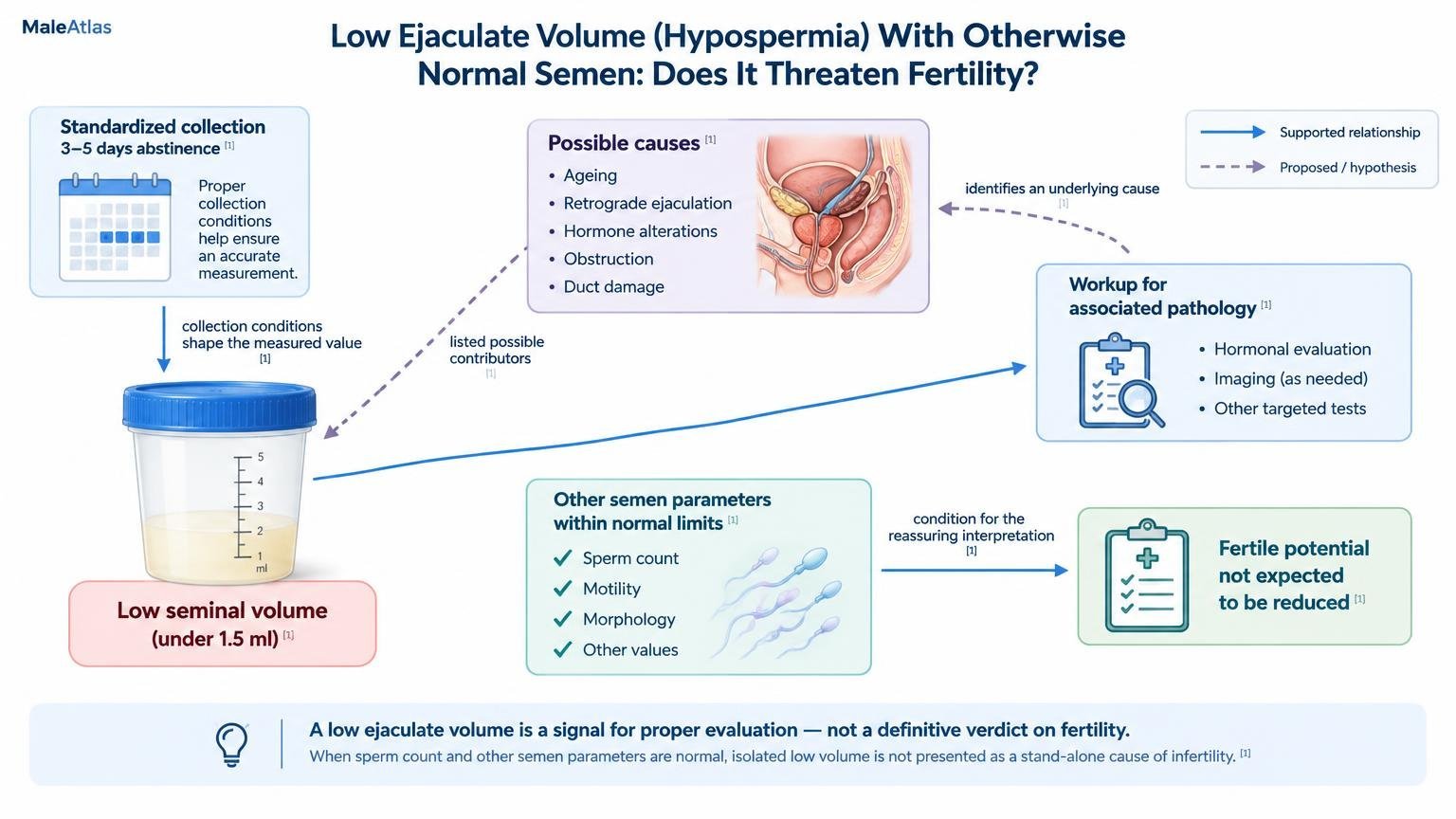
Measurement quality comes first. The source specifies that assessing seminal volume requires a semen analysis performed with a sexual abstinence period of between 3 and 5 days. Abstinence interval is one of the most influential pre-analytical variables for volume, so a value obtained outside that window is a weaker basis for classification. This is a procedural recommendation rather than a finding from a controlled comparison; the supplied text reports no data on how much volume shifts across abstinence intervals.
Repetition is the second safeguard. The source advises that when two semenograms give the same volume value, a urologist should be consulted to identify causes that may be affecting ejaculate volume. The logic is that a single low reading can reflect collection problems or short-term factors, whereas a consistent finding across two properly collected samples deserves etiological investigation. Notably, the source's criterion is two samples showing the same value, not merely two samples both below threshold — a nuance worth preserving, because it signals that consistency of the finding is what triggers escalation.
| Variable or step | Source-grounded description | Interpretive weight |
|---|---|---|
| Seminal volume threshold | Hypospermia is considered when the seminogram shows volume below 1.5 ml | Classification only; not a fertility diagnosis |
| Abstinence interval | Semen analysis performed after 3 to 5 days of sexual abstinence | Pre-analytical control; value outside this window is a weaker basis for classification |
| Repeat testing | If two semenograms give the same volume value, urological consultation is advised | Separates a persistent finding from a single unconfirmed reading |
| Other semen parameters | Sperm count values within the normal range; other values above normal limits | The condition under which the source does not expect fertility to be affected |
| Associated pathology workup | Complementary tests and an exhaustive study to identify conditions causing low volume | Determines whether the volume finding is a marker of something treatable |
| Typical companion finding | Hypospermia is usually related to low sperm concentration, which complicates pregnancy | Context for why the isolated-low-volume scenario is interpreted differently |
Biological and Clinical Mechanisms Behind Low Volume
The source lists potential contributors to reduced seminal volume: male ageing, partial retrograde ejaculation, alterations in hormone production, obstructions in the ejaculatory ducts, and damage to the vas deferens and seminal vesicles, among many others. The list is presented as possibilities rather than as a ranked or quantified set of causes, and the supplied text gives no prevalence estimates for any of them.
These mechanisms are conceptually distinct, which is clinically useful even without frequency data. Partial retrograde ejaculation and ejaculatory duct obstruction are problems of transport and outflow — seminal fluid or sperm that should be expelled is partly redirected or held back. Hormonal alterations sit upstream, affecting the secretory activity that produces seminal fluid. Damage to the vas deferens or seminal vesicles affects the structures that contribute fluid and the conduit that carries it. Male ageing is a broad, non-specific factor that may act through several of these routes at once.
This diversity explains why the source pairs the volume finding with a workup rather than with a single test. Different mechanisms predict different accompanying findings: a transport problem may alter the sperm profile in particular ways, while a hormonal or glandular problem may leave concentration relatively preserved. It also explains why the answer to the article's central question cannot come from volume alone. Volume is a downstream, composite signal; the mechanisms that produce it are multiple, and knowing that the volume is low does not identify which one is operating.
What the Evidence Shows on Low Volume and Fertility
The source's central claim is conditional and should be quoted in its own terms. It states that hypospermia may be associated with male infertility if it is an impediment to pregnancy; otherwise, if sperm count values are within the normal range, male fertility should not be affected. Its conclusion restates the point: a semen-analysis diagnosis of hypospermia does not have to be associated with a decrease in the male's fertile potential as long as the rest of the values are above normal limits.
Read carefully, the claim has two parts. The first is a mechanism of harm: low volume matters when it prevents sperm from reaching the site of fertilization — an impediment to pregnancy. The second is a conditional reassurance: when sperm count and other parameters are normal, the volume finding alone is not expected to reduce fertility. The two parts are consistent, because they describe different scenarios. In the isolated-low-volume scenario the source is addressing, the presumed functional bottleneck is absent or at least not demonstrated.
The source also supplies the counterweight that keeps this from becoming blanket reassurance. It notes that hypospermia is usually related to low sperm concentration that complicates the achievement of pregnancy. In other words, in the population where low volume is most often encountered, it tends to travel with a parameter that genuinely does affect fertility. The reassuring statement is therefore best understood as applying to an atypical subset — men whose volume is low while concentration and the rest of the profile are normal — rather than to hypospermia in general.
What the evidence does not show is equally important to state. The supplied material contains no fertility outcome data for men with isolated low volume: no pregnancy rates, no time-to-conception figures, no comparison group, no sample size and no follow-up period. The claim that fertility should not be affected is an expert-oriented expectation consistent with the physiology, not a measured effect. It should be presented to patients as a reasoned position, not as a demonstrated result.
Interpretation and Limitations
Several limitations bound how far this review can go. The primary source is an educational FAQ written by an embryologist for a fertility-clinic website, last updated in 2023. It is not a cohort study, a systematic review or a guideline, and the supplied text cites no underlying studies for its clinical statements. Every quantitative element available — the 1.5 ml threshold and the 3 to 5 day abstinence window — is a definition or a procedural recommendation, not an effect estimate.
There is also a scope limitation. The source is framed around the question of whether isolated low volume is a cause of male infertility, and it answers that question at the level of general principle. It does not address how volume interacts with sperm motility or morphology in detail, does not discuss how couple factors alter the interpretation, and does not distinguish between types of infertility presentation. A reader should therefore treat the reassurance as conditional on the full semen profile being normal, and should not extend it to men whose other parameters are borderline or abnormal.
Finally, the source's own emphasis on workup limits any reading of low volume as benign. It advises associated assessments and complementary tests to rule out other conditions, and it calls for an exhaustive study to determine whether associated pathologies explain the reduced volume. Those recommendations are not footnotes; they are the operational content of the source's answer. Practically, this means the correct interpretation of an isolated low-volume result is "evaluate, then reassure if evaluation is negative" rather than "reassure immediately."
Research Outlook
The evidence gap identified here is specific and addressable. What is missing is outcome data for the exact subgroup the source describes: men with volume below 1.5 ml and all other semen parameters within normal limits, followed for natural conception or assisted-reproduction outcomes. Studies of that kind would let clinicians attach a prognosis to the classification rather than an expectation. They would also clarify whether the "impediment to pregnancy" framing is the right threshold for clinical concern, or whether volume exerts subtler effects that current semen analysis does not capture.
A second gap concerns mechanism attribution. The source lists ageing, partial retrograde ejaculation, hormonal alterations, ejaculatory duct obstruction and damage to the vas deferens and seminal vesicles as possible causes, but gives no information on how often each is found in men presenting with low volume, or how often an identified cause changes management. Without that, the workup recommendation is sound in principle but cannot be prioritized or costed.
Key Takeaways
- Hypospermia is a laboratory classification — seminal volume below 1.5 ml on a seminogram — not a diagnosis of infertility.
- Volume should be assessed after 3 to 5 days of sexual abstinence, and a consistent low value on two semenograms warrants urological evaluation for causes.
- Potential causes include male ageing, partial retrograde ejaculation, altered hormone production, ejaculatory duct obstruction and damage to the vas deferens or seminal vesicles.
- The source states that when sperm count and other semen parameters are normal, low volume by itself should not affect male fertility; hypospermia matters when it impedes pregnancy.
- Hypospermia is usually associated with low sperm concentration, so the reassuring scenario is a distinct subset rather than the typical presentation.
- Because the underlying source is an educational FAQ without reported outcome data, the reassurance is an expert expectation, and a workup for associated conditions remains part of the recommended response.
Questions and Answers
What ejaculate volume counts as hypospermia?
Hypospermia is considered when a semen analysis shows a seminal volume below 1.5 ml. That figure is a laboratory classification threshold applied to a single measured variable, not a diagnosis of infertility and not an explanation of why the volume is low. Because volume is sensitive to collection conditions, the classification carries most weight when the sample was properly collected and the finding is repeated.
Does low ejaculate volume cause male infertility if sperm count and other semen parameters are normal?
According to the reviewed source, low volume by itself should not affect male fertility when sperm count values are within the normal range and the other semen parameters are above normal limits. The source frames hypospermia as relevant to infertility when it impedes pregnancy. This is an expert expectation rather than a measured outcome, and the source still recommends investigating possible underlying causes.
How should semen volume be measured before hypospermia is diagnosed?
The source specifies a semen analysis performed after 3 to 5 days of sexual abstinence, because abstinence interval strongly influences volume. If two semenograms give the same volume value, urological consultation is advised to look for causes affecting ejaculate volume. These are procedural recommendations rather than findings from controlled comparisons, and the supplied text reports no data on how much volume shifts with abstinence length.
What conditions can cause low ejaculate volume in adult men?
The source lists male ageing, partial retrograde ejaculation, alterations in hormone production, obstructions in the ejaculatory ducts, and damage to the vas deferens and seminal vesicles, among others. These are presented as possible contributors without prevalence estimates or supporting citations. Because the mechanisms differ — transport, outflow, hormonal secretion and structural integrity — the source pairs the finding with complementary testing to identify an underlying condition.
How strong is the evidence that isolated low semen volume does not reduce fertility?
It is weak in formal terms. The claim comes from an educational fertility-clinic FAQ rather than a cohort study or guideline, and the supplied text reports no sample size, pregnancy outcomes or follow-up. The position is physiologically coherent and explicitly conditional on the rest of the semen profile being normal, but it should be presented as expert expectation rather than demonstrated evidence.
Why is low ejaculate volume often linked with low sperm concentration?
The source notes that hypospermia is usually related to low sperm concentration, which complicates achieving pregnancy. That observation describes the typical companion finding rather than the isolated case. It helps explain why a man with low volume but normal concentration is interpreted differently: his situation falls outside the usual pattern, and the rest of the semen profile carries much of the interpretive weight.
Conceptual framework: Conceptual framework: how low ejaculate volume, collection conditions, possible causes, the rest of the semen profile and pathology workup relate to fertility interpretation. Supported and proposed relationships are distinguished; the framework is not a tested causal model and is not study data.
Academic References & Evidence
- Álvaro Martínez Moro. FAQs – inviTRA. 2023
SANYUN Science Center explains published research on men's reproductive and sexual health, connecting scientific evidence with everyday questions while making sources and limitations clear.
Disclaimer: This article is for scientific education and research communication only. It does not provide medical advice, diagnosis, or individualized treatment recommendations, and does not endorse any medication, supplement, device, penile enlargement procedure, or other intervention. Decisions about sexual and reproductive health should be made in consultation with a qualified healthcare professional. Do not delay seeking professional care because of information in this article.
Original Content & Copyright Notice
- This article is prepared for SANYUN Science Center, drawing on published research and publicly available academic literature on men’s sexual and reproductive health. Its editorial explanations and presentation are developed for this platform.
- Copyright in the original editorial content, selection, and arrangement is reserved by SANYUN Science Center to the extent protected by applicable law. Referenced research, quotations, and third-party materials remain subject to the rights of their respective owners. This notice does not claim ownership of scientific facts or third-party research.
- Except where permitted by applicable law or an applicable license, prior written permission is required to reproduce, republish, translate, adapt, redistribute, or commercially reuse protected content. Attribution alone does not grant permission for such reuse.
- For permitted quotation or authorized reuse, clearly identify the source and retain a link to the original article.
- Source: SANYUN Science Center
- Original URL: Retain the original article URL on science.san-yun.com.
- Copyright Holder: SANYUN Science Center, for its own protected editorial content.
- Quotation, excerpts, or authorized reuse must not distort the scientific meaning, omit material limitations or disclaimers, or imply unverified medical claims, product efficacy, or endorsement by SANYUN Science Center.



