




Category: Clinical Insights
Core Research Direction: Clinical interpretation of low semen volume in adult men: how semen volume relates to total sperm output and other semen parameters, which collection-related and medical factors can produce persistently low volume, and when repeat testing or further male-factor evaluation is warranted.
Search Intent: If a man's semen analysis shows low semen volume, what might explain it and when does it actually matter clinically?
Platform: SANYUN Science Center
Evidence reviewed through: 2026-11-20
Executive Summary
Semen volume is one measurement within a semen analysis and refers to the amount of fluid in the collected sample rather than to the number of sperm it contains. A low result is defined operationally as fluid volume below the reporting laboratory's reference range, so the threshold is laboratory-specific rather than a universal number.[1]
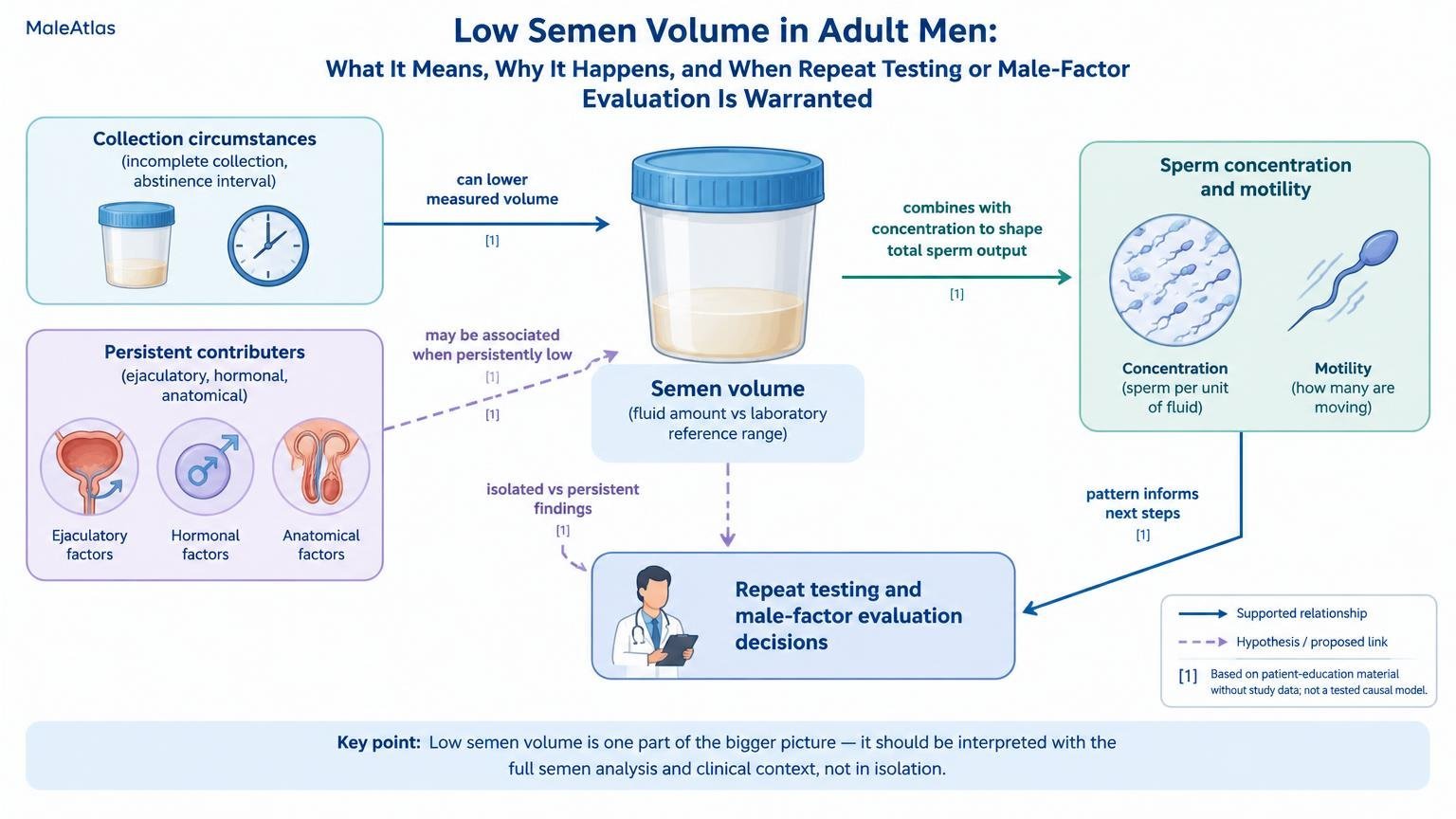
The central interpretive point is that low semen volume does not by itself mean that sperm count is low. Volume interacts with sperm concentration to shape the total number of sperm in the ejaculate, and motility describes how many of those sperm are moving. Two men with the same volume can therefore have very different findings, and a man with relatively low volume may still have a meaningful number of motile sperm if concentration is sufficiently high.
Collection circumstances can lower measured volume, particularly when the complete sample is not collected. Persistently low volume, by contrast, may sometimes be associated with ejaculatory, hormonal or anatomical factors. The most useful next step after an isolated low result is usually to review the full semen analysis and the collection circumstances before assuming a fertility problem.
Why This Matters
Semen volume is interpreted alongside sperm concentration, motility, morphology and total motile sperm count rather than in isolation. Because the amount of fluid interacts with concentration to influence total sperm output, a volume result carries different weight depending on the rest of the analysis. This is why reading a low volume in isolation can be misleading in either direction: it may overstate concern in a man whose concentration and motility are reassuring, or it may distract from a more important abnormality elsewhere in the sample.
The clinical significance of a low volume result depends on the rest of the semen analysis and on the circumstances surrounding collection. That principle shapes the practical question this article addresses: when does a low volume result reflect a temporary or technical issue, and when does it justify repeat testing or a broader male-factor evaluation?
How Semen Volume Relates to Sperm Output
Semen is a fluid mixture, and volume measures that fluid rather than sperm number. The amount of fluid in the sample interacts with sperm concentration to influence the total number of sperm present in the ejaculate, while motility provides information about how many of those sperm are moving. This conceptual relationship is the reason a volume result cannot be interpreted as a stand-alone fertility verdict.
The practical consequence is that two patients with the same semen volume can have very different fertility findings depending on sperm concentration and motility. Conversely, a patient with relatively low semen volume may still have a meaningful number of motile sperm if concentration is sufficiently high. The word meaningful is used qualitatively in the source and no numeric threshold is defined, so this reasoning should not be converted into a cutoff.
Semen volume is also interpreted alongside sperm concentration, motility, morphology and total motile sperm count. This multi-parameter framing is important because isolated low volume with otherwise reassuring parameters raises different clinical questions from persistently low volume accompanied by other abnormalities.
| Measure or construct | What it describes | Why it matters for interpreting low volume |
|---|---|---|
| Semen volume | Amount of fluid in the collected sample; low means below the laboratory's reference range | Reflects fluid, not sperm number; threshold is laboratory-specific |
| Sperm concentration | Sperm per unit of seminal fluid | Interacts with volume to shape total sperm output |
| Total sperm number | Total sperm present in the ejaculate | Influenced by the combination of volume and concentration |
| Motility | How many sperm are moving | Helps show whether motile sperm remain available despite low volume |
| Morphology and total motile sperm count | Sperm shape and the motile sperm total used in interpretation | Volume is read with these rather than alone |
Collection-Related Contributors
Collection circumstances can affect semen volume, particularly if the complete sample was not collected. A shorter abstinence interval before testing is also listed as a possible contributor. These are technical or timing-related possibilities rather than disease processes, and they are important because they can produce a low result that does not reflect a man's usual reproductive function.
When part of the ejaculate was not collected or the recommended collection instructions were not followed, repeating the semen analysis may provide a more representative result. The source presents repeat testing in this context as a way to clarify the sample before further decisions are made, but it does not provide comparative data on how often repeat testing changes the picture. This is a reasoned recommendation from patient-education material, not an outcome measured in a study.
Persistent Low Volume: Ejaculatory, Anatomical and Hormonal Factors
Persistently low volume may sometimes be associated with ejaculatory, hormonal or anatomical factors. Among the listed possibilities are retrograde ejaculation, in which semen enters the bladder rather than exiting through the urethra, and obstruction affecting the reproductive tract. Hormonal factors and individual variation are also listed. The source does not rank these by likelihood or attach frequencies to any of them.
The distinction between isolated and persistent findings matters clinically. Persistently low semen volume accompanied by other abnormalities may raise different clinical questions than isolated low volume with otherwise reassuring semen parameters. Similarly, persistently low volume accompanied by very low sperm numbers or no sperm in the ejaculate may warrant a different evaluation from isolated low semen volume. These are interpretive statements about how clinicians frame the problem; they are not validated decision rules with published accuracy.
Retrograde ejaculation is a specific example rather than a general explanation for every low volume. The same is true of obstruction and hormonal factors: each is a possible contributor that a clinician may consider depending on the full pattern and history, not a label to apply from a single volume value. Individual variation is also acknowledged, which is a reminder that some differences between men are not necessarily pathological.
When to Consider Repeat Testing or Further Evaluation
The source logic follows a stepwise pattern. First, consider whether collection circumstances could have affected the sample; if part of the ejaculate was not collected or instructions were not followed, repeat testing may be appropriate. If low volume persists, the rest of the semen analysis becomes particularly important, because concentration, total sperm count, motility and total motile sperm count help show whether low volume is occurring alone or alongside other abnormalities.
Depending on the pattern and medical history, additional evaluation may be appropriate to consider hormonal, ejaculatory, anatomical or other reproductive factors. The source does not define a specific number of repeat samples, a waiting interval, or numeric criteria that trigger evaluation. Those decisions are described as clinician judgment based on the complete analysis and history rather than fixed protocol steps.
- Isolated low volume with otherwise reassuring parameters: the source suggests interpreting the full analysis and considering whether collection issues explain the result before further decisions.
- Low volume that persists across samples: the source notes possible ejaculatory, hormonal or anatomical contributors that a clinician may consider with the medical history.
- Low volume with very low sperm numbers or no sperm in the ejaculate: the source indicates this pattern may warrant a different evaluation from isolated low volume.
Interpretation and Limitations
This review interprets a patient-education and clinical-explainer source rather than a primary study. The source reports no sample size, no study design, no comparison group and no quantitative outcomes. Its statements about contributors, repeat testing and evaluation are interpretive guidance, so the strength of evidence behind each specific recommendation cannot be graded from the source itself. This article therefore distinguishes conceptual relationships from established quantitative findings and does not treat the source's lists as ranked probabilities.
Several boundaries should be explicit. The source does not provide a numeric lower reference limit for volume; low is defined relative to the reporting laboratory's range. It does not quantify how much a shorter abstinence interval or incomplete collection lowers volume, nor does it report how often repeat testing yields a different result. The statement that total sperm number is influenced by volume and concentration is a conceptual relationship, not a measured effect size. Finally, the exploratory framing that two men with identical volume can differ is an illustrative point rather than an empirical comparison.
These limitations do not make the guidance useless; they define what it can and cannot support. The source is useful for explaining the logic of reading volume alongside other parameters and for describing the differential a clinician might consider. It is not a substitute for laboratory-specific reference ranges, a formal diagnostic protocol, or a validated prediction of fertility outcome.
Research Outlook
The source highlights several questions that remain open rather than answered. There is no reported evidence here on the diagnostic yield of repeat testing after a low volume result, on how frequently persistent low volume reflects ejaculatory versus anatomical versus hormonal contributors, or on the clinical usefulness of distinguishing isolated from combined abnormalities. Future research could compare testing strategies and clarify whether specific volume thresholds, measured against laboratory-specific reference ranges, improve male-factor evaluation. Until such data exist, the source's stepwise framing should be read as clinical reasoning rather than a validated pathway.
Key Takeaways
- Semen volume measures the fluid in a sample and is one component of a semen analysis; low means below the laboratory's reference range.
- Low volume does not automatically imply low sperm count; volume interacts with concentration to influence total sperm output, and motility adds further context.
- Collection problems, including incomplete collection and a shorter abstinence interval, can lower measured volume, so repeat testing may be considered when these are suspected.
- Persistently low volume may sometimes be associated with ejaculatory, hormonal or anatomical factors, including retrograde ejaculation and reproductive-tract obstruction.
- Low volume with very low sperm numbers or no sperm in the ejaculate may warrant a different evaluation than isolated low volume with otherwise reassuring parameters.
Questions and Answers
What does low semen volume mean on a semen analysis?
Low semen volume means the amount of fluid in the collected sample is below the reporting laboratory's reference range. It describes fluid, not sperm number, and is interpreted alongside concentration, motility, morphology and total motile sperm count rather than as a stand-alone diagnosis.
Does low semen volume mean the sperm count is low?
Not necessarily. Low semen volume does not by itself mean sperm count is low. Volume interacts with sperm concentration to influence the total number of sperm in the ejaculate, and a man with relatively low volume may still have a meaningful number of motile sperm if concentration is sufficiently high. The other semen parameters need to be reviewed.
What can cause persistently low semen volume in adult men?
The source lists possible contributors including incomplete sample collection, a shorter abstinence interval before testing, retrograde ejaculation, obstruction affecting the reproductive tract, hormonal factors and individual variation. Persistently low volume may sometimes be associated with ejaculatory, hormonal or anatomical factors. The source does not rank these by likelihood or provide frequency data.
When should a low semen volume result be repeated?
Repeat testing may be considered when part of the ejaculate was not collected or collection instructions were not followed, because a more representative sample may clarify the result. If volume stays low across samples, the rest of the semen analysis becomes more important for deciding whether further male-factor evaluation is appropriate. The source does not specify a number of repeats or a fixed interval.
How strong is the evidence behind guidance on low semen volume?
The source used here is patient-education and clinical-explainer material without sample size, study design or quantitative outcomes. Its statements about causes, repeat testing and evaluation are interpretive guidance rather than measured findings. It supports a logical framework for reading the full semen analysis but cannot establish how often specific factors cause low volume or how much repeat testing changes outcomes.
Is low semen volume with no sperm in the ejaculate evaluated differently?
The source suggests that persistently low volume accompanied by very low sperm numbers or no sperm in the ejaculate may warrant a different evaluation from isolated low semen volume. This is a clinical reasoning statement rather than a validated decision rule, and the appropriate work-up depends on the complete analysis and medical history.
Conceptual framework: Conceptual framework for interpreting low semen volume. The diagram shows that measured volume can be lowered by collection circumstances, that persistent low volume may sometimes be associated with ejaculatory, hormonal or anatomical factors (a proposed rather than established relationship), and that volume is read alongside concentration and motility when considering repeat testing or evaluation. Based on patient-education material without study data; not a tested causal model.
Academic References & Evidence
SANYUN Science Center explains published research on men's reproductive and sexual health, connecting scientific evidence with everyday questions while making sources and limitations clear.
Disclaimer: This article is for scientific education and research communication only. It does not provide medical advice, diagnosis, or individualized treatment recommendations, and does not endorse any medication, supplement, device, penile enlargement procedure, or other intervention. Decisions about sexual and reproductive health should be made in consultation with a qualified healthcare professional. Do not delay seeking professional care because of information in this article.
Original Content & Copyright Notice
- This article is prepared for SANYUN Science Center, drawing on published research and publicly available academic literature on men’s sexual and reproductive health. Its editorial explanations and presentation are developed for this platform.
- Copyright in the original editorial content, selection, and arrangement is reserved by SANYUN Science Center to the extent protected by applicable law. Referenced research, quotations, and third-party materials remain subject to the rights of their respective owners. This notice does not claim ownership of scientific facts or third-party research.
- Except where permitted by applicable law or an applicable license, prior written permission is required to reproduce, republish, translate, adapt, redistribute, or commercially reuse protected content. Attribution alone does not grant permission for such reuse.
- For permitted quotation or authorized reuse, clearly identify the source and retain a link to the original article.
- Source: SANYUN Science Center
- Original URL: Retain the original article URL on science.san-yun.com.
- Copyright Holder: SANYUN Science Center, for its own protected editorial content.
- Quotation, excerpts, or authorized reuse must not distort the scientific meaning, omit material limitations or disclaimers, or imply unverified medical claims, product efficacy, or endorsement by SANYUN Science Center.



