




Category: Reproductive Care
Core Research Direction: Post-vasectomy semen analysis (PVSA) completion and clearance: how mail-in at-home lab testing compares with clinic-based testing in completion adherence, and how clearance criteria, timing windows, and the limits of instant at-home strips shape follow-up after vasectomy.
Search Intent: Does switching to mail-in at-home post-vasectomy semen analysis testing improve completion rates compared with clinic-based testing, and what role do timing, clearance thresholds, and test format play?
Platform: SANYUN Science Center
Evidence reviewed through: 2026-11-22
Executive Summary
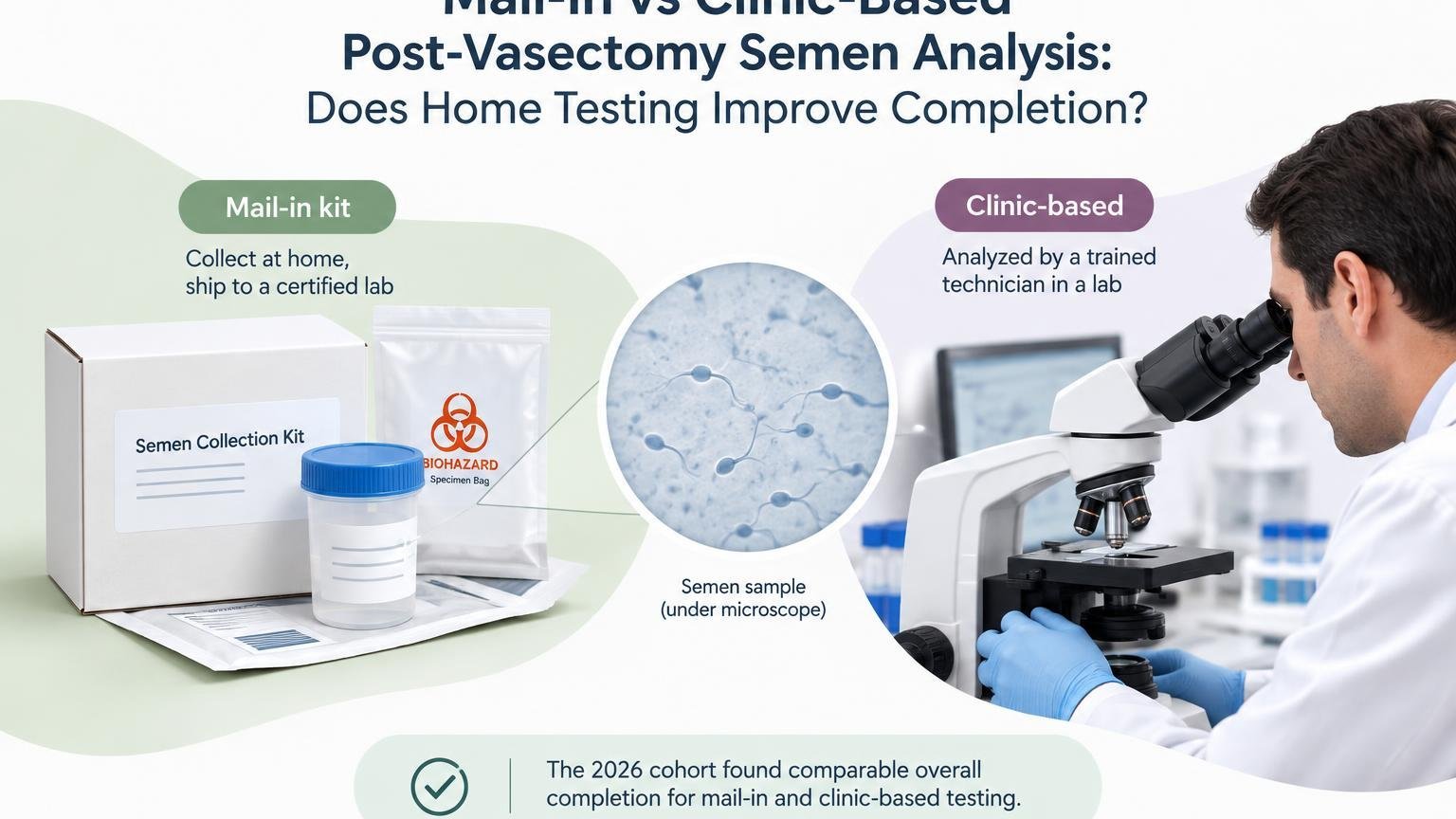
After a vasectomy, a post-vasectomy semen analysis (PVSA) is the only way to confirm that no sperm, or only a permitted trace of non-motile sperm, remain in the ejaculate. The practical problem is that many men never complete the test. A 2026 retrospective cohort from a single US institution compared completion before and after an institutional switch from clinic-based to mail-in PVSA. Among 966 patients, 592 were in the clinic-based group and 374 in the mail-based group.[1][2]
The headline result is nuanced. Completion within 6 months was higher in the mail-based group (77.7% vs 83.42%, P = .0485), but overall completion did not differ significantly (84.49% vs 80.57%, P = .101). After multivariable adjustment, only marital status and age were associated with PVSA completion, not testing modality. The authors concluded that mail-based and clinic-based PVSA showed comparable adherence and that mail-based testing is a reasonable alternative, particularly where baseline compliance is already high.
This is an updated evidence review, not a new study. The evidence does not show that mail-in kits universally rescue non-completion, and it does not establish that instant at-home strips are equivalent to laboratory analysis. Timing, the laboratory standard used, and urologist sign-off remain central.[3]
Why This Matters
Vasectomy is not immediately effective. Sperm can remain in the reproductive tract for weeks to months after the procedure, and unintended pregnancy after vasectomy is most often attributed to unprotected intercourse before a negative semen analysis is confirmed. The test is therefore not administrative; it is the step that converts a procedure into reliable contraception.[4]
Skipping the PVSA leaves a couple using contraception indefinitely or, worse, stopping it without confirmation. The logistical friction of producing a sample and delivering it to a clinic is widely described as a reason men postpone or skip testing, although that causal claim is not firmly established in the supplied peer-reviewed data. The 2026 cohort was designed around exactly this question: whether changing the submission route changes completion.
The topic also matters because testing formats are often conflated. A mail-in kit analyzed by a certified laboratory, an in-clinic microscopic analysis, and an instant home strip are three different products with different information yields. Understanding which one answers the clinical question is part of understanding PVSA completion.
Biological and Clinical Mechanism
A vasectomy interrupts the vas deferens, but sperm already downstream of the cut do not disappear at the moment of surgery. They must be cleared through ejaculation over time. This is why a sample taken too early can contain sperm for reasons unrelated to surgical failure, and why a positive early result provides little useful information. The clinical task is to wait long enough for natural clearance, then measure what remains.
The laboratory distinguishes three broad outcomes. Azoospermia means no sperm are seen. Rare non-motile sperm means a very small number of sperm, none moving; one consumer summary of the AUA Vasectomy Guideline describes this as acceptable clearance in most cases when the count stays at or below 100,000 non-motile sperm per milliliter. Motile sperm means the sample has not met clearance, usually because the tract has not fully emptied, and retesting in a few weeks is typical.
The timing window reflects this biology. One consumer summary states the AUA guideline points to 8 to 16 weeks after the procedure, with many surgeons adding a rough benchmark of about 20 ejaculations; that ejaculation count is described as a guideline rather than a finish line. A US provider page states an AUA recommendation of at least 8–12 weeks and a minimum of 20 ejaculations, with that practice testing at 12 weeks. The discrepancy between 8–16 and 8–12 weeks in these secondary sources is a reminder to follow the treating urologist's protocol rather than a single web summary.
Clearance is not simply a lab value; it is a clinical decision. Even a clean at-home result is described as a screening tool, with formal clearance to rely on vasectomy alone coming from the treating urologist reading a result against the clinical threshold. This distinction matters because the test format can change the confidence of that reading.
What the Evidence Shows
The central peer-reviewed source is a retrospective review of patients who underwent vasectomy between January 2015 and September 2023 at a single institution. The study compared PVSA completion between clinic-based and mail-in testing following an institutional protocol change. Outcomes included completion within 6 months, overall completion, semen analysis result, vasectomy failure, and repeat vasectomy. Because the comparison arose from a change in institutional practice rather than randomization, group differences may reflect patient selection and secular trends as well as testing format.
Completion within 6 months was significantly higher with mail-based testing: 77.7% versus 83.42%, P = .0485. The absolute difference is roughly six percentage points, and the P value sits close to the conventional 0.05 threshold. Statistical significance here does not automatically translate into a large clinical advantage; it indicates that the observed difference is unlikely to be explained by chance alone under the study's assumptions, while the size of the difference and the non-randomized design limit how strongly it should be interpreted.
Overall completion, however, did not differ significantly: 84.49% versus 80.57%, P = .101. This null result is important. It suggests that at this institution, switching to mail-in testing did not substantially increase the proportion of men who eventually completed a PVSA. The format may have shifted when testing happened, bringing some completions inside the 6-month window, without changing the overall proportion who tested at some point.
The adjustment analysis complicates a simple logistical story. In unadjusted analysis, mail-based testing, marital status, and travel time were associated with increased odds of 6-month PVSA completion. After multivariable adjustment controlling for baseline characteristics, only marital status and age remained associated with completion. In other words, the apparent advantage of mail-in testing in the unadjusted comparison was not robust to adjustment for who the patients were. This pattern is consistent with testing modality being a marker of patient characteristics rather than an independent driver of adherence in this cohort.
The authors' conclusion is measured: mail-based and clinic-based PVSA demonstrated comparable adherence, completion was more strongly associated with age and marital status than with testing modality, and mail-based PVSA is supported as a safe and effective alternative for follow-up, particularly in populations with high baseline compliance. The qualifier about high baseline compliance acknowledges that the institution's overall completion was already high, which may limit how much improvement any format change could produce.
Other supplied sources are consumer or provider education pages rather than primary studies. One commercial page states that clinic logistics are the single biggest reason men skip PVSA and that skipping leads to late pregnancies; this is a plausible hypothesis but is presented without citation and should not be treated as established causal evidence. A provider page asserts that studies show at-home testing significantly improves compliance compared with in-office testing, an uncited claim that conflicts with the retrospective cohort's null overall finding. These conflicting claims illustrate why the peer-reviewed cohort deserves more weight than marketing copy.
Test Format: Clinic, Mail-In Lab, and Instant Strip
The three testing routes are not interchangeable. In-clinic analysis is described as the reference standard: a trained technician examines a fresh sample under a microscope, counts sperm, and assesses motility, usually within an hour of collection. Mail-in kits also involve laboratory analysis, but the sample is collected at home, protected by a preservative, and shipped. Instant strips react to sperm concentration above a cutoff and display a line that the user reads without laboratory involvement.
| Testing route | Who reads the result | Motility assessed | Applies clinical clearance standard | Main limitation |
|---|---|---|---|---|
| In-clinic laboratory analysis | Trained technician | Yes, per consumer description | Yes | Requires clinic visit or timed sample delivery |
| Mail-in laboratory kit | Laboratory (certified per consumer sources) | Described as laboratory analysis | Described as following the AUA standard | Transit handling; not the clinical sign-off itself |
| Instant at-home strip | The user | No | No | Detects only above a cutoff; can miss low but meaningful results |
The instant strip is the weakest option for confirming vasectomy. It does not measure motility, it can miss rare non-motile sperm, and independent comparisons against laboratory analysis are described as showing poor correlation. It also cannot apply the clinical clearance standard that distinguishes rare non-motile sperm, which may be acceptable, from motile sperm, which is not. A low but meaningful sperm count can fall below the strip's cutoff and read as negative. For a rough preliminary check it may have a place; for the test that determines when contraception can stop, it leaves out the parts that matter.
Cost is part of the completion picture, though the evidence is weak. One consumer page reports clinic semen analysis typically costs $150 to $500 before travel and time off, and describes mail-in kits as typically cheaper and often eligible for flexible spending or health savings accounts. These figures come from a commercial source rather than a formal cost study and vary by region and practice. Cost should be discussed with the urologist's office and insurer rather than assumed.
Interpretation and Limitations
The strongest available evidence is a single-institution retrospective cohort, which carries inherent limitations. Patients were not randomized to testing format; the comparison followed an institutional protocol change, so differences in age, relationship status, travel distance, and calendar period could confound the results. The fact that only marital status and age survived adjustment suggests that patient factors, not the test route, may drive completion. The 6-month difference had a P value near the threshold, and the overall difference was not significant.
Generalizability is another limit. The authors specifically qualify their support for mail-based PVSA to populations with high baseline compliance. An institution where most men already complete testing may see little gain from removing logistics, whereas a setting with low baseline completion could behave differently. The supplied packet does not include data on vasectomy failure or repeat vasectomy rates by group, so the study cannot establish that mail-in testing changes clinical outcomes such as pregnancy or recanalization detection.
The non-peer-reviewed sources introduce their own biases. Commercial pages have an incentive to favor mail-in products and to frame instant strips as inadequate. Provider pages may promote partner services. Uncited claims that at-home testing significantly improves compliance conflict with the cohort's overall null result and should be treated cautiously. The timing window also varies across secondary sources (8–16 weeks in one summary, 8–12 weeks in another), underlining the need to follow the treating urologist's instructions and, where possible, the primary guideline.
Finally, none of the supplied sources is a randomized trial or a systematic review of PVSA completion. The evidence supports a reasonable conclusion—mail-in testing is an acceptable alternative with comparable overall adherence in one cohort—but not a strong claim that switching formats will solve non-completion everywhere.
Research Outlook
Several questions remain open. Prospective or randomized studies across institutions with different baseline completion rates would clarify whether mail-in testing causally improves adherence or mainly shifts timing. Studies stratified by travel distance, age, and relationship status could identify who benefits most. Research linking testing format to downstream outcomes—confirmed clearance, repeat testing, unintended pregnancy, and detection of recanalization—would be more clinically meaningful than completion alone.
Better evidence on instant strips is also needed. The supplied consumer sources describe poor correlation with laboratory analysis but do not cite the underlying comparison studies. Independent validation against laboratory microscopy, including performance near the clearance threshold and for non-motile sperm, would help clinicians advise patients who ask whether a strip is enough. Until then, the strip should not be presented as a substitute for laboratory-based confirmation or urologist clearance.
Key Takeaways
- In a 2026 single-institution retrospective cohort of 966 patients, PVSA completion within 6 months was higher with mail-based than clinic-based testing (77.7% vs 83.42%, P = .0485), but overall completion did not differ significantly (84.49% vs 80.57%, P = .101).
- After multivariable adjustment, only marital status and age were associated with PVSA completion, not testing modality, suggesting patient factors may matter more than the submission route in this cohort.
- Timing matters: secondary sources describe guideline windows of roughly 8–16 weeks or 8–12 weeks after vasectomy, often with a benchmark of about 20 ejaculations, but patients should follow their urologist's specific protocol.
- Clearance criteria distinguish azoospermia, rare non-motile sperm at or below 100,000 per milliliter in most cases, and motile sperm, which means not cleared and usually prompts retesting.
- Instant at-home strips detect concentration above a cutoff without assessing motility and cannot apply the clinical clearance standard; they are not a substitute for laboratory analysis or urologist sign-off.
Questions and Answers
What is a post-vasectomy semen analysis and why is it needed?
A post-vasectomy semen analysis (PVSA) checks whether sperm remain in semen after vasectomy. It is needed because vasectomy is not immediately effective; sperm can remain in the reproductive tract for weeks to months. The test confirms whether the man has reached azoospermia or an acceptable rare non-motile sperm threshold, allowing the urologist to clear him to rely on the vasectomy alone.
Does mail-in post-vasectomy semen testing improve completion compared with clinic testing?
A 2026 retrospective cohort of 966 patients found higher completion within 6 months with mail-based testing (77.7% vs 83.42%, P = .0485), but no significant difference in overall completion (84.49% vs 80.57%, P = .101). After adjustment, only marital status and age were associated with completion, not testing modality. The evidence suggests comparable overall adherence in that institution, not a universal improvement.
When should post-vasectomy semen analysis be done after a vasectomy?
Secondary sources describe guideline windows of roughly 8–16 weeks or 8–12 weeks after vasectomy, often with a rough benchmark of about 20 ejaculations. Testing too early can show sperm for reasons unrelated to failure. The exact timing should follow the treating urologist's protocol, because summaries differ and the primary guideline was not supplied.
What sperm count counts as clearance after a vasectomy?
Azoospermia, meaning no sperm seen, is the clearest result. One consumer summary of the AUA Vasectomy Guideline states that rare non-motile sperm at or below 100,000 non-motile sperm per milliliter is acceptable clearance in most cases. Motile sperm means not cleared and usually prompts retesting in a few weeks. The urologist makes the formal clearance decision.
Are instant at-home sperm test strips reliable for confirming a vasectomy?
Instant strips are described as the weakest option. They react only to sperm concentration above a cutoff, do not measure motility, and can miss rare non-motile sperm or low but meaningful counts. Independent comparisons against laboratory analysis are described as showing poor correlation. They cannot apply the clinical clearance standard and should not replace laboratory-based testing or urologist sign-off.
What are the limitations of the evidence comparing mail-in and clinic post-vasectomy semen analysis?
The main comparison is a single-institution retrospective cohort, not a randomized trial. Testing format changed by institutional protocol, so patient selection and secular trends may confound results. The 6-month P value was close to threshold, the overall difference was not significant, and the authors qualified their support to populations with high baseline compliance. Non-peer-reviewed sources include uncited claims and commercial interests.
Sources and References
- Mark Doss; Hunter Kraus; Glendon Markollari; Shelby Salisbury; Chase Schlesselman; Eliza DeFroda; Mark Wakefield. Post Vasectomy Semen Analysis Completion in Clinic-Based Versus Mail-In Testing. Urology. 2026 DOI: 10.1016/j.urology.2026.05.002.
- At-Home Post-Vasectomy Semen Analysis: Confirm It Worked Without the Clinic Trip. 2026
- At-Home vs In-Clinic Post-Vasectomy Semen Analysis: How to Choose. 2026
- Post-Vasectomy Semen Analysis | University Urology Knoxville.
SANYUN Science Center explains published research on men's reproductive and sexual health, connecting scientific evidence with everyday questions while making sources and limitations clear.
Disclaimer: This article is for scientific education and research communication only. It does not provide medical advice, diagnosis, or individualized treatment recommendations, and does not endorse any medication, supplement, device, penile enlargement procedure, or other intervention. Decisions about sexual and reproductive health should be made in consultation with a qualified healthcare professional. Do not delay seeking professional care because of information in this article.
Original Content & Copyright Notice
- This article is prepared for SANYUN Science Center, drawing on published research and publicly available academic literature on men’s sexual and reproductive health. Its editorial explanations and presentation are developed for this platform.
- Copyright in the original editorial content, selection, and arrangement is reserved by SANYUN Science Center to the extent protected by applicable law. Referenced research, quotations, and third-party materials remain subject to the rights of their respective owners. This notice does not claim ownership of scientific facts or third-party research.
- Except where permitted by applicable law or an applicable license, prior written permission is required to reproduce, republish, translate, adapt, redistribute, or commercially reuse protected content. Attribution alone does not grant permission for such reuse.
- For permitted quotation or authorized reuse, clearly identify the source and retain a link to the original article.
- Source: SANYUN Science Center
- Original URL: Retain the original article URL on science.san-yun.com.
- Copyright Holder: SANYUN Science Center, for its own protected editorial content.
- Quotation, excerpts, or authorized reuse must not distort the scientific meaning, omit material limitations or disclaimers, or imply unverified medical claims, product efficacy, or endorsement by SANYUN Science Center.



