




Category: Reproductive Care
Core Research Direction: Whether male age above 40 is associated with semen parameters (concentration, motility, progressive motility, morphology, acrosomal index) in men attending an IVF centre for infertility evaluation in a Turkish population
Search Intent: Does a man's age affect his sperm parameters?
Platform: SANYUN Science Center
Evidence reviewed through: 2026-11-14
Executive Summary
A retrospective analysis from a single IVF centre in Istanbul examined semen samples from men attending for infertility evaluation and asked whether being over 40 years of age was associated with poorer semen quality. The investigators divided samples into two groups around a 40-year threshold and compared sperm concentration, total motility, progressive motility, normal morphology and acrosomal index.[1]
The central result is counterintuitive: sperm concentration was statistically significantly higher in the group over 40 years (p<0.05), while the differences in total motility, progressive motility, morphology and acrosome index were not statistically significant (p>0.05). The authors concluded that concentration rose with age in this sample while other parameters did not change.
This is one clinic-based observational comparison, not a verdict on paternal age and fertility. The authors themselves note that the relationship between advanced paternal age and infertility remains under investigation, and they call for further genetic and biochemical work. Readers should treat the concentration finding as a hypothesis-generating observation rather than a biological rule.
Why Male Age and Sperm Parameters Matter
Public discussion of reproductive ageing is heavily weighted toward women. The authors open by acknowledging that advanced maternal age clearly affects infertility, while the paternal side is less settled. That asymmetry is part of why studies like this one are published at all: the question is not settled, and clinical counselling for older men often proceeds with more uncertainty than for older women.
Semen analysis remains the basic laboratory test in male infertility evaluation. It is not a direct measure of fertility, but it gives a structured snapshot of sperm production and function across several dimensions. Understanding what each parameter reflects helps explain why a single-age cut-off can produce mixed results across them.
The Parameters That Were Compared
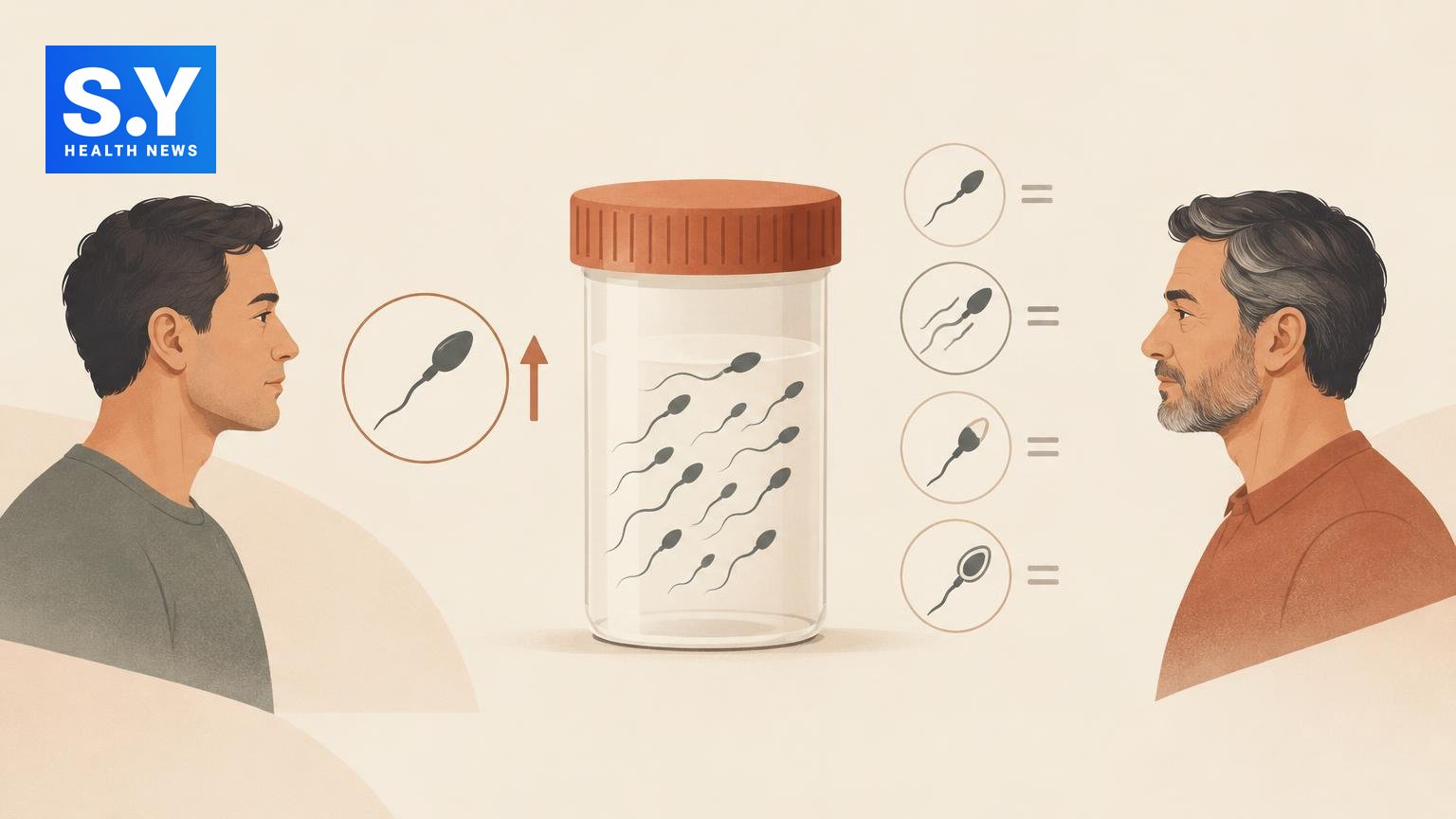
The study compared two groups on five laboratory variables: sperm concentration, expressed in million per millilitre; total motility and progressive motility, each expressed as a percentage; normal morphology, the percentage of sperm with normal shape; and acrosomal index, a percentage measure tied to the acrosome, the cap-like structure involved in penetrating the egg. Semen volume was listed among the study aims, but the abstract's comparison list covers the five parameters above.
These variables are related but not interchangeable. Concentration reflects how many sperm are produced per unit volume; motility reflects movement, with progressive motility specifically capturing forward movement; morphology reflects structural normality; and acrosomal index reflects the proportion of sperm carrying an intact acrosome. A change in one does not automatically imply a change in the others, which is one reason the split result in this study is biologically plausible rather than paradoxical on its face.
What the Study Did
The analysis covered 1,402 patients who attended the IVF Center of Istanbul Florence Nightingale Hospital and had semen analysis performed between January 2017 and May 2019. Samples were assessed according to WHO criteria and split into under-40 and over-40 age groups. The authors describe this as the largest Turkish sample on the topic, a self-assessment that has not been independently verified in the available text.
The design is retrospective and comparative: existing clinical records were grouped by age and compared on laboratory outcomes. It was not a prospective experiment, not a randomised study and not a general-population survey. The men were attending a fertility centre for evaluation, which means the sample is enriched for reproductive difficulty and may not reflect men in the wider community.
What the Evidence Shows
The headline comparison produced one statistically significant difference and four non-significant ones. Sperm concentration was significantly higher in the over-40 group (p<0.05). Total motility, progressive motility, normal morphology and acrosomal index showed no statistically significant difference between groups (p>0.05).
| Parameter | How it is expressed | Result in the over-40 vs under-40 comparison |
|---|---|---|
| Sperm concentration | Million per mL | Statistically significantly higher in the over-40 group (p<0.05) |
| Total motility | Percentage | No statistically significant difference (p>0.05) |
| Progressive motility | Percentage | No statistically significant difference (p>0.05) |
| Normal morphology | Percentage | No statistically significant difference (p>0.05) |
| Acrosomal index | Percentage | No statistically significant difference (p>0.05) |
Beyond the p-values, the available abstract does not report the actual group means, the size of the concentration difference or confidence intervals. That gap matters: 'statistically significant' describes the probability that an observed difference is unlikely under a no-difference assumption, not how large or how clinically meaningful the difference is. A small absolute difference in a large sample can be statistically significant without changing a man's reproductive prospects.
It is also worth being precise about direction. The authors state that concentration increased with male age while the other parameters did not change. This is the opposite of the common assumption that older men necessarily have lower sperm counts. The result therefore deserves attention, but it also deserves scrutiny before being generalised.
Interpretation and Limitations
Several features limit how far these findings can be pushed. First, the study is single-centre and drawn from an IVF population, so selection effects are likely: men presenting for infertility evaluation differ from the general male population in ways that could interact with age. Second, age was dichotomised at 40 years, which discards information about trends within each group and can obscure non-linear relationships. Third, the abstract reports no effect sizes or confidence intervals, so clinical magnitude cannot be judged.
The observational design also means the concentration finding cannot establish causation. Age is entangled with duration of infertility, referral patterns, lifestyle, occupational exposures and other unmeasured factors. A higher concentration among older attendees could reflect who gets referred and when, rather than a biological effect of ageing on spermatogenesis. The authors do not claim a mechanism, and the available text does not test one.
The non-significant results are similarly constrained. Failing to detect a statistically significant difference is not proof that no difference exists, particularly when the analysis strategy and statistical power are not fully described. The appropriate reading is that this dataset did not show clear age-related differences in motility, morphology or acrosomal index at the 40-year cut-off, not that age is irrelevant to those parameters across the lifespan.
Research Outlook
The authors explicitly call for further investigations at genetic and biochemical levels to understand the relationship between advanced age and infertility. That framing is important: routine semen analysis captures only part of male reproductive biology. Sperm DNA integrity, chromatin packaging, epigenetic marks and other molecular features are not measured by the parameters compared here, and the paper does not report data on them.
Future work would ideally use finer age categories, report effect sizes and confidence intervals, and include comparison populations beyond fertility clinics. Prospective designs and molecular endpoints would help separate biological ageing effects from referral and lifestyle confounders. Until such evidence accumulates, the relationship between paternal age and infertility should be described as under active investigation, which is exactly how the authors frame it.
Key Takeaways
- In 1,402 men attending an Istanbul IVF centre between January 2017 and May 2019, sperm concentration was statistically significantly higher in the over-40 group (p<0.05).
- Total motility, progressive motility, normal morphology and acrosomal index showed no statistically significant difference between the under-40 and over-40 groups (p>0.05).
- The authors concluded that concentration increased with age in this sample while other parameters did not change, but the abstract reports no effect sizes or confidence intervals.
- The study is a single-centre, retrospective comparison of fertility-clinic attendees; it cannot establish causation or generalise to all men.
- The relationship between advanced paternal age and infertility remains under investigation, and the authors call for genetic and biochemical research.
Questions and Answers
What does semen analysis measure in male fertility evaluation?
Semen analysis is a laboratory assessment of sperm production and function. This study compared sperm concentration in million per millilitre, total and progressive motility as percentages, normal morphology as a percentage, and acrosomal index as a percentage, all assessed under WHO criteria. These parameters describe different aspects of sperm and do not move together automatically.
Did men over 40 have worse sperm quality in the Turkish IVF centre study?
Not in the direction usually assumed. Among 1,402 men, sperm concentration was statistically significantly higher in the over-40 group (p<0.05), while total motility, progressive motility, morphology and acrosomal index showed no statistically significant difference (p>0.05). The authors concluded concentration increased with age in this sample and other parameters did not change.
How strong is the evidence that male age raises sperm concentration?
The evidence is limited. It comes from one retrospective, single-centre comparison of fertility-clinic attendees, with age split at 40 years and no reported effect sizes or confidence intervals. Statistical significance does not establish causation or clinical importance. The finding is best treated as hypothesis-generating and in need of confirmation in other populations and designs.
Can these Turkish fertility clinic findings be applied to all men?
Probably not directly. The sample consisted of men attending an IVF centre for infertility evaluation in Istanbul, a group likely enriched for reproductive difficulty and shaped by referral patterns. Findings may not reflect the general male population, and the single-centre design limits wider generalisation. Age was also dichotomised at 40, hiding trends within each group.
What are the main limitations of research linking paternal age to semen parameters?
Key limitations include single-centre sampling, selection of fertility-clinic patients, a single age cut-off, absent effect sizes and confidence intervals, and an observational design that cannot separate age from lifestyle, referral and other confounders. Non-significant results also do not prove no effect exists, and molecular features such as DNA integrity were not assessed here.
What should men over 40 understand about sperm and fertility?
Semen quality is multi-dimensional, and a single number does not define fertility. This study found higher concentration but no significant differences in motility, morphology or acrosomal index in older attendees, and its limits mean it cannot predict an individual's outcome. Men with fertility concerns should discuss full evaluation with a clinician rather than rely on age alone.
Sources and References
- Berna Yıldırım; İlknur Keskin; Yusuf Sağıroğlu; Seda Karabulut. Erkek yaşı sperm parametrelerini etkiliyor mu? Türk popülasyonuna ait ilk seri []. Andrology Bulletin (Androloji Bülteni). 2020 22(4):213-218 DOI: 10.24898/tandro.2020.01069.
SANYUN Science Center explains published research on men's reproductive and sexual health, connecting scientific evidence with everyday questions while making sources and limitations clear.
Disclaimer: This article is for scientific education and research communication only. It does not provide medical advice, diagnosis, or individualized treatment recommendations, and does not endorse any medication, supplement, device, penile enlargement procedure, or other intervention. Decisions about sexual and reproductive health should be made in consultation with a qualified healthcare professional. Do not delay seeking professional care because of information in this article.
Original Content & Copyright Notice
- This article is prepared for SANYUN Science Center, drawing on published research and publicly available academic literature on men’s sexual and reproductive health. Its editorial explanations and presentation are developed for this platform.
- Copyright in the original editorial content, selection, and arrangement is reserved by SANYUN Science Center to the extent protected by applicable law. Referenced research, quotations, and third-party materials remain subject to the rights of their respective owners. This notice does not claim ownership of scientific facts or third-party research.
- Except where permitted by applicable law or an applicable license, prior written permission is required to reproduce, republish, translate, adapt, redistribute, or commercially reuse protected content. Attribution alone does not grant permission for such reuse.
- For permitted quotation or authorized reuse, clearly identify the source and retain a link to the original article.
- Source: SANYUN Science Center
- Original URL: Retain the original article URL on science.san-yun.com.
- Copyright Holder: SANYUN Science Center, for its own protected editorial content.
- Quotation, excerpts, or authorized reuse must not distort the scientific meaning, omit material limitations or disclaimers, or imply unverified medical claims, product efficacy, or endorsement by SANYUN Science Center.



