




Category: Clinical Insights
Core Research Direction: Evidence on the diagnosis and management of male chronic pelvic pain, centered on the 2025 American Urological Association guideline and its Chinese-language interpretation, including its symptom-based classification and its evidence-graded treatment approach
Search Intent: What does the 2025 American Urological Association guideline recommend for classifying and managing chronic pelvic pain in men, and how strong is the underlying evidence?
Platform: SANYUN Science Center
Evidence reviewed through: 2026-11-11
Executive Summary
Male chronic pelvic pain is described in the supplied interpretation as a clinically heterogeneous syndrome in urology and andrology, with complex etiology, substantial impact on quality of life, and many available treatments whose effectiveness remains uncertain. In 2025 the American Urological Association issued a guideline on its diagnosis and management, which a Chinese-language interpretation by Liu Zhuo and Yang Weimin, published in Clinical Surgery Journal in 2026, presents as a response to these diagnostic and therapeutic difficulties.[1][2][3]
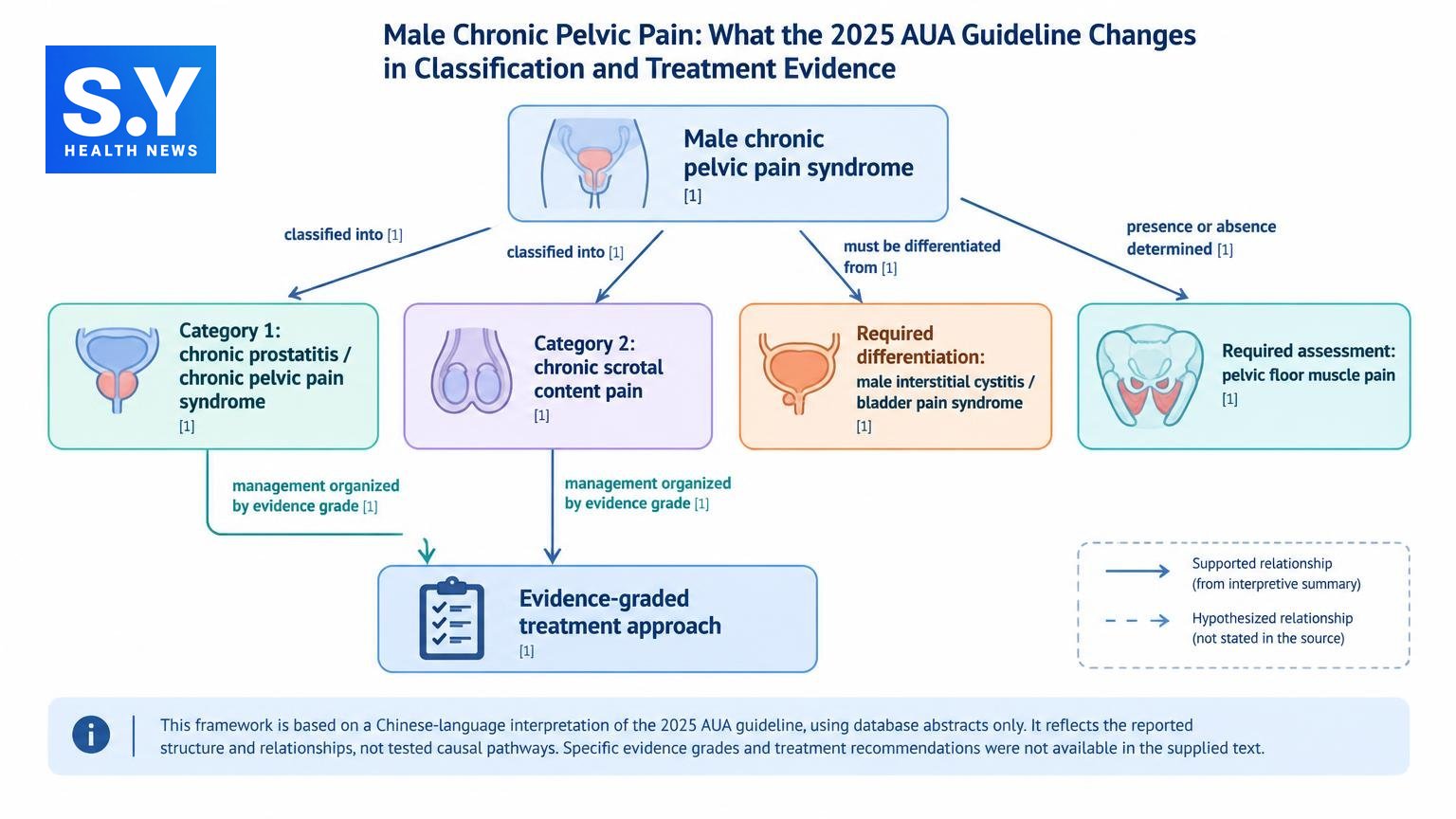
The interpretation reports two structural changes: a finer symptom-based classification into chronic prostatitis/chronic pelvic pain syndrome and chronic scrotal content pain, and an evidence-graded approach that places existing treatment modalities on an evidence-based footing. It also records a diagnostic requirement to differentiate male interstitial cystitis/bladder pain syndrome and to determine whether pelvic floor muscle pain is present.
The supplied material does not include the primary guideline document or the graded recommendation tables. Specific evidence grades, effect sizes, trial results and recommendation strengths therefore cannot be reported here, and any such figures would be unverified. This review covers the documented framework and explains, with appropriate caution, what the interpretive article establishes and what remains to be confirmed against the source guideline.
Why This Matters
The interpretive article frames male chronic pelvic pain as a condition in which clinicians face both diagnostic ambiguity and an unusually wide menu of treatments of uncertain benefit. That combination matters for patients as well as clinicians: without a structured classification, symptoms arising from the prostate, scrotal contents, bladder or pelvic floor can be conflated, and without evidence grading, widely used treatments may persist on habit rather than demonstrated benefit.
Three separate database records, including two with identical abstract wording, attest that the interpretation characterizes the syndrome in the same terms and attributes a refined classification to the 2025 guideline. These are duplicate or overlapping bibliographic records rather than independent corroboration, and the abstract text is truncated in all three, so they confirm the existence and framing of the interpretation more reliably than they confirm its detailed content.
A further contextual reason for interest lies in how much certainty guideline users should grant recommendation wording. An exploratory study in a different specialty, decompensated cirrhosis, found that agreement between guideline authors and independent assessment against Cochrane review conclusions was 14.5% (95% CI 7.7% to 25.6%), with most disagreements reflecting guideline authors overstating recommendation strength. Its authors proposed a systematic tendency toward overstated certainty with potential direct impact on patient care. That study examined US and European liver guidelines, not the AUA pelvic pain guideline, so it should be read as a general caution about guideline certainty language rather than as evidence about any specific AUA recommendation.[4]
Classification: A Two-Category Framework Plus Required Differentials
According to the interpretation, the 2025 AUA guideline divides male chronic pelvic pain into chronic prostatitis/chronic pelvic pain syndrome and chronic scrotal content pain. This is a decidedly practical split: it anchors the working diagnosis in the anatomical region most often implicated, while acknowledging that scrotal pain is a distinct clinical problem requiring its own assessment rather than being absorbed into a prostate-centered label.
Classification alone is not presented as sufficient. The interpretation also records two required considerations: male interstitial cystitis/bladder pain syndrome must be differentiated, and the presence or absence of pelvic floor muscle pain must be determined. Both are conditions that can produce overlapping pelvic pain, and separating them has direct implications for which management pathway a patient enters. The supplied text describes this requirement but provides no diagnostic accuracy data, no testing algorithm and no thresholds, so the operational details depend on the primary guideline.
| Construct | What the interpretation reports | Why it matters clinically |
|---|---|---|
| Chronic prostatitis/chronic pelvic pain syndrome | One of two categories in the guideline's revised classification of male chronic pelvic pain. | Provides a named diagnostic category for prostate-region pain; the supplied text does not detail its criteria. |
| Chronic scrotal content pain | The second category in the revised classification. | Separates scrotal pain from prostate-centered pain so that scrotal assessment is not absorbed into a prostate label. |
| Male interstitial cystitis/bladder pain syndrome | A condition the guideline requires be differentiated from male chronic pelvic pain. | Overlapping bladder pain symptoms can otherwise be misattributed; no diagnostic accuracy data were supplied. |
| Pelvic floor muscle pain | Presence or absence must be explicitly determined according to the interpretation. | Pelvic floor involvement can alter which treatment pathway is chosen; the assessment method is not described in the supplied text. |
| Evidence-graded treatment approach | The interpretation states that existing treatment modalities are placed on an evidence-based footing. | Intended to replace ungraded treatment lists; specific grades and recommendations were not available in the supplied material. |
What the Evidence Shows — and What the Supplied Material Cannot Show
What is documented at the level of the guideline's architecture is limited but clear: a 2025 AUA guideline exists, it addresses both diagnosis and management, it introduces a two-part classification of male chronic pelvic pain, it requires differentiation from male interstitial cystitis/bladder pain syndrome, it requires determination of pelvic floor muscle pain, and it organizes treatments by evidence. Each of these points appears in the interpretation's abstract as recorded across three database entries.
What is not documented in the supplied material is equally important. The abstract sentence describing evidence-based grading is truncated mid-phrase, and no treatment-specific recommendations, evidence levels, outcome measures, trial data or recommendation strengths are present. Statements such as "the guideline strongly recommends treatment X" or "treatment Y has level B evidence" cannot be supported from the available text and are deliberately omitted here. Readers seeking the graded recommendations should consult the primary guideline and the full interpretation rather than a summary of a summary.
The interpretation's framing also includes an implicit evidence claim of its own: that existing treatments are numerous but of uncertain effectiveness. This is presented as background motivating the guideline, not as a measured estimate. No pooled effect size, response rate or comparative ranking accompanies it in the supplied text, so it should be read as a characterization of clinical uncertainty rather than a quantified finding.
How Much Certainty Should Guideline Users Grant?
Guidelines are only as strong as the evidence and judgment behind each statement, and the wording of recommendations can outrun the underlying data. The cirrhosis study is a useful, if indirect, illustration. Nine guidelines covering four topics contained 62 statements also addressed by seven Cochrane reviews; agreement between guideline authors and independent assessment was 14.5% (95% CI 7.7% to 25.6%), and the disagreements were mostly about recommendation strength rather than direction. Differences in search dates did not explain the pattern.
The authors interpreted this as a possible systematic issue of overstated recommendation strength with direct implications for patient care. Because the study was exploratory, used purposive sampling, and addressed decompensated cirrhosis rather than urological pain, its numeric findings should not be transported to the AUA guideline. Its transferable lesson is procedural: when a guideline grades a treatment, clinicians and patients benefit from knowing whether the grade reflects high-quality comparative evidence or expert consensus, and the supplied interpretation does not let us make that distinction for any specific therapy.
For male chronic pelvic pain specifically, this caution is amplified by the condition's own evidence profile as described in the interpretation: many treatments, uncertain effectiveness, heterogeneous etiology. A graded approach is a genuine advance over an ungraded list, but it does not by itself create high-quality evidence where none exists. The value lies in making the strength of that evidence visible and usable.
Interpretation and Limitations
This article is based on a Chinese-language interpretation of the 2025 AUA guideline as recorded in bibliographic databases, not on the guideline itself. The interpretation by Liu Zhuo and Yang Weimin appeared in Clinical Surgery Journal 2026, issue 1, pages 30-33, a publication year that should not be confused with the 2025 date of the underlying guideline. Only truncated abstracts were available, and one key sentence about evidence grading is cut off, so the review cannot verify how faithfully the interpretation represents the primary document or how the guideline's grades are distributed.
The three database records are overlapping rather than independent: two reproduce identical abstract wording and the third a truncated version of the same summary. They corroborate that the interpretation exists and how it frames the guideline, but they do not add clinical evidence. No patient-level data, diagnostic accuracy studies or randomized trials on male chronic pelvic pain were supplied, so no statement here should be read as a comparative judgment about specific treatments.
Finally, the cirrhosis study is included only as methodological context about guideline certainty language. It concerns a different disease area, used a purposive sample and an exploratory design, and its authors' conclusion about systematic overstatement is a hypothesis drawn from that sample. It neither validates nor invalidates the AUA guideline, and it cannot substitute for an appraisal of the urological evidence base.
Research Outlook
The most immediate need is transparent access to the primary guideline's graded recommendations and the full interpretation, so that the two-category classification and the required differentials can be evaluated against the diagnostic evidence behind them. The supplied material establishes the framework but not its supporting data.
Beyond that, the field would benefit from comparative studies in the two classified groups — chronic prostatitis/chronic pelvic pain syndrome and chronic scrotal content pain — and from work clarifying how pelvic floor muscle pain and bladder pain syndrome are best separated in practice. The interpretation identifies these distinctions as clinically required; whether specific assessment strategies improve outcomes is a question the supplied text does not answer.
Methodologically, the cirrhosis comparison suggests that future appraisals of urological guidelines should examine not only whether recommendations align with evidence but also whether recommendation strength is calibrated to that evidence. For a syndrome characterized by numerous treatments of uncertain benefit, distinguishing confident recommendations from cautious ones may be as consequential as the recommendations themselves.
Key Takeaways
- The 2025 AUA guideline on male chronic pelvic pain reclassifies the syndrome into chronic prostatitis/chronic pelvic pain syndrome and chronic scrotal content pain, according to the Chinese-language interpretation.
- The interpretation also records a requirement to differentiate male interstitial cystitis/bladder pain syndrome and to determine whether pelvic floor muscle pain is present.
- The guideline is described as placing existing treatment modalities on an evidence-based footing; however, the supplied abstract is truncated and no specific grades, effect sizes or recommendation strengths are available here.
- Male chronic pelvic pain is framed as etiologically complex, quality-of-life impairing and served by many treatments of uncertain effectiveness — background for the guideline rather than a quantified finding.
- An exploratory cirrhosis study found only 14.5% agreement (95% CI 7.7% to 25.6%) between guideline authors and independent assessment, mostly due to overstated recommendation strength; it is context about guideline certainty, not evidence about pelvic pain treatment.
Questions and Answers
What is male chronic pelvic pain, and how does the 2025 AUA guideline classify it?
The interpretation describes male chronic pelvic pain as a clinically heterogeneous urology-and-andrology syndrome with complex etiology that substantially impairs quality of life, and with many treatments of uncertain effectiveness. The 2025 AUA guideline reportedly divides it into chronic prostatitis/chronic pelvic pain syndrome and chronic scrotal content pain, while requiring differentiation from male interstitial cystitis/bladder pain syndrome and assessment for pelvic floor muscle pain.
What did the Chinese-language interpretation of the 2025 AUA male chronic pelvic pain guideline report?
Published by Liu Zhuo and Yang Weimin in Clinical Surgery Journal (2026, issue 1, pages 30-33), the interpretation reports that the 2025 AUA guideline introduced a finer two-category classification, required differentiation from bladder pain syndrome and determination of pelvic floor muscle pain, and placed existing treatments on an evidence-based footing. The supplied abstract is truncated where evidence grading is described, so specific graded recommendations are not available here.
How strong is the evidence behind the 2025 AUA male chronic pelvic pain treatment recommendations?
The supplied material cannot answer this. The interpretation states that treatments were organized on an evidence-based footing, but the sentence is cut off and no grades, effect sizes or recommendation strengths are provided. The article therefore does not claim any specific level of evidence for any therapy; readers need the primary guideline and full interpretation to assess strength of evidence.
Does the two-category classification of male chronic pelvic pain apply to all men with pelvic pain?
Not necessarily as a complete diagnostic system. The interpretation reports that the guideline also requires differentiating male interstitial cystitis/bladder pain syndrome and determining whether pelvic floor muscle pain is present, indicating that overlapping conditions must be assessed before a category is assigned. The supplied text does not describe the criteria, testing sequence or thresholds used, so applicability in individual cases cannot be judged from it.
What are the main limitations of the evidence summarized in this review?
The review relies on database abstracts of a Chinese-language interpretation, not the primary AUA guideline. Only truncated abstract text was available, no treatment-specific grades or outcome data were supplied, and the three records overlap rather than provide independent corroboration. The cirrhosis study on guideline certainty addresses a different disease area and is context only.
Why should patients and clinicians care about how guideline recommendations are graded?
Grading makes the strength of underlying evidence visible, which matters for a syndrome with many treatments of uncertain benefit. An exploratory cirrhosis study found agreement between guideline authors and independent assessment of only 14.5% (95% CI 7.7% to 25.6%), mostly because authors overstated recommendation strength. That finding concerns liver guidelines, not the AUA pelvic pain guideline, but it illustrates why the basis of a recommendation deserves attention.
Conceptual framework: Conceptual framework of the 2025 AUA male chronic pelvic pain guideline as summarized in a Chinese-language interpretation. The framework shows a two-category classification (chronic prostatitis/chronic pelvic pain syndrome and chronic scrotal content pain), required differentiation from male interstitial cystitis/bladder pain syndrome, required determination of pelvic floor muscle pain, and an evidence-graded treatment approach. Relations reflect the interpretive summary, not tested causal pathways; specific evidence grades were not available in the supplied text and the figure is not study data.
Academic References & Evidence
- 刘卓; 杨为民. 2025美国泌尿外科学会《男性慢性盆腔疼痛的诊断与管理》指南解读. 临床外科杂志 34(1)
- 刘卓; 杨为民. 2025美国泌尿外科学会《男性慢性盆腔疼痛的诊断与管理》指南解读. 临床外科杂志. 2026
- 刘卓; 杨为民. 《临床外科杂志》. 临床外科杂志. 2026 (1):30-33
- Gurusamy; Roberts; Leung; O’Brien; Gluud; Pavlov; Davidson. Clinical practice guidelines recommendations compared to the findings of the Cochrane systematic reviews on the management of decompensated liver cirrhosis in the USA and Europe. Frontline Gastroenterology. 2026 DOI: 10.1136/flgastro-2026-103856.
SANYUN Science Center explains published research on men's reproductive and sexual health, connecting scientific evidence with everyday questions while making sources and limitations clear.
Disclaimer: This article is for scientific education and research communication only. It does not provide medical advice, diagnosis, or individualized treatment recommendations, and does not endorse any medication, supplement, device, penile enlargement procedure, or other intervention. Decisions about sexual and reproductive health should be made in consultation with a qualified healthcare professional. Do not delay seeking professional care because of information in this article.
Original Content & Copyright Notice
- This article is prepared for SANYUN Science Center, drawing on published research and publicly available academic literature on men’s sexual and reproductive health. Its editorial explanations and presentation are developed for this platform.
- Copyright in the original editorial content, selection, and arrangement is reserved by SANYUN Science Center to the extent protected by applicable law. Referenced research, quotations, and third-party materials remain subject to the rights of their respective owners. This notice does not claim ownership of scientific facts or third-party research.
- Except where permitted by applicable law or an applicable license, prior written permission is required to reproduce, republish, translate, adapt, redistribute, or commercially reuse protected content. Attribution alone does not grant permission for such reuse.
- For permitted quotation or authorized reuse, clearly identify the source and retain a link to the original article.
- Source: SANYUN Science Center
- Original URL: Retain the original article URL on science.san-yun.com.
- Copyright Holder: SANYUN Science Center, for its own protected editorial content.
- Quotation, excerpts, or authorized reuse must not distort the scientific meaning, omit material limitations or disclaimers, or imply unverified medical claims, product efficacy, or endorsement by SANYUN Science Center.



