




Category: Clinical Insights
Core Research Direction: Male fertility literacy and the male side of fertility care: how much adult men know about male fertility, lifestyle-linked and medical aspects, and where knowledge is weakest, framed as a research-based review of the evidence in a knowledge survey and contextual reviews.
Search Intent: What do adult men actually know about male fertility and its lifestyle and medical determinants, and where are the knowledge gaps that could delay male fertility assessment?
Platform: SANYUN Science Center
Evidence reviewed through: 2026-11-22
Executive Summary
Male fertility is often investigated after the female partner has already been assessed, yet male factors are estimated to cause approximately half of all infertility cases. A 2026 cross-sectional questionnaire study asked how much adult men actually know about the medical and lifestyle aspects of their own fertility, and whether knowledge tracks with age, medical background or prior fertility concerns. The survey was small and non-representative, but its pattern of results is informative: recognition of broad lifestyle links was relatively good, while clinically specific concepts were poorly understood.[1]
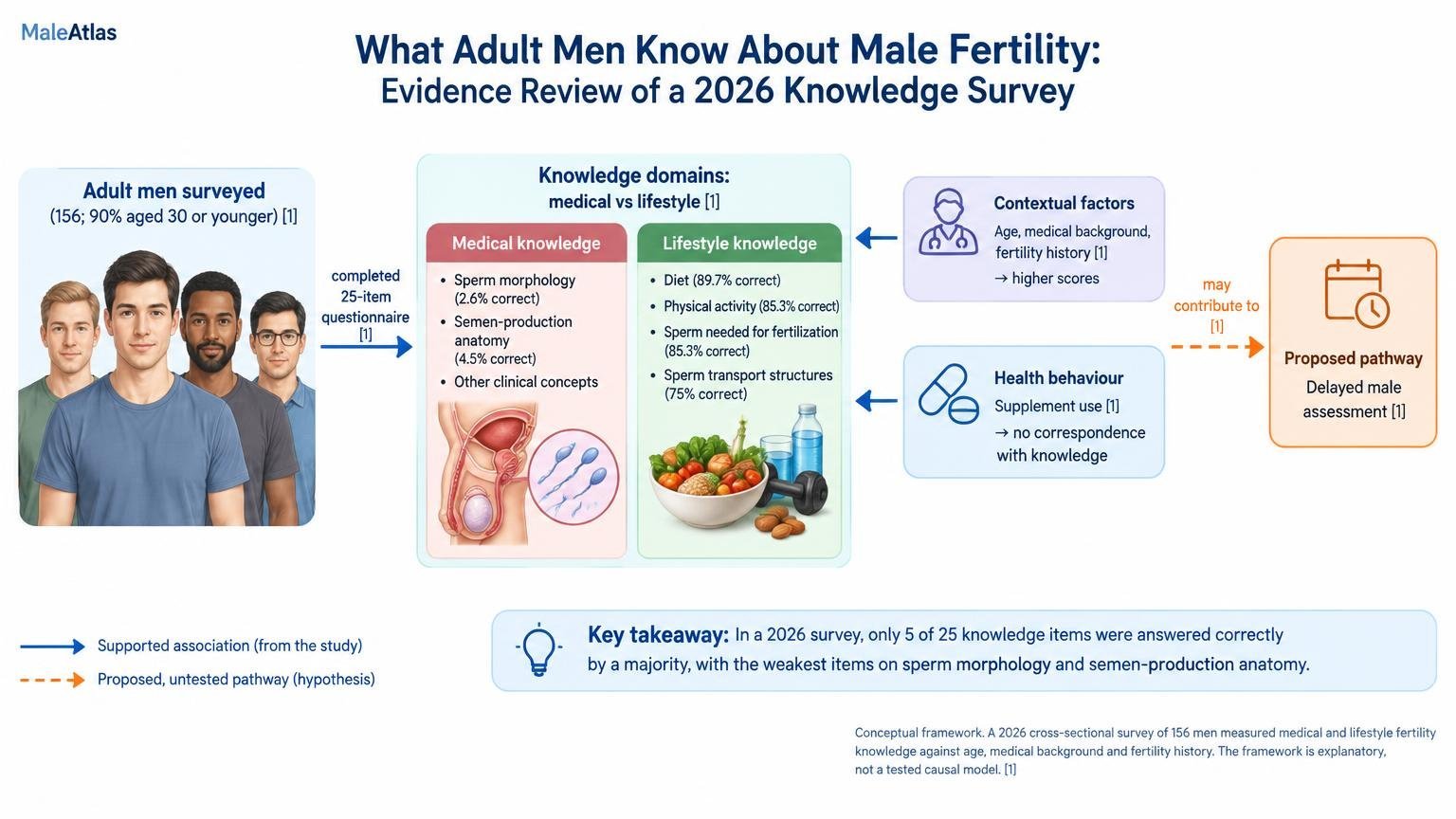
The study enrolled 156 men of reproductive age in Poland through an anonymous online form; ages ranged from 18 to 74, and 90% were aged 30 or younger. On a 25-item knowledge questionnaire, only 5 of 25 items were answered correctly by a majority of respondents. The lowest-scoring items were both medical: 2.6% correctly identified the minimum normal sperm morphology percentage, and 4.5% correctly identified a structure essential for semen production. By contrast, 89.7% knew that eating habits can affect fertility.
The authors concluded that knowledge was inadequate in most areas assessed, and they reported that high supplement use did not correspond with higher fertility knowledge. These are descriptive findings from a convenience sample; they do not establish that poor knowledge delays care, nor do they show that education would improve outcomes. Still, the contrast between confidence about lifestyle and weakness on clinical concepts is a useful signal for how male fertility literacy might be framed.
Why This Matters
Fertility care has historically been organised around the female partner. The survey's introduction notes that fertility clinics most often see women first, even though male factors are estimated to be the cause in approximately half of all infertility cases. When male assessment is deferred, modifiable risk factors may go unrecognised for longer, and couples may undergo investigations on one side while the other side remains unexamined. Whether low knowledge directly causes that delay is not settled; the authors cite growing evidence that low awareness may contribute to delays in diagnosis and treatment, but this was not tested in their survey.[2]
The public-health framing matters too. Approximately one in six people globally will experience infertility during their lifetime, according to the WHO estimate cited in an advocacy article. That scale makes fertility literacy a general men's health issue rather than a niche concern for couples already in treatment. The same source describes male infertility as carrying psychological costs, including anxiety, depression and isolation, and calls for psychological support alongside clinical care.[3]
How the Knowledge Survey Was Designed
The study used an anonymous online questionnaire developed by the authors from a literature review, with input from dietetics and infertility specialists and a pilot phase to check clarity. Part I collected demographics, including age, education, occupation, relationship status, children, whether the respondent's education or profession was medicine-related, and whether he had been suspected of or treated for infertility. Part II contained 25 single-choice knowledge items: 10 medical and 15 lifestyle-related, each scored one point for a correct answer, for a maximum of 25 points.
Because distributions were non-normal, the analysts used nonparametric tests: Mann–Whitney for two-group comparisons and Spearman correlation for continuous associations, with significance set at p < 0.05. Internal consistency of the knowledge test was assessed with the Kuder–Richardson Formula 20, yielding 0.78, which the authors describe as good. That reliability figure concerns the coherence of the instrument, not the representativeness of the sample.
What the Evidence Shows
Overall performance was low. Only 5 of 25 questions, or 20%, were answered correctly by the majority of respondents. Correct answers were spread across lifestyle and medical topics at the top end, but the two worst-performing items were both medical, suggesting that familiarity with general health messages does not translate into understanding of clinical fertility assessment.
The strongest items were practical and broadly framed. Eating habits affecting fertility was answered correctly by 89.7%, insufficient physical activity by 85.3%, the number of sperm needed to fertilize an egg by 85.3%, and the structures transporting sperm from the testes by 75%. The weakest were the minimum normal sperm morphology percentage, correct in 2.6%, and the structure essential for semen production, correct in 4.5%.
| Survey finding | Reported value | What it suggests |
|---|---|---|
| Men completing the questionnaire | 156 men of reproductive age; ages 18–74; 90% aged 30 or younger | Small, young-skewed convenience sample; not representative of all adult men |
| Items answered correctly by a majority | 5 of 25 (20%) | Most individual knowledge items were missed by most respondents |
| Correct on diet affecting fertility | 89.7% | Broad lifestyle messaging appears to reach men |
| Correct on minimum normal sperm morphology | 2.6% | Clinical semen-analysis thresholds are poorly understood |
| Reported supplement use | 80.1%; 84.8% of users chose multi-ingredient products | Health interest did not correspond with higher knowledge scores |
| Knowledge score versus age | Spearman R = 0.26, p < 0.001 | Weak positive correlation; cross-sectional, so ageing and experience are entangled |
Two subgroup differences stood out. Men whose education or profession was connected with medicine scored significantly higher than those without a medical background (p < 0.001), and men suspected of or treated for infertility scored significantly higher than those without such history (p < 0.001). The authors also found a weak positive correlation between total score and age (Spearman R = 0.26, p < 0.001) and a strong positive correlation between lifestyle-question scores and medical-question scores (R = 0.52, p < 0.001), suggesting that respondents did not specialise in one knowledge domain.
The supplement finding is the most provocative. 80.1% of respondents used supplements, and 84.8% of those used products with more than two ingredients, yet the authors observed that this health-oriented behaviour did not correspond with higher fertility knowledge. They further reported no statistically significant associations between supplement characteristics linked to fertility, such as oxidative potential, and age, medical background or fertility-treatment status. This is a null result in a small sample and should not be read as evidence that supplements are irrelevant; it is better understood as a mismatch between taking action and understanding the evidence behind it.
The Biology Behind the Weak Items
The poor performance on morphology and semen-production anatomy is clinically meaningful because semen analysis is the core initial test in male factor assessment. A patient-education article describes the WHO 6th edition (2021) reference framework: a lower reference limit of around 16 million sperm per millilitre for concentration, around 42% or more for total motility, and around 4% or more for normal morphology. Men who do not know that a low morphology percentage can still fall within the reference range may misinterpret a result as definitive sterility.
Timing is another concept the survey did not directly test but that follows from the biology. Sperm are produced continuously, and a full production cycle takes roughly 72 to 90 days, so lifestyle changes appear in a semen analysis around three months later. A clinic source reports typically repeating a semen analysis after 4 to 12 weeks before drawing conclusions. Together these points argue for explaining variability and repeat testing, not just pass-fail thresholds.
Lifestyle mechanisms are plausible but unevenly established. The survey authors describe dietary minerals and vitamins as relevant to sperm maturation and DNA integrity, and they note that lifestyle modification is commonly recommended. However, they also state that the influence of lifestyle changes on semen parameters is under-researched and that well-designed prospective studies are needed, and that causal relationships between specific interventions and improved semen quality remain unclear. Knowledge education should therefore avoid promising that behaviour change will normalise a semen analysis.
Interpretation and Limitations
The central limitation is the sample. A convenience online survey of 156 men, 90% of whom were aged 30 or younger, cannot represent adult men generally, and the authors themselves note that existing studies do not provide a clear consensus on the extent or nature of men's fertility knowledge gap. Their conclusion that knowledge was inadequate is an interpretation of a non-representative group. Item-level percentages from a single author-developed instrument are useful for hypothesis generation, not for population prevalence estimates.
The design cannot separate knowledge from experience. Men already investigated for infertility scored higher, but that is consistent with learning through clinical contact rather than with prior knowledge prompting earlier care. The weak age correlation may similarly reflect life-stage exposure rather than ageing itself. And the survey measured self-reported answers to 25 single-choice questions, which cannot capture whether men understood the reasoning behind a correct answer or would act on it.
There is also a citation problem in the surrounding literature. The educational and advocacy sources used here are secondary: the semen reference values are paraphrased, the one-in-six estimate is cited secondhand, and the claim that a BMC Public Health systematic review found substantial depression among men with infertility lacks bibliographic detail in the supplied text. These points are best treated as contextual framing, not as independently verified findings.
Research Outlook
The authors position their results as a basis for further work identifying knowledge gaps and developing educational strategies. The more useful next steps would be a representative sample, a validated instrument with published item difficulty, and prospective testing of whether targeted education changes help-seeking or time to male assessment. Linking knowledge scores to actual clinical timelines would test the hypothesis that low awareness delays diagnosis, which this survey could not do.
Key Takeaways
- Male factors are estimated to account for approximately half of infertility cases, yet male assessment often follows female investigation.
- In a 2026 survey of 156 men, only 5 of 25 knowledge items were answered correctly by a majority, with the weakest items on clinical semen concepts.
- Broad lifestyle knowledge was stronger: 89.7% knew diet can affect fertility, yet supplement use was high and did not track with knowledge.
- Higher scores among medically trained and fertility-treated men are associations in a small cross-sectional sample, not proof that education improves outcomes.
- Semen analysis uses reference limits, not absolutes, and repeat testing after 4 to 12 weeks is typical clinic practice; fertility literacy should reflect that nuance.
Questions and Answers
What does the 2026 male fertility knowledge survey show about how much adult men know?
In 156 men of reproductive age, only 5 of 25 questionnaire items were answered correctly by a majority of respondents, and the authors concluded knowledge was inadequate across most medical and lifestyle domains. The sample was a small, young-skewed convenience group, so the finding describes these respondents rather than all adult men.
Which male fertility topics do men understand least, according to the survey?
The weakest items were clinical: only 2.6% correctly identified the minimum normal sperm morphology percentage, and 4.5% correctly identified a structure essential for semen production. Broad lifestyle items scored far better, with 89.7% knowing diet can affect fertility. This suggests general health messaging reaches men more than semen-analysis specifics.
Does taking fertility supplements mean a man understands male fertility?
Not necessarily. In the survey, 80.1% of respondents used supplements, and 84.8% of users chose multi-ingredient products, yet the authors observed that this did not correspond with higher knowledge scores. The study was descriptive and small, so this shows a mismatch between behaviour and understanding, not that supplements are ineffective.
How strong is the evidence that low fertility knowledge delays male fertility assessment?
It is suggestive but unproven. The survey authors cite growing evidence that low awareness may contribute to delays in diagnosis and treatment, but their cross-sectional design did not test timing or causation. Men already treated for infertility scored higher, which could reflect learning through clinical contact rather than knowledge prompting earlier care.
What are the main limitations of the male fertility knowledge study?
The main limits are a convenience online sample of 156 men, 90% aged 30 or younger, and a single author-developed questionnaire. The authors themselves note no clear consensus exists on the extent of men's knowledge gap. Results are useful for identifying possible gaps, not for estimating prevalence in the general male population.
Why do semen analysis reference values matter for male fertility literacy?
Reference limits frame results as a range rather than a pass-fail verdict. Educational sources cite WHO 6th edition values of around 16 million sperm per millilitre, around 42% total motility and around 4% normal morphology, and clinics often repeat testing after 4 to 12 weeks. Understanding this reduces the risk of misreading one abnormal result.
Conceptual framework: Conceptual framework. A 2026 cross-sectional survey of 156 men measured medical and lifestyle fertility knowledge against age, medical background and fertility history. Arrows show supported associations within the sample and one proposed, untested pathway from low knowledge to delayed male assessment. The framework is explanatory, not a tested causal model.
Academic References & Evidence
- Analysis of adult men’s knowledge in the area of male fertility in relation to selected lifestyle factors – Scientific Reports. Scientific Reports. 2026 16
- Understanding male fertility — the other half of the story. 2026
- Kenya SRHR Alliance. The Other Half of the Story: Understanding Male Infertility. 2026
SANYUN Science Center explains published research on men's reproductive and sexual health, connecting scientific evidence with everyday questions while making sources and limitations clear.
Disclaimer: This article is for scientific education and research communication only. It does not provide medical advice, diagnosis, or individualized treatment recommendations, and does not endorse any medication, supplement, device, penile enlargement procedure, or other intervention. Decisions about sexual and reproductive health should be made in consultation with a qualified healthcare professional. Do not delay seeking professional care because of information in this article.
Original Content & Copyright Notice
- This article is prepared for SANYUN Science Center, drawing on published research and publicly available academic literature on men’s sexual and reproductive health. Its editorial explanations and presentation are developed for this platform.
- Copyright in the original editorial content, selection, and arrangement is reserved by SANYUN Science Center to the extent protected by applicable law. Referenced research, quotations, and third-party materials remain subject to the rights of their respective owners. This notice does not claim ownership of scientific facts or third-party research.
- Except where permitted by applicable law or an applicable license, prior written permission is required to reproduce, republish, translate, adapt, redistribute, or commercially reuse protected content. Attribution alone does not grant permission for such reuse.
- For permitted quotation or authorized reuse, clearly identify the source and retain a link to the original article.
- Source: SANYUN Science Center
- Original URL: Retain the original article URL on science.san-yun.com.
- Copyright Holder: SANYUN Science Center, for its own protected editorial content.
- Quotation, excerpts, or authorized reuse must not distort the scientific meaning, omit material limitations or disclaimers, or imply unverified medical claims, product efficacy, or endorsement by SANYUN Science Center.



