




Category: Health Academy
Core Research Direction: Popcorn-style debunking of common male fertility myths, focused on which claims are supported by clinical guidance versus unsupported, with emphasis on semen analysis, testosterone, antioxidants, azoospermia, and heat exposure
Search Intent: Which common beliefs about male fertility are actually supported by evidence, and which should be discarded?
Platform: SANYUN Science Center
Evidence reviewed through: 2026-11-06
Executive Summary
Popular beliefs about male fertility often treat a single observation as a firm conclusion. The educational sources reviewed here suggest a different picture: male factor contributes a substantial share of infertility, and semen analysis should be an early test rather than an afterthought. Yet no single semen parameter is highly predictive of fertility on its own, and one abnormal sample should be repeated before conclusions are drawn.[1]
Several widely repeated claims do not survive scrutiny. Exogenous testosterone suppresses sperm production and can cause azoospermia, so it is not a fertility treatment. Antioxidant supplements have not shown a robust, high-certainty live-birth benefit in subfertile men. Azoospermia does not always rule out biological parenthood. Heat exposure from hot tubs, saunas and prolonged laptop use has better support than the idea that tight underwear is a major cause.
Why This Matters
The examined source states that male factor contributes to a substantial proportion of infertility cases. This matters because assessment of the male partner is often delayed or skipped, according to the same educational source. A semen analysis is described as quick, inexpensive and non-invasive, yet claims that equate normal ejaculation with fertility can make couples wait unnecessarily before seeking evaluation.
A separate consumer blog reviewed for this article asserts that about 30% of men worldwide face fertility issues. That figure is not accompanied by a source, definition or study population, so it should be treated as an estimate rather than an established prevalence. The gap illustrates why myth correction requires careful reading: some claims are guideline-supported, some are unsupported, and some are simply unverifiable.[2]
Biological and Clinical Background
Sperm production takes roughly 72 to 90 days. This provides a timing rule for evaluating changes: approximately three months should be allowed before repeating a test after a lifestyle or treatment change. It also means that a new semen analysis is needed when circumstances change, because weight gain, ageing, varicocele development, new medications, testosterone or steroid use, and new infections can all impair sperm quality that was previously normal.
Semen appearance and volume are not reliable proxies for sperm count, motility or morphology. Under strict criteria, a low proportion of normal sperm forms is common even in fertile men, and no single parameter is highly predictive of fertility by itself. These biological points explain why semen analysis depends on several measures and why a single abnormal value must be interpreted in context.
What the Evidence Shows, Myth by Myth
Myth: infertility is mainly a female problem. The evidence does not support treating male assessment as optional. The examined source states that male factor is involved in a substantial proportion of cases and that semen analysis should be among the first tests. Exact proportions are not supplied in the text, so the claim should be understood qualitatively rather than as a precise attributable fraction.
Myth: testosterone boosts fertility. The opposite is the concern. Exogenous testosterone suppresses sperm production and can cause azoospermia. The AUA/ASRM guideline, as relayed in the examined source, states that testosterone monotherapy should not be prescribed to men interested in current or future fertility and is not a treatment for male infertility. This is a clear example of a widely marketed hormone being contrary to the goal of conception.
Myth: supplements will fix it. A Cochrane review described in the examined source included 90 trials in over 10,000 subfertile men. A possible live-birth benefit disappeared when poor-quality studies were excluded, and the authors rated the evidence very low certainty and called it inconclusive. There was insufficient evidence for any specific antioxidant or dose. Supplements may be low risk and low cost, but they are not a treatment and are not a reason to delay assessment.
Myth: azoospermia means no chance of biological children. Extended search of the centrifuged sample finds rare sperm in up to 35% of men previously thought azoospermic. Where no sperm are found, surgical retrieval succeeds in many men, and retrieved sperm can be used with ICSI. These figures concern detection and retrieval, not guaranteed pregnancy, and the source does not quantify the proportion of successful retrievals.
Myth: a varicocele always needs fixing. Repair should be considered when a varicocele is palpable, semen parameters are abnormal and the couple is infertile. Repair is not recommended for non-palpable varicoceles found only on imaging, a strongly graded recommendation against. The distinction between palpable and imaging-only varicoceles is central to avoiding unnecessary procedures.
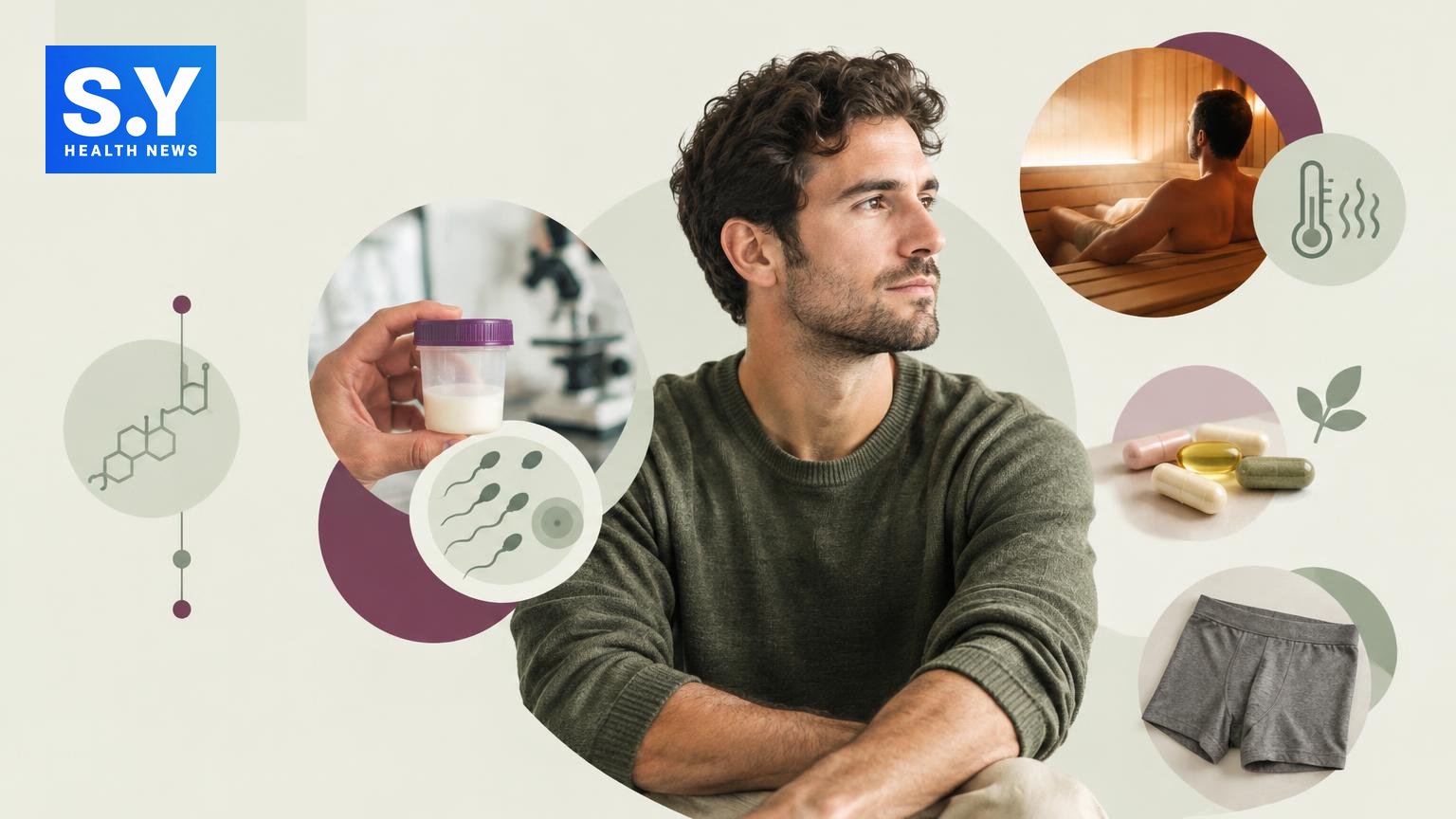
Myth: tight underwear is a major cause, and heat does not matter. The evidence judgment in the examined source is that tight underwear is weakly supported as a major cause, while sustained heat exposure from hot tubs, saunas and prolonged laptop use on the lap has better support. The source also reports that a well-designed Harvard study found men wearing boxers had 25% higher sperm concentration than men in tight underwear, attributed to lower scrotal temperature; the effect is described as real but modest and not a cure for low sperm production from other causes.
Claims about smoking and caffeine from the commercial blog are less reliable. That source states smoking raises testosterone and that a sperm concentration around 200 million per millilitre falls significantly, and claims heavy caffeine is lethal and reduces conception chance by about 45%. No study, dose or population is specified, and the concentration figure is far above usual reference values. These statements are hypotheses from a commercial blog rather than established findings.
Evidence Table: Claims and Their Support
| Claim | Supporting evidence in reviewed sources | Interpretation |
|---|---|---|
| Semen analysis should be an early test | Male factor contributes a substantial proportion of cases; semen analysis is quick, inexpensive and non-invasive (educational summary, no numeric estimate). | Guideline-directed approach; not an exact prevalence figure. |
| Testosterone improves fertility | Exogenous testosterone suppresses sperm production and can cause azoospermia; guideline advises against monotherapy in men interested in current or future fertility. | Claim is contradicted by guideline-based evidence. |
| Antioxidants treat male infertility | 90 trials in over 10,000 subfertile men; possible live-birth benefit disappeared when poor-quality studies were excluded; very low certainty; no specific antioxidant or dose supported. | Not a treatment under current certainty; evidence inconclusive. |
| Azoospermia means no biological children | Rare sperm found in up to 35% of men previously thought azoospermic after extended search; surgical retrieval succeeds in many men and retrieved sperm can be used with ICSI. | Chance is not zero, but the source does not quantify pregnancy success. |
| Tight underwear is a major cause | Weak evidence; sustained heat from hot tubs, saunas and prolonged laptop use on the lap has better support; boxers versus tight underwear difference of 25% in sperm concentration described as modest. | Low priority compared with heat exposure; observational evidence. |
| One abnormal semen analysis is conclusive | Semen parameters vary substantially between samples from the same man; an abnormal result should be repeated. | Repeat testing is required before conclusions. |
| A varicocele always needs surgery | Repair considered when palpable with abnormal semen in an infertile couple; not recommended for non-palpable imaging-only varicocele, a strongly graded recommendation against. | Selective repair, not universal surgery. |
Interpretation and Limitations
The primary examined source is a consumer educational article that asserts it was reviewed against ASRM, ESHRE and ACOG guidelines and updated in 2026. That review status cannot be independently verified from the text provided, and the article does not cite primary studies for most of its claims. The commercial blog agrees on some points but adds unsupported figures and mechanisms. None of the sources constitutes original clinical research or a systematic review performed for this article.
Several claims remain uncertain. The 25% higher sperm concentration among boxer wearers is described without the study name, year or sample size, and the design is not provided; observational associations of this kind cannot establish that underwear choice causes improved fertility outcomes. The cycling thresholds (under 5 hours per week versus over 5–8 hours per week) are described as associational, not causal, and the specific studies are not cited. The up-to-35% rare-sperm finding lacks a citation or sample size. These gaps mean that the direction of the evidence may be more trustworthy than the exact numbers.
The claim that low testosterone reduces seminal fluid and that above-normal testosterone reduces sperm count conflicts with the more standard statement that exogenous testosterone suppresses sperm production. It is a hypothesis from a consumer blog, unsourced and inconsistent with other material in the packet, and should not be used to guide decisions. Similarly, the claim that low folic acid intake causes infertility is attributed to an unnamed study and lacks design details.
Research Outlook
The main research needs are clearer than any single new supplement. Better evidence would include adequately powered trials with live birth as the outcome, standardized definitions of antioxidant dose, and longer follow-up. For heat exposure, prospective studies with measured scrotal temperature and semen outcomes would help move beyond the current qualitative judgments. For azoospermia, reporting of retrieval success and pregnancy outcomes by genetic diagnosis would clarify which men benefit most.
Key Takeaways
- Male factor contributes to a substantial proportion of infertility, and semen analysis should be an early test rather than a delayed one.
- Normal ejaculation, semen volume and appearance do not confirm fertility; azoospermia can look entirely normal.
- Exogenous testosterone suppresses sperm production and is not a treatment for male infertility; the AUA/ASRM guideline advises against it in men interested in current or future fertility.
- Antioxidant supplements have not shown a robust live-birth benefit; the Cochrane review was very low certainty and inconclusive, and no specific agent or dose is supported.
- Up to 35% of men previously thought azoospermic may have rare sperm on extended search, and surgical retrieval can succeed in many men, but success is not guaranteed.
- Sustained heat exposure from hot tubs, saunas and prolonged laptop use has better support as a modifiable factor than tight underwear, which is weakly implicated.
- Allow roughly three months before repeating a semen test, and do not assume a previous normal result or a prior child guarantees current fertility.
Questions and Answers
How is male factor infertility assessed, and why is semen analysis an early test?
The examined source states that male factor is involved in a substantial proportion of infertility cases and that semen analysis is quick, inexpensive and non-invasive, so it should be among the first tests rather than a later one. It does not provide a precise percentage, and male assessment is frequently delayed or skipped in practice.
Does testosterone therapy improve sperm count or male fertility?
No. Exogenous testosterone suppresses sperm production and can cause azoospermia. The AUA/ASRM guideline, as relayed in the reviewed source, states that testosterone monotherapy should not be prescribed to men interested in current or future fertility and is not a treatment for male infertility.
What does the Cochrane review say about antioxidants for male subfertility?
A Cochrane review of 90 trials in over 10,000 subfertile men found a possible live-birth benefit that disappeared when poor-quality studies were excluded. The authors rated the evidence very low certainty, called it inconclusive and found insufficient evidence for any specific antioxidant or dose. Supplements are not a treatment or a reason to delay assessment.
Can men with azoospermia still father biological children?
Sometimes. Extended search of centrifuged semen finds rare sperm in up to 35% of men previously thought azoospermic. Where none are found, surgical retrieval succeeds in many men and retrieved sperm can be used with ICSI. The source does not quantify pregnancy success, and genetic testing helps determine whether retrieval is worth attempting.
Do tight underwear or laptop heat affect sperm quality?
Evidence that tight underwear is a major cause is weak. Sustained heat exposure from hot tubs, saunas and prolonged laptop use on the lap has better support. One Harvard study described in the reviewed source found 25% higher sperm concentration in boxer wearers than in men wearing tight underwear, but the effect is described as modest and the study details are not given.
How long should men wait before repeating an abnormal semen analysis?
Semen parameters vary substantially between samples from the same man, so an abnormal result should be repeated before conclusions are drawn. Because sperm production takes roughly 72 to 90 days, about three months should be allowed before repeating a test after a change. A new analysis is also warranted when fertility history changes, such as after weight gain, new medications or a new infection.
Sources and References
- Male Fertility Myths Debunked — What Science Shows.
- 6 Common Male Fertility Myths You Should Stop Believing – Apollo Fertility.
SANYUN Science Center explains published research on men's reproductive and sexual health, connecting scientific evidence with everyday questions while making sources and limitations clear.
Disclaimer: This article is for scientific education and research communication only. It does not provide medical advice, diagnosis, or individualized treatment recommendations, and does not endorse any medication, supplement, device, penile enlargement procedure, or other intervention. Decisions about sexual and reproductive health should be made in consultation with a qualified healthcare professional. Do not delay seeking professional care because of information in this article.
Original Content & Copyright Notice
- This article is prepared for SANYUN Science Center, drawing on published research and publicly available academic literature on men’s sexual and reproductive health. Its editorial explanations and presentation are developed for this platform.
- Copyright in the original editorial content, selection, and arrangement is reserved by SANYUN Science Center to the extent protected by applicable law. Referenced research, quotations, and third-party materials remain subject to the rights of their respective owners. This notice does not claim ownership of scientific facts or third-party research.
- Except where permitted by applicable law or an applicable license, prior written permission is required to reproduce, republish, translate, adapt, redistribute, or commercially reuse protected content. Attribution alone does not grant permission for such reuse.
- For permitted quotation or authorized reuse, clearly identify the source and retain a link to the original article.
- Source: SANYUN Science Center
- Original URL: Retain the original article URL on science.san-yun.com.
- Copyright Holder: SANYUN Science Center, for its own protected editorial content.
- Quotation, excerpts, or authorized reuse must not distort the scientific meaning, omit material limitations or disclaimers, or imply unverified medical claims, product efficacy, or endorsement by SANYUN Science Center.



