




Category: Reproductive Care
Core Research Direction: Male fertility preservation: guideline-based semen analysis and testosterone avoidance, public awareness and intention gaps in China, and the experimental status of testicular tissue transplantation for boys facing gonadotoxic treatment
Search Intent: What does current evidence and guidance say about preserving male fertility — from semen analysis and testosterone avoidance to still-experimental tissue freezing — and how aware and willing are men to use it?
Platform: SANYUN Science Center
Evidence reviewed through: 2026-11-02
Executive Summary
Male fertility preservation rests on a simple principle: collect and freeze sperm before a threat to sperm production arrives. For adolescent and adult males, semen freezing is an established option. It is not available to prepubertal boys, who do not yet produce sperm, and there is currently no established clinical method to restore fertility in boys facing treatments that can cause permanent infertility.[1]
Guideline-based assessment is comparatively straightforward. A single semen analysis that is normal by WHO criteria is sufficient, and no further andrological investigation is indicated; normal semen volume, motility and morphology override concerns about FSH because semen analysis is the gold standard for male fertility potential.[2]
The main avoidable threat is exogenous testosterone. It suppresses spermatogenesis through negative feedback on the hypothalamus and pituitary and can cause azoospermia that may take months to years to recover. The practical guidance is to avoid testosterone therapy entirely if fertility is desired at any point in the future.
A 2026 cross-sectional survey of 2,692 people in mainland China found that only 31.68% said they would choose male fertility preservation in the future. Most respondents (77.6% of those willing) cited delaying childbearing as a healthy man, rather than cancer treatment (23.8%). A separate single-patient UK procedure in which frozen testicular tissue was transplanted back in August 2026 has not yet reported whether sperm production was restored.[3]
Why This Matters
Fertility preservation is usually discussed in the context of cancer treatment, but the Chinese survey suggests the public frames it differently. Among people who said they would use it, the leading reason was being a healthy man delaying childbearing (77.6%), far above cancer-related reasons (23.8%). That mismatch matters for how services are designed and explained: a system built only around oncology referrals may not reach the people who say they want preservation for timing reasons.
The survey also illustrates a knowledge-to-action gap. Awareness differed significantly by sex, age, occupation, education, income and region, and occupation (highest among healthcare workers), education, income and region remained independent factors in multivariate analysis. The authors concluded that overall awareness is insufficient, with clear occupational, educational and economic gradients.
Reasons for not choosing preservation were often informational rather than clinical: 56.1% of unwilling respondents said they saw no need and 38.6% cited lack of information. The most commonly perceived barrier was financial cost (29.9%), and the most desired supports were cost subsidies (77.4%) and convenient medical services (57.7%).
Semen Analysis and the Guideline Pathway
Semen analysis is the backbone of male fertility assessment. In the guideline summary used here, a normal result by WHO criteria means one test is enough and further andrological investigation is not indicated. The summary also states that normal volume, motility and morphology override concerns about FSH, because semen analysis remains the gold standard for male fertility potential.
For couples conceiving without difficulty, the same guidance advises no medical intervention or fertility preservation at that time, with evaluation advised only if pregnancy has not occurred after 12 months of regular unprotected intercourse. This is a threshold for investigation, not a guarantee that nothing can be wrong, and it is a secondary summary of guideline recommendations rather than primary trial evidence.
Lifestyle factors such as smoking, poor diet, obesity and environmental exposures can temporarily affect the hypothalamic-pituitary-gonadal axis and semen parameters. The guideline summary frames these as modifiable influences rather than as reasons for immediate escalation, while emphasizing that exogenous testosterone is the most significant threat to fertility.
How Testosterone Suppresses Sperm Production
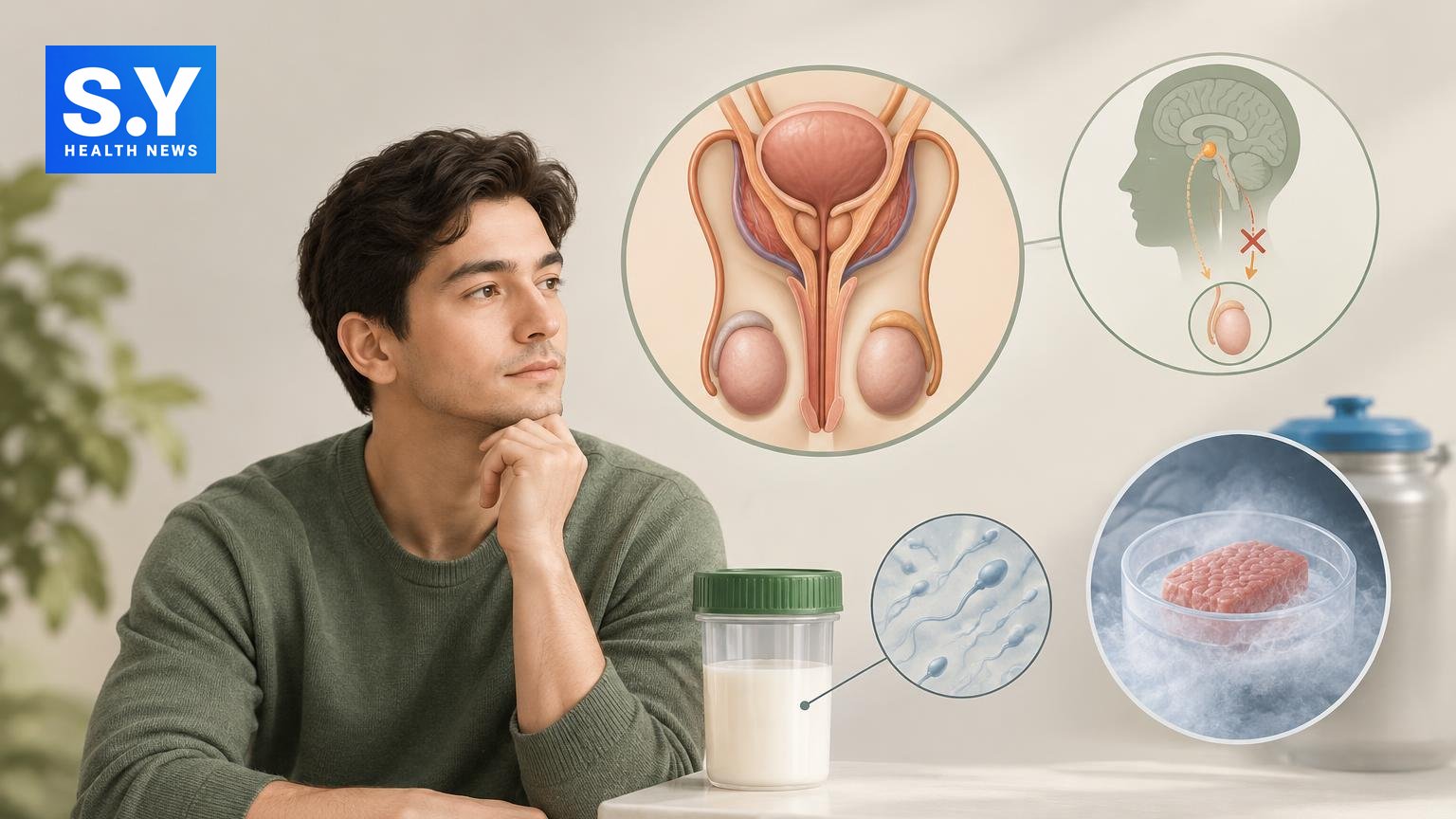
Exogenous testosterone does not add to sperm production. It acts through negative feedback on the hypothalamus and pituitary, reducing the gonadotropin signal that the testes need to produce sperm. The result can be complete suppression of spermatogenesis and azoospermia, with recovery taking months to years after stopping. The guidance is unambiguous: avoid testosterone therapy entirely if fertility is desired at any point in the future.
This mechanism is why a normal-looking hormone picture in a man using testosterone can be misleading. The guideline summary treats semen analysis as the functional test that matters, rather than isolated hormone values.
Fertility Preservation for Boys: Still Experimental
Semen freezing is established for adolescent and adult males but is not available to prepubertal boys because they do not yet produce sperm. There is currently no established clinical method to restore fertility in boys who face treatments that can cause permanent infertility.
Testicular tissue freezing is the experimental alternative. The tissue contains spermatogonial stem cells responsible for sperm production from puberty onward, and the hope is that tissue frozen before treatment can later be transplanted back and allow sperm production. This is a mechanistic rationale and a hypothesis, not an established human treatment.
Animal evidence supports plausibility. In non-human primates, testicular tissue frozen before sterilizing chemotherapy was transplanted back successfully, and mature sperm produced by the transplanted tissue were used in assisted reproduction, resulting in a live birth. Animal success does not establish human efficacy.
Human evidence remains very limited. A Belgian patient is reported to have had prepubertally frozen testicular tissue transplanted back and to have subsequently produced mature sperm. In the UK, a 19-year-old had testicular tissue removed and frozen in 2023 before a bone marrow transplant for a serious blood disorder. Three years later he had no sperm in his semen, and in August 2026 previously frozen tissue was transplanted back with the hope of restoring sperm production. The protocol plans to remove and examine some transplanted tissue after eight months to determine whether sperm were produced. No efficacy result has been reported.
Scale of storage is not scale of success. More than 1,200 patients in the UK and 3,100 worldwide have stored testicular tissue for potential future clinical use, but these are storage counts, not outcome data.
What the Survey Evidence Shows and Cannot Show
| Survey measure | Reported result | What it means |
|---|---|---|
| Design and timing | Cross-sectional questionnaire of the general public in mainland China, March–December 2025 | One-time snapshot; cannot track changes in awareness or behavior |
| Valid responses | 2,692 valid questionnaires | Large sample, but not a population-representative sample |
| Sample profile | 93.7% male; 45.5% under 25; 71.7% unmarried; 78.2% childless; 80.7% bachelor's degree or higher | Young, educated, male, childless skew limits generalization |
| Awareness differences | Statistically significant by sex, age, occupation, education, income and region | Group differences, not causes of low awareness |
| Independent awareness factors | Occupation (highest in healthcare workers), education, income and region | Cross-sectional associations only; no causal inference |
| Stated intention to use | 31.68% (853 of 2,692) said they would choose preservation in future | Intention, not actual uptake or access |
| Reported barriers and desired support | Cost barrier 29.9%; want cost subsidies 77.4%; want convenient services 57.7% | Perceived preferences, not measured service availability |
The survey was conducted between March and December 2025 with a cross-sectional design, so it captures stated awareness and intention at one point rather than behavior over time. Its respondents were predominantly male (93.7%), under 25 (45.5%), unmarried (71.7%), childless (78.2%) and educated to bachelor's level or higher (80.7%). Those characteristics may inflate or distort estimates of general public awareness, and the authors' conclusion of insufficient overall awareness comes from this single non-representative sample.
Interpretation and Limitations
Three evidence streams in this review differ sharply in strength. The semen analysis and testosterone guidance is a secondary summary of professional society recommendations, useful for orientation but not a substitute for reading the primary guidelines. The China survey is a large cross-sectional study with self-reported outcomes and a skewed sample. The testicular tissue transplant is a single-patient news report with a planned, not yet reported, outcome assessment.
Statistical significance in the survey should not be read as clinical importance. Significant differences in awareness by occupation, education, income and region describe gradients in a self-selected sample; they do not prove that any intervention would close those gaps. Likewise, the reported 31.68% intention figure does not mean that roughly one-third of men would actually use preservation if offered, because stated intention and real uptake are different outcomes.
The tissue-transplant report must be read as a safety and feasibility step. Hope of restored sperm production, a planned eight-month tissue examination, and a Belgian case report of mature sperm do not together establish that the procedure works, is durable, or is safe at scale. Peer-reviewed outcome data are needed before clinical claims can be made.
Research Outlook
The key open question for boys facing gonadotoxic treatment is whether transplanted testicular tissue can produce sperm that support fertilization in humans, and whether that effect persists. The planned tissue examination after eight months in the UK case is one early checkpoint, but single cases cannot answer the question. Animal evidence, including a live birth in non-human primates, supports continued research but not clinical adoption.
On the public health side, the survey points to informational and financial levers rather than to clinical ones: lack of information and perceived lack of necessity were common reasons for declining, and cost subsidies and convenient services were the most desired supports. Whether those supports would change intention or uptake remains untested.
Key Takeaways
- A single WHO-normal semen analysis is sufficient for assessment, and normal semen parameters override FSH concerns in the guideline summary.
- Exogenous testosterone can suppress sperm production completely and cause azoospermia that may take months to years to recover; it should be avoided when future fertility is desired.
- Semen freezing is established for adolescent and adult males but not available to prepubertal boys, for whom no established fertility-restoring method exists.
- Testicular tissue freezing and transplantation remains experimental; a UK single-patient procedure was performed in August 2026 with a planned eight-month tissue check and no reported efficacy result.
- In a 2,692-person cross-sectional survey in mainland China, only 31.68% said they would choose male fertility preservation, with awareness differing by occupation, education, income and region.
- Survey findings are associations from a young, educated, largely male sample and do not establish causes or predict actual uptake.
Questions and Answers
What is male fertility preservation and how does semen analysis fit into it?
Male fertility preservation means collecting and storing sperm or testicular tissue before a treatment or condition threatens sperm production. In guideline-based assessment, a single semen analysis that is normal by WHO criteria is sufficient, and normal volume, motility and morphology override FSH concerns because semen analysis is the gold standard for male fertility potential.
Why does testosterone therapy threaten male fertility?
Exogenous testosterone suppresses spermatogenesis through negative feedback on the hypothalamus and pituitary. This can cause azoospermia, and recovery may take months to years after stopping. Guidance summarized from the American Urological Association advises avoiding testosterone therapy entirely if fertility is desired at any point in the future.
What did the 2026 survey in China find about awareness and willingness to use male fertility preservation?
The cross-sectional survey collected 2,692 valid responses between March and December 2025. Awareness differed significantly by sex, age, occupation, education, income and region, and only 31.68% said they would choose preservation in future. Among willing respondents, 77.6% cited delaying childbearing as healthy men, versus 23.8% for cancer-related reasons.
How strong is the evidence that testicular tissue transplantation can restore sperm production in boys?
It is early-stage. Non-human primate research produced mature sperm and a live birth after transplanted frozen tissue, and a single Belgian patient reportedly produced mature sperm. In the UK, a 19-year-old received transplanted frozen tissue in August 2026, but the planned eight-month tissue examination has not reported whether sperm were produced.
What are the limitations of the China male fertility preservation survey?
It was a cross-sectional, self-reported questionnaire with a skewed sample: 93.7% male, 45.5% under 25, 80.7% with a bachelor's degree or higher, and 78.2% childless. Reported differences are associations, not causes, and the 31.68% figure reflects stated intention rather than actual use of services.
When should a couple seek fertility evaluation according to the guideline summary?
The European Association of Urology summary advises no medical intervention or fertility preservation when couples are conceiving normally, and evaluation only if pregnancy has not occurred after 12 months of regular unprotected intercourse. This is a secondary summary of guideline recommendations and does not replace individual clinical assessment.
Sources and References
- Rod Mitchell. UK first as frozen testicular tissue transplanted to help restore fertility.
- Fertility Preservation in Males. 2025
- 郭颖; 周芳; 王晓尉. 生殖医学杂志. 生殖医学杂志. 2026 35(06):727-734
SANYUN Science Center explains published research on men's reproductive and sexual health, connecting scientific evidence with everyday questions while making sources and limitations clear.
Disclaimer: This article is for scientific education and research communication only. It does not provide medical advice, diagnosis, or individualized treatment recommendations, and does not endorse any medication, supplement, device, penile enlargement procedure, or other intervention. Decisions about sexual and reproductive health should be made in consultation with a qualified healthcare professional. Do not delay seeking professional care because of information in this article.
Original Content & Copyright Notice
- This article is prepared for SANYUN Science Center, drawing on published research and publicly available academic literature on men’s sexual and reproductive health. Its editorial explanations and presentation are developed for this platform.
- Copyright in the original editorial content, selection, and arrangement is reserved by SANYUN Science Center to the extent protected by applicable law. Referenced research, quotations, and third-party materials remain subject to the rights of their respective owners. This notice does not claim ownership of scientific facts or third-party research.
- Except where permitted by applicable law or an applicable license, prior written permission is required to reproduce, republish, translate, adapt, redistribute, or commercially reuse protected content. Attribution alone does not grant permission for such reuse.
- For permitted quotation or authorized reuse, clearly identify the source and retain a link to the original article.
- Source: SANYUN Science Center
- Original URL: Retain the original article URL on science.san-yun.com.
- Copyright Holder: SANYUN Science Center, for its own protected editorial content.
- Quotation, excerpts, or authorized reuse must not distort the scientific meaning, omit material limitations or disclaimers, or imply unverified medical claims, product efficacy, or endorsement by SANYUN Science Center.



