


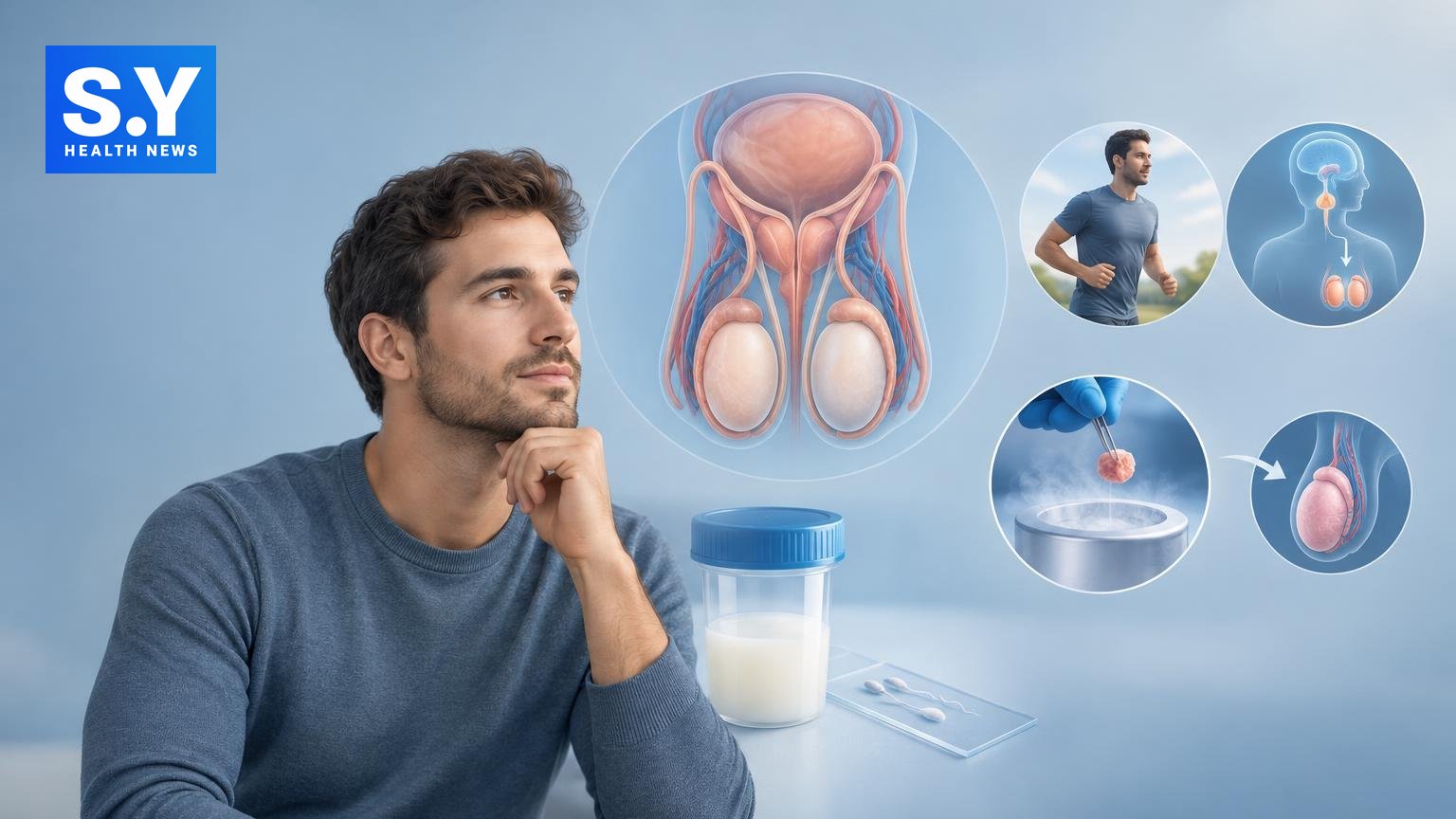


Category: Reproductive Care
Core Research Direction: Male fertility preservation: standard semen-based assessment and lifestyle/testosterone risks alongside experimental testicular tissue freezing and re-transplantation for patients treated before sperm production
Search Intent: What are the established options for preserving male fertility, and where does experimental testicular tissue transplantation stand for boys treated before puberty?
Platform: SANYUN Science Center
Evidence reviewed through: 2026-11-11
Executive Summary
Male fertility preservation has a well-established route for adolescents and adults and a still-unproven route for prepubertal boys. For adolescent and adult males, semen freezing is an established option; it cannot be used in prepubertal boys because they do not yet produce sperm. For those boys, the source describes no established clinical method to restore fertility after potentially sterilising treatment.[1]
In August 2026, a UK team transplanted previously frozen testicular tissue back into a 19-year-old patient whose tissue had been stored in 2023 before a bone marrow transplant. The procedure, described as the first of its kind in the UK and the second reported worldwide, aims to restore sperm production. The patient recovered well in the short term, but whether the graft produces sperm is not yet known; the protocol plans to remove and examine some tissue after eight months.
Standard assessment still rests on semen analysis. The cited European Association of Urology guidance states that a single semen analysis meeting WHO criteria is sufficient and no further andrological investigation is indicated when the result is normal. The same source describes exogenous testosterone as the most significant threat to fertility because it suppresses spermatogenesis through negative feedback, and advises avoiding it entirely if fertility is desired at any future point.[2]
Why This Matters
Fertility preservation is a time-sensitive conversation. Treatments such as high-dose chemotherapy for serious blood disorders can permanently damage the cells needed to produce sperm, leaving children who undergo them at risk of infertility in adulthood. For adolescent and adult males, semen freezing can be arranged before treatment begins. For prepubertal boys, the same option does not exist because sperm production has not started.
The scale of stored tissue is substantial but should not be confused with proven outcomes. More than 1,200 patients in the UK and 3,100 worldwide have had testicular tissue stored for potential future clinical use. These are storage counts, not counts of patients whose fertility was restored. That distinction matters when families are counselled about experimental options.
How Semen Analysis Fits Into Fertility Assessment
Semen analysis is the core laboratory test for male fertility potential. The cited clinical reference states that normal sperm volume, motility and morphology completely override any concern about the FSH level, because semen analysis is the gold standard for assessing male fertility potential. This is an editorial assertion in a reference resource rather than a trial result, but it reflects a widely used clinical approach: a normal semen profile carries more weight than a single hormone value in the initial assessment.
The guidance summarized in the source also sets a boundary against unnecessary testing. When semen analysis is normal according to WHO criteria, the cited EAU recommendation is that a single test is sufficient and no further andrological investigation is indicated. For couples trying to conceive, the same source recommends seeking evaluation only if pregnancy has not occurred after 12 months of regular unprotected intercourse. These are guideline summary statements, not findings from a new trial.
Lifestyle, Hormones and the Hypothalamic-Pituitary-Gonadal Axis
Lifestyle factors such as smoking, poor diet, obesity and environmental exposures can temporarily affect the hypothalamic-pituitary-gonadal axis and semen parameters. The source frames these as transient influences rather than fixed verdicts on fertility. That framing is clinically useful: it suggests that semen quality can change, but the source does not quantify how much any single exposure matters or how long recovery takes. Men should not interpret one abnormal parameter as proof of permanent infertility.
Exogenous testosterone stands apart from lifestyle factors in the cited guidance. The American Urological Association position described in the source calls testosterone use the most significant threat to fertility because it completely suppresses spermatogenesis through negative feedback on the hypothalamus and pituitary. This can cause azoospermia, and recovery may take months to years. The same guidance advises avoiding testosterone therapy entirely if fertility is desired at any future point. This is a strong statement about a common medication class, and it deserves a direct conversation with a clinician rather than a casual decision.
What the Evidence Shows for Testicular Tissue Freezing and Re-transplantation
The rationale for freezing testicular tissue before sterilising treatment is straightforward. The tissue contains spermatogonial stem cells, the cells responsible for producing sperm from puberty onward. If these cells can survive freezing and be returned to the body, the hope is that sperm production can resume. The Edinburgh programme has spent more than ten years developing this approach, supported by charity funding that began in 2015 and continued with further funding for the transplantation study in 2024.
The evidence base includes animal work and single human cases. In non-human primate research, testicular tissue frozen before sterilising chemotherapy was transplanted back successfully, and mature sperm produced by the transplanted tissue were later used in assisted reproduction, resulting in a live birth. In a prior human case in Belgium, testicular tissue frozen before puberty was transplanted back and subsequently produced mature sperm, as described in the report. That case demonstrates sperm production, not a live birth, and the primary publication was not supplied.
The UK case adds a second reported human procedure. The patient was 19 years old and had testicular tissue removed and frozen in 2023 before a bone marrow transplant for a serious blood disorder. Three years after treatment, tests showed no sperm in his semen. In August 2026, some of the previously frozen tissue was transplanted back. He recovered well and is being closely monitored. The protocol plans to remove and examine some transplanted tissue after eight months to determine whether sperm have been produced. No outcome from that planned assessment is reported in the source.
| Approach or factor | What the source states | Status and interpretation |
|---|---|---|
| Semen analysis in adolescent and adult males | A single normal WHO-criteria semen analysis is sufficient and no further andrological investigation is indicated per cited EAU guidance. | Established assessment; guideline summary in a reference resource. |
| Semen freezing | Established fertility preservation option for adolescent and adult males; not available to prepubertal boys because they do not yet produce sperm. | Established for eligible patients; does not address the prepubertal gap. |
| Exogenous testosterone | Described as the most significant threat to fertility; suppresses spermatogenesis via negative feedback, potentially causing azoospermia with recovery over months to years. | Guideline position; avoid if fertility is desired at any future point. |
| Testicular tissue freezing and re-transplantation | In a single UK patient, tissue frozen in 2023 was transplanted in August 2026; planned tissue examination after eight months will assess sperm production. | Experimental; no fertility outcome reported at time of source. |
| Prior human case in Belgium | Tissue frozen before puberty was transplanted back and subsequently produced mature sperm. | Single case; demonstrates sperm production, not live birth. |
| Non-human primate evidence | Frozen tissue transplanted successfully; mature sperm used in assisted reproduction led to a live birth. | Animal evidence; does not establish human efficacy. |
Interpretation and Limitations
The most important limitation is that the UK procedure has not yet reported a fertility outcome. Short-term recovery after transplantation is encouraging but does not show that the graft will produce sperm, that sperm will be usable, or that pregnancy will follow. The planned eight-month tissue examination is a research assessment, not a guarantee of function. Calling the procedure a breakthrough would outrun the evidence.
The human evidence consists of single cases described in news coverage. Single-case reports cannot establish how often the approach works, who is most likely to benefit, or what the risks are across a population. The Belgian case and the UK case differ in what they demonstrate: the Belgian report describes mature sperm production after transplantation, while the UK report describes a procedure and a monitoring plan. The non-human primate live birth is important biological support, but animal results do not automatically translate into human fertility outcomes.
The semen assessment guidance has its own limits. The source is a clinical reference resource summarizing guideline recommendations, and the primary guideline text was not supplied. The statement that normal semen volume, motility and morphology override FSH concerns is an editorial assertion, not a controlled comparison. The advice to avoid testosterone entirely if future fertility is desired is similarly a guideline summary. These are reasonable points for clinical discussion, but they are not personalized predictions for any individual.
Research Outlook
The next useful signal will be the planned tissue examination after eight months, which is designed to determine whether sperm have been produced. Even if sperm are found, further questions remain: whether those sperm can fertilize an egg, whether pregnancy can be achieved, and whether the procedure is safe over longer follow-up. The source does not report those outcomes.
Broader research questions include how to select the best candidates, how much tissue to store, and how to counsel families when storage is offered years before any outcome is known. The existence of more than 1,200 stored tissue samples in the UK and 3,100 worldwide creates both an opportunity for research and an ethical responsibility to report outcomes honestly. Until then, testicular tissue freezing and re-transplantation should be described as experimental, not as a standard fertility preservation option.
Key Takeaways
- Semen analysis is the core assessment for male fertility potential; a single normal WHO-criteria result is sufficient per cited EAU guidance, and no further andrological investigation is indicated in that setting.
- Semen freezing is established for adolescent and adult males but is not available to prepubertal boys because they do not yet produce sperm.
- Exogenous testosterone is described as the most significant threat to fertility; it suppresses spermatogenesis and may cause azoospermia that can take months to years to recover, so the cited guidance advises avoiding it entirely if fertility is desired at any future point.
- Testicular tissue freezing and re-transplantation remains experimental. The 2026 UK procedure is the second reported worldwide; the patient recovered well, but sperm production has not yet been reported and a planned tissue examination after eight months will assess it.
Questions and Answers
What is male fertility preservation and when is semen freezing used?
Male fertility preservation refers to storing sperm or testicular tissue before treatment that could damage fertility. Semen freezing is an established option for adolescent and adult males. It is not available to prepubertal boys because they do not yet produce sperm. For those boys, the source describes no established clinical method to restore fertility after potentially sterilising treatment.
Is one normal semen analysis enough to assess male fertility potential?
The cited European Association of Urology guidance states that when semen analysis is normal according to WHO criteria, a single test is sufficient and no further andrological investigation is indicated. The same source describes semen analysis as the gold standard and states that normal sperm volume, motility and morphology override concern about FSH level. This is guideline summary information, not a personalized result.
How does testosterone therapy affect male fertility?
The cited American Urological Association position describes exogenous testosterone as the most significant threat to fertility. It completely suppresses spermatogenesis through negative feedback on the hypothalamus and pituitary and can cause azoospermia, with recovery potentially taking months to years. The same guidance advises avoiding testosterone therapy entirely if fertility is desired at any future point. These are general guideline statements, not individual predictions.
Has testicular tissue transplantation been proven to restore fertility in boys treated before puberty?
No. Testicular tissue freezing and re-transplantation remains experimental. In the 2026 UK case, tissue frozen before treatment was transplanted back and the patient recovered well, but sperm production has not yet been reported. A planned tissue examination after eight months will assess whether sperm have been produced. A prior Belgian case reportedly produced mature sperm, but this is single-case evidence and does not establish fertility or live birth.
What evidence supports testicular tissue freezing before sterilising chemotherapy?
The evidence includes non-human primate research in which frozen testicular tissue was transplanted back successfully and mature sperm from the graft led to a live birth through assisted reproduction. Human evidence consists of single cases described in news coverage, including a Belgian case that reportedly produced mature sperm and the 2026 UK procedure with no outcome yet reported. Animal success does not establish human efficacy.
What should patients know about lifestyle factors and male fertility assessment?
The source states that smoking, poor diet, obesity and environmental exposures can temporarily affect the hypothalamic-pituitary-gonadal axis and semen parameters, but it does not quantify these effects. For couples trying to conceive, the cited guidance recommends seeking evaluation only if pregnancy has not occurred after 12 months of regular unprotected intercourse. Normal semen analysis is the core assessment, and lifestyle changes should be discussed with a clinician rather than assumed to be decisive.
Sources and References
- UK first as frozen testicular tissue transplanted to help restore fertility.
- Fertility Preservation in Males.
SANYUN Science Center explains published research on men's reproductive and sexual health, connecting scientific evidence with everyday questions while making sources and limitations clear.
Disclaimer: This article is for scientific education and research communication only. It does not provide medical advice, diagnosis, or individualized treatment recommendations, and does not endorse any medication, supplement, device, penile enlargement procedure, or other intervention. Decisions about sexual and reproductive health should be made in consultation with a qualified healthcare professional. Do not delay seeking professional care because of information in this article.
Original Content & Copyright Notice
- This article is prepared for SANYUN Science Center, drawing on published research and publicly available academic literature on men’s sexual and reproductive health. Its editorial explanations and presentation are developed for this platform.
- Copyright in the original editorial content, selection, and arrangement is reserved by SANYUN Science Center to the extent protected by applicable law. Referenced research, quotations, and third-party materials remain subject to the rights of their respective owners. This notice does not claim ownership of scientific facts or third-party research.
- Except where permitted by applicable law or an applicable license, prior written permission is required to reproduce, republish, translate, adapt, redistribute, or commercially reuse protected content. Attribution alone does not grant permission for such reuse.
- For permitted quotation or authorized reuse, clearly identify the source and retain a link to the original article.
- Source: SANYUN Science Center
- Original URL: Retain the original article URL on science.san-yun.com.
- Copyright Holder: SANYUN Science Center, for its own protected editorial content.
- Quotation, excerpts, or authorized reuse must not distort the scientific meaning, omit material limitations or disclaimers, or imply unverified medical claims, product efficacy, or endorsement by SANYUN Science Center.



