




Category: Reproductive Care
Core Research Direction: Clinical evaluation of male infertility: definitions, causes, the limits of semen analysis, and how DNA fragmentation fits into assessment and counselling
Search Intent: When a couple cannot conceive, what does a male fertility evaluation involve, and what can semen analysis and related tests actually tell them?
Platform: SANYUN Science Center
Evidence reviewed through: 2026-11-25
Executive Summary
Infertility is defined as the inability of a sexually active, non-contraceptive couple to achieve spontaneous pregnancy within 12 months. Roughly 15% of couples do not conceive within 12 consecutive months and seek medical treatment, and a male-infertility-associated factor is found in about half of involuntarily childless couples, usually alongside abnormal semen parameters.[1]
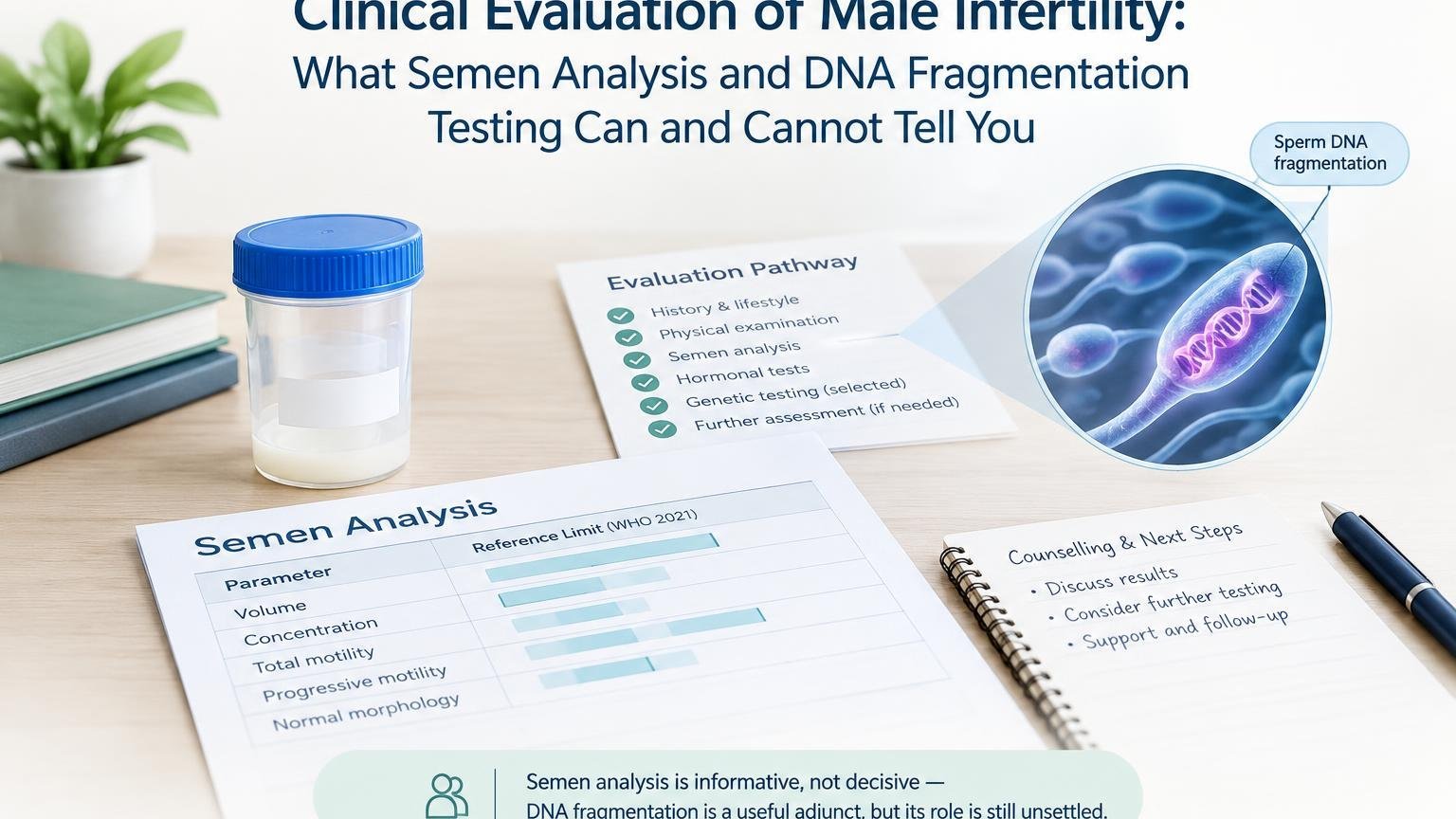
The central practical lesson from current guidance is that semen analysis is informative but not decisive. Semen analysis on its own cannot separate fertile from infertile men, and no single sperm parameter is diagnostic of infertility. A normal result on one test is considered sufficient, while abnormal results on at least two tests justify further andrological investigation.
Sperm DNA fragmentation (SDF) has become the best-known of the "extended" tests, and it is genuinely associated with reduced natural conception and poorer assisted reproduction outcomes. Its clinical usefulness is far less settled: current assays do not reliably predict treatment outcomes, and routine use remains controversial. This article explains the evaluation pathway, the meaning of reference limits, and how to hold the SDF evidence honestly.
Why This Matters
Male factors are common enough that every infertile couple's evaluation should include a trained urological assessment of the man, not just testing of the female partner. The guideline panel states that a comprehensive andrological examination is always indicated, including when sperm parameters fall within reference ranges. It also advises counselling and follow-up of infertile men because of a higher risk of malignant and non-malignant comorbid conditions later in life.
This matters for how couples interpret results. A report that reads "normal" can be reassuring, but it does not prove fertility; a report that reads "abnormal" does not by itself define a cause or a treatment. Understanding what the numbers represent — and what the report leaves out — is the difference between informed conversation and false certainty.
Biological and Clinical Mechanism: Where Male Infertility Comes From
Male fertility can be impaired by many different conditions, including congenital or acquired urogenital abnormalities, genetic abnormalities, urogenital tract infections, increased scrotal temperature such as from varicocele, endocrine disturbances, immunological factors, iatrogenic factors such as previous scrotal surgery, and gonadotoxic exposure such as radiotherapy or chemotherapy. Advanced paternal age has emerged as an additional risk factor, and advanced maternal age also shapes the timing and strategy of the male partner's workup.
When testicular function is deficient, the hormonal pattern is usually hypergonadotropic (primary) hypogonadism, with high FSH and LH and possibly low testosterone. FSH generally correlates negatively with the number of spermatogonia. The clinical inference has limits, however: in men undergoing testicular sperm extraction, FSH does not accurately predict whether spermatogenesis is present, because men with maturation arrest on histology may have normal FSH and testicular volume, and men with non-obstructive azoospermia and high FSH may still have focal areas of spermatogenesis at surgery.
A large share of cases resists explanation. In 30–40% of cases with impaired sperm parameters, no male-associated factor is found, historically called idiopathic male infertility. Separate from this is unexplained male infertility, defined as infertility of unknown origin with normal sperm parameters and a normal partner evaluation, which applies to 20–30% of couples. Idiopathic infertility is now theorised to involve previously unidentified factors such as environmental endocrine disruption, reactive oxygen species and sperm DNA damage, or genetic and epigenetic abnormalities — but that remains a hypothesis rather than an established causal chain.
What the Evidence Shows: The Evaluation Pathway
A focused evaluation combines medical and reproductive history, physical examination, semen analysis with strict adherence to WHO reference values, and hormonal evaluation. History-taking looks for risk factors and behaviours such as lifestyle, family history including testicular cancer, comorbidities, genitourinary infections including sexually transmitted infections, testicular surgery, and gonadotoxic medications or recreational drugs. Physical examination covers secondary sexual characteristics, testicular size, texture and consistency, the vas deferens, epididymal fullness, varicocele and other palpable abnormalities.
Testicular volume illustrates how measurement details matter. Mean Prader orchidometer-derived volume is reported as 20.0 ± 5.0 mL in the European general population and 18.0 ± 5.0 mL in infertile patients, but orchidometry may over-estimate volume compared with ultrasound, and there are no uniform reference values across populations.
Genetic testing follows semen findings. In pooled data from 11 publications including 9,766 infertile males, chromosomal abnormalities were found in 5.8% (sex chromosome 4.2%, autosomal 1.5%), against 0.38% in pooled newborn male data from 94,465 infants. On that basis, karyotype analysis is currently indicated in men with azoospermia or oligozoospermia below 10 million sperm per mL, a threshold the guideline notes is still subject to cost-effectiveness evaluation.
For azoospermia specifically, full andrological investigation should distinguish obstructive from non-obstructive causes, and the laboratory plays a direct role: centrifugation at 3,000g for 15 minutes with careful phase-contrast microscopy can separate absolute azoospermia from cryptozoospermia, in which rare sperm might still be usable for intracytoplasmic sperm injection and could remove the need for surgical retrieval.
Reference Limits Are Not a Fertility Line
WHO lower reference limits are among the most misinterpreted numbers in reproductive medicine. They derive from the lower fifth percentile of semen analysis values in approximately 3,500 men across 12 countries who contributed to a natural conception within 12 months of trying. The threshold is explicitly not a boundary between fertile and infertile men.
The 2021 limits are specific: semen volume 1.4 mL (95% CI 1.3–1.5), total sperm number 39 million per ejaculate (35–40), sperm concentration 16 million per mL (15–18), total motility 42% (40–43), progressive motility 30% (29–31), vitality 54% (50–56), and normal morphology 4% (3.9–4.0). Note that the progressive motility limit is 30%, while the older classification of asthenozoospermia used a 32% progressive motility threshold.
The workup implications are practical rather than dramatic. If semen analysis is normal by WHO criteria, a single test is sufficient; if results are abnormal on at least two tests, further andrological investigation is indicated. Because semen analysis alone cannot distinguish fertile from infertile men, and none of the individual parameters is diagnostic of infertility, the report is best read as one input into a multiparametric assessment that includes the partner's reproductive potential.
Where Sperm DNA Fragmentation Fits
Sperm DNA fragmentation is the accumulation of single- and double-strand breaks in sperm DNA. Increased SDF has been shown to reduce the chances of natural conception, is more common in infertile men, and has been linked to poorer outcomes after assisted reproduction, including impaired embryo development, miscarriage, recurrent pregnancy loss and birth defects. The crucial caveat is that no studies have unequivocally and directly tested the impact of SDF on the clinical management of infertile couples.
Assay thresholds are method-specific and should not be transplanted between tests. Using the sperm chromatin structure assay (SCSA), a DNA fragmentation index (DFI) of 25% is suggested to be associated with reduced pregnancy rates via natural conception or intrauterine insemination, and DFI values above 50% with poorer IVF outcomes. These are associations within a particular assay, not validated individual decision rules.
The recurrent pregnancy loss data deserve careful description. In a meta-analysis covering seven SCSA studies, nine sperm chromatin dispersion (SCD) studies and eight TUNEL studies, SDF was associated with recurrent pregnancy loss. That meta-analysis was limited by small participant numbers in each trial and by heterogeneity in definitions and inclusion criteria, so the finding supports awareness of a possible paternal contribution rather than a treatment algorithm.
Direct and indirect methods are not interchangeable. TUNEL and the alkaline comet test measure DNA damage directly, whereas SCSA and SCD assess it indirectly. It has been suggested that current methods for assessing sperm DNA integrity still do not reliably predict ART treatment outcomes, and whether to recommend them routinely remains controversial.
What raises SDF is similarly broad: hormonal anomalies, varicocele, chronic infection and lifestyle factors such as smoking. Repeated ejaculation separated by a three-hour interval has been reported to significantly decrease SDF, and in a cohort study of 10,000 semen samples SDF was increased in older age groups. Oxidative stress is considered central, and sperm have limited capacity to repair damaged DNA; antioxidant and lifestyle interventions may reduce DNA fragmentation and improve sperm quality, but the guideline states these data have not been supported by randomised controlled trials.
One tempting clinical step is using testicular sperm in men with raised SDF in ejaculate, since testicular sperm is reported to have lower SDF. For men with unexplained infertility and raised SDF, testicular sperm extraction may be considered after ART failure, but only with counselling that live-birth rates are under-reported in the literature and that the procedure is invasive in a man who may be normozoospermic. Advantages in cryptozoospermia or oligozoospermia have not been confirmed in large-scale randomised studies.
| Measure | Reference or threshold | What it supports | Key caveat |
|---|---|---|---|
| Semen volume | 1.4 mL (95% CI 1.3–1.5) | WHO 2021 lower fifth percentile | Not a fertile/infertile cutoff |
| Sperm concentration | 16 million/mL (95% CI 15–18) | WHO 2021 lower fifth percentile | Single parameters are non-diagnostic |
| Progressive motility | 30% (95% CI 29–31) | WHO 2021 lower fifth percentile | Older asthenozoospermia cutoff was 32% |
| Normal morphology | 4% (95% CI 3.9–4.0) | WHO 2021 lower fifth percentile | Not a stand-alone fertility verdict |
| Karyotype indication | Azoospermia or < 10 million sperm/mL | Genetic investigation threshold | Cost-effectiveness still under evaluation |
| SCSA DFI | 25% and > 50% | Suggested association with lower natural/IUI and IVF success | Assay-specific; predictive value debated |
Interpretation and Limitations
The strength of the evidence varies sharply by question. Definitions, reference limits, the two-test rule for abnormal results and the karyotype threshold are guideline-level statements built on observational data and expert synthesis. SDF associations with pregnancy loss and ART outcomes rest on meta-analyses and cohort studies with real heterogeneity. The proposed benefit of antioxidant or lifestyle interventions to lower DNA fragmentation lacks randomised controlled trial support, and routine reactive oxygen species measurement should remain experimental until validated in randomised trials because no standardised methods exist.
Conflicting findings should not be smoothed over. SDF is associated with poorer outcomes, yet the assays do not reliably predict ART results, which means a raised value cannot be treated as a definitive explanation for a couple's failure to conceive or as an automatic indication for a different treatment path. Similarly, FSH is a useful marker of testicular deficiency at the group level but a poor predictor of sperm retrieval for an individual.
Several gaps remain. Idiopathic and unexplained categories persist because the underlying mechanisms are incompletely understood. The SDF intervention literature is underpowered and definitionally inconsistent. Testicular sperm strategies await large randomised confirmation. And the balance of benefits and harms of routine DNA fragmentation testing has not been established, so couples should expect a discussion of uncertainty rather than a single definitive answer.
Research Outlook
The trajectory of this field is toward better stratification rather than more tests for their own sake. Two priorities stand out from the guidance: validating oxidative stress and DNA integrity assays in randomised trials so that results can change decisions, and clarifying which men benefit from testicular sperm retrieval when ejaculated sperm shows high fragmentation. A third is the re-evaluation of cost-effectiveness for genetic thresholds such as the 10 million/mL karyotype trigger.
For now, the durable message is procedural: evaluate the man properly, repeat abnormal semen analyses before escalating, interpret reference limits as distributional rather than diagnostic, and treat SDF as a promising but unsettled adjunct that belongs in a counselling conversation.
Key Takeaways
- Infertility means no spontaneous pregnancy after 12 months of unprotected intercourse; in about half of involuntarily childless couples a male factor is found, usually with abnormal semen parameters.
- WHO lower reference limits come from the lower fifth percentile of about 3,500 men in 12 countries who conceived within 12 months, and they do not separate fertile from infertile men.
- One normal semen analysis is sufficient; abnormal results on at least two tests warrant further andrological investigation.
- Sperm DNA fragmentation is associated with reduced natural conception, miscarriage and poorer ART outcomes, but current assays do not reliably predict treatment outcomes and routine use is controversial.
- SCSA-based DFI thresholds of 25% and above 50% are assay-specific associations, not validated individual decision rules.
Questions and Answers
What counts as male infertility and how common is a male factor?
Infertility is the inability of a sexually active, non-contraceptive couple to achieve spontaneous pregnancy within 12 months. About 15% of couples do not conceive within 12 consecutive months and seek treatment, and a male-infertility-associated factor is found in 50% of involuntarily childless couples, usually together with abnormal semen parameters.
Why can a normal semen analysis not prove that a man is fertile?
WHO reference limits are the lower fifth percentile of values from roughly 3,500 men in 12 countries who conceived within 12 months, and they are not a boundary between fertile and infertile men. Semen analysis alone cannot distinguish fertile from infertile men, and no individual parameter is diagnostic, so results feed a broader assessment.
How reliable is sperm DNA fragmentation testing for predicting IVF success?
It is suggestive but not reliable enough for routine decisions. Increased fragmentation is associated with poorer ART outcomes and pregnancy loss, but current sperm DNA integrity methods do not reliably predict treatment outcomes and routine clinical recommendation is controversial. SCSA-based DFI thresholds of 25% and above 50% are assay-specific associations rather than validated individual rules.
What does the male fertility workup include besides a semen analysis?
Guidance recommends a comprehensive andrological evaluation: medical and reproductive history, physical examination including testicular size and varicocele, semen analysis using WHO methods, and hormonal evaluation, with genetic analysis or imaging added according to findings. Karyotype analysis is indicated for azoospermia or sperm counts below 10 million per mL, and men with azoospermia need obstructive versus non-obstructive classification.
Is there evidence that lifestyle changes or antioxidants reduce sperm DNA damage?
Only weak evidence. Oxidative stress is considered central and is linked to poor lifestyle such as smoking, and antioxidant or lifestyle measures may reduce DNA fragmentation and improve sperm quality. However, the guideline states these data have not been supported by randomised controlled trials, and routine reactive oxygen species measurement remains experimental pending validation.
When is testicular sperm extraction considered for high sperm DNA fragmentation?
For men with unexplained infertility and raised SDF, testicular sperm extraction may be considered after assisted reproduction failure, since testicular sperm is reported to have lower fragmentation. Counselling must note that live-birth rates are under-reported and the procedure is invasive in a potentially normozoospermic man; benefits in cryptozoospermia or oligozoospermia are not confirmed in large randomised studies.
Sources and References
SANYUN Science Center explains published research on men's reproductive and sexual health, connecting scientific evidence with everyday questions while making sources and limitations clear.
Disclaimer: This article is for scientific education and research communication only. It does not provide medical advice, diagnosis, or individualized treatment recommendations, and does not endorse any medication, supplement, device, penile enlargement procedure, or other intervention. Decisions about sexual and reproductive health should be made in consultation with a qualified healthcare professional. Do not delay seeking professional care because of information in this article.
Original Content & Copyright Notice
- This article is prepared for SANYUN Science Center, drawing on published research and publicly available academic literature on men’s sexual and reproductive health. Its editorial explanations and presentation are developed for this platform.
- Copyright in the original editorial content, selection, and arrangement is reserved by SANYUN Science Center to the extent protected by applicable law. Referenced research, quotations, and third-party materials remain subject to the rights of their respective owners. This notice does not claim ownership of scientific facts or third-party research.
- Except where permitted by applicable law or an applicable license, prior written permission is required to reproduce, republish, translate, adapt, redistribute, or commercially reuse protected content. Attribution alone does not grant permission for such reuse.
- For permitted quotation or authorized reuse, clearly identify the source and retain a link to the original article.
- Source: SANYUN Science Center
- Original URL: Retain the original article URL on science.san-yun.com.
- Copyright Holder: SANYUN Science Center, for its own protected editorial content.
- Quotation, excerpts, or authorized reuse must not distort the scientific meaning, omit material limitations or disclaimers, or imply unverified medical claims, product efficacy, or endorsement by SANYUN Science Center.



